Table of Contents
- October in the old calendar of remembrance
- Why October? A season that speaks of passing
- Souling and soul cakes – prayers at the door
- Feasting with the dead – the English funeral meal
- Words over the coffin – from printed sermons to the modern eulogy
- The catafalque – the heart of every space of mourning
- Coffin stands in our range – from compact trestles to a permanent chapel stand
- Remembrance today – re-enactments, stages and the family table
- Why return to the October season of memory?
- FAQ – frequently asked questions about October customs of remembrance and the catafalque
- A final word – an October evening around the table
For most of us, October means falling leaves, early frosts and evenings that close in a little sooner each week. For our ancestors it meant something more. Once the last of the harvest was in and the barns were full, the rural year turned quietly towards those who had gone before. In the old calendars of Britain and Ireland, the end of October was a hinge – the point at which summer gave way to winter, the living looked back at the dead, and the boundary between the two worlds was believed to grow unusually thin.
In this article we follow that October season of remembrance. We look at the Celtic festival of Samhain and the Christian Allhallowtide that grew around it, at the soulers who went from door to door begging for soul cakes, at the funeral feast in its many English guises – from Shakespeare's "funeral baked meats" to the arval bread of the northern dales – and at the strange figure of the sin-eater on the Welsh border. Finally, we turn to the object that has stood at the centre of almost every space of mourning for centuries: the catafalque, or coffin stand, and why it still matters today.
October in the old calendar of remembrance
Today we tend to think of the dead on a single day, or perhaps a single weekend, at the start of November. Historically, however, remembrance was a season rather than a date. It began as the agricultural year wound down in October and stretched through the dark weeks that followed.
The end of the harvest
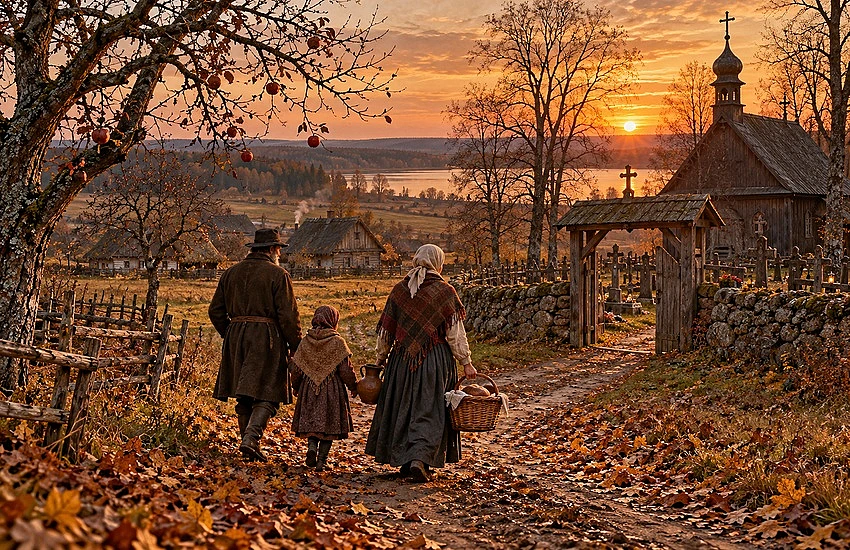
The rural calendar was ruled by the work of the fields. Spring was for sowing, summer for growing and gathering, autumn for giving thanks. When the grain was threshed and the root crops lifted, families finally had time to gather, to feast and to remember. In a world where land passed from parents to children and the work of one generation fed the next, it was natural to think of the dead at exactly the moment when their labour bore fruit. The October table was both a harvest table and a table of memory.
Samhain and the thinning veil
In the Gaelic world, the turning point of the year was Samhain, celebrated at the end of October and the beginning of November. It marked the close of the harvest and the start of the dark half of the year. Samhain was believed to be a time when the world of the living and the otherworld drew close, when spirits and the dead could pass between them more easily than at any other time. Fires were lit, livestock brought down from summer pastures, and households prepared for winter. Many of the customs later attached to Halloween – disguise, divination, lanterns and bonfires – have been linked by folklorists to the beliefs that surrounded this old Celtic festival.
Allhallowtide – three days of remembering
The Christian Church gradually layered its own feasts over this season. In the 8th century a chapel in St Peter's in Rome was dedicated to all the saints on 1 November, and over time this date became the feast of All Saints, or All Hallows, across the Western Church. The day before it became All Hallows' Eve – the origin of the word Halloween – and the day after it, 2 November, All Souls' Day, dedicated to prayer for all the faithful departed. Together these three days formed Allhallowtide, a short season of remembrance that began on the last night of October. In medieval England, bells were rung for the dead, candles lit and prayers said for souls in purgatory.
Why October? A season that speaks of passing
It was no accident that the old feasts of the dead fell in autumn. October is the month in which nature itself tells the story of transience, and it does so in ways that are impossible to ignore.
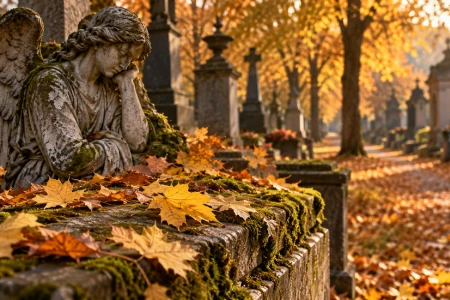
Mist, dusk and falling leaves
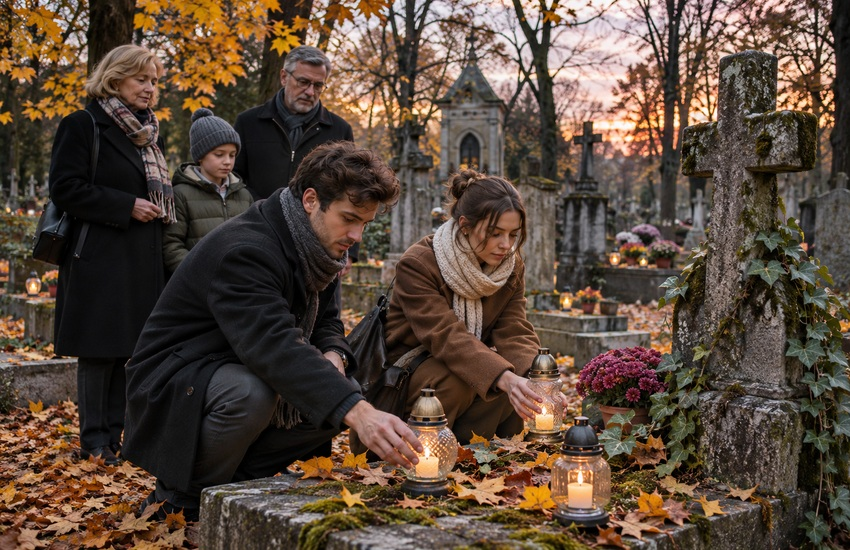
The days shorten noticeably and darkness comes earlier each evening. Mornings are wrapped in fog, through which trees, gravestones and church towers loom and dissolve. In folk imagination, mist was often the medium through which the dead could pass, and a sudden chill in the air could be read as their presence. Leaves that were green only weeks before turn gold and red and fall to the ground. For people who lived close to the land, this was a clear image of human life: the fullness of summer, the golden ripeness of maturity, and then a quiet descent into the earth from which new life would eventually grow.
A curiosity from the East – the Slavic Dziady
The same instinct appears far beyond the British Isles. Among the Slavic peoples of Central and Eastern Europe, the dead were honoured at a rite called Dziady – literally "the forefathers" – held several times a year, most importantly in spring and in autumn, around the turn of October and November. Households laid out food for the visiting souls, left doors and windows open so that they could enter, and lit fires at crossroads to guide them home. A 15th-century Polish calendar even records that peasants held funeral feasts for the dead between 4 and 15 October. The Polish Romantic poet Adam Mickiewicz turned the rite into one of the great dramas of his nation's literature. The parallels with Samhain and Allhallowtide are striking: across Europe, October was the month when the dead were invited back to the table.
Souling and soul cakes – prayers at the door
Of all the English customs connected with the October season of the dead, few are as touching as souling. It linked remembrance, charity and food in a way that echoes far older traditions.
The soulers
During Allhallowtide, children and the poor – known as soulers – went from house to house, offering to pray "for the souls of the givers and their friends", especially the departed relatives of the household. In return they received soul cakes: small, round, spiced cakes, rather like shortbread. Each cake eaten was, in popular belief, a prayer offered for a soul. The earliest reported instance of souling in England dates from 1511, and Shakespeare alludes to it in The Two Gentlemen of Verona, where a lovesick character is said to speak "like a beggar at Hallowmas".
Many names, many places
The custom took different shapes across the country. In Lancashire and the north-east, soul cakes were known as harcakes. In Staffordshire the custom was kept on All Saints' Eve and the cakes were called soul-mass or "somas" cakes. In late 19th-century Shropshire, households would set out a great pile of soul cakes on All Hallows' Eve for visitors to take. In some northern areas souling continued into the 1930s, and in rural Cheshire, northern Shropshire and parts of Staffordshire it survived until the 1950s. Sheffield and Cheshire have kept the tradition alive into modern times.
Songs and souling plays
Soulers sang as they went, and the traditional souling songs were delivered in a slow, lamenting tone quite unlike modern trick-or-treat rhymes. The folk song collector Lucy Broadwood published a Cheshire version in 1893. In Cheshire, too, souling plays were performed, featuring a mysterious horse's head carried by one of the players. Some historians see in souling one of the roots of modern trick-or-treating, although the meaning has shifted: where Halloween today plays with fear, the soulers' visit was above all an act of remembrance.
Feasting with the dead – the English funeral meal
The October customs remembered all the dead together. But every individual funeral, too, ended with food. In English tradition the funeral meal has borne many names, and each tells a slightly different story.
"Funeral baked meats"
Shakespeare gave the funeral feast its most famous line. In Hamlet, the prince bitterly remarks that his mother remarried so quickly that "the funeral baked meats did coldly furnish forth the marriage tables". The jibe only works because every Elizabethan audience knew the custom: after a burial, the household provided food and drink for the mourners, often in quantities that strained its resources. Pies, cold meats, cakes and ale were the backbone of the meal. In most of England, the relatives of the deceased were expected to offer this hospitality – and to skimp on it was to dishonour the dead.
The arval – an inheritance feast
In the North of England and in Scotland, the funeral feast was called the arval, arvel or arthel, and the meal itself the arvel-dinner. The word is usually traced to Old Norse roots linked to inheritance and ale – a reminder that, for the Norse settlers of the north, the funeral feast was also the moment when the heir formally took up his inheritance. Around the feast grew the custom of arval bread: a light, sweet cake spiced with cinnamon and nutmeg, given to the poor and to the guests.
Regional variations multiplied. In Cumberland, mourners were handed a rich cake wrapped in sealed paper, which they took home unopened. In Yorkshire, a paper bag of biscuits was sent to friends along with a card bearing the name of the deceased. The Pitt Rivers Museum in Oxford preserves a paper wrapper from a funeral held in 1828 in the Cleveland district of Yorkshire, sealed with black wax and once distributed with wine. In Cumbria, small loaves called "arval breed" were still known in the 1920s, before giving way to the more familiar funeral tea. In Lancashire, biscuits were handed out at the door while the tea was held inside the house.
The sin-eater of the Welsh border
No account of funeral food in Britain would be complete without the sin-eater. In the Welsh Marches – the borderland between England and Wales – there was a custom of paying someone, usually a poor person, to eat bread and drink over the body of the dead, symbolically taking on the sins that the deceased had had no chance to confess. Sin-eaters were often shunned by their neighbours, as if the sins they consumed clung to them. The custom was recorded in various parts of the country but had largely died out by the 19th century.
A remarkable exception was Richard Munslow, a farmer from Ratlinghope near Shrewsbury, who died in 1906 and is often described as the last known sin-eater in England. Unlike the outcasts of tradition, Munslow was a respected and fairly prosperous man. It has been suggested that grief may have led him to revive the old rite: he lost four children young, three of them to scarlet fever within a single week in May 1870. In 2010 local people restored his grave at St Margaret's Church and held a service in his memory.
The funeral tea
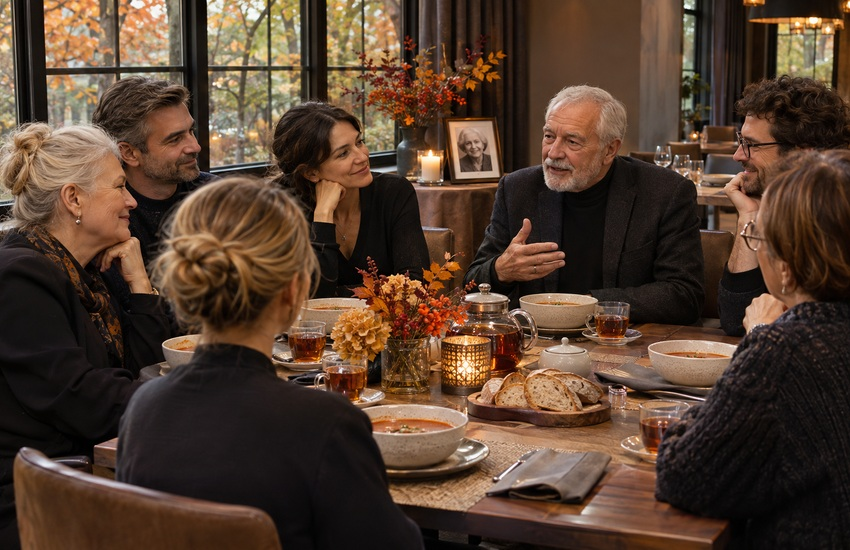
Out of all these customs grew the familiar funeral tea, still a fixture of British funerals today. It may be held at home, in a church hall, a pub or a hotel, but its purpose is unchanged: to feed those who came, to let the bereaved be surrounded by people, and to give everyone a chance to remember the dead together. Sandwiches, cakes and cups of tea have replaced the baked meats and arval bread, but the gesture is the same one Shakespeare's audience would have recognised.
Words over the coffin – from printed sermons to the modern eulogy
Alongside food, the old funeral had another essential ingredient: words. The dead were not only mourned but spoken of. People told who they had been, what they had done, why they deserved to be remembered.
Funeral sermons in print
In 17th-century England, funeral sermons became a literary genre in their own right. Preached over the bodies of gentry, clergy and pious townsfolk, many were afterwards printed and distributed to mourners and friends of the family, sometimes with a short biography of the deceased attached. Today these pamphlets are a valuable source for historians of family life, religion and attitudes to death. Preachers drew on Scripture and classical authors, held up the deceased as an example of a good life and a good death, and sometimes turned directly to the coffin, as if the dead could still hear them.
The eulogy today
The modern eulogy is a direct descendant of that tradition, usually shorter and more personal. A son or daughter, a friend or a colleague speaks for a few minutes about the person who has died: a life in outline, a characteristic story, a word of thanks to those present. Such words often stay with mourners long after the ceremony. Where they are spoken matters too – at a lectern beside the coffin, in a chapel or crematorium. We looked at that tradition in our article on the funeral lectern and its history.
The catafalque – the heart of every space of mourning
Whether the occasion is a parish funeral, a lying-in-state, a heritage re-enactment or a candlelit evening of remembrance, one object almost always stands at the centre of the space: the catafalque. On it rests the coffin, real or symbolic; around it burn the candles; before it the living gather.
A word from Italy
The English word comes from the Italian catafalco, meaning a raised platform or scaffold, and for centuries it has described the stand on which a coffin rests during a ceremony. In a medieval village church the "catafalque" might be nothing more than a pair of trestles. In great cathedrals and royal chapels it became a richly carved platform draped in black. In the Baroque era, especially on the Continent, it could grow into an elaborate temporary monument with canopies, heraldry and hundreds of candles. Whatever the scale, the principle was the same: the coffin should rest above the heads of the seated congregation, at the centre of the space, where everyone could see it and approach it.
Westminster Hall and the lying-in-state
In Britain the catafalque is perhaps most familiar from the great lyings-in-state in Westminster Hall. The first recorded occasions there were for William Ewart Gladstone in 1898 and King Edward VII in 1910. They were followed by King George V in 1936, King George VI in 1952, Queen Mary in 1953, Sir Winston Churchill in 1965, Queen Elizabeth the Queen Mother in 2002 and Queen Elizabeth II in 2022. On each occasion the coffin rested on a raised platform in the middle of the hall, with each corner guarded around the clock, while members of the public filed past. Around 200,000 people paid their respects to the Queen Mother during her three days of lying-in-state. The scene is a modern descendant of the oldest form of funeral ceremony: the dead raised up in a place of honour, the living passing by in silence.
The Lincoln catafalque
Across the Atlantic, one of the most famous catafalques in the world is the one built in 1865 to bear the coffin of President Abraham Lincoln in the Rotunda of the US Capitol. Hastily made of rough pine boards and covered in black cloth, it was meant to be temporary. Instead it has been used for many of those who have since lain in state or in honour in the Capitol. A simple wooden structure, draped in black, has become one of the most powerful symbols of national mourning – proof that the dignity of a catafalque lies less in its materials than in what it carries.
Black cloth and candles
The traditional dressing of the catafalque was built from a few simple elements. The most important was the black pall or drape, falling to the floor and hiding the structure beneath. Around it stood candles in tall holders, usually four or six, set symmetrically on either side. A crucifix or a wreath might rest on the coffin, and on grand occasions a coat of arms or the regalia of the deceased. We explored the meaning of the different colours of the pall in our article The colours of mourning.
The trouble with old trestles
Historic catafalques were heavy timber structures, kept in churches and great houses and brought out when needed. Today few parishes, schools or community halls own one, and where they do it is usually too heavy and cumbersome to move from place to place. Yet autumn events of remembrance happen in many different spaces – a cemetery chapel, a museum gallery, a school hall, a village church, sometimes even outdoors. What is needed is a stand that is stable and dignified, but easy to transport and store. Before the coffin reaches the catafalque, of course, it has to be carried there; we traced that older story in Carried by the Parish: Biers, Coffin Roads and the Long History of Bearing the Dead.
Coffin stands in our range – from compact trestles to a permanent chapel stand
In our coffin stands category you will find metal, wooden and folding designs in a range of sizes. For autumn ceremonies, remembrance events and re-enactments we particularly recommend two solutions that answer very different needs.
Coffin trestles – G-shaped: two pieces that go anywhere
The G-shaped coffin trestles are designed for anyone who needs a stable support for a coffin that is also easy to move. The set consists of two identical elements, each measuring 39 × 48 × 59 cm. They are placed a suitable distance apart – one beneath the head of the coffin and one beneath the foot – echoing the oldest form of catafalque found in country churches: a simple pair of trestles. The construction is chrome-plated steel and the set will safely carry up to 350 kg, enough for a heavy solid oak coffin.
The chrome finish is easy to clean and looks equally good on its own or dressed with a drape. The two compact pieces can be stored in a vestry cupboard, a community hall storeroom or the boot of a car, and setting them up takes moments. For schools staging a play, heritage groups recreating a historic funeral, or parishes holding an occasional requiem, it is one of the most practical solutions available.
Coffin stand no 5 – a permanent part of the chapel
If you are looking for a catafalque that will stay in a chapel of rest, a cemetery chapel or a church, consider coffin stand no 5. It has a solid, stable steel frame, 57.5 cm wide and 57.5 cm high, with a powder-coated finish. Its great strength is the choice of finishes: beige, gold, copper and silver marble effect, matte black, glossy black and chrome, with other colours possible on request. That allows the stand to be matched to its setting, from a traditional dark chapel to a light, contemporary ceremony room. It is made in Poland.
Uses beyond the funeral home
In funeral homes the catafalque is basic equipment for every chapel of rest. But its role is far wider. Parishes use it for requiem masses and for services of remembrance on All Souls' Day. Museums telling the story of historic funeral customs can use it for temporary displays and education sessions. Theatres, drama groups and schools staging plays with funeral scenes – and there are many in the classic repertoire, from Hamlet onwards – will find in it an authentic piece of staging. Re-enactment societies recreating funerals of different periods value its stability. Cemetery chapels hosting autumn evenings of remembrance, concerts or memorial gatherings gain a stand that turns any room into a dignified space in minutes.
If the stand also needs to move, see our coffin trolleys, and to dress it, our range of covers and drapes.
Remembrance today – re-enactments, stages and the family table
The old October customs have not vanished entirely. They live on in new forms – less as religious obligation, more as living history and a personal way of marking the season.
Revived customs
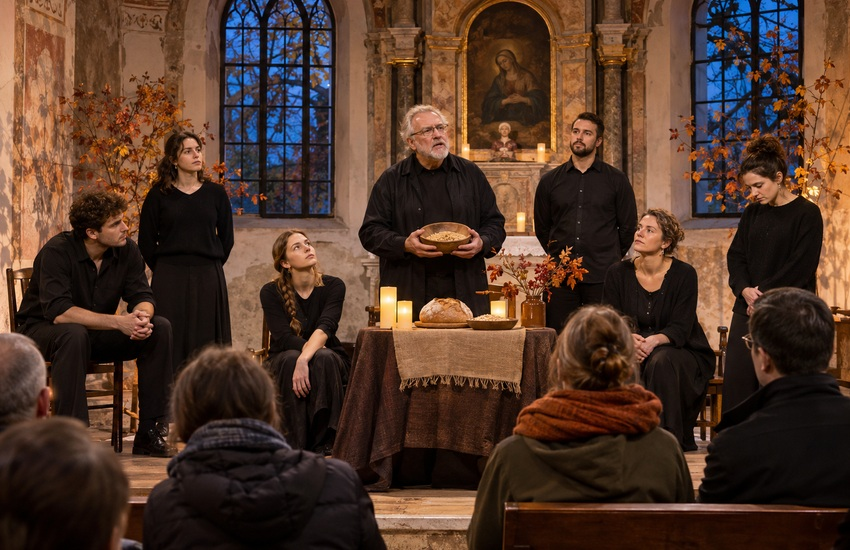
Soul cakes are baked again in many kitchens at the end of October, and souling songs have been recorded and performed by folk musicians. Churches of several traditions hold All Souls' services at which the names of those who have died during the year are read aloud, sometimes with a symbolic catafalque standing in the aisle. Heritage sites and museums use the autumn months to tell visitors about historic mourning customs, from Victorian mourning dress to funeral biscuits and memorial jewellery.
Theatre and remembrance
Autumn is also a season for drama that deals with death and memory. Productions of Hamlet, readings of ghost stories, candlelit concerts of requiem music – many of these take place outside conventional theatres, in churches, chapels, museum galleries and historic houses. They need staging that is easy to transport, quick to set up and just as quick to remove, and a coffin on a draped catafalque is one of the most immediate images such staging can offer.
An evening of remembrance at home
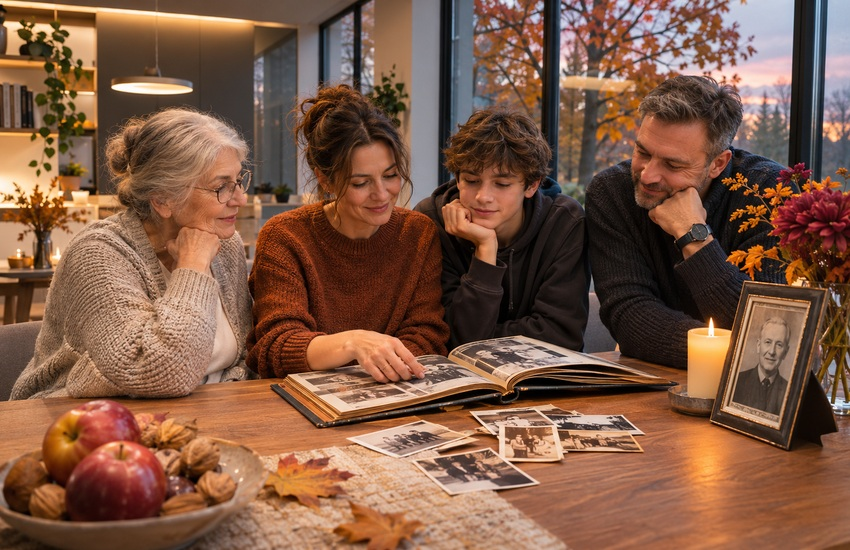
Above all, the October season of the dead was a domestic one, and that is where it is easiest to revive. More and more families deliberately slow down on the last evenings of October: they switch off the television, light a candle and look through old photograph albums. Children hear stories of great-grandparents they never met – where they came from, what they did, how they lived through war and hardship. Recipes handed down from a grandmother appear on the table. This is not a reconstruction of old rites, nor a pretence that the dead come to supper. It is simply a way of making room, in a hurried world, for one evening of memory. The tradition of keeping company with the dead has deep roots in Britain and Ireland; we wrote about one of its forms in The Home Vigil – a Vanishing Tradition of Keeping Watch Over the Dead.
Why return to the October season of memory?
We might ask why anyone today should care about soul cakes, arval bread or sin-eaters. We no longer work the land, we do not leave food out for visiting souls, and funeral feasts no longer last for days. Yet these customs still have something to teach us.
Memory spread over time
First, they remind us that remembering the dead need not be squeezed into a single crowded day. In the past it was a whole season, in which the dead were remembered gradually and calmly. October evenings lend themselves to that kind of remembering: looking at old photographs, telling family stories, visiting graves before the crowds arrive.
The shared table
Second, the old customs show that remembering the dead goes hand in hand with the community of the living. Soul cakes, arval bread, the funeral baked meats – all of them involved people coming together, eating, talking and giving to the poor. Mourning was not a solitary experience but something shared by a whole community. The modern funeral tea continues that tradition, and it is worth remembering when we plan one.
A setting worthy of the occasion
Third, the old ceremonies teach us that a farewell deserves a dignified setting. A black pall, candles, a catafalque – these simple elements gave even a modest country funeral a sense of solemnity and beauty. Today, thanks to modern stands that are easy to transport, that setting can be recreated almost anywhere, without heavy timber structures but in the same spirit.
FAQ – frequently asked questions about October customs of remembrance and the catafalque
What is Samhain and how is it linked to Halloween?
Samhain was a Gaelic festival held at the end of October and the start of November, marking the end of the harvest and the beginning of winter. It was believed to be a time when the boundary between the living and the dead grew thin. Many Halloween customs have been linked by folklorists to beliefs surrounding Samhain, while the name Halloween comes from All Hallows' Eve, the night before All Saints' Day.
What were soul cakes and who were the soulers?
Soul cakes were small, round, spiced cakes given to soulers – children and poor people who went from house to house during Allhallowtide offering prayers for the dead of each household. The custom is recorded in England from 1511 and survived in parts of Cheshire, Shropshire and Staffordshire until the 1950s.
What is an arval?
The arval, arvel or arthel was the traditional funeral feast of the North of England and Scotland. Arval bread was a light, spiced cake given to guests and to the poor. In some areas mourners received cakes or biscuits in sealed paper wrappers to take home.
Who was the last sin-eater in England?
Richard Munslow, a farmer from Ratlinghope near Shrewsbury who died in 1906, is often described as the last known sin-eater in England. Sin-eaters ate bread and drank over the body of the dead, symbolically taking on their unconfessed sins. Munslow's grave was restored by local people in 2010.
Who has lain in state in Westminster Hall?
The first recorded lyings-in-state in Westminster Hall were those of William Ewart Gladstone in 1898 and King Edward VII in 1910. They were followed by George V, George VI, Queen Mary, Sir Winston Churchill, Queen Elizabeth the Queen Mother and Queen Elizabeth II. The coffin rests on a raised platform in the middle of the hall.
How should a catafalque be prepared for a ceremony or a play?
The simplest approach is to use a stable, easily transported stand, dress it with a black drape falling to the floor and place four or six candles symmetrically around it. The G-shaped coffin trestles consist of two identical elements, each 39 × 48 × 59 cm, and will carry a coffin of up to 350 kg.
Who besides funeral homes uses coffin stands?
Coffin stands are used by parishes for requiem masses and All Souls' services, by museums for displays about historic funeral customs, by theatres, drama groups and schools staging plays with funeral scenes, by re-enactment societies, and by cemetery chapels hosting evenings of remembrance.
A final word – an October evening around the table
October is the month in which nature slows down and we have a little more time to think. Our ancestors used it to remember the dead – at the harvest table, at the door with a soul cake, over arval bread and funeral baked meats, before a coffin raised on a catafalque. These customs have not disappeared completely. They survive in the funeral tea, in All Souls' services, in folk songs and revived recipes, in plays and family stories. They are worth cherishing – and worth giving a setting that does them justice.
If you are preparing a ceremony, a re-enactment or a performance this season, take a look at the compact G-shaped coffin trestles, the elegant coffin stand no 5 and our full range of coffin stands. Simple, solid equipment allows us to recreate an image that has accompanied the remembrance of the dead for centuries.