Table of Contents
- Why the speaker's place has always been set apart
- Rostra – ships' beaks and the invention of the funeral oration
- Ambo, analogion and lectern – the Christian geography of the word
- Speaking over the dead in the anglophone tradition
- The secular eulogy and the modern celebrant
- What actually makes a funeral lectern work
- Funeral lectern no 2 – description and use
- Positioning the lectern in the chapel
- Words, echoes and other curiosities
- Why this matters to a funeral home
- FAQ – frequently asked questions about funeral lecterns
- Conclusion
Every funeral has a point in the room that people look towards before a single word is spoken. It is not the coffin – they have already seen that. It is not the cross or the flowers – those are the backdrop. It is the place where someone is about to stand and say something about the person who has died, something everyone present needs to hear. Today we call that place a lectern, but long before it acquired the name it passed through the beaks of Roman warships, the marble ambos of Byzantine basilicas, the brass eagles of English parish churches and the plain reading desks of village chapels. The history of the funeral lectern is really the history of how one culture after another tried to make possible the hardest task in public speech – saying something true over the body of a person who can no longer reply.
This article traces how a small, unassuming piece of furniture became one of the most meaningful objects in the space of farewell. We will follow it from ancient Rome, through the liturgical architecture of the medieval church and the funeral sermons of the English Reformation, to the modern crematorium chapel where a celebrant, a minister or a grandson shaking with grief steps forward in front of a hundred mourners. We will also see why an apparently technical detail – the ability to raise a reading surface by a few dozen centimetres – can decide whether a farewell is remembered as dignified or as awkward.
Why the speaker's place has always been set apart
Anthropologists point to a pattern that repeats across almost every recorded community: whoever speaks on behalf of the group does so from a place marked off from everyone else. It may be a stone, a mound, a step, a tree stump, a platform, a carpet or a piece of furniture. The separation is not a matter of vanity. It is a matter of legibility. The gathering needs to know who is speaking, and the speaker needs to know that they have permission to speak.
In the funeral context that need becomes acute. Grief disorganises people. Mourners in a chapel do not behave like an audience at a lecture or a play – they are distracted, tearful, some have travelled far and do not know where to sit, some do not know the order of service, some are meeting relatives they have not seen in years. In that fog of attention a fixed point is essential. The lectern is exactly that point: a piece of furniture that says "the important thing will happen here" before anyone has even stepped behind it.
A few inches that reorder a room
It takes remarkably little to give a space a hierarchy. A platform twenty centimetres high, a reading surface at chest level, a single chair turned side-on – each of these instantly changes the way people look. Researchers in non-verbal communication describe this as framing: a physical element establishes an interpretative frame for whatever happens inside it. The same words delivered from the middle of a room and from behind a lectern will be received differently, even though the sentences are identical.
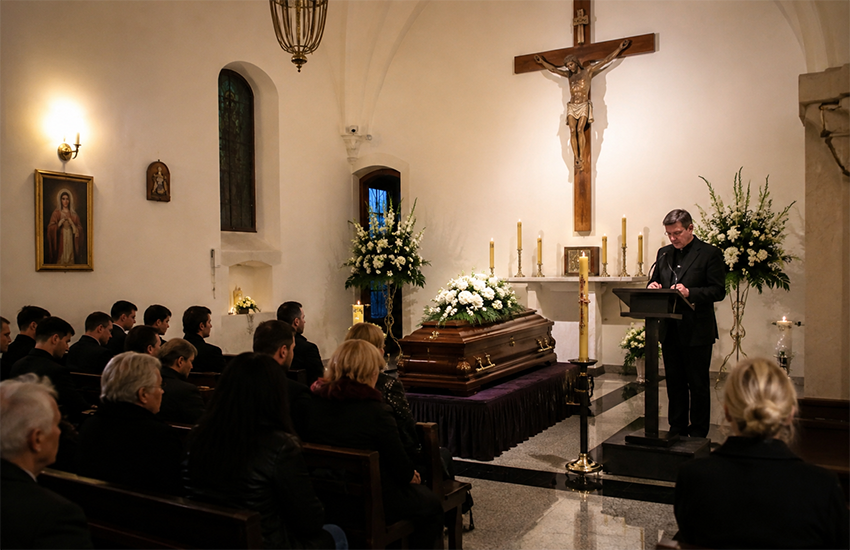
In funeral practice this has very concrete consequences. A family listening to a tribute to their mother receives it not only as content but as gesture. If the speaker stands in an arbitrary spot with a sheet of paper trembling in their hands, the message is undermined by the disorder of its form. If they stand behind a solid, well-proportioned piece of furniture, in good light, with their notes resting on a stable surface, the same words gain a setting that carries them.
Voice, posture and nerves – what happens to a speaker with nothing to hold
Celebrants have long known what speech and voice coaches confirm: posture directly affects breathing, and breathing affects the carrying power and timbre of the voice. A person under stress hunches, draws in their shoulders, breathes shallowly and speaks more quietly than they intend. A lectern encourages an upright stance and gives the hands something to do – they can rest on it, hold the edge, place a page on it. For someone speaking in public for the first time in their life, and about their own father, that possibility is worth more than any specification sheet suggests.
There is also a purely human dimension. The reading surface forms a discreet barrier between the speaker and the congregation. It hides shaking knees, conceals the hands and allows a pause in which the eyes can drop to the page and composure can be gathered. Experienced funeral directors say plainly that the lectern is the place where it is permitted to cry, because the furniture takes on part of the burden of being seen.
Rostra – ships' beaks and the invention of the funeral oration
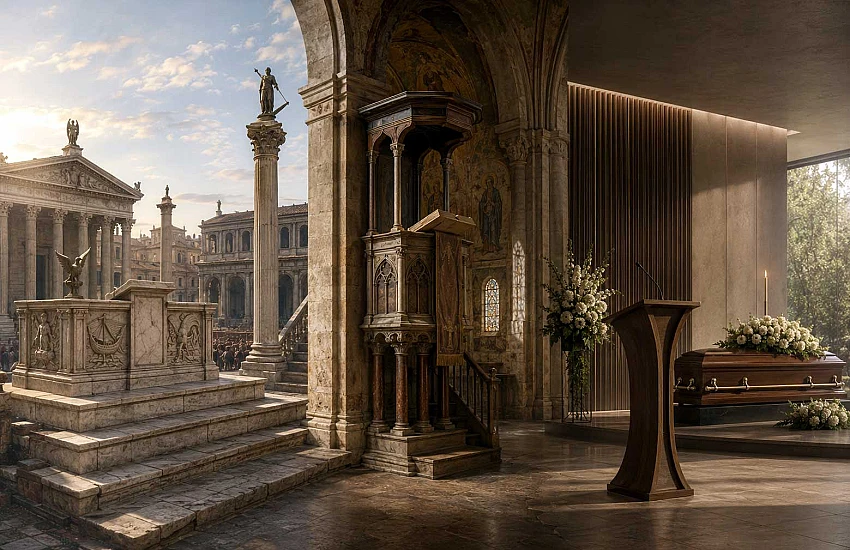
The first piece of furniture in the Western tradition that can fairly be called an ancestor of the lectern was the Roman speaker's platform in the Forum. It was known as the rostra – literally "the beaks" – because it was decorated with the rams taken from the prows of captured enemy ships. From that raised place politicians, generals and, most importantly for our story, the relatives of dead patricians addressed the people.
Laudatio funebris – the funeral as an act of public memory
The Romans invented the form we still call the funeral oration. The laudatio funebris was a public tribute to the deceased, usually delivered by a son or close male relative. It took place neither at home nor at the grave but in the heart of the city, before the crowd. The dead were carried on a bier, set down in front of the platform, and the speaker climbed the rostra to talk not only about the individual but about the entire family line.
That detail is the key to understanding what a lectern is for. The Roman funeral oration was not a private goodbye but a communal act – a reminder that a fragment of the city's history departs with each death. The place from which the words came was designed to underline exactly that public dimension. It was therefore raised, ornamented and visible from every corner of the square.
Imagines maiorum – a theatre of ancestors
Among the most striking Roman customs was the practice of bringing the wax masks of ancestors, normally kept in cupboards at home, to the funeral. Actors or family members wore them and sat on ceremonial chairs around the platform. The speaker therefore addressed the crowd surrounded by a silent assembly of generations. The historian Polybius described the effect on young Romans as immense – they saw the whole lineage gathered in one place at the moment another member joined it.
If there is a point in history at which the lectern became more than a prop for a text, this is it. The rostra were a stage for memory. The modern funeral chapel, with its photograph of the deceased, its candles and a lectern positioned so that the speaker stands in the same field of view as the portrait, repeats that Roman composition in miniature.
Ambo, analogion and lectern – the Christian geography of the word
Christianity brought an entirely different understanding of speech over the dead. The point was no longer to praise deeds but to read a human life in the light of faith. The content changed; the need for a set-apart place did not. It was ecclesiastical architecture that developed the forms from which today's funeral lectern descends directly.
The bema and the ambo
Early basilicas had a raised area known as the bema and, on it, the ambo – a stone or marble structure with a parapet, reached by steps. The name derives from the Greek verb meaning to ascend. In many Eastern churches the ambos came in pairs: the Gospel was read from one, the epistles and psalms from the other. The division was strictly observed, because place determined the standing of the words spoken there.
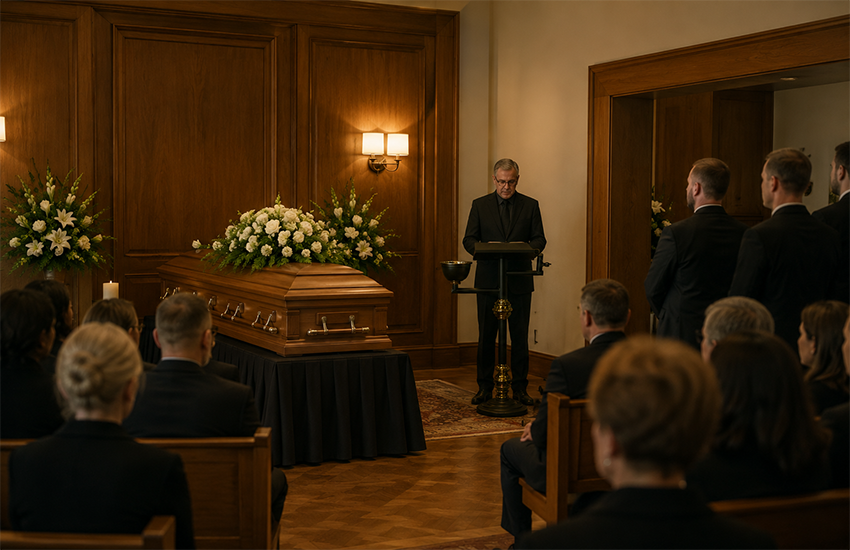
The idea has a surprisingly practical afterlife. In a modern funeral chapel a similar distinction still appears: the minister officiates from beside the coffin, the celebrant stands at the lectern, family members come forward to it with their pages. Without a clear furniture-based reference point that order dissolves and the ceremony begins to feel improvised.
The eagle lecterns of English parish churches
A simpler ancestor developed in parallel – the reading desk. In the Eastern tradition it is the analogion, a light, portable stand with a sloping top on which a book or icon rests. Western monasteries used lecterns for reading during meals and the daily offices. The English word itself comes from the medieval Latin lectrum, related to legere, to read, and the Latin pulpitum originally meant a platform or the boards of a stage.
Britain produced one of the most distinctive forms in Europe: the brass eagle lectern, in which the Bible rests on the outstretched wings of an eagle standing on an orb. Hundreds survive in parish churches and cathedrals, some of them medieval. Various explanations of the symbolism have been offered, most commonly that the eagle represents the evangelist John, or the belief that the bird alone could gaze directly at the sun, as the faithful were held to be able to look at divine revelation. What matters for our purposes is the underlying idea: the desk that carries the word is itself worth making beautiful.
Three-decker pulpits and the Reformation shift
The Reformation moved the centre of gravity of worship from the altar to the sermon, and the furniture moved with it. In English churches of the seventeenth and eighteenth centuries this produced the remarkable three-decker pulpit: the parish clerk at the bottom, the reading desk for the lessons in the middle, and the preaching pulpit on top, often crowned with a canopy. That canopy, the sounding board or tester, was not decoration. It reflected the voice downwards towards the congregation centuries before anyone thought of a microphone, and its angle and curvature were calculated with real care. It is one of the oldest examples of deliberate acoustic design in furniture.
The consequences for funeral rites were significant. Farewells were increasingly organised around the spoken word – the sermon, the tribute, the reading – rather than around ritual alone. And the spoken word needs somewhere to be spoken from.
Speaking over the dead in the anglophone tradition
The funeral sermon
The English funeral sermon became a genre in its own right during the sixteenth and seventeenth centuries. Preached at the burial of the notable dead and frequently printed afterwards as a pamphlet, it combined theology, biography and moral instruction. Collections of these sermons are now among the most valuable sources for the mentality of the period. The point relevant here is that the sermon was delivered from a specific, elevated place, and that the architectural setting formed part of the message.
Wakes, graveside orations and the vernacular voice
Alongside the formal tradition ran a completely different one. In rural Britain and Ireland the wake brought the community into the house of the deceased for a night of watching, prayer, food and storytelling. There was no furniture involved – there was a hat removed, a handful of earth, and words spoken plainly over an open grave by a neighbour, a schoolmaster or a foreman. Variants of this survive today in the short tribute given on behalf of a village, a lifeboat crew, a regiment or a workplace.
Contemporary ceremonies frequently combine both registers. The chapel portion is structured, with a lectern, an order of service and amplification; the committal at the graveside retains the austerity of the older custom. A well-equipped funeral director serves both, and a piece of furniture that can be carried outside is genuinely useful in that context.
The Victorian funeral and the rise of the funeral director
The nineteenth century turned the British funeral into an elaborate visual code: mourning dress, mutes, plumed horses, black-edged stationery and a precisely graded scale of display. The undertaker developed into the modern funeral director, responsible not only for the coffin but for the entire choreography of the day. From that moment the fittings of the chapel of rest – the coffin stand, the candlesticks, the photograph stand, the lectern – ceased to be improvised and became professional equipment, chosen deliberately and matched to one another.
The secular eulogy and the modern celebrant
The last few decades have seen a marked rise across Britain, Ireland, North America and Australasia in secular, humanist and mixed ceremonies, as well as in religious services that make room for a personal tribute. That shift has direct consequences for chapel equipment.
From praise to storytelling
The Greek word eulogia means, simply, good words. The modern eulogy differs fundamentally from the Roman laudatio: it is not an enumeration of achievements but a piece of storytelling. Speakers recall anecdotes, quote the sayings of the deceased, describe their habits and small eccentricities. The result is far more intimate – and far harder to deliver, precisely because it is closer to home.
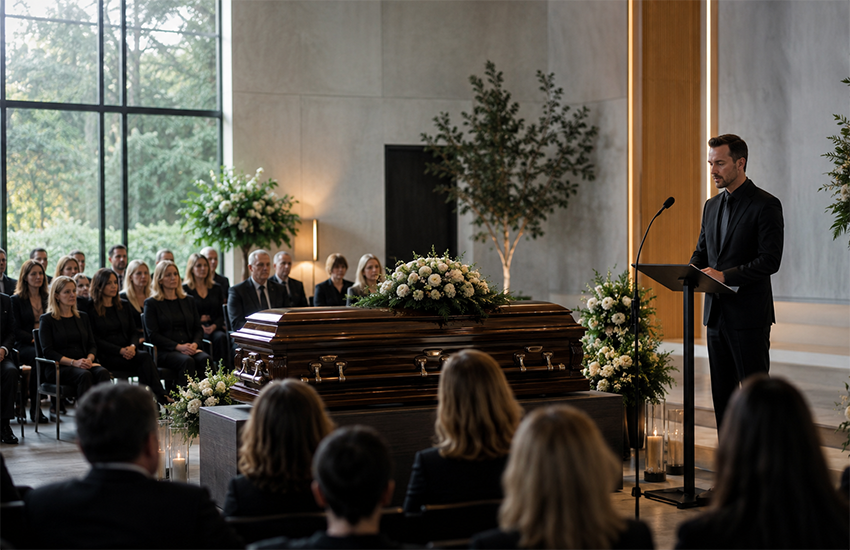
That has practical implications. A tribute lasts longer than a liturgical formula, is often read from several sheets or a phone, and is interrupted by emotion. The speaker needs somewhere to put the paper, somewhere for a glass of water, and a place to stand for several minutes without feeling wholly exposed.
Who stands at the lectern today
In a typical contemporary ceremony several people of very different builds come forward: the celebrant, the minister, a granddaughter, a colleague, a representative of a club or regiment. The difference in height between the shortest and the tallest can easily be thirty or forty centimetres. It is from that everyday observation that the entire modern discussion about adjustable reading heights arises.
The crematorium chapel and the twenty-minute service
Cremation now accounts for the large majority of funerals in the United Kingdom, and most crematorium chapels operate on tightly scheduled slots, often twenty or thirty minutes, with a full changeover between services. In that environment the furniture has to be quick to reposition, easy to wipe down and instantly ready for whoever steps up next. Anything that requires tools, assembly or two people to move is a liability.
What actually makes a funeral lectern work
Funeral homes buying their first lectern generally choose on appearance. Those buying their second look at four quite different things.
Height – the most overlooked specification
The established standard is around 106 cm. That is a tested, comfortable dimension for a person of average height – the surface falls at roughly the lower chest, the hands rest naturally, and the text is legible without dropping the head. The difficulty appears at the extremes of the range.
A speaker of, say, 1.90 m has to stoop at such a desk. The effect is doubly unhelpful: the voice is directed downwards into the floor rather than out towards the mourners, and the posture loses its gravity. A short speaker standing behind a tall desk, by contrast, all but disappears – only the top of the head is visible, which at a funeral simply looks wrong.
A lectern that can be adjusted removes the problem permanently, and opens up possibilities that are rarely considered. Raising the surface helps not only tall speakers; it is also useful when the chapel is full, mourners are standing and the text has to be read over people's heads. A raised position improves the speaker's visibility from the back rows and allows the voice to travel more freely.
Accessibility and reasonable adjustments
Adjustability is also an accessibility question. Under the Equality Act 2010, service providers in Great Britain are expected to make reasonable adjustments so that disabled people are not placed at a substantial disadvantage, and comparable duties exist under equality legislation in Northern Ireland, Ireland and other jurisdictions. In practice this rarely means structural work – it means being able to lower a reading surface for a wheelchair user delivering a tribute, or to raise it for someone who cannot bend comfortably. A lectern with a wide adjustment range quietly answers a requirement that a fixed one cannot.
Stability and the base
A lectern gets touched. Nervous people lean on it, someone puts their full weight on the edge, someone else tugs at it while reaching for a page. An unsteady desk in that situation is not merely impractical – it threatens the ceremony itself. A lectern knocked over during a tribute is the thing the family will remember instead of the words.
Stability comes chiefly from the diameter and mass of the base and from the distribution of weight. In height-adjustable designs this matters even more, because the centre of gravity rises as the column extends. A properly engineered lectern has to remain reliable at full extension, not only in its lowest setting.
The reading surface
The top of a funeral lectern should be neither too small nor too large. Too small and it will not take two A4 sheets side by side or an open ritual book. Too large and it turns into a barrier that separates the speaker from the congregation more than necessary. A format close to 35 × 29 cm is a proven compromise – enough for a text, notes and the occasional small object, while keeping the silhouette slim and discreet.
The angle matters too. A surface that is too flat forces the head down; one that is too steep lets pages slide. A moderate slope with a small lip along the bottom edge works best.
Finish, light and background
Funeral chapels are seldom brightly lit. They tend towards a soft gloom, with candles giving warm, local light and walls that are dark or draped. In those conditions the finish of the furniture matters more than a catalogue photograph suggests.
Matte black absorbs light and makes the lectern almost disappear, so attention rests on the speaker. Gloss black picks up highlights and adds a note of ceremony, photographing well when the family has asked for a record of the service. Chrome reads as the most contemporary and suits the pale, minimal interiors of funeral homes built in the last decade or two. The choice is not abstract taste – it should follow from what the actual room looks like.
Funeral lectern no 2 – description and use
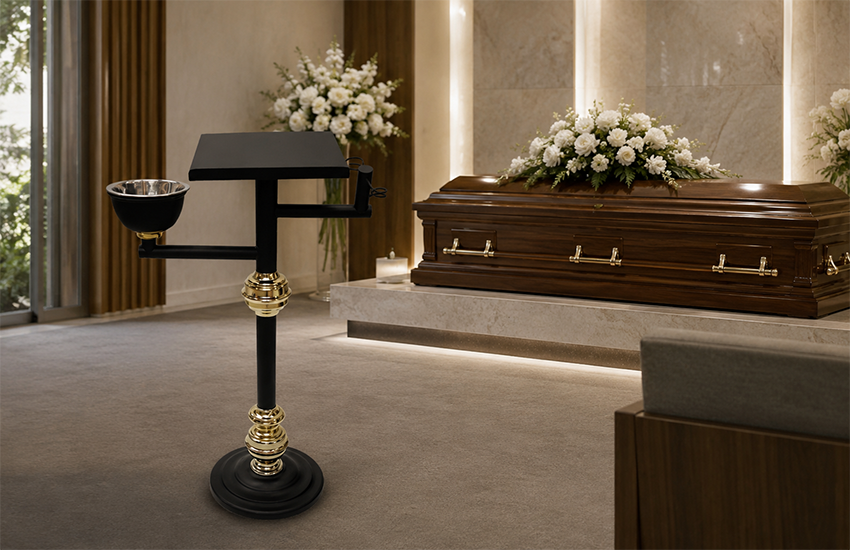
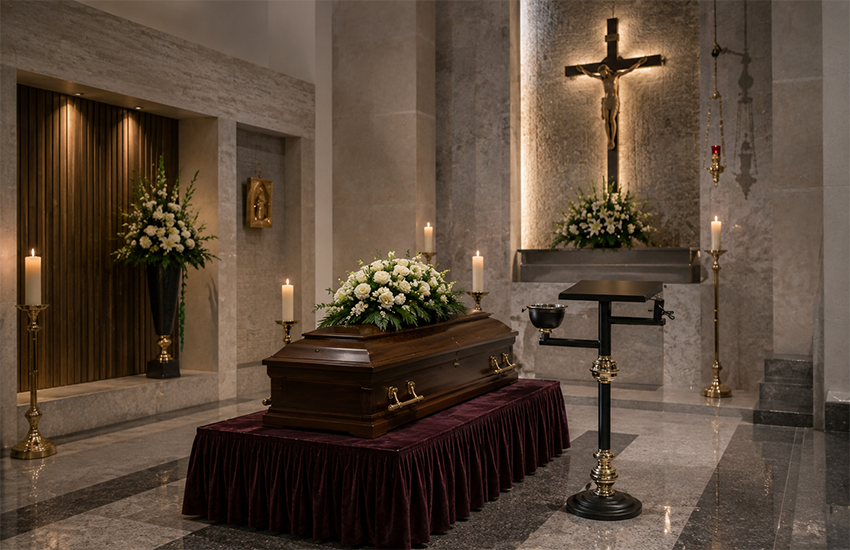
Everything set out above is neatly summarised by one product in the Prima-Tech range: the Funeral lectern no 2. It is the classic, proven form, built around the details that turn out to matter in daily practice.
A working height of 106 cm
The standard version stands at 106 cm, the established chapel height, and is designed to sit comfortably alongside Chapel Set No. 3 for funeral homes that want a coherent scheme rather than an accumulation of unrelated items. At 9 kg it is light enough for one person to carry from the chapel to a vehicle, and solid enough never to feel makeshift.
A height-adjustable version made to order
The same model is also produced with an adjustable column, and the manufacturer builds the mechanism to raise the reading surface as far as 176 cm. That is a substantial range, giving four practical working modes.
At its base setting the lectern behaves like a traditional chapel desk – low, discreet, well suited to someone seated beside the coffin who rises briefly to read a prayer. At mid setting it suits tall speakers, who no longer have to stoop. Raised further it becomes visible above the heads of a standing congregation, which matters in full chapels. At maximum extension it can serve a very tall officiant, or hold a tablet or a large book of condolence.
Adjustment is quick and requires no tools, which counts for a great deal where services follow one another within the hour and the flowers and photograph have to be changed in between. If you need this version, it is worth asking the sales office directly, since the standard listing covers the fixed-height model; custom height adjustment is noted on the product page as available.
The removable holy water bowl
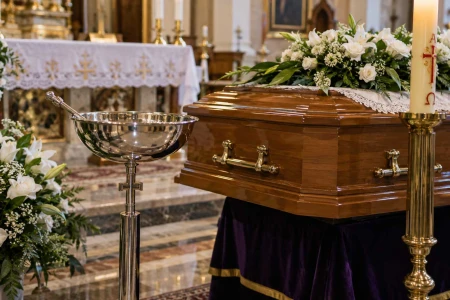
The feature that distinguishes this model is the removable holy water bowl mounted on the side. It looks like a small thing, but anyone who has run a religious service knows how much it simplifies the work. The aspergillum and water sit exactly where the officiant is standing; nothing has to be carried or hunted for; and afterwards the bowl lifts out to be emptied and rinsed.
In Catholic and Anglican practice the sprinkling of the coffin is among the oldest gestures of the funeral rite, a recollection of baptism and a statement of hope in resurrection. That a piece of furniture intended for words also holds a provision for gesture says something accurate about the modern ceremony, in which the two layers are constantly interwoven.
Finishes
Three finishes are available: matte black, gloss black and chrome. As noted above, the choice should follow the character of the chapel. Traditional interiors with dark drapes and timber take matte black best. Rooms with pale walls and directional lighting suit gloss black. Chrome belongs in contemporary funeral homes with minimal interiors, particularly where the other fittings have metal detailing.
Specifications
Height 106 cm, with custom height adjustment available on request. Weight 9 kg. Reading surface 35 × 29 cm. Base diameter 36 cm. SKU PRT-M2. Manufactured by Prima-Tech S.C. in Poland.
Accessories
Two accessories are sold separately and, in practice, are used with the lectern almost every time: the funeral sprinkler (aspergillum) and the soil spade. The second belongs to the gesture that closes a burial in much of Europe and increasingly in Britain – the handful of earth cast onto the coffin. A neat, matching spade offered to mourners looks considerably better than an improvised tool and keeps the graveside tidy.
Other models in the range
The range also includes the simpler Funeral lectern no 1 in a classic form, Lectern no 3 and Lectern no 4 in polished brass for more formal interiors, and Lectern no 5 finished in cloth. The full selection can be browsed in the Funeral Podiums category, and complete room schemes under Chapel sets.
Positioning the lectern in the chapel
Buying good furniture is half the task. The other half is placing it well, and practitioners have arrived at a few reliable rules.
Distance from the coffin and sight lines
A lectern set too close to the coffin competes with it visually and obstructs the family's approach. Set too far away, it makes the speaker seem detached from the person they are speaking about. Practice suggests something in the order of one and a half to two metres, offset slightly to one side, so that the speaker does not block the coffin or the photograph but stands within the same field of view.
It is worth checking the sight lines from the back row. If all that is visible from there is the backs of the people in front, raising the reading surface solves the problem immediately, without moving a single chair.
Traffic routes
Several people come forward during a service, and afterwards the congregation files out. The lectern must not stand on that route. Good practice places it on the same side as the family seating, so that the walk from seat to lectern is short and does not pass in front of the coffin.
A light lectern has a clear advantage here: it can be shifted in seconds when a particular service turns out to run differently from the plan. Nine kilograms is a weight that one hand can manage.
Graveside and outdoor ceremonies
An increasing number of farewells take place entirely at the graveside or under a tent, with no chapel element at all, and the lectern travels with the rest of the equipment. An indoor model can be used outside with sensible precautions, but two things deserve attention: the ground and the wind. On soft earth or gravel the base should rest on a firm slab or a made path, and in any breeze the pages need securing – a heavy folder or a clip is usually enough. Woodland burial grounds, where vehicle access is often limited and everything is carried in by hand, are precisely the setting in which a nine-kilogram lectern earns its keep.
Words, echoes and other curiosities
A few footnotes that show how deeply this piece of furniture is embedded in our culture.
The English lectern derives from medieval Latin lectrum and ultimately from legere, to read – a reminder that the object's original job was reading, not speaking. Pulpit comes from pulpitum, the boards of a stage, which is also the root of the French pupitre and the German Pult. The Polish word for the same object, mównica, was formed transparently from the verb meaning to speak.
The acoustic canopy above a preaching pulpit is called a sounding board or tester in English, and the metaphorical sense of "sounding board" – a person on whom you try out an idea – comes directly from it. For several centuries it was the most effective known method of amplifying speech in a large interior.
In Jewish tradition the synagogue reading desk is the amud and the platform on which it stands is the bimah. The resemblance to the Greek bema is not accidental; the words share an origin and describe the same idea of a raised place for the reader. Cultures separated by centuries arrived independently at the same solution to the same problem: how to make a word both audible and visible at once.
And one curiosity from an entirely different field. Studies of public speaking consistently find that speakers who hold something, or who rest their hands on a stable surface, display fewer observable signs of stress than those standing empty-handed. At a funeral, where the speaker is usually a bereaved relative rather than a trained orator, that simple mechanism may be the single most valuable function the furniture performs.
Why this matters to a funeral home
A family arranging a funeral does not assess a funeral director by their equipment catalogue. They assess them by whether, on one of the worst days of their lives, they felt looked after. That impression is built from hundreds of small things, most of them invisible: punctuality, tone of voice, the polish on the bearers' shoes, the way a tissue was offered.
The lectern belongs in that category. Nobody says afterwards that the furniture was well chosen. But if a granddaughter stood behind it and, despite a shaking voice, got to the end of what she had written – because there was somewhere to rest the page and somewhere to hide her hands – that is the moment the family will remember as a dignified farewell. The whole history set out in this article, from the ship's beaks on the Roman Forum to an adjustable column made in a Polish workshop, leads finally to that single scene.
Professional chapel equipment is no substitute for compassion, but without it compassion has nothing to lean on. It is worth treating the lectern not as an accessory to a set but as the working tool of the most important part of the ceremony – the part where the words are said.
FAQ – frequently asked questions about funeral lecterns
What is the difference between a lectern, an ambo and a pulpit?
An ambo is a permanent element of church architecture, usually built in or fixed in place, historically raised above the floor and used for proclaiming scripture during the liturgy. A pulpit is the enclosed, elevated structure from which sermons are preached. A lectern is a free-standing reading desk with a sloping top, generally portable. The modern funeral lectern descends directly from the reading desk: mobile, self-supporting and suited to tributes delivered in a chapel, a funeral home or at the graveside. In the trade all three terms are often used loosely, though their origins differ.
What height should a funeral lectern be?
Around 106 cm is the accepted standard, corresponding to a comfortable working position for a speaker of average height. Difficulties arise with very tall or very short speakers, with wheelchair users, and in chapels where part of the congregation is standing. A version with adjustment from 106 cm up to 176 cm covers every one of those situations in a few seconds, without tools and without keeping two different lecterns in store.
Is a height-adjustable lectern stable at full extension?
Yes, provided the design accounts for it. The essentials are a base of sufficient diameter and weight and a properly engineered adjustment mechanism. In this model the base measures 36 cm across and the complete lectern weighs 9 kg, which keeps it secure even when the column is extended to its maximum.
What is the removable bowl on the side for?
It holds holy water for religious rites, principally the sprinkling of the coffin. Mounting it on the side of the lectern puts everything within reach of the officiant, so the rite is not interrupted. Because the bowl lifts out, filling, emptying and cleaning between services is straightforward.
Can the lectern be used outdoors at a graveside?
It is designed primarily for indoor use, but with sensible precautions it works well outside. Stand the base on firm, level ground, avoid leaving it out in rain, and secure the pages in windy weather. At 9 kg it is easily carried from the chapel to the grave by one person, which makes it practical for graveside committals and for woodland burial grounds with limited vehicle access.
Which finish suits which chapel?
Matte black works best in traditional interiors with dark drapes and timber, since it does not reflect light and keeps attention on the speaker. Gloss black suits rooms with directional lighting where a note of ceremony is wanted, and photographs well. Chrome belongs in contemporary funeral homes with pale, minimal interiors and metal detailing elsewhere. The coffin stand and the rest of the chapel set are the best reference points for the decision.
Do secular and humanist ceremonies need a lectern?
They need one more than religious services do. In a liturgical rite the structure comes from the ritual and the space is organised by the architecture of the church. In a secular or humanist ceremony the whole burden of organising the space falls on the furniture, and the tribute – often long, read from paper and interrupted by emotion – is the central event. The lectern then defines the point around which the entire farewell is arranged.
Conclusion
The history of the funeral lectern is the history of a stubborn human need: that someone should stand in an appointed place and say something about the dead that allows everyone else to go on. The Romans built platforms out of captured ships' rams for the purpose, the Byzantines raised marble ambos, English parishes cast brass eagles, and country communities made do with a handful of earth and the words of a neighbour. All of these were attempts at the same problem.
The modern chapel inherits from them something modest and precise – a light, mobile desk sized to the particular person about to stand behind it. The Funeral lectern no 2, with its 106 cm working height, its removable holy water bowl and the option of an adjustable column reaching 176 cm, is an example of how a small piece of engineering translates into the real quality of a ceremony: into the comfort of the speaker, and into whether their words reach the back row.
There is nothing insignificant in funeral service. There are only things whose presence nobody notices until they are missing. The lectern is one of them – which is exactly why it deserves to be chosen deliberately.