Table of Contents
- The parish bier: an object owned by everybody
- Who had the right to carry
- Coffin roads, resting stones and the lychgate
- From bier to stretcher: what changed in the nineteenth century
- The modern removal: what the equipment actually has to do
- The MAX black waterproof funeral stretcher
- Black, grey and white: colour as a message
- The etiquette a family never sees
- Choosing a model and building the wider kit
- How others carry: European comparisons
- Frequently asked questions
- The continuity of a gesture
Before the first churchyard was consecrated, before the first headstone was cut and long before anyone delivered a eulogy, there was a single gesture from which every funeral in human history begins – someone lifted a body and carried it somewhere else. That movement is so obvious that we barely notice it, yet it is the true origin of funerary ritual. The grave is the destination, but the journey gives a death its social meaning. Carrying came first.
In Britain this gesture left behind an unusually rich material record: parish biers still standing in vestries, lychgates at hundreds of churchyard entrances, coffin roads crossing the fells of Cumbria and the hills of Wales, resting stones set beside them at intervals a team of bearers could manage. Most of that vocabulary has fallen out of everyday speech, and with it a whole grammar of who carried whom and in what order. This article traces that history – from the parish bier owned by the whole community to the folding, waterproof stretcher in the back of a removal vehicle – and argues that the two are not opposites but the same tool separated by four centuries of problem-solving.
The parish bier: an object owned by everybody
For most of the medieval and early modern period, ordinary people in Britain and Ireland were not buried in coffins. They were wrapped in a shroud and carried to the grave on a bier: a wooden frame with two long poles and a boarded platform, sometimes with low sides, occasionally with turned legs so it could be set down without touching the ground.
The bier belonged to the parish. That single fact carries enormous cultural weight. It was not the family's property and was not hired from a tradesman. It was kept in the church – in the vestry, under the tower, in the porch – listed in the churchwardens' inventories alongside the chalice and the vestments, repaired out of parish funds and lent out each time a parishioner died. The instrument of the last journey was communal property, which meant burial was understood as the business of the whole community rather than the private duty of the grieving.
The parish coffin
Some parishes went further and kept a reusable parish coffin. The shrouded body was carried to the graveside inside it, the coffin was lifted away, and the body was lowered into the earth. The coffin returned to the church to serve the next funeral. This was not merely thrift. It reflected a view of the coffin as a vehicle rather than a possession – a conveyance for a journey, not a permanent house.
Bier and catafalque are not the same thing
Two objects are frequently confused. The bier moves; the catafalque stands. The bier was light enough to be shouldered by four to eight bearers and was built for the road. The catafalque was static, often tiered, draped in black and ringed with candles, standing in the chancel for the duration of the service. The ceremony was the passage between these two states: the body arrived on the bier, rested on the catafalque during the office, and returned to the bier to be taken out to the grave. That distinction survives intact today, simply rendered in different materials – stretchers move, coffin stands display. The technology changed completely; the grammar of the rite did not change at all.
Who had the right to carry
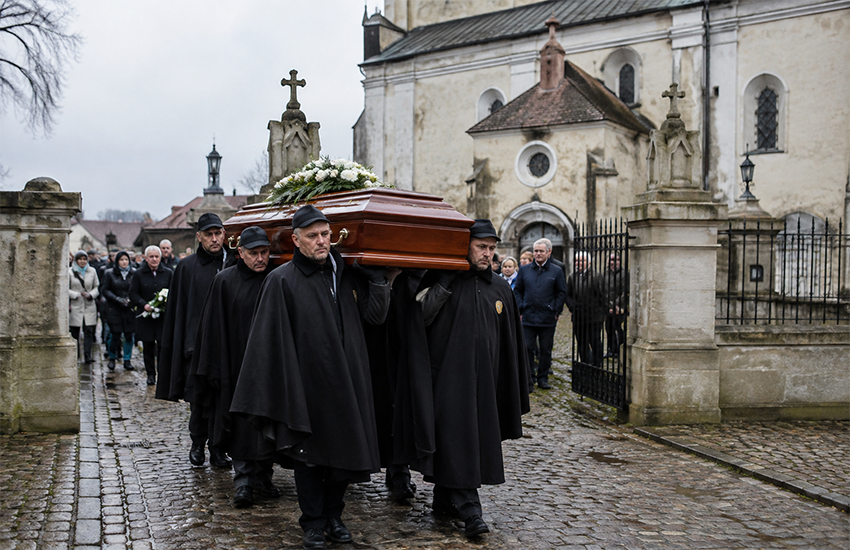
Bearing the dead was never a casual task assigned to whoever happened to be standing nearby. It was a privilege and an obligation, governed by the social structures of the day.
Guilds, fraternities and burial clubs
Medieval English guilds were, among other things, burial societies. A member paid his dues and received the certainty that when he died his brethren would attend, carry his bier, follow him to the churchyard and pray for his soul. Guild ordinances are remarkably specific: how many brothers must attend, what candles must be carried, what fine is levied for absence without good cause. The Reformation dissolved the religious fraternities, but the function re-emerged as the friendly society and the burial club, whose central purpose was to guarantee members a decent funeral rather than a pauper's grave. That fear was not abstract, and it made the burial club one of the most widespread forms of voluntary association in the country. Behind the modern removal team stands the guild brother who was fined for failing to turn up.
Feet first, and other rules of order
Which end went forward mattered. Across most of Britain and Ireland the dead were carried feet first, so that the body faced the direction of travel, away from the house, and would not look back and beckon the living to follow. Clergy were the recognised exception in many places, carried head first – turned toward their congregation, as they had stood at the altar in life.
Numbers mattered too. Four, six or eight bearers, always an even count, always symmetrical. Symmetry was physical balance, but it was also a visible guarantee of order, and a bier that swayed unevenly was read as an ill omen and a disgrace to the bearers. The same instinct survives in secular form: a family knows nothing about load ratings or frame alloys, but registers immediately whether a body moved smoothly or in a series of corrections.
Coffin roads, resting stones and the lychgate
The route was never merely a route. It was a sequence of thresholds, each with its own observance – and in Britain much of that sequence was built in stone and is still walkable today.
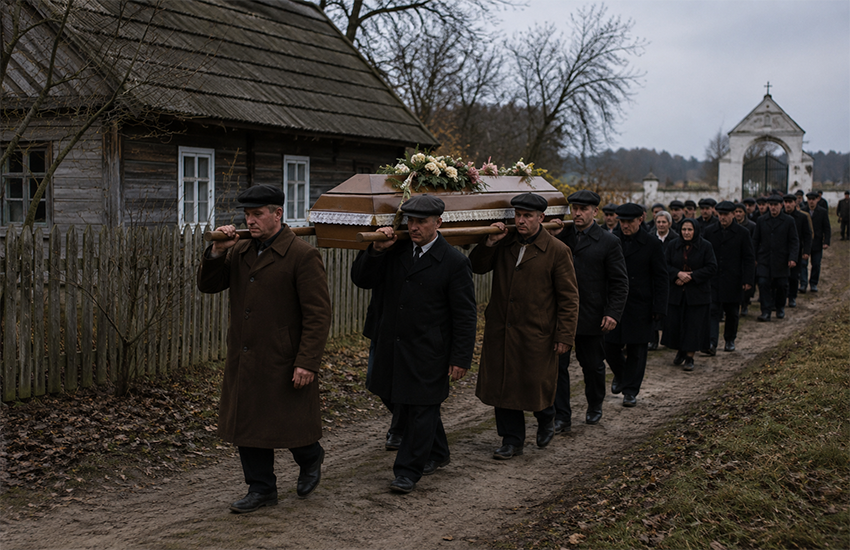
The corpse road
Across upland Britain, remote settlements often lay within a chapelry that had no right of burial. The dead had to be carried, sometimes for many miles, to the mother church that held that right. The tracks worn by these processions are known as corpse roads, coffin roads or bier ways, and they survive as rights of way in the Lake District, on Dartmoor, in the Yorkshire Dales, across Snowdonia and through much of the Scottish Highlands – some now among the best-loved walking routes in the country, trodden by people who have no idea what wore the path.
Folklore attached itself densely to these roads. They were believed to be paths that spirits followed, and custom governed where they might pass and what should never be built across them. Running water was regarded as a barrier the dead could not cross, and many corpse roads make deliberate detours over a stream so that the deceased would not find the way home.
Coffin stones and resting places
The most eloquent survivals along these routes are the resting stones – flat slabs, low walls or purpose-set boulders placed where bearers could set the bier down and change over. Known as coffin stones or bier stones, their spacing is essentially an ergonomic record: they mark the distance a team could manage before their arms gave out.
Prayers were said at these halts, and sometimes a cross was cut into the stone. What looks like pure ritual is ritual and ergonomics fused into one practice: the prayer gave the shoulders their rest, and the rest allowed the body to arrive at the churchyard gate carried evenly. Funerary culture has always been simultaneously a system of meaning and a system of practical solutions.
The lychgate
The final threshold was the churchyard entrance, and Britain gave it a dedicated piece of architecture. The lychgate – from the Old English word for a corpse – is a roofed gateway, usually timber-framed, frequently fitted with a stone slab or bench in the middle. Its purpose was precise: the bier was set down beneath the roof and the body waited there, sheltered, until the priest arrived to receive it and begin the burial office. Thousands survive across England and Wales, and most visitors walk under them without registering that they are passing through a purpose-built waiting room for the dead.
From bier to stretcher: what changed in the nineteenth century
The transformation took only a few decades and had several independent causes that happened to coincide.
Burial moved out of town
Urban churchyards in early Victorian Britain had become notoriously overcrowded, and sanitary reform forced the issue. The great commercial cemeteries opened on the edges of London – Kensal Green, Highgate, West Norwood, Nunhead – and the Burial Acts of the 1850s permitted the closure of intramural burial grounds and the creation of publicly managed cemeteries beyond the built-up area. Glasgow had already opened its Necropolis; the industrial cities followed the same pattern.
The consequence was immediate. A journey that had been a hundred yards from a cottage door to the churchyard became several miles across a growing city, and shouldering the bier for the whole distance ceased to be possible.
The hearse, and the division of the journey
The answer was the horse-drawn hearse: at first plain, then increasingly elaborate, with glazed sides, carved pillars and black ostrich plumes above the horses' heads. It took over the long middle section of the route but did not abolish carrying. On the contrary, it isolated carrying as a distinct, ceremonial act performed over two short stretches – house to hearse, hearse to graveside. That is exactly the pattern still followed today, with a motor vehicle in place of the horses.
Brookwood, opened in Surrey in 1854 as the largest cemetery in the world, took the logic to its extreme with its own railway line: funeral parties boarded at a private station near Waterloo and travelled out to the cemetery's platforms. Nothing illustrates more sharply how completely the act of carrying had been squeezed into two short, symbolic passages at either end.
The undertaker, and equipment as business property
Somebody had to keep the horses, the hearse, the stock of coffins and the staff. The professional undertaker emerged to do it, and with him a new requirement: equipment owned by the firm, used repeatedly, transportable between jobs and capable of being cleaned. The parish bier – heavy, fixed to one place, belonging to the church – met none of these conditions, and was replaced within two generations.
The military inheritance
The third, less obvious ancestor of the modern funeral stretcher is battlefield medicine. The wars of the nineteenth and twentieth centuries forced the development of light, folding, mass-produced stretchers with tensioned fabric, tubular frames, hinged legs and secure handles. Those designs passed from military ambulance work into civilian emergency services, and from there into the funeral trade. A contemporary funeral stretcher descends from two separate lines: the parish bier, from which it inherits its ceremonial function and the requirement to look right, and the field stretcher, from which it inherits its engineering.
The modern removal: what the equipment actually has to do
Today the stretcher is a tool families rarely see in full, and it determines the success of the most difficult stage of the work. The great majority of deaths occur in hospitals, hospices, care homes or private dwellings, and each setting makes its own demands.
Stairs, landings and lifts
A removal from a flat or a terraced house is the sternest test any stretcher faces. Narrow halls, doors that open inward, a tight turn on a half-landing, a lift shallower than the stretcher is long, steep Victorian staircases with a winder at the top. The team must work quietly, without knocking the walls, often with the family standing a few feet away. A frame that folds in half to pass through a constricted space and then opens on the landing is not a convenience here – it is the difference between a job that can be done and one that cannot.
Ground conditions and weather
The second environment is outdoors. Older churchyards grew organically over centuries: unmade paths, root-broken ground, soft turf that turns to mud after rain, frost and wet leaves on a slope. Equipment has to stay stable and the covering has to shed water and clean quickly. A stretcher that cannot be washed down on site becomes a problem for the rest of the week after one wet burial.
Hygiene and manual handling
The third dimension is regulatory. Equipment in contact with the deceased must be decontaminated after every use, and porous surfaces, seams and awkward recesses lengthen that process and increase the chance of it being done imperfectly. A smooth, impermeable covering that tolerates disinfectants shortens the turnaround and makes it repeatable.
Alongside infection control sits manual handling. Under the Manual Handling Operations Regulations, employers must avoid hazardous manual handling where reasonably practicable and reduce the risk where it cannot be avoided. Musculoskeletal injury is a principal occupational risk in this sector, accumulating quietly over years of awkward lifts on staircases. Every kilogram removed from the equipment, and every metre that can be wheeled rather than carried, contributes directly to that duty.
The MAX black waterproof funeral stretcher
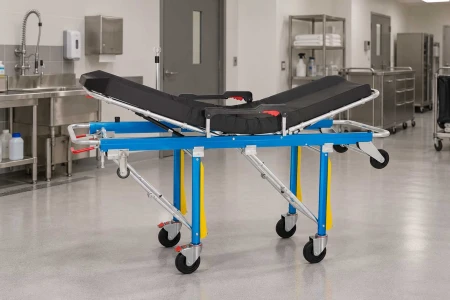
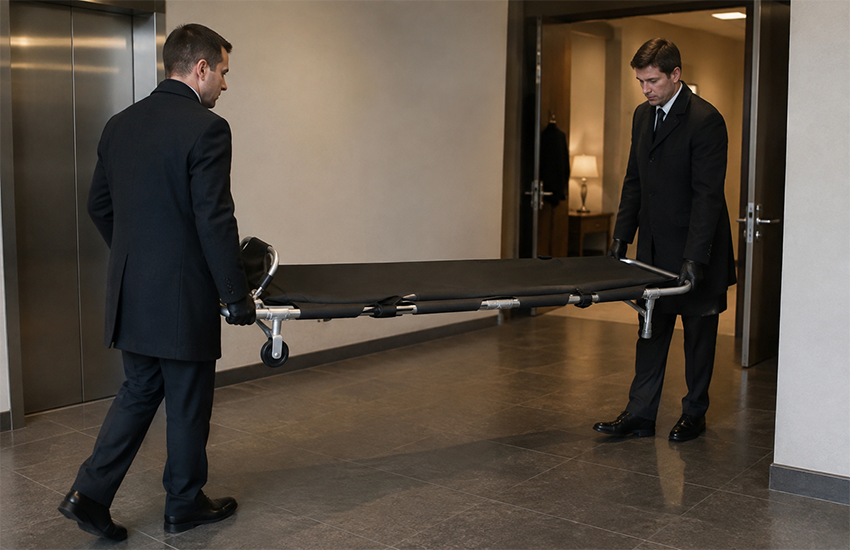
Set against this history, it is worth looking closely at one piece of equipment that unites the ceremonial requirements inherited from the parish bier with engineering borrowed from emergency medicine. The MAX funeral stretcher in black waterproof finish, available from funeraryaccessories.com, is a bestselling model and the longest stretcher of its type on the market.
Length: 207 cm, and why it matters
Unfolded, the MAX measures 207 x 53 x 35 cm. That length is not a marketing figure but a response to a real difficulty. Stretchers under two metres work well until a firm has to move a tall person, or needs a margin of space to work in. At that point every centimetre decides whether the operation proceeds calmly or becomes a sequence of adjustments made in front of the family. Extra length is a margin of safety, and equally a margin of dignity.
Aluminium frame and 160 kg capacity
The frame is aluminium, giving the combination designers in this category constantly fight for: low self-weight against a rated capacity of 160 kg. Weight matters because a two-person team lifts the sum of body and equipment, often in positions far from ergonomic – on stairs, mid-turn, through a narrow doorway. Every kilogram taken out of the structure comes off the crew's spines. Aluminium also resists corrosion, a condition of longevity in equipment routinely soaked by rain and wiped down with chemical agents.
Waterproof PVC covering
The PVC covering answers the hygiene requirements directly: impermeable, smooth, moisture-resistant and designed for rapid cleaning and disinfection. In practice the equipment returns to readiness within minutes of a wet graveside rather than after a day of drying out. It is the same principle that led parishes to keep their bier in a dry, designated place – expressed in a material that forgives a great deal more.
The integral cover, and discretion as a cultural act
The most culturally interesting feature of the MAX is its sewn-in cover, with separate shrouding for the head and feet. Functionally this is about protection and appearance; in terms of meaning it is very much older.
Veiling the dead during transport is among the most widespread of all European funerary gestures. The Romans draped the body on the lectus funebris. Medieval biers were covered with a pall – often a fine cloth belonging to the guild or parish, the most valuable textile many communities owned. Victorian mourning codified the practice in black crape and velvet, with white palls reserved for children and the unmarried. The pall was never simply concealment. It marked the body as being in a state withdrawn from ordinary view, and told everyone who passed that this required their respect.
An integral cover continues precisely this function. During a removal from a block of flats, where neighbours may be on the landing and children coming home from school outside, discretion stops being a matter of appearance and becomes elementary respect – for the deceased, for the family and for bystanders who did not choose to witness anything. A firm that understands this builds a reputation no advertising can replicate.
Folding legs, wheels and footrest
The MAX is fitted with folding legs, built-in wheels and a folding footrest, addressing three situations that often occur one immediately after another. The legs allow the stretcher to be set down stably without being placed on the floor. The wheels allow it to be rolled along a made path, a hospital corridor or a car park, instead of being carried over a distance where carrying serves no purpose. The footrest adds positioning flexibility and secures the foot end.
Folded, it measures 108 x 53 x 12 cm, closing in half. That fits the load space of a standard removal vehicle and stores in modest shelf space – a real constraint for firms operating from urban premises where every square metre of back-of-house is contested.
Two securing straps included
Two stabilising straps are supplied with the stretcher, eliminating the risk of movement during transport, particularly when the frame is tilted on stairs or the vehicle is in motion. They too have a direct ancestor: early modern biers were frequently fitted with cords to secure the body or coffin, and many parishes kept a set of burial cords – often the same ropes used to lower the coffin into the grave. The securing strap is among the oldest and least-changed items in the whole history of funeral equipment.
Black, grey and white: colour as a message
Choosing the black version is not a neutral decision. Black has dominated European mourning since the late medieval period, entrenched by the Burgundian and Spanish courts and then codified with extraordinary thoroughness by Victorian etiquette, which prescribed fabrics, durations and degrees of dress for every category of bereavement. British funerary black reached its most elaborate form in the nineteenth century and retreated sharply after the First World War, when mass loss made ostentatious mourning impossible to sustain.
In daily work, black means visual coherence with everything else – with the trolley drapes, with staff dress, with the vehicle. A family does not analyse a colour palette, but it does form an impression of order or its absence. For firms working to a different register, a grey version of the MAX is available with identical construction and specification.
The etiquette a family never sees
There is a layer of funeral work that appears in no price list and no technical specification: a body of small rules passed down within firms, largely inherited from the ritual described above.
Equipment is prepared out of sight. The stretcher is opened in the vehicle or on the landing, not in the room where the deceased is lying. Nobody discusses unrelated matters during a transfer. The stretcher is never left across a doorway the family is about to use, or unattended somewhere visible. After the removal, the door is closed slowly.
None of this is written into any regulation. It is the modern equivalent of the guild ordinance specifying how many brothers should carry and where the procession should halt. The medium has changed – from the fraternity's book to spoken instruction within a family firm – but the function is identical: to turn a difficult technical operation into a gesture the bereaved can bear to watch.
Choosing a model and building the wider kit
Stretchers rarely work alone. In a typical inventory they form a system with several other items, each responsible for a different stage of the journey.
Multidirectional stair wheels – an attachment for buildings without a lift, substantially reducing the load on the crew in stairwells.
Basket stretchers – a two-piece folding design for difficult terrain, confined spaces and vertical or angled lifts.
Transport chairs – for tight stair turns where a full-length frame simply will not pass.
Coffin trolleys, including off-road models, for unmade cemetery paths and soft ground.
The full range is listed in the funeral stretchers category at funeraryaccessories.com. When selecting a model, the deciding factor should be the character of the operating area rather than the specification alone: a firm serving high-rise blocks with shallow lifts faces entirely different constraints from one working across scattered rural churchyards.
How others carry: European comparisons
The differences beyond Britain are striking, and reveal how deeply carrying technique is bound to local culture.
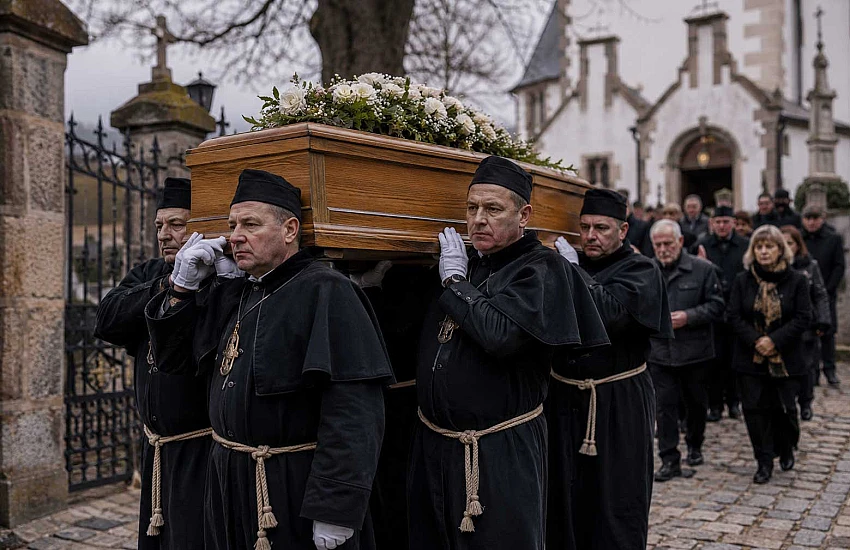
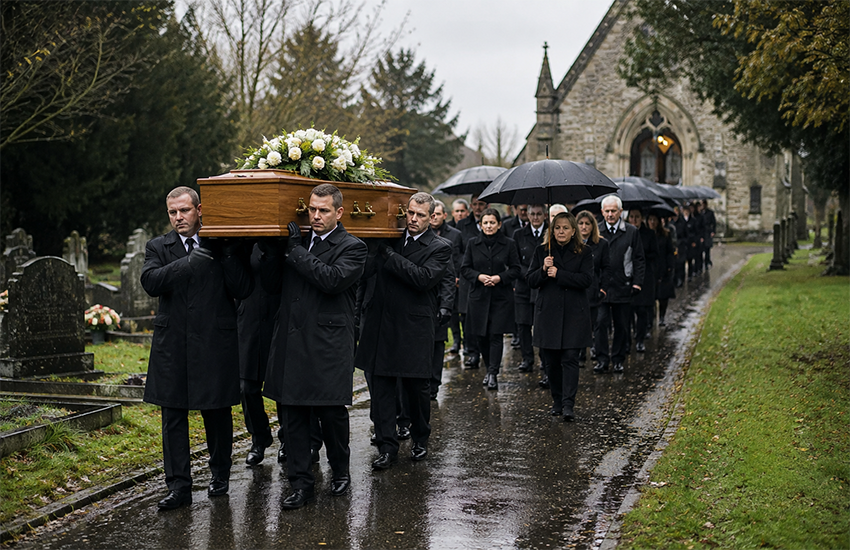
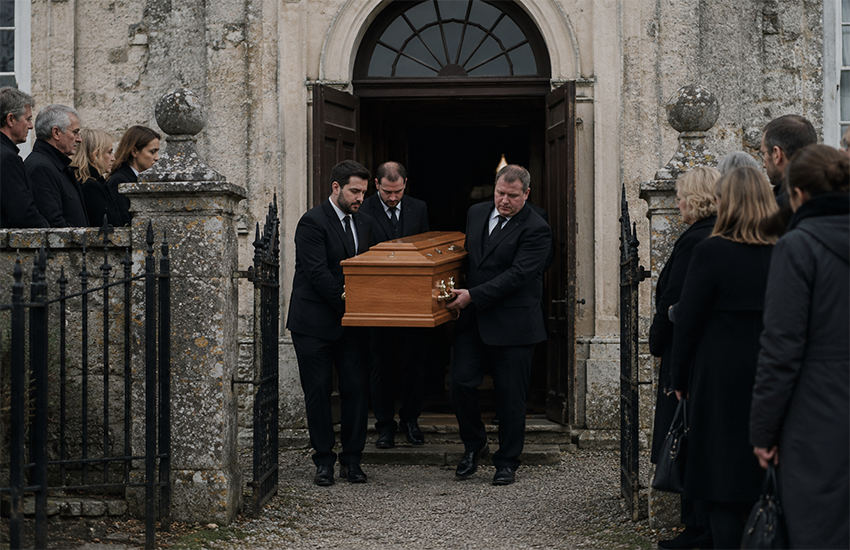
Britain retained shoulder-bearing more strongly than almost anywhere else in Europe. Six bearers in dark suits, the coffin lifted to shoulder height rather than carried in the hands, a slow pace rehearsed in advance: the image is recognised worldwide thanks to state funerals, and it sets the standard by which many families still judge a firm.
Italy places the emphasis elsewhere. A strong tradition of family tombs, chapels and columbaria means transport frequently ends not at an open grave but in front of a wall of loculi several metres up – an entirely different logistical problem. Italy also preserves the confraternite, lay brotherhoods whose original purpose included carrying and burying the dead, several of which still function today. In Bavaria and Austria, village bearer brotherhoods have survived in continuous operation for centuries, with their own regalia and rules, in one of the very few places where the medieval institution never broke.
Modern practice is a hybrid, and a remarkably functional one. It keeps symbolic carrying over the short stretches – from the house, into the chapel, from the gate to the grave – and hands the rest of the journey to vehicles and equipment. The gesture from which the whole of funerary ritual began is still performed, but it no longer costs the bearers their backs. The funeral stretcher is the instrument of that compromise: it takes the strain where strain carries no meaning, and gives way to human shoulders where the meaning is greatest.
Frequently asked questions
What exactly was a parish bier, and do any survive?
A bier was a wooden frame with carrying poles used to convey a shrouded body, or later a coffin, to the grave. It belonged to the parish rather than the family, was stored in the church, listed in the churchwardens' inventories and lent for each funeral. Many survive in English and Welsh parish churches, usually in the vestry or under the tower, and others are held in museum collections.
Why are the dead traditionally carried feet first?
The custom is recorded across Britain, Ireland and much of Europe. The usual explanation is that the deceased should face the direction of travel, away from the home they are leaving, rather than looking back and beckoning the living to follow. There was a practical dimension too: feet-first carrying gives bearers better control descending stairs. Clergy were the recognised exception in many dioceses, carried head first so as to face the congregation.
What length of funeral stretcher is optimal?
It depends on the profile of the business, but the principle is straightforward: greater length gives a larger margin of safety and a calmer operation. The MAX at 207 cm is the longest model on the market. Firms working exclusively in buildings with very tight stairwells may hold a shorter model in parallel, but as primary equipment the longer frame covers a wider range of circumstances.
Will the MAX cope with unmade cemetery paths?
Yes. The lightweight aluminium frame, folding legs and built-in wheels allow the method of movement to be matched to the ground – rolling where the surface permits, carrying where it is soft or uneven. The waterproof PVC covering protects the equipment in rain and mud and allows a quick clean-down after the committal.
How should stretchers be cleaned, and how often?
Equipment that has been in contact with the deceased should be decontaminated after every use, following the firm's infection control procedures and the disinfectant manufacturer's instructions. A smooth PVC surface makes this straightforward, since it does not absorb moisture and can be wiped without leaving damp recesses. Handles, straps and folding mechanisms are the points most often missed.
What is the advantage of an integral cover over a removable one?
An integral cover is permanently attached to the frame, removing any possibility of it being forgotten, mislaid or confused with a cover from a different model, and it shortens preparation time. The head and foot shrouding on the MAX provides full discretion during transport, which matters most during removals in public spaces and multi-occupancy buildings.
How many staff are needed to operate a funeral stretcher?
Two is the working standard, and modern equipment is designed around two-person teams. The lightweight frame, wheels and folding legs exist precisely to make safe two-person operation possible. In demanding circumstances – very narrow stairs, no lift, high load – a larger team or additional equipment such as stair wheels should be used, and a manual handling assessment should inform that decision rather than habit.
The continuity of a gesture
Several centuries and a complete reorganisation of how we manage death separate the parish bier lifted out of a church porch from an aluminium frame folded into a removal vehicle. The gesture, however, is unchanged. Someone lifts a body and carries it to where it will rest. Around that movement accumulated guild ordinances and coffin stones, the symmetry of the bearers, the lychgate roof, the pall and the black crape – and in our own time, infection control procedures, rated load capacities and waterproof coverings.
Every one of those layers served the same end: to ensure that a person's last journey passed calmly, decently and without disorder. The equipment a funeral home works with today is simply the current form of a very old obligation. The MAX funeral stretcher is a tool, but it stands at the end of a long chain whose first link was a person lifting their dead from the ground and walking with them – across the fell, over the threshold, under the lychgate, all the way.