Table of Contents
- From the Crowded Churchyard to the Garden Cemetery
- Trees That Speak of Life and Death
- Autumn Written in Stone – Symbols Worth Reading
- October – the Season for Cemetery Walks
- Forgotten Graves – Autumn Work by Volunteers
- Photographing a Cemetery in Autumn
- Autumn Behind the Scenes – Working in a Cemetery in October
- The Off-Road Coffin Cart – a Dignified Procession on Autumn Paths
- A Cemetery That Lives Alongside Nature
- FAQ – Common Questions About Autumn Cemeteries and Working on Rough Ground
- Finally – a Walk Before the Year Turns
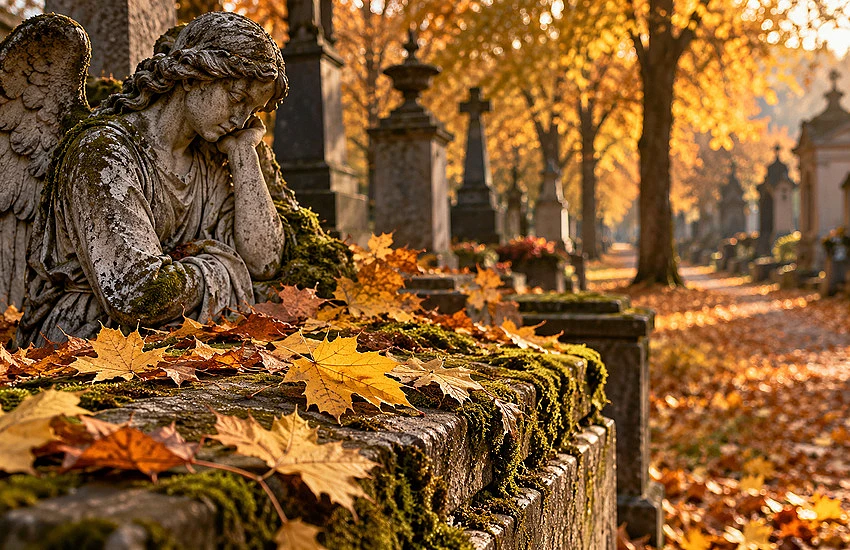
There is a moment each year when old cemeteries become the most beautiful parks in town. It arrives in October, when the limes and horse chestnuts along the main avenues turn to gold and copper, and fallen maple leaves gather on stone ledgers in bright mosaics. Morning mist drifts between the headstones, afternoon light slips through the canopy, and the air smells of damp earth and leaf litter. It is still quiet. A few people walk the paths – someone carrying a pot of heather, someone with a camera, a small group gathered around a volunteer guide.
In this article we take an October walk through the great cemeteries of Britain and America. We look at how burial grounds became landscaped gardens and why particular trees were planted in them, at the growing appetite for guided heritage walks that reaches its peak in autumn, and at the volunteers who care for graves that no family visits any more. We also step behind the scenes, into the work of cemetery staff, bearers and funeral directors, for whom autumn means leaves, mud, mist and soft ground. Finally, we look at the equipment that helps them keep every farewell dignified in those conditions.
From the Crowded Churchyard to the Garden Cemetery
For most of European history the dead were buried around the parish church – in vaults beneath the floor, in the nave, in walled churchyards that grew more crowded with every generation. Being close to the altar mattered: the dead rested at the heart of the community. But as towns swelled in the eighteenth and nineteenth centuries, churchyards became dangerously overfull, and doctors and reformers began to see them as a threat to public health.
Père-Lachaise and the idea of a garden
The turning point came from Paris. In 1804 the city opened the cemetery of Père-Lachaise on a hillside to the east, laid out not as a utilitarian burial yard but as a landscape garden, with winding paths, slopes, trees and views. The idea was revolutionary. A cemetery could be a place to walk, to reflect and to meet history, not merely a place to dispose of the dead. Within a generation the garden cemetery had crossed the Channel and the Atlantic.
Mount Auburn, Green-Wood and the American rural cemetery
In the United States the first great example was Mount Auburn Cemetery in Cambridge, Massachusetts, dedicated in 1831. The idea came from the physician Jacob Bigelow, and the Massachusetts Horticultural Society helped to choose its trees, shrubs and flowers. Mount Auburn is described as the first rural or garden cemetery in the country, and it is credited with starting the American movement for public parks and gardens – before cities had municipal parks, families came here simply to stroll. It inspired many others, including Green-Wood in Brooklyn, founded in 1838. Today Mount Auburn is also an important arboretum, with more than five thousand trees representing hundreds of species and varieties.
Glasgow's city of the dead
In Scotland, the Glasgow Necropolis opened in 1833 on a hill beside the medieval cathedral, consciously modelled on Père-Lachaise. Its terraces of obelisks, temples and mausolea, built by the city's merchants and industrialists, still form one of the most dramatic skylines of any Victorian cemetery – and in autumn, with the trees turning on the slopes below, one of the most photographed.
London's Magnificent Seven
London's response to its overflowing churchyards was a ring of seven private cemeteries built outside what was then the edge of the city. In the first half of the nineteenth century the capital's population more than doubled, burial grounds became contaminated and epidemics spread. In 1832 Parliament passed an act encouraging the creation of private cemeteries beyond central London. Kensal Green opened in 1833, followed by West Norwood in 1837, Highgate in 1839, Abney Park, Brompton and Nunhead in 1840, and Tower Hamlets in 1841. Historians later named them the Magnificent Seven. Each was laid out with avenues, planting and chapels, and each became, in its own way, a garden of memory.
Trees That Speak of Life and Death
Planting in a cemetery was never accidental. Every tree and shrub carried a meaning that Victorian gardeners and grieving families understood perfectly well.
Evergreens and the old churchyard yew
Cemeteries have always favoured evergreens – yew, holly, cypress, juniper and box. Their leaves and needles do not fall in autumn or change in winter, so in the language of mourning they stand for eternity, the immortality of the soul and the endurance of memory. In England the yew is the churchyard tree above all others. Many parish churchyards still have ancient yews that are older than the churches beside them, and they appear in poetry and folklore as guardians of the dead. In October, when everything around them yellows and falls, the dark green yew is a reminder that not everything passes.
The weeping willow and the birch
The weeping willow, its branches bowed towards the ground, is one of the most recognisable symbols of grief in nineteenth-century art. Its outline was carved on headstones, painted on mourning jewellery and embroidered on samplers. The silver birch, with its pale bark, has long been associated with purity and with the north; on many hillside cemeteries old birches become columns of gold in late October.
Limes, horse chestnuts and maples – the autumn avenues
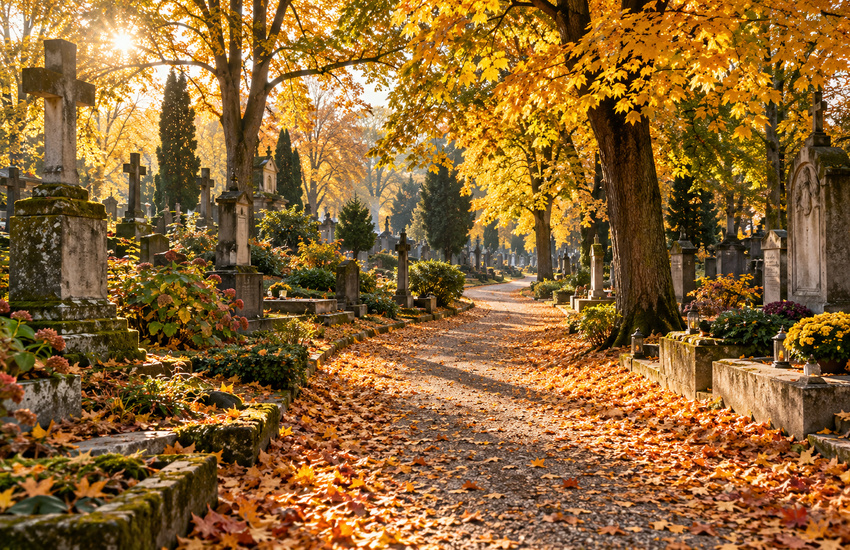
The main drives of large cemeteries were usually lined with limes, horse chestnuts, planes and maples. They gave shade in summer, gave structure to the plan and lent the whole landscape a sense of ceremony. It is these trees that make old cemeteries so striking in October. Golden limes, russet chestnuts and crimson maples form arches over the avenues, and their leaves carpet the graves. Photographers return to cemeteries at this time of year for good reason.
Ivy and periwinkle
Ground cover such as ivy and periwinkle is common on graves. Ivy, clinging to headstones and trees, stands for fidelity and attachment – it holds to whatever it has grasped. Periwinkle, with its small blue flowers, was linked in folk tradition with remembrance and love. Both stay green through the autumn, framing the stones with living colour.
Autumn Written in Stone – Symbols Worth Reading
On an autumn walk it soon becomes clear that nature does not only surround the graves – it is carved on them. Victorian monumental masons drew freely on plant and seasonal imagery, and each motif had its meaning. We have written about gravestone symbols in more detail in Cemetery Symbolism – What Gravestones Really Say.
The wheat sheaf – a life harvested in its season
On the graves of farmers, and of people who reached a great age, we often find a carved sheaf of wheat or a few ears of corn. It is the image of harvest: a life that ripened and was gathered at the right time, like grain at the end of summer. In a society whose year was governed by the farming calendar, the metaphor was obvious to everyone. Death here is not an interruption but the natural close of a full cycle.
Oak leaves, laurel and palm
Oak leaves, from a long-lived and mighty tree, stood for strength, endurance and honour, which is why they appear on the graves of soldiers and public figures. The laurel wreath signified victory and glory in the classical tradition. The palm frond in Christian symbolism means victory over death and martyrdom.
The poppy, the inverted torch and the broken column
Poppy heads and flowers signified sleep – Victorian sepulchral art often presented death as a peaceful rest from which the dead would wake on the day of resurrection. After the First World War the poppy acquired a second, national meaning as the flower of remembrance, worn in the weeks leading to Remembrance Sunday in November. The inverted, extinguished torch represents a life that has come to its end. The broken column, or a tree stump cut short, marks a life ended prematurely, in its prime. An October walk is a good time to learn to read this quiet language.
October – the Season for Cemetery Walks
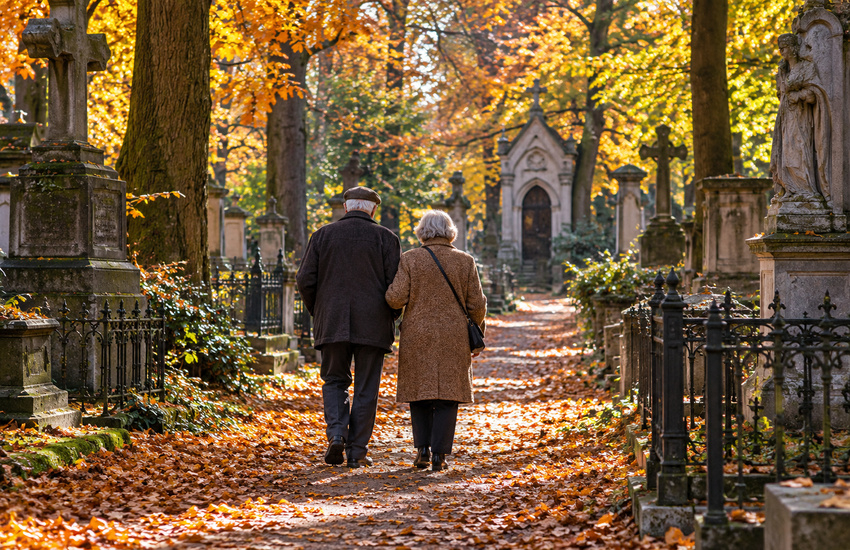
More and more people now visit old cemeteries as places worth exploring in their own right. The attraction is not the macabre but history, art and the stories of people who built our towns. The interest is sometimes called taphophilia – a love of cemeteries as places of memory and beauty – and October, with its colour and its long shadows, is its natural high season.
The Friends movement
In Britain many historic cemeteries owe their survival to volunteers. Highgate Cemetery, opened in 1839, fell into decline in the twentieth century, and in 1975 the Friends of Highgate Cemetery Trust was founded to rescue it. The Trust is run by volunteers, supported by paid staff, and volunteers guide visitors around the grounds and help to care for the landscape. Similar Friends groups now look after cemeteries across the country, from the other members of the Magnificent Seven to municipal Victorian cemeteries in northern industrial towns. Many of them run guided walks through the year, with autumn and the weeks around Halloween among the most popular times.
Stories carved in stone
Those who join such walks learn who lies beneath the monuments, what businesses they founded, where they lived and how they shaped their town. Guides explain the meaning of the carvings, the masons who made them and the changing fashions in memorials. Walks often have themes – women's lives, engineers and inventors, philanthropists, soldiers, writers and artists. Groups are usually small, and booking is often required, so that the visit stays calm and does not disturb people tending the graves of their own family.
From cemetery to nature reserve
Some Victorian cemeteries have become valuable green spaces in their own right. Tower Hamlets Cemetery in east London, closed to new burials in 1966, is now a designated local nature reserve, where woodland has grown up among the graves. Across the Atlantic, Mount Auburn manages its grounds as an arboretum and a haven for migrating birds. In October these places show how closely remembrance and nature can be intertwined.
Etiquette for visitors
Exploring a cemetery calls for particular tact. Do not walk on graves or sit on monuments, do not photograph people visiting the graves of their loved ones, keep your voice low, and if you meet a funeral procession, stop and wait for it to pass. Take nothing away – no stones, no leaves from graves, no flowers. The space belongs to the dead and to those who mourn them. The visitor is a guest.
Forgotten Graves – Autumn Work by Volunteers
Not every grave has someone to tend it. Families move away, die out or simply lose touch, and Victorian sections of municipal cemeteries are full of plots that no one has visited for decades. Autumn is the season when many of them briefly come back to life.
Volunteers with rakes and notebooks
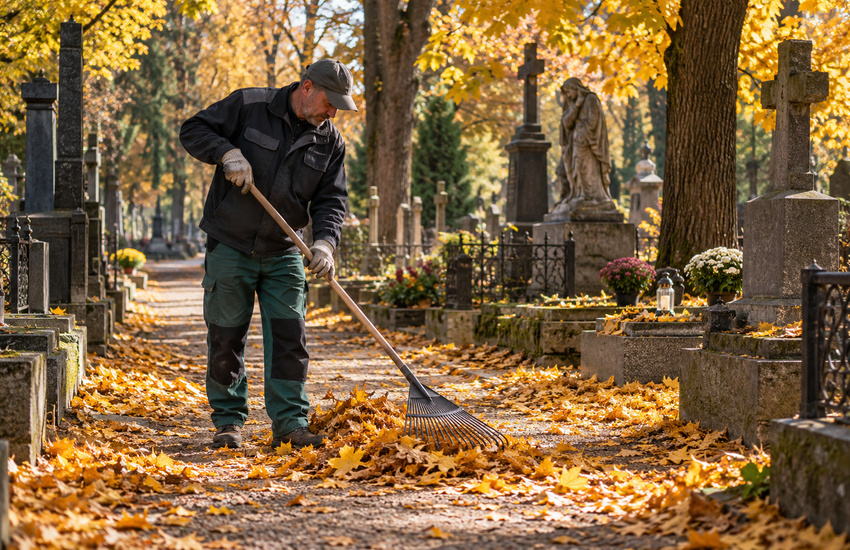
Friends groups, schools, scout troops and local history societies organise working parties in the autumn to clear self-sown saplings, rake leaves, lift fallen headstones where it is safe to do so and record worn inscriptions. For young volunteers it is a history lesson that cannot be learned at a desk. For local communities it is a way of recovering the memory of neighbours who once lived in the same streets.
War graves in parish churchyards
A particular case is the war graves scattered across Britain. The Commonwealth War Graves Commission looks after more than 160,000 headstones in the United Kingdom alone, many of them in small churchyards and municipal cemeteries rather than in large dedicated plots. Through its volunteer programme Eyes On, Hands On, trained volunteers act as the Commission's eyes on the ground, inspecting and caring for war graves near where they live and reporting problems so that they can be dealt with quickly. Autumn, as the country prepares for the season of remembrance, is when many of these graves receive their most careful attention.
Reading inscriptions
Documentation is an important part of this work. Volunteers photograph headstones, transcribe their inscriptions and build databases used by family historians around the world. For the descendants of emigrants, finding a great-grandparent's grave in an English or Scottish cemetery can be a moment of real emotion. Low autumn light helps: it brings out lettering on weathered stone that disappears in the flat glare of summer.
Photographing a Cemetery in Autumn
The October cemetery draws photographers, professional and amateur alike. Golden leaves, mist, stone angels and light filtering through the trees make for images of real power. Taking them, however, calls for sensitivity.
Light and time of day
The best pictures are made early in the morning, when mist lies between the graves, and late in the afternoon, when the low sun warms the stone. On overcast days the light is soft and even, which suits carvings and inscriptions. Look for details: a leaf resting on the face of a stone angel, raindrops on a bronze plaque, ivy wound around a cross.
Respect first
The most important rule is respect. Do not photograph people praying at graves or funerals in progress, do not step on graves to get a better angle, and do not move flowers or tributes. Before publishing images, consider whether they show the names of people who died recently, whose families may not want them online. A good photograph of a cemetery captures its atmosphere without disturbing the peace of the living or the dead.
Autumn Behind the Scenes – Working in a Cemetery in October
For visitors the October cemetery is golden leaves and mist. For those who work in it, this is one of the hardest times of the year.
Leaves, and more leaves
A large wooded cemetery in October becomes an enormous leaf-collection site. Grounds staff rake and remove leaves day after day from paths, verges and untended graves. Families come with brushes and bags to tidy their own plots. And the leaves keep coming back – after every gust of wind and every shower the work starts again. Some cemeteries now compost the leaves on site, so that what falls from the trees returns to the grass and borders as mulch – a solution very much in the spirit of the place itself.
Heather and chrysanthemums
Autumn grave-tending has its own plants. Heather is a favourite, flowering from late summer into autumn in purple, pink and white, coping well with cold and lasting for weeks. Chrysanthemums, originally from East Asia, became popular in Europe precisely because they flower late, when almost everything else in the garden is over. Small evergreens and ornamental grasses in pots are increasingly used too, so that the grave stays dressed through the winter.
Wet paths and soft ground
October rain turns unsurfaced paths to mud. Gravel softens, the ground between graves becomes waterlogged, and wet leaves on stone are as slippery as ice. The roots of old trees, barely noticeable in summer, become real obstacles in autumn. In rural churchyards and woodland burial grounds, where paths may not be surfaced at all, conditions can be genuinely difficult.
Dark by five o'clock
When the clocks go back at the end of October, darkness falls early. Afternoon funerals often finish in half-light, and outdoor work has to stop sooner than in summer. For cemetery staff and funeral directors this means better planning, good lighting in chapels and along main paths, and particular care on wet surfaces. A slip while bearing a coffin or moving heavy equipment can have serious consequences.
A funeral in the October mist
Life – and death – do not wait for better weather. Funerals take place in autumn just as they do in summer. The procession has to move from the chapel to the grave, and the coffin has to travel along narrow, wet paths, often over a long distance, between trees, through puddles and over uneven ground. Bearers and funeral staff must do this safely, smoothly and with complete composure, so that the family never notices the difficulty. Every jolt, tilt or wheel stuck in mud is painful for those watching. Long before trolleys, communities met the same challenge on their shoulders and on parish biers along old coffin roads, as we described in Carried by the Parish: Biers, Coffin Roads and the Long History of Bearing the Dead. Today the answer is equipment designed for rough ground.
The Off-Road Coffin Cart – a Dignified Procession on Autumn Paths
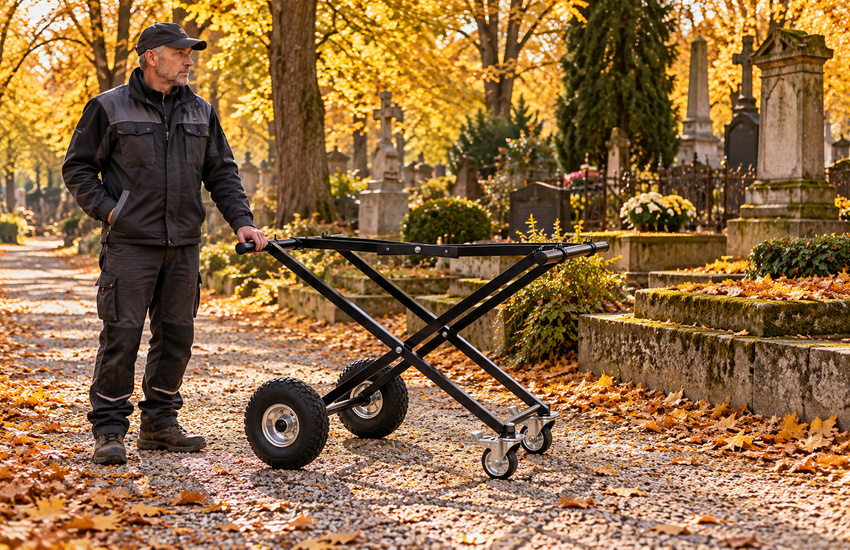
This is exactly the situation for which the Off-road Coffin Cart (New Type) was designed – one of the newest products in our range. It is a folding premium trolley for professionals who work every day in cemeteries with unsurfaced, gravel, woodland or waterlogged paths.
Built for difficult ground
The cart has a reinforced frame of powder-coated steel that resists moisture and knocks, and a load capacity of 300 kg. The key, though, is the wheels. Two large rear terrain wheels, 26 cm in diameter and fitted with an improved mounting system, roll steadily over gravel, grass, soft earth and uneven surfaces without sinking into mud. The two front castors swivel and are each fitted with a brake, so the cart can be steered precisely between graves and held securely at the graveside, even on a slight slope.
Dimensions and transport
Unfolded, the cart measures 89 × 61 × 64 cm; folded, it measures 27 × 61 × 96 cm. It weighs just 16 kg, so one person can lift it easily, and folded it fits even into a small service vehicle or the back of a hearse. That matters particularly for funeral directors who serve many different cemeteries and churchyards: the cart can travel with the team to places where the local infrastructure offers nothing suitable. It is made in Poland.
A dignified appearance in hard conditions
Autumn mud need not mean giving up an elegant presentation. A trolley cover hides the frame and wheels and gives the cart a ceremonial appearance, so that the coffin seems to glide along the cemetery paths and mourners see the coffin rather than the equipment carrying it. You will find our covers in the category coffin trolley covers and drapes; please check the dimensions with us when choosing one for the off-road cart.
Who needs an off-road cart
The obvious users are funeral directors and cemetery managers – especially those running large, tree-lined cemeteries with long avenues, and rural or woodland burial grounds without surfaced paths. But an off-road cart is equally useful to parishes that manage their own churchyards and hold burials on sloping, grassy ground, to natural and woodland burial sites where the coffin must cross a meadow or pass between trees, to councils and trusts caring for historic or closed cemeteries that still host occasional commemorations, and to those organising formal reburials of war dead in rural or remote locations.
If you need a model with adjustable height, see also the Off-Road funeral trolley with chain height adjustment and the full range of coffin trolleys. For help choosing between trolley types, read Which funeral trolley should you choose – scissor, off-road or hydraulic?
A Cemetery That Lives Alongside Nature
The October cemetery teaches us something important. It shows that life and death are not opposites but are woven together, like the roots of old trees and the stones above the graves. Leaves falling on monuments will become soil in a few months, and new growth will rise from it. Trees planted two hundred years ago by grieving families still grow and still change colour every autumn. Birds nest in the limes above the graves, and squirrels bury acorns between the plots.
A refuge for wildlife in the city
Old cemeteries are now often among the most valuable pockets of nature in our towns. Their mature trees, ground cover and quiet favour birds, insects and small mammals. Some, like Tower Hamlets Cemetery, have formal protection as nature reserves. Ecologists and gardeners increasingly stress that looking after cemetery greenery is not only a matter of appearance but also of protecting biodiversity.
The balance between order and nature
Cemetery managers have to strike a balance between order and nature. Paths must be passable, graves accessible and funerals safe. At the same time it is worth keeping what makes an old cemetery special: trees, greenery, silence and a little romantic disorder. The right equipment – light, mobile and built for rough ground – makes it possible to work in such places without damaging their character and without having to surface every path.
FAQ – Common Questions About Autumn Cemeteries and Working on Rough Ground
Why do Victorian cemeteries look like parks?
By the early nineteenth century urban churchyards were dangerously overcrowded. New cemeteries were laid out on open land outside towns and designed as landscape gardens, following the example of Père-Lachaise in Paris, opened in 1804. Mount Auburn in Massachusetts (1831), the Glasgow Necropolis (1833) and London's Magnificent Seven, beginning with Kensal Green in 1833, followed this model.
What do the trees in a cemetery symbolise?
Evergreens such as yew, holly and cypress stand for eternity and enduring memory; the yew is the traditional churchyard tree in England. The weeping willow is a classic emblem of grief, ivy signifies fidelity, and avenues of limes, chestnuts and maples gave the grounds structure and a sense of ceremony.
What is taphophilia?
Taphophilia is a love of cemeteries as places of history, art and memory. Many historic cemeteries, often cared for by Friends groups such as the Friends of Highgate Cemetery Trust, offer guided walks, and autumn is among the most popular seasons for them.
How should I behave when visiting a cemetery?
Do not walk on graves or sit on monuments, do not photograph mourners, keep your voice low, and stop to let any funeral procession pass. Take nothing away from the cemetery.
Which trolley works best on unsurfaced cemetery paths?
For gravel, grass, woodland and waterlogged paths, choose a trolley with large terrain wheels. The Off-road Coffin Cart (New Type) has two 26 cm rear terrain wheels, swivel front castors with brakes, a powder-coated steel frame and a load capacity of 300 kg.
How much does the off-road cart weigh and how big is it when folded?
The cart weighs 16 kg. Unfolded it measures 89 × 61 × 64 cm, and folded 27 × 61 × 96 cm, so it fits into a small service vehicle. It is made in Poland.
Who else uses an off-road coffin cart besides funeral directors?
Cemetery managers, parishes caring for their own churchyards, natural and woodland burial sites, councils and trusts looking after historic cemeteries, and organisers of formal reburials in rural or remote locations all benefit from a cart designed for rough ground.
Finally – a Walk Before the Year Turns
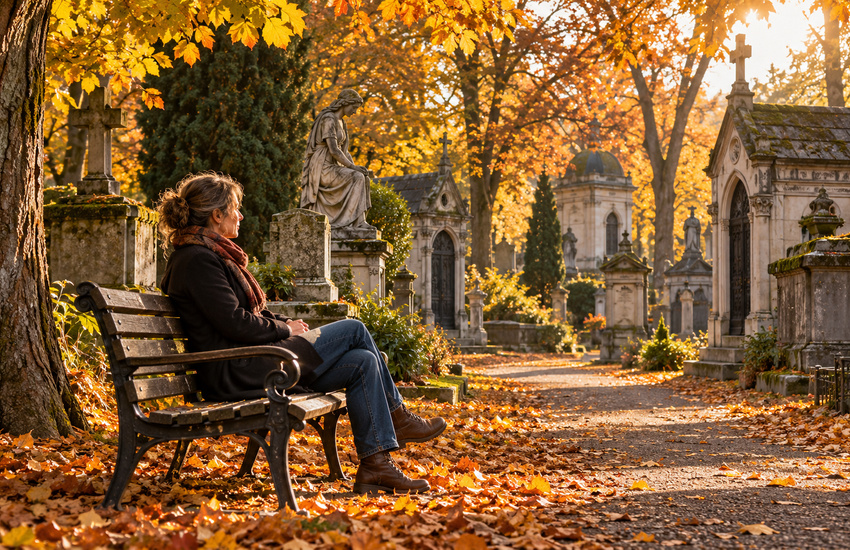
October is the best time to visit an old cemetery without hurrying. To walk the main avenue under golden limes, to stop by a forgotten grave and read an inscription from a hundred and fifty years ago, to listen to a volunteer guide describe the people who built our towns. It is also the season when cemeteries are busy with work – raking leaves, tidying graves, caring for war graves before the season of remembrance. And it is a time when funerals take place in mist, rain and mud, asking particular care of everyone who serves them.
If you work in a cemetery with difficult ground, or conduct funerals in rural churchyards and woodland burial sites, take a look at the Off-road Coffin Cart (New Type) and our coffin trolley covers. Autumn weather should never take even a little of the dignity away from a last farewell.