Table of Contents
- The pall – a cloth that organises the space of farewell
- Black – the colour that was not, in fact, the first
- Purple – a liturgical colour with an entirely separate lineage
- White, silver and gold – the lighter shades of farewell
- Grey, charcoal and the palette of the modern funeral home
- Beyond the funeral – mourning cloth in public life
- The modern pall – from drapery to tailored cover
- Three covers, three registers – the Prima-Tech range
- Matching colour and cut to the character of the service
- Caring for a funeral pall
- Frequently asked questions
- A cloth that says nothing and communicates everything
Someone walking into a chapel of rest almost never looks at the fabric. They look at the coffin, at the flowers, at the faces of the family, at the clock counting down the last minutes before the committal. And yet it is the fabric that tells them, before anything else, how to behave in that room – whether to speak in a whisper, whether they may sit, whether they are standing somewhere ceremonial or merely passing through. The funeral pall does exactly what it should: it works without being noticed.
Across European funeral tradition, the draped cloth is one of the few elements of ceremonial furnishing to have survived every shift in custom of the past several centuries. Coffins have changed, vehicles have changed, the shape of the service has changed almost beyond recognition – and the dark cloth covering the base of the bier has stayed exactly where it was. What has changed, and changed dramatically, is its colour. What seems self-evident today was not self-evident for most of that history, and every shade of mourning cloth carries a different story.
This article is about colour. About where black came from, why purple occupies an entirely separate category in church use, when white appeared at a funeral, and what silver and gold fringing actually signify on the trolley covers used by funeral directors today. Along the way we will look into a Roman atrium, a medieval English church hung with black for a heraldic funeral, the mourning industry of the Victorian era, the flagpoles of a nation in official mourning, and finally the modern chapel, where the pall has stopped being a loosely thrown drape and become a precisely tailored piece of equipment.
The pall – a cloth that organises the space of farewell
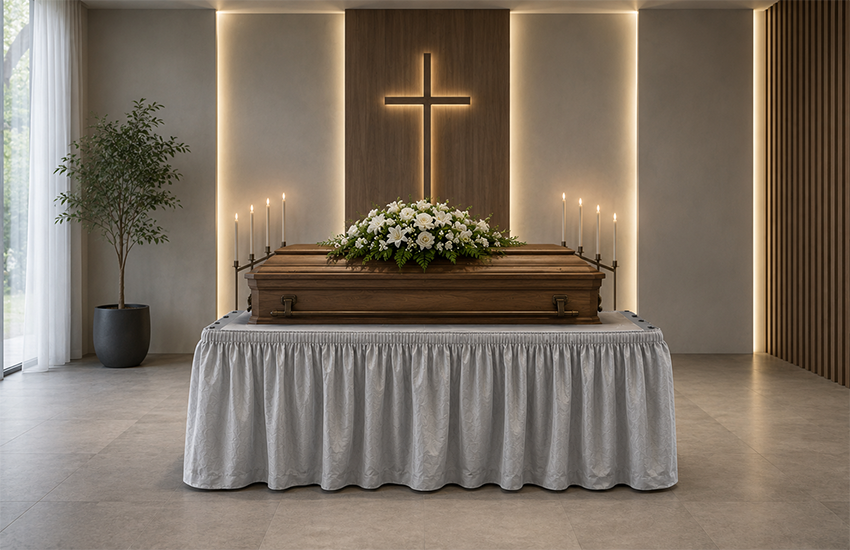
Before we get to colour, it is worth pausing on function. A funeral pall is not decoration in the everyday sense. Decoration draws attention to itself; a pall draws attention to something else – to the coffin, and to the person being remembered. It does this by a method well understood by architects and stage designers: by removing from view everything capable of distracting.
A funeral trolley is a piece of engineering. It has a frame, wheels, a scissor mechanism, brakes and levers. Every one of those parts is essential, and every one of them – left uncovered – would remind those present that what stands before them is transport equipment. The pall takes that information out of the room. Underneath the cloth the machinery disappears and only the form remains: a rectangle, a plinth, a base. The coffin is no longer resting on a device. It is lying in state.
Where the word comes from
The English word derives from the Latin pallium, a cloak or covering, and entered Old English long before it acquired any strictly funerary meaning. Its journey is instructive: mourning did not invent a fabric of its own, it adapted one that already existed. The same is true of much funeral equipment. Objects associated with death are rarely created from nothing; far more often they are ordinary things transferred into an extraordinary setting.
Something similar happened on the continent, where the equivalent cloth is known as the kir – a name originally denoting a dense, dark woollen cloth from a particular weaving region, later narrowed to mean specifically the fabric used for mourning. In both languages the pattern is identical: a material named for its quality or its origin gradually became a material named for its purpose.
From church drapery to tailored trolley cover
For most of its history the pall was loose. It was hung, thrown, draped and pinned. Churches were dressed in it during periods of mourning, biers were swathed in folds reaching the flagstones, coffins were covered with it as a shroud-cloth. Nobody expected the fabric to fit – they expected it to fall in generous folds, because generosity of material was itself a statement about the importance of the occasion.
Change arrived with movement. As long as the bier stood still in the chancel, loose drapery caused no difficulty. Once the coffin began to travel on a trolley – from chapel to hearse, from hearse to graveside, through gates, along paths, over uneven ground – freely hanging cloth became a liability. It caught in wheels, slipped when the trolley started, needed constant adjustment. The modern pall is the answer to that problem: it retains the appearance of traditional drapery while being built for equipment that moves.
Black – the colour that was not, in fact, the first
The association of black with mourning feels so natural that an alternative is hard to imagine. In fact that association has a traceable starting point and a specific geography. It is not universal – in many cultures the colour of mourning is white, elsewhere yellow or blue – and even within Europe it settled into place slowly, over more than a millennium.
The Roman toga pulla and medieval cloth
The oldest European trace leads to ancient Rome. Those in mourning wore the toga pulla – a garment of undyed wool in its natural dark shade, anywhere from greyish-brown to almost black. The key word is undyed. Funerary black did not begin as an aesthetic decision but as an act of refusal. The mourner gave up dyed cloth, gave up the white of the formal toga, gave up the purple that signified office. They wore wool exactly as it came off the loom – and that renunciation was the message.
The Middle Ages inherited the logic and then inverted it. As dyeing improved, black ceased to be a natural colour and became an achieved one, achieved with considerable difficulty. A deep, even black required repeated immersion, often using oak gall and iron compounds, and even then it behaved badly: it faded in sunlight, turned brown in the wash, streaked unpredictably. Cloth of genuinely pure black therefore testified to the skill of the workshop that produced it.
When black became the colour of gravity
The turning point came in the late medieval and early modern period. Flemish and Italian dyers mastered techniques producing black that was both deep and stable, and court fashion – Burgundian first, then Spanish – made it the colour of seriousness, discipline and religious austerity. Black dress stopped signalling limited means and began signalling self-command and dignity. That is when black moved definitively from the category of "absence of colour" into the category of "colour chosen deliberately".
Mourning thereby acquired a shade capable of holding two contradictory values at once: restraint and solemnity. Black cloth on a bier does not shout, yet it announces unambiguously that what is taking place is an event of the highest order. That doubleness explains the persistence of black in funeral practice to this day. No other colour manages to be simultaneously so quiet and so emphatic.
Heraldic funerals, hearses and hatchments
The English tradition produced its own remarkable chapter. From the late medieval period until the seventeenth century, the funerals of the nobility and gentry were regulated by the College of Arms, and the visual staging was elaborate. The church was hung with black cloth from the walls to the pillars, escutcheons bearing the family arms were pinned across it, and above the coffin stood the herse – originally a frame of candles, the word later transferring to the vehicle we know today.
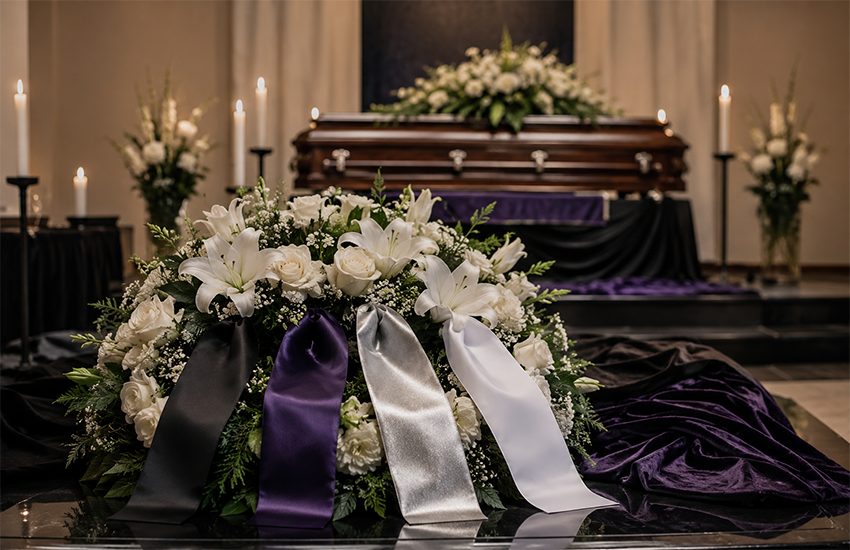
Black performed a theatrical function in those interiors. It absorbed light, extinguished the colours of the building, and ensured that the only bright points remaining were candle flames, gilded lettering and heraldic colour. Anyone entering lost their bearings in a familiar building and stepped instead into a space created solely for that single occasion. The hatchment – the diamond-shaped armorial panel hung on the deceased's house and later moved into the parish church – belonged to the same visual language. Continental Europe developed an equivalent in the castrum doloris, a tiered structure clad in cloth, candles and inscriptions, raised in the centre of the nave.
The modern equivalent operates on an incomparably smaller scale, but the mechanism has not changed at all: a dark pall covering the base of a trolley removes the everyday from view and leaves only what is meant to be remembered.
Not all blacks are alike
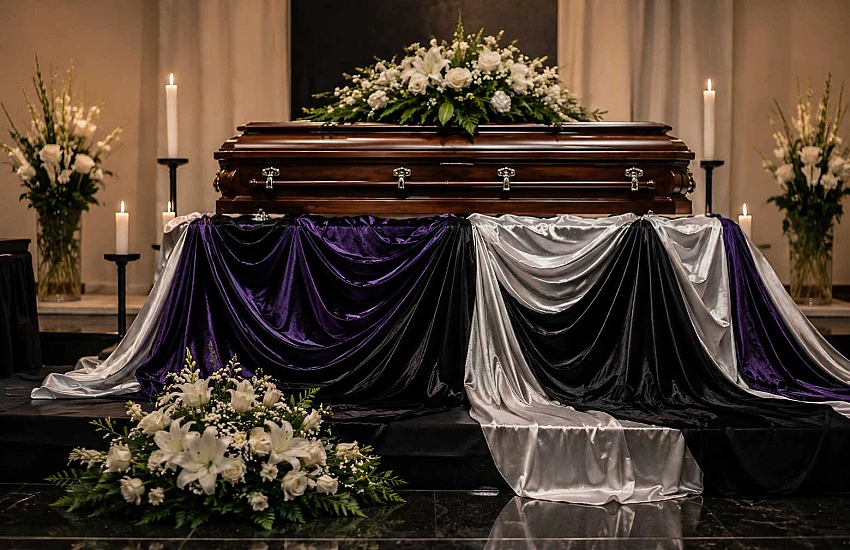
Practitioners know that black in textiles is surprisingly variable. Weave, fibre and finish determine whether a material reflects light or swallows it. A matt fabric produces depth and gravity, and performs well in bright chapels and under directional lighting. A fabric with a slight sheen – velvet, satin, or anything with light-reflective fibres – looks richer, but under a strong spotlight it can throw unwanted highlights.
Experienced funeral homes therefore choose their black not by eye alone but according to the conditions they most often work in. A pall behaves one way in a Victorian chapel with stained glass and soft side light, another in a modern crematorium with ceiling downlighters, and another again in an open churchyard at midday. The same cloth can look like three different materials across those three settings.
Purple – a liturgical colour with an entirely separate lineage
Purple palls are sometimes treated as a softer version of black. In reality their origin is quite different and lies not in secular custom but in the liturgical calendar of the Church.
Advent, Lent and the rites for the dead
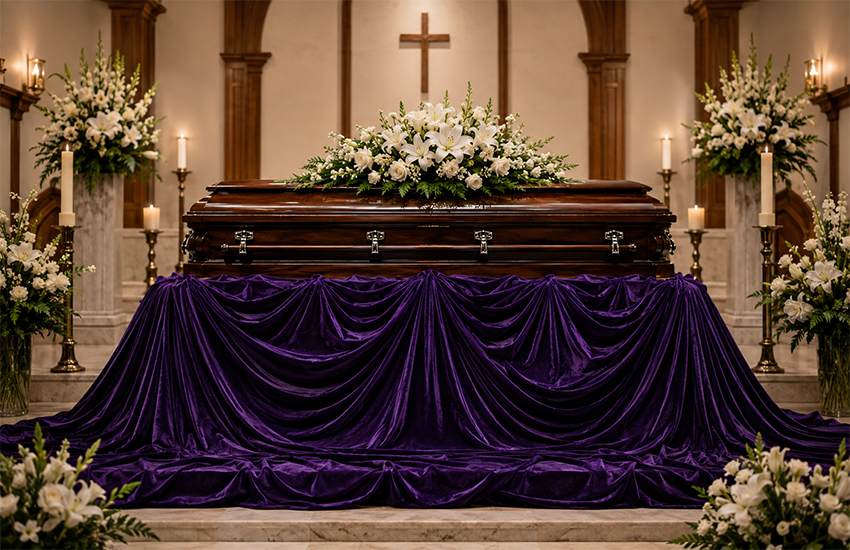
In the Roman liturgy purple is the colour of penitence, waiting and preparation. It accompanies Advent and Lent, appears in the sacrament of reconciliation, and features in rites connected with the dead. It does not signify despair or finality – it signifies a time of passage and a hope not yet fulfilled. For a funeral service that meaning is fundamental, because it shifts the emphasis from grief at a loss towards prayer for the journey still ahead.
Purple has a further, very practical advantage: it sits well with church furnishings. Vestments, stoles, veils and altar frontals in a matching tone create a coherent whole in which the pall on the bier does not read as an intrusion. In parishes attached to traditional liturgical aesthetics, that is often the deciding argument.
What changed in the twentieth century
The liturgical reforms of the mid-twentieth century introduced a significant change to funeral rites: alongside black, purple was permitted, and in many countries white as well. The reasoning was theological. A Christian funeral is not solely a rite of mourning but also a profession of faith in the resurrection, and the colour was meant to express that duality. In England and Wales, and across much of the Anglican Communion, the white pall embroidered with a cross became widespread precisely on those grounds – as a visual echo of the white garment of baptism.
In practice the shift has been gradual and uneven. Black remains dominant in public perception, purple is firmly established in liturgy, and white – as we shall see – retains particular applications. For a funeral director this means it is worth holding more than one colourway in stock, because a family's expectations and a parish's custom do not always coincide.
White, silver and gold – the lighter shades of farewell
A pale pall provokes surprise in some quarters, occasionally resistance. Yet white has a European funerary tradition no shorter than black; it is simply attached to particular circumstances.
White palls and children's funerals
The most deeply rooted use of white is at the funeral of a child. A white coffin, white flowers, white drapery on the bier – all of it expresses a conviction about the innocence of the deceased and about the absence of any need for a penitential rite. The custom is older than any liturgical regulation and has survived every subsequent reform, because it answers a deep cultural intuition.
White is also chosen for the funerals of those in religious orders and, increasingly, at the express wish of a family who want the farewell to read as thanksgiving for a long life rather than as an act of grieving alone. In such cases pale drapery does not diminish the gravity of the ceremony; it changes its register, moving the emphasis from sorrow to gratitude.
Silver and gold – catching the light
Metallic accents in funeral furnishing descend from the baroque. In a chapel lit by candles, gilding and silvering were the only elements that responded to the movement of a flame – they flickered, came alive, guided the eye. Modern lighting is steadier, but the underlying mechanism is unchanged: a matt, dark surface needs a point that catches light.
Today that role is usually played by decorative finishing – braid, cord and fringing in silver or gold. Silver reads cooler and more restrained, pairs well with charcoal and deep grey, and suits contemporary interiors. Gold is warmer and distinctly more ceremonial, sitting naturally with timber, brass and traditional church furnishing. Choosing between them is, in practice, choosing between two registers: understated and stately.
Grey, charcoal and the palette of the modern funeral home
The past two decades have brought something the profession barely knew before: deliberate colour design across an entire ceremonial setting. Funeral directors have begun selecting the shades of palls, upholstery, decorative elements and chapel interiors so that they form a coherent, recognisable whole.
The pall as part of a visual identity
Light grey, charcoal, deep brown, muted burgundy – shades that would once have been unthinkable in funeral use now pass entirely without comment. Their advantage is that they remain serious without being severe. They lack the weight of full black, yet in no way diminish the gravity of the occasion. For families who say plainly that they do not want a "gloomy" funeral, they offer a workable middle path.
A degree of restraint is nonetheless sensible. The colour of the setting should not be an aesthetic manifesto on the part of the funeral home; it should answer the expectations of the family. The arrangement that works best is one in which the firm holds several sets in different tones and matches them to the character of each ceremony, rather than imposing a single palette on everyone.
Colour and light – the factor most often forgotten
Fabric does not have one colour. It has as many colours as there are lighting conditions in which it is viewed. Charcoal that looks deep and elegant in a showroom can look simply washed out in a churchyard on an overcast November afternoon. Burgundy, attractive in the warm light of a chapel, can drift towards brown in cold daylight.
Experienced staff therefore assess colour swatches under several conditions rather than one: by a window, under artificial light, and outdoors. It takes a few minutes and it prevents the kind of disappointment that cannot be put right on the day of the service.
Beyond the funeral – mourning cloth in public life
Although the pall is associated first and foremost with the funeral service, its cultural role is broader. It is one of very few funerary objects to have left the chapel and the churchyard and taken up residence in public space.
Flags, standards and armbands
The most widely recognised application is the flag flown at half-mast during a period of national mourning, and – in continental practice – the black streamer tied to the staff immediately below the finial, where it contrasts clearly with the flag's own colours. The two conventions are sometimes used interchangeably and sometimes together. In the United Kingdom the arrangements are governed by their own protocol, in which the Royal Standard is famously never flown at half-mast, since the sovereignty it represents does not lapse.
Standards carried by organisations, schools, fire brigades and associations taking part in a cortège are treated the same way, tied with black to indicate that the party is attending a funeral rather than a celebration. The black armband, worn by pallbearers and – in a survival now familiar largely from sport – by teams marking a death, belongs to the same family of signals. Each gesture is minor, wholly conventional, and yet legible to everyone present without a word of explanation.
Draped buildings, dimmed theatres and Victorian crape
History records the practice on a much larger scale. In earlier centuries, city gates, guildhalls and the façades of houses along a processional route were hung with black cloth during official mourning. Theatres draped the proscenium after the death of a distinguished actor, and the modern equivalent survives in the dimming of West End and Broadway marquee lights for an evening.
Nineteenth-century Britain took the practice further than anywhere else. Victorian mourning had its own dedicated textile – crape, a crimped silk with a deliberately dull, lightless surface – along with strict conventions governing how long it was worn and by whom. Houses hung black at the door, mirrors were covered, carriages were drawn by plumed black horses, and professional mutes stood at the entrance. Much of that apparatus disappeared within a generation of the First World War, but the underlying idea outlived it entirely.
The common denominator across all these customs is the same as at the bier: cloth changes the status of a place. The building, the flagstaff and the stage remain physically unaltered, yet they cease to be ordinary. A pall functions like punctuation in space – it adds no content, it simply requires the content to be read differently.
The modern pall – from drapery to tailored cover
Back to practice. The contemporary trolley cover is the product of a long evolution in which aesthetics had to be reconciled with the demands of transport. That reconciliation proved harder than it might sound.
Why loose fabric stopped being good enough
The problems with classic drapery are always the same, and every member of funeral staff knows them first-hand. Fabric hanging below the frame catches in the wheels on a turn. Under acceleration or braking it slips to one side, producing an asymmetry visible to everyone present. At a threshold, a kerb or a chapel ramp it has to be held by hand – which means the person guiding the trolley is attending to the cloth instead of the coffin.
Each of those situations is technically trivial and ceremonially expensive. Mourners do not assess equipment, but they register very precisely when something is going wrong. Adjusting fabric mid-procession interrupts the continuity of the rite at exactly the moment when smoothness matters most.
The solutions that work in practice
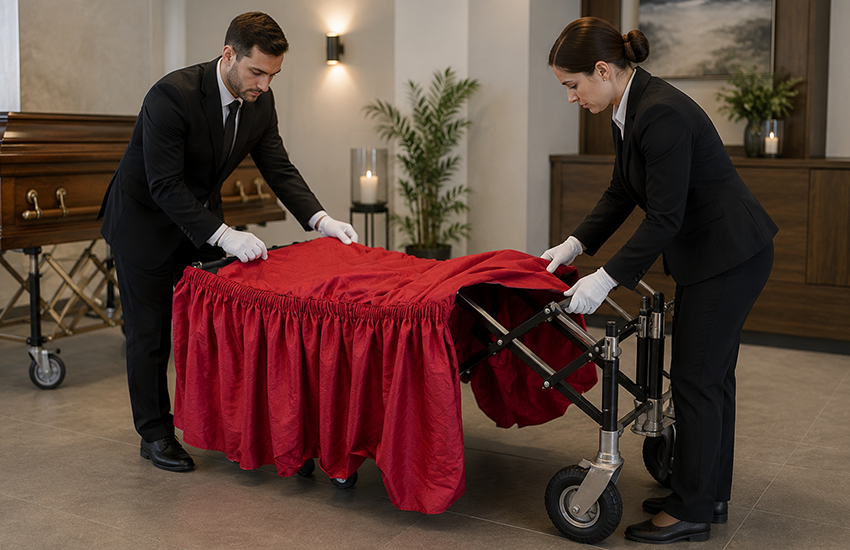
The answer is a pall sewn as a piece of equipment rather than cut as a sheet of cloth. Four features have proved decisive. A pleated finish with a sewn-in elastic band means the fabric adjusts itself to the length of the trolley whatever its current extension. Riveted eyelets allow the cover to be fastened securely to the frame so that it does not shift in transit. Velcro fasteners at the corners secure the lower edges of the material, removing the risk of it catching in the wheels. And machine washability keeps the pall in presentable condition across years of use rather than a single season.
It is a list of functions that sounds prosaic and determines whether the fabric will be an ally or an obstacle. A well-cut cover goes on in seconds, holds its shape throughout the service, and returns to the store without any sign of a struggle.
Three covers, three registers – the Prima-Tech range
The cart drape and trolley cover range at funeraryaccessories.com includes products that differ not only in dimensions but, more importantly, in the register they speak in. Below are three models that funeral homes turn to most often.
Aluminum trolley cover for PRT-XH-14 – form matched to the frame
The aluminum trolley cover (SKU AF034) is designed as a cover tied closely to one specific trolley construction. Its dimensions of 123 × 48 × 60 cm correspond to the geometry of the PRT-XH-14, so the material sits evenly and does not create overhang where it might get in the way.
The pleated design and reinforced corner fasteners eliminate the risk of fabric tangling in the wheels during transport – which matters particularly on a catafalque trolley, frequently manoeuvred through the confined interiors of chapels and rooms of rest. Reinforced eyelets provide secure attachment to the frame and prevent the cover slipping or shifting. The flexible construction allows fast, effortless mounting and dismounting, and the material is machine washable, which under heavy use is the precondition for maintaining a professional appearance. The model is available in multiple colours, and made-to-order versions can be produced in custom sizes and colourways.
This is the choice for firms who want reliability and discretion above all – a cover that is invisible in the sense that it never draws attention to itself through a fault.
Standard trolley cover – the universal cut
The standard trolley cover (SKU AF024) is the most versatile of the three, with standard dimensions of 150 × 60 × 60 cm. Its greatest strength is the way it handles the changing geometry of a scissor trolley. Thanks to its gathered finish and sewn-in elastic band, the cover adjusts automatically to different trolley lengths – whether the trolley is fully extended or shortened, the fabric falls evenly and looks neat.
That has a very practical consequence: one cover serves several trolley settings, so a funeral home need not keep multiple variants of the same item. The remaining engineering follows the proven pattern – strong Velcro strips at the corners secure the fabric against contact with the wheels, riveted eyelets stabilise the cover on the frame, and the tailored cut allows it to be fitted and removed in seconds without adjustment. The fabric is machine washable.
The model is available in a wide selection of colours and can be made to special order in a chosen colourway and custom dimensions, so the shade can be matched to a firm's own aesthetic or to the interiors in which its ceremonies usually take place. Customer feedback returns repeatedly to the corner fasteners – a simple solution that removes the single most common operational nuisance.
Trolley cover with fringes – the ceremonial register
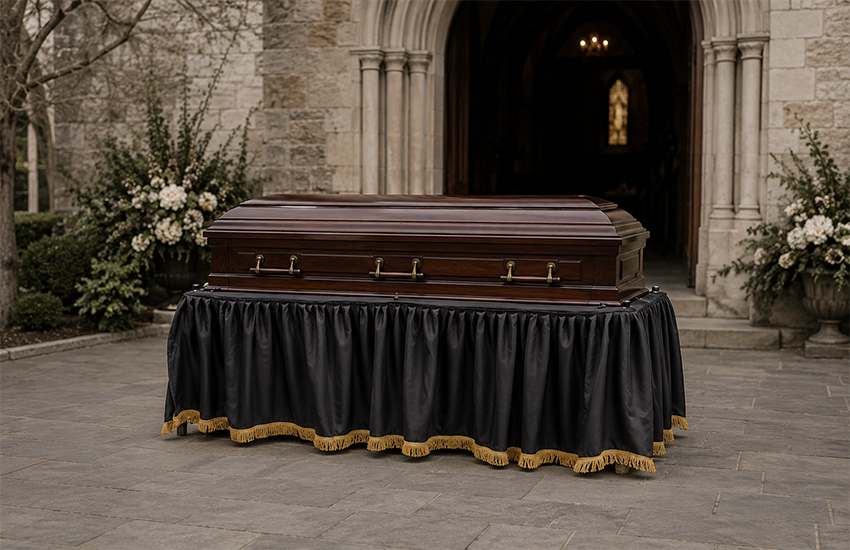
The trolley cover with fringes (SKU AF033), measuring 150 × 60 × 56 cm, represents the register discussed earlier in connection with the baroque – a distinctly stately setting. Decorative fringes add an exclusive, ceremonial touch that complements the solemn atmosphere of the occasion.
The decorative element does not come at the expense of function. The product is made from high-quality, wrinkle-resistant material, ensuring a flawless appearance at all times, and integrated Velcro straps allow the cover to be secured around the trolley's wheels, preventing the fabric from being caught during transport.
Made-to-order options extend to both dimensions and ornament: the cover can be tailored to specific measurements, and decorative elements such as fringes, edging or other trim can be customised to individual requirements. It is a proposition for firms handling services of particular standing, or working in regions where expectations around ceremonial presentation remain firmly traditional.
Matching colour and cut to the character of the service
There is no single pall suitable for everything – and that is not a shortcoming but a natural consequence of how varied funerals are. Below are the three most common contexts and what works best in each.
Church and chapel services
For services with a clearly liturgical character, black or purple remains the safest choice, ideally in a tone close to the vestments used in that parish. It is worth considering how the pall relates to the building: in churches with a great deal of timber and gilding, gold accents will read better; in more austere or contemporary architecture, silver, or none at all.
A cover with decorative finishing sits well at services with elaborate staging – standard bearers, an honour guard, a choir. At small, private farewells, fringing can feel excessive, and a plain model serves better.
Civil and humanist ceremonies
Civil and humanist services follow a different aesthetic. Families more often ask for a lighter register – grey, charcoal, muted navy – and for a setting without explicit religious reference. A plain cover, free of metallic accents, in a shade matched to the flowers and the interior of the ceremony room, creates a calm and focused atmosphere without imposing a particular confessional context.
Requests for a colour connected to the person are increasingly common: a favourite shade, the colours of a club, a colour associated with a trade or a regiment. The option of having a cover made in a chosen colourway allows a funeral director to answer such requests without improvising on the day, provided there is reasonable notice.
Ground conditions and the seasons
The last factor is the most prosaic and the most frequently overlooked. Rural churchyards and woodland burial grounds, with gravel paths, uneven ground and slopes, place quite different demands on a cover than a well-maintained municipal cemetery. Where a trolley has to cross rough ground, the fasteners and mounting eyelets become critical – without them, every kerb means readjusting the fabric.
Season matters too. In late autumn and winter, with mud and damp underfoot, the lower edges of the cloth will inevitably soil, and machine washability earns its keep. In full summer sun the differences between blacks become apparent: a fabric with pronounced sheen can throw highlights, while a matt weave holds its depth.
Caring for a funeral pall
A pall is worth looking after not only so that it lasts longer, but because its condition is visible to everyone attending – even if nobody ever says so.
Washing, drying and storage
Machine washability, common to all three models discussed, simplifies the routine considerably. A cover should be washed regularly rather than only when soiling becomes obvious, because dust settling on dark fabric shifts its shade gradually and imperceptibly, until a side-by-side comparison with a fresh piece reveals the difference.
After washing, the fabric should be dried hanging, without creasing at the gathered section, and stored loosely folded or on a hanger – never compressed beneath other equipment. Wrinkle-resistant materials make this considerably easier, but even they dislike months under weight.
Rotation and reserve stock
Funeral homes conducting a high volume of services generally operate a rotation: at least two sets of covers in the principal colourway, used alternately. That allows one set to be laundered without any risk of arriving at the next service without a presentable cover.
It is also worth holding one set in an alternative tone – white or pale – precisely for the exceptional situations in which standard black would be wrong. A child's funeral is not an event anyone can prepare for at the last moment, and a firm's readiness in that situation is itself a form of respect towards the family.
Frequently asked questions
What is the difference between a trolley cover, a coffin pall and a coffin drape?
A trolley cover clothes the base – the bier, the trolley, the plinth – and its purpose is to conceal the load-bearing structure and give it a dignified form. A coffin pall is the cloth laid over the coffin itself, across the lid. Coffin drapes may be decorative or symbolic, as with a national flag at a service with military honours. In practice these elements are frequently used together, but they serve different functions and are not interchangeable.
Is a purple pall appropriate at any Catholic funeral?
Purple is a liturgical colour permitted in funeral rites and used routinely in many parishes. It is not, however, obligatory: black remains entirely proper, and white is used in defined circumstances. The best approach is a brief conversation with the celebrant or the verger, since local parish custom often carries more weight than general guidance.
Will one cover fit a scissor trolley at different extensions?
Yes, provided it has a gathered finish and a sewn-in elastic band. That construction is precisely what allows the cover to adapt to the trolley's current length – whether fully extended or shortened – and to fall evenly in both cases. A cover without elasticated finishing has to be matched to one specific setting.
How do you stop the fabric catching in the wheels?
The key element is the Velcro fastening at the corners of the cover. It secures the lower edges of the fabric at exactly the points where contact with the wheels usually occurs – on turns and when crossing thresholds. Riveted eyelets complete the arrangement by stabilising the whole cover on the frame so it cannot shift. Together the two features remove the problem entirely in practice.
Can a cover be made in a non-standard size or colour?
Yes. All three models can be produced to order, both in a chosen colourway and in dimensions differing from the standard. Covers can be shortened or lengthened, or made to a completely different geometry to suit an unusual trolley construction. Decorative elements are also customisable, including fringes and edging.
When is a white pall used?
Most often at the funerals of children, where white expresses the innocence of the deceased, and at the funerals of those in religious life. A pale setting is also increasingly chosen at the express wish of a family who want the farewell to read as thanksgiving for a life fully lived. White does not diminish the gravity of a service; it changes its register, moving the emphasis from grief towards gratitude and hope.
How should a pall be cared for so it lasts?
The foundation is regular laundering – the materials used in these models are machine washable, so covers can be refreshed without specialist cleaning. The fabric should be dried hanging and stored loosely folded or suspended, without compression at the gathered section. Under heavy use it is worth keeping at least two sets in rotation so that one is always ready.
A cloth that says nothing and communicates everything
The history of the funeral pall is the history of a remarkably constant idea in changing forms. A Roman in undyed wool, an English parish church hung with black for a heraldic funeral, a Victorian household draped in crape, a standard tied with black on a day of national mourning, and a precisely tailored trolley cover in a twenty-first-century chapel all belong to a single story. The technique, the material and the method of fastening change; the task does not. It is to mark a place, a time and a situation as exceptional.
For a funeral director the practical conclusion is straightforward enough. A pall is one of those pieces of equipment whose quality is judged not when it works but when it fails. A well-chosen cover – in the right colour, matched to the frame, securely fastened and kept in immaculate condition – will be noticed by nobody at all. And that is precisely the measure of its success. At a service of farewell the attention of those present belongs to one person, and anything that draws it away is a mistake, even a small and technical one.
It is worth treating the choice of a pall, then, as a decision about the culture of ceremony rather than a matter of procurement alone. The colour, finish and cut of a fabric form the language in which a funeral home speaks to a family at the moment when words are hardest to find. That language deserves to be chosen with care.