Table of Contents
- Why October is the month of the rosary
- Crosses in the landscape – a thousand years of stone and wood
- Grottoes, holy-year crosses and the family rosary
- Crosses with a story
- The rosary in the hand – a prayer that goes with us to the end
- The wooden cross on a new grave
- Funeral crosses in our range
- October care for crosses and graves
- FAQ – rosary, wayside crosses and grave crosses
- Finally – the October rosary and the sign that remains
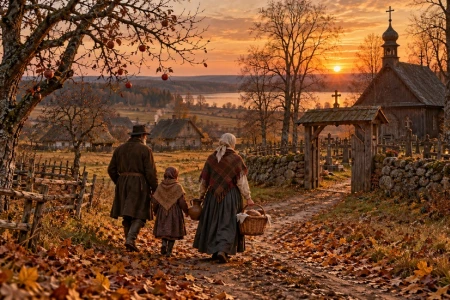
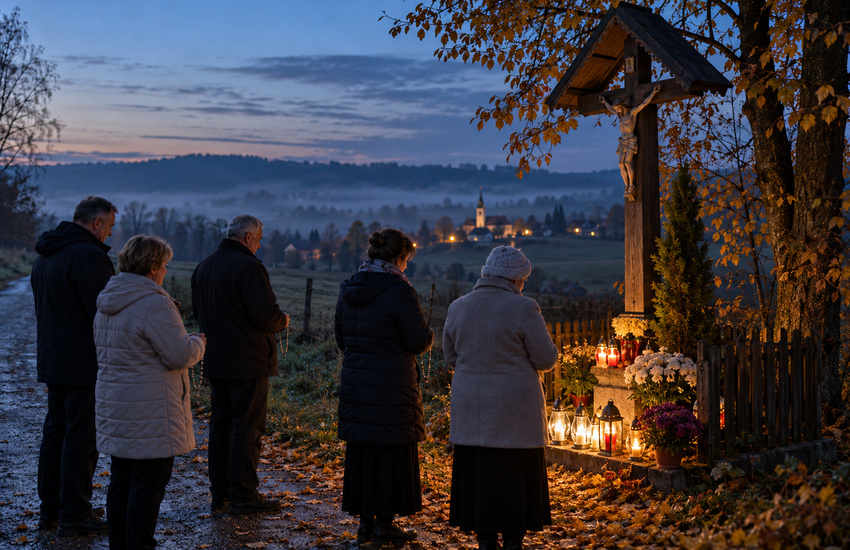
Picture an October evening in rural Ireland some seventy years ago. The light fades early, smoke from turf fires drifts across the fields, and at a crossroads beside a small grotto of Our Lady a handful of neighbours gather – older women in headscarves, a few children, a farmer still in his working boots. Someone lights a candle in a jam jar, someone else begins: “In the name of the Father…”. For the next twenty minutes the steady murmur of the rosary rises over the hedges. In many parishes across Ireland, and in Catholic corners of Britain, this was what October sounded like.
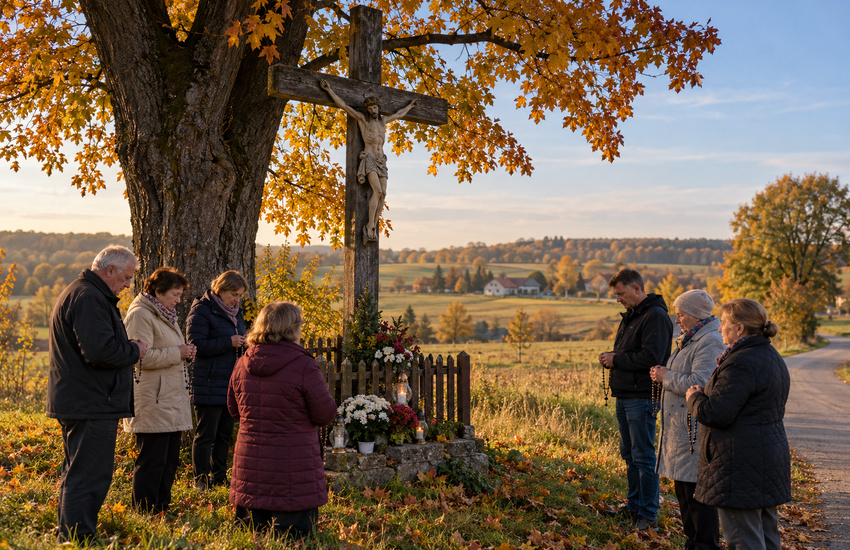
Today such a scene is rare. October devotions have moved almost entirely indoors, into parish churches, and the habit of praying together at a roadside cross or grotto survives only in a few places, usually kept alive by a small number of older parishioners. Yet the crosses and shrines themselves have not disappeared. They still stand at crossroads and holy wells, on hilltops and at the edges of villages – many of them freshly painted, tended and decorated with flowers. They are among the most characteristic features of the Irish and British landscape, and silent witnesses to a tradition that once shaped the rhythm of rural life.
That old scene brings together several very long traditions: the rosary, to which the whole month of October is dedicated; the crosses and shrines that have marked our roads and churchyards for more than a thousand years; and the cross as a sign of remembrance – the same sign we still place on every new grave. In this article we look at each of them in turn. We explain why October became the month of the rosary, where the high crosses, market crosses and Mass rocks came from, what happened to the soldiers’ wooden crosses brought home after the First World War, and why a simple wooden cross still stands on a fresh grave before any headstone arrives.
Why October is the month of the rosary
The link between October and the rosary has a very specific starting point. It goes back to a naval battle fought more than four and a half centuries ago in Greek waters.
Lepanto, 7 October 1571
On 7 October 1571, off the coast of Greece near the entrance to the Gulf of Corinth and the town then called Lepanto, the fleet of the Holy League – an alliance of Catholic states built around the Papal States, Spain and Venice – met the fleet of the Ottoman Empire. It was one of the largest sea battles in history, involving hundreds of galleys on each side, and the League’s victory halted Ottoman expansion in the western Mediterranean.
Pope Pius V, who had urged the faithful to pray the rosary for the success of the campaign, attributed the victory to that prayer. In 1572 he established 7 October as the feast of Our Lady of Victory. His successor, Gregory XIII, renamed it the feast of Our Lady of the Rosary and moved it to the first Sunday of October. Today the memorial of Our Lady of the Rosary is once again kept on 7 October.
The “Rosary Pope”
Lepanto alone did not make the whole month a rosary month. That came at the end of the nineteenth century, with Pope Leo XIII, often called the “Rosary Pope”. In his encyclical Supremi apostolatus officio of 1 September 1883 he urged Catholics to pray the rosary in a special way throughout October, and in the same year he added the invocation “Queen of the Most Holy Rosary, pray for us” to the Litany of Loreto. Over the following years he wrote eleven encyclicals on the rosary, and in Octobri mense of 1891 he described October explicitly as the month dedicated to Our Lady of the Rosary.
From the Dominicans to the Luminous Mysteries
Church tradition attributes the origins of the rosary to Saint Dominic, founder of the Dominican order, and the fifteenth-century Dominican Alan de la Roche did much to spread it among ordinary people. In monasteries the rosary could stand in for the sung office; among people who could not read it replaced the prayer book. A string of beads and a few memorised prayers were enough to pray in the fields, on the road or at a sickbed. The last major change came from John Paul II: in the apostolic letter Rosarium Virginis Mariae, published on 16 October 2002, he added the Luminous Mysteries – again, in October.
Crosses in the landscape – a thousand years of stone and wood
In Ireland and Britain, crosses in the open air are far older than the rosary. Long before anyone gathered at a roadside grotto, carved stone crosses stood in monastic enclosures, churchyards and market places.
The high crosses of Ireland
Between the eighth and twelfth centuries some three hundred high crosses were carved in Ireland. They are the largest free-standing sculptures produced in Europe between the fall of Rome and the revival of monumental sculpture in Renaissance Italy. The most celebrated, Muiredach’s Cross at Monasterboice in County Louth, dates from the early tenth century; an inscription names the abbot who had it raised. Its sandstone faces are crowded with scenes – the Crucifixion, the Last Judgment with Saint Michael weighing souls, Adam and Eve, Cain and Abel – framed by interlace, spirals and even two small cats. Art historians believe such crosses were originally painted. They are often called “Celtic crosses”, though specialists prefer the simpler term high crosses.
Churchyard, preaching and market crosses
In England the standing cross was a familiar sight throughout the Middle Ages. Most were raised between the mid-tenth and mid-sixteenth centuries, and Historic England estimates that there were once more than twelve thousand of them. In churchyards they served as stations for outdoor processions, especially on Palm Sunday. In towns and villages they were places for preaching, public proclamations and penance. In market places they may have helped to validate bargains, and elsewhere they marked the boundaries of parishes and estates.
The Reformation changed that landscape for good. Many cross-heads were destroyed by iconoclasts during the sixteenth and seventeenth centuries, and today fewer than two thousand medieval crosses are thought to survive in England – often only a stepped base and a broken shaft. Where you see a stump of weathered stone at the centre of a village green or by a churchyard path, you are very likely looking at what remains of one.
Mass rocks – an altar in the open air
In Ireland the Penal Laws of the late seventeenth and eighteenth centuries placed severe restrictions on Catholic worship. Where churches were unavailable, Mass was celebrated in secret in remote places – at a large flat stone in a glen, on a hillside, at the edge of a bog. These Mass rocks, often marked with a small carved cross, are scattered across the Irish countryside. Many are still remembered locally, and in some parishes Mass is celebrated at them on special occasions. They are a powerful reminder that for generations Irish Catholics associated prayer with the open landscape rather than with buildings.
The penal rosary
From the same period comes the so-called penal rosary – a single decade of beads, small enough to be hidden in a sleeve or a fist, sometimes with a ring to count the decades. It belongs to a long Irish habit of praying the rosary away from churches: at home, on the road, at wakes and at holy wells. That habit is the background to the wayside devotions of the twentieth century.
Grottoes, holy-year crosses and the family rosary
The roadside shrines that most people in Ireland picture today are much younger than the high crosses. Many date from a single decade in the middle of the twentieth century.
The Marian Year of 1954
Pope Pius XII declared 1954 a Marian Year, and in rural Ireland it was celebrated with remarkable enthusiasm. Parishes, townlands and families built grottoes to Our Lady – often modelled on Lourdes, with a statue set in a rocky niche – at crossroads, beside holy wells and at the entrances to villages. On many hilltops “holy year crosses” were raised, some marking the 1950 Holy Year and many more the Marian Year of 1954. A good number began as simple wooden crosses and were later replaced with metal ones, some of them illuminated at night. Drive through Kerry, Cork or Kilkenny today and you will still pass these grottoes and crosses every few miles.
“The family that prays together stays together”
The same year brought the Family Rosary Crusade of Father Patrick Peyton, a Mayo-born priest whose slogan – “The family that prays together stays together” – became famous around the world. After rallies in Great Britain in 1951 and 1952, including a large gathering at Wembley Stadium, the Irish crusade opened in Tuam in April 1954. Rallies followed across the country, from Knock and Galway to Belfast and Waterford, and the twenty-first and final rally at Our Lady’s Island in County Wexford on 15 August drew more than forty thousand people.
For decades afterwards the family rosary, said at home in the evening, was part of everyday life in countless Irish households. In October, in some rural parishes, neighbours also gathered at the local grotto or cross. Those evening devotions have largely faded. The grottoes, however, have stayed – and many are still lovingly kept by local committees, who repaint the statues, trim the hedges and plant flowers every year.
October and November at the wayside
October devotions at a grotto had a different character from the May processions. May was bright and joyful, full of flowers and children in white. October was quieter and more inward, the prayers said at dusk by candlelight, their intentions turning towards the dead as the month drew to a close. One small trace of that custom survives in many places: at the end of October a few candles or flowers still appear at roadside crosses, a first sign of the season of remembrance.
Crosses with a story
Not every cross by the roadside was raised for the same reason. Many conceal specific stories, sometimes remembered only by the oldest residents or by local historians.
Memorials of the Great War
One of the most moving kinds of cross in British and Irish churches is the battlefield cross. During the First World War, most of the dead were first buried under temporary wooden crosses, often improvised by their comrades from whatever material was at hand. After the war the Imperial War Graves Commission replaced them with the uniform headstones we see in war cemeteries today. Many of the original wooden crosses were sent home to the families, who frequently did not know what to do with them. Some were placed in parish churches, others in churchyards, where a century of weather took its toll. In 2024 Cheltenham opened what is described as the UK’s only museum dedicated to these crosses, in a corner of Bouncers Lane cemetery, holding twenty-three battlefield crosses that commemorate thirty-one soldiers. Next time you visit an old parish church in October, look along the walls – you may find one.
Roadside memorials
The most recent form of wayside cross marks the place of a sudden death, usually a road accident. Family and friends set up a small cross, leave flowers and candles, and return on anniversaries. It is a new expression of a very old need: to mark the place where a life ended and to ask those who pass to pause for a moment.
Calvaries and boundary crosses
Across Catholic parts of Britain and Ireland you will also find calvaries – crosses with a carved figure of Christ, sometimes under a small roof – raised after parish missions or as war memorials, and boundary crosses marking the edge of an old parish or estate. Each tells something about the community that put it there: its faith, its losses, its pride.
The rosary in the hand – a prayer that goes with us to the end
In Catholic tradition the rosary accompanies a person through life – from a First Communion present to daily prayer and finally to the last farewell. That link with mortality gives the October rosary a particular seriousness.
At the wake
In Ireland the rosary was for generations the backbone of the wake. Neighbours came to the house to pay their respects, and at intervals through the night the rosary was led beside the body. In many places the rosary is still said in the funeral home or at the house the evening before the funeral, even where other wake customs have disappeared.
Beads in the coffin
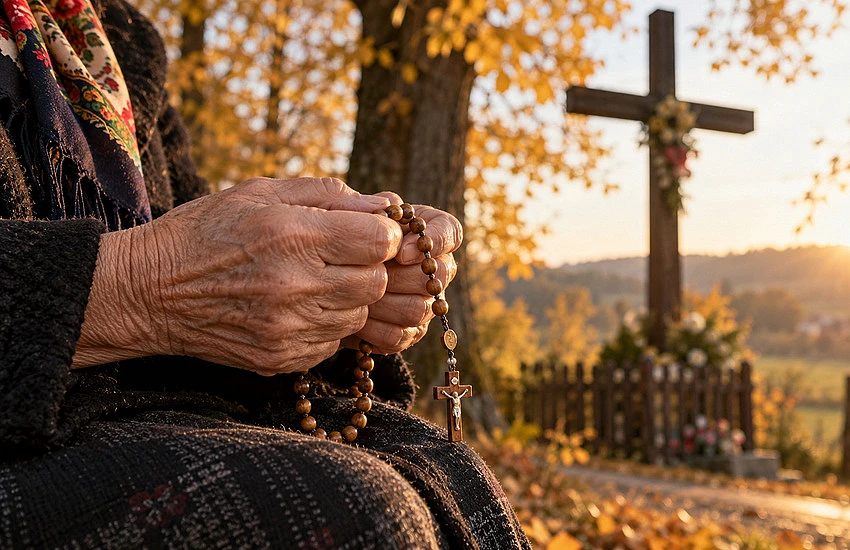
One of the most widespread customs is to place rosary beads in the folded hands of the deceased. Often they are the person’s own beads – the ones carried in a pocket for decades, held during Mass, worn smooth by use. Families choose them with care and sometimes add a holy picture or a medal. It is a simple gesture that says more than many words: the person leaves this life with the prayer they knew best.
Praying for the dead in October
In the last days of October, the intentions of rosary devotions in many parishes turn more and more towards the dead. People remember those who have died during the year, and a few still light candles at roadside crosses – one of the last traces of the old prayer in the open air.
The wooden cross on a new grave
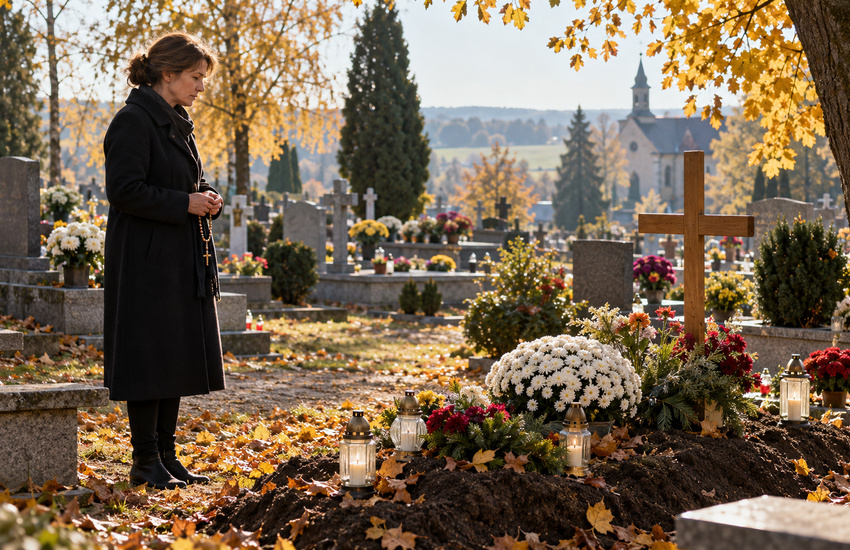
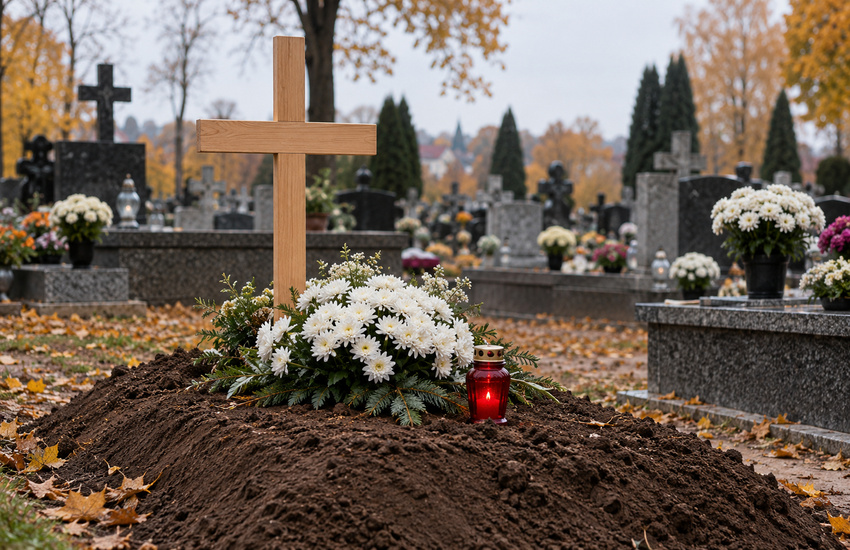
The wayside cross and the grave cross have more in common than it might seem. Both are signs of faith and remembrance, both stand out in the open, exposed to rain, wind and frost. And on a new grave the most familiar marker is still a plain wooden cross.
Why wood comes first
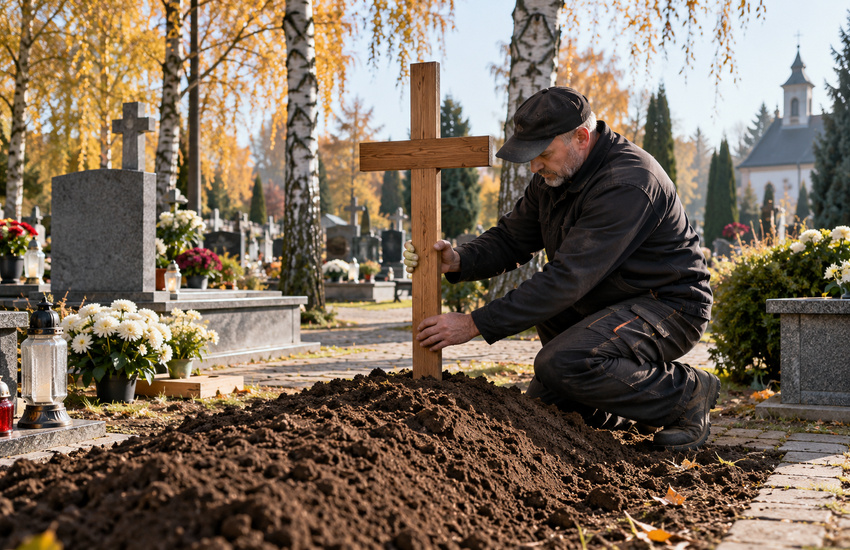
After a burial a permanent headstone cannot be placed straight away. The ground needs time to settle – many cemetery authorities in Britain ask families to wait around six months, and longer in some soils. During that time the grave is usually marked by a temporary wooden cross or marker bearing the name and dates of the deceased. Local rules vary, so it is always worth checking the size of marker your cemetery allows. But the meaning of that first cross goes far beyond the practical. In the first months of grief it is the focus of remembrance: the place where the family lays flowers, lights a candle and says a prayer – often the first place where they feel they can “visit” the person they have lost.
Simplicity with meaning
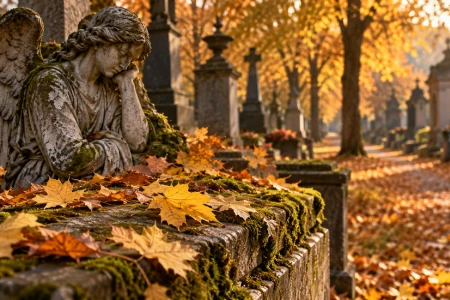
A wooden cross has a humility that grander monuments sometimes lack. It reminds us that everyone is equal in death, and that however elaborate the later memorial, the beginning is always the same. In old country churchyards wooden crosses were often the only marker a grave ever had. Today they are returning as a deliberate choice – in natural burial grounds, on the graves of people who valued simplicity, in places with a special character.
Different crosses for different traditions
Not every grave cross looks the same. The Latin cross, with a single crossbar, is the sign of Catholics and most Protestants. The Orthodox cross has three bars: the top one represents the title board above Christ’s head, the middle one the beam on which his arms were stretched, and the lowest, slanting bar, according to tradition, points upward towards heaven for the good thief and downward for the other. Children’s graves are often marked with smaller, lighter crosses; urn plots with crosses scaled to the smaller grave. For people without religious belief, or for a humanist or civil funeral, a plain post with a name plate and no religious symbol is the natural choice. You can read more about the meaning of graveside symbols in our article Cemetery Symbolism – What Gravestones Really Say.
What to write on the plate
The plate on a wooden cross is the first epitaph. It usually carries the full name, date of birth and date of death. Many families add a short line – “Rest in peace”, “Forever in our hearts”, “Eternal rest grant unto him, O Lord” – or a phrase that meant something to the person who has died. For a married woman the maiden name is often added with the word “née”. The plate should be legible from a few steps away and resistant to damp, because for the first months it will be the one thing that tells passers-by who lies there.
Funeral crosses in our range
In our funeral crosses category you will find markers for different traditions and different kinds of grave – from the classic Latin cross to Orthodox, children’s and urn crosses and a secular post. What they have in common is careful workmanship and resistance to autumn and winter weather.
Gravestone Cross No. 2 – a timeless ceremonial cross
Gravestone Cross No. 2 is an elegant ceremonial cross 189 cm high and 68 cm wide. It is carefully cut and finished, and its timeless shape suits both traditional churchyards and modern cemeteries. Protective coatings make it resistant to rain, snow and UV light – which matters a great deal from October onwards, when a grave cross stands through the hardest months of the year. It is available in light, medium and dark brown and is made in Poland.
Gravestone Cross No. 5 – classic pine
Gravestone Cross No. 5 is a traditional cross in quality pine, 185 cm high and around 60 cm wide. The wood is treated against moisture, UV light and other weather, and it too comes in three shades of brown, with other colours available on request. It is a plain, honest cross that captures the character of old country churchyards and wayside crosses. Like any timber outdoors, it benefits from regular care.
Crosses for every tradition and grave
For Orthodox families we offer an Orthodox Cross with its characteristic three bars. A child’s grave can be marked with a Child’s Gravestone Cross, and an urn plot with an Urn Cross sized for the smaller grave – useful also in cemeteries where ashes are interred rather than placed in a columbarium, a choice we discuss in Columbarium or Urn Grave?. For non-religious funerals there is a Secular pole. Every family can choose a marker that reflects the beliefs of the person they have lost.
Not only for funeral directors
Wooden crosses are useful well beyond the funeral home. Parishes and cemetery managers need them for new sections and for graves cared for by the community. Volunteer groups, scouts and local history societies who restore neglected war graves and forgotten burial grounds often replace long-rotted markers with new crosses – one of the finest examples of autumn care for memory. Museums and heritage sites recreating historic churchyards use them in displays, and theatre and film crews use them on set. And families who want to mark the place where someone died suddenly can set up a dignified cross that will last through autumn rain and winter frost.
October care for crosses and graves
October is also the month when many people visit cemeteries to tidy family graves before the darker days. It is a good time to look after wooden crosses too – on graves and by the roadside.
Caring for a wooden grave cross
Timber, however well protected, needs attention. In autumn it is worth checking that the cross is still upright and firm, because the soil on a new grave settles and heavy rain can wash it away. Brush off leaves, moss and dust with a soft brush and, if needed, refresh the surface with a wood preservative. Wipe the name plate with a damp cloth. Avoid harsh chemicals, which can damage the protective coating.
Looking after wayside crosses and grottoes
Many wayside crosses no longer have regular keepers. The people who raised them have died and their families have moved away. Increasingly, restoration falls to local committees, tidy towns groups, parishes and councils. Statues are repainted, rotten timbers replaced, flowers planted and benches put in place. Thanks to that work, although communal prayer at the wayside has almost vanished, the crosses and grottoes remain a well-kept part of the landscape. October, the month of the old evening devotions, is a natural time to check their condition and plan repairs.
FAQ – rosary, wayside crosses and grave crosses
Why is October the month of the rosary?
The tradition goes back to the battle of Lepanto on 7 October 1571, after which Pope Pius V established the feast of Our Lady of Victory, later renamed Our Lady of the Rosary. Pope Leo XIII dedicated the whole of October to the rosary in his encyclical Supremi apostolatus officio of 1 September 1883.
Is praying the rosary at wayside crosses still a living tradition?
In the past, especially in rural Ireland, neighbours gathered at grottoes and roadside crosses for the rosary in October and for May devotions. Today October devotions take place almost entirely in churches, and the rosary at the wayside is rare. The crosses and grottoes themselves, many built for the Marian Year of 1954, still stand and are looked after by local communities.
What are Mass rocks?
Mass rocks are stones in remote places used as altars when Catholic worship was restricted under the Penal Laws in Ireland. Mass was celebrated at them in secret, and many are still remembered locally, sometimes with occasional open-air Masses.
What happened to the wooden crosses from First World War graves?
Most soldiers were first buried under temporary wooden battlefield crosses. When the Imperial War Graves Commission replaced them with standard headstones, many original crosses were sent home to families and ended up in churches and churchyards. Cheltenham opened a museum dedicated to them in 2024.
Why is a wooden cross placed on a new grave?
A permanent headstone can only be installed once the ground has settled – many cemeteries ask families to wait about six months. Until then the grave is marked by a temporary wooden cross with a name plate. Check your cemetery’s rules on the size of temporary markers.
Which marker suits an Orthodox or non-religious funeral?
For an Orthodox burial the appropriate marker is the Orthodox cross with three bars, the lowest one slanting. For a non-religious or civil funeral, a secular post – a plain marker with a name plate and no religious symbol – is the usual choice.
How large are wooden grave crosses?
Gravestone Cross No. 2 is 189 cm high and 68 cm wide, and Gravestone Cross No. 5 in pine is 185 cm high and around 60 cm wide. Both come in light, medium and dark brown. Children’s and urn crosses are smaller – but always check what size your cemetery permits for temporary markers.
Finally – the October rosary and the sign that remains
October in the old Irish and British Catholic tradition was a time of prayer in the open air – at crossroads grottoes, at holy wells, beside crosses on the edge of the village. That custom has almost disappeared, but the crosses and shrines have stayed, and they still remind anyone travelling our roads of the people who once gathered there. October is also the month when thoughts turn towards the dead and families go to tidy the graves of those they love. The cross – by the road and on the grave – connects those two experiences. It is a sign of faith, memory and hope that has stood in our landscape for more than a thousand years.
If you are looking for a dignified cross for the grave of someone close, or to restore a place of remembrance, explore our funeral crosses and take a look at Gravestone Cross No. 2 and Gravestone Cross No. 5. A simple wooden sign can say more than the grandest monument.