Table of Contents
- Why Gravestones Speak in Pictures
- Symbols of Mortality – A Lesson in Stone on the Fragility of Life
- Symbols of Hope and Resurrection
- The Garden of the Dead – Plant Symbolism
- Animals on Gravestones – Guardians and Guides of the Soul
- Figures, Hands and Gestures
- The Cross – The Oldest and Most Universal Sign of Hope
- Graves of the Youngest – A Separate Alphabet of Tenderness
- Farewells Without Religious Symbols – Secular Symbolism
- How to Read a Cemetery on Your Walk – A Practical Guide
- Frequently Asked Questions
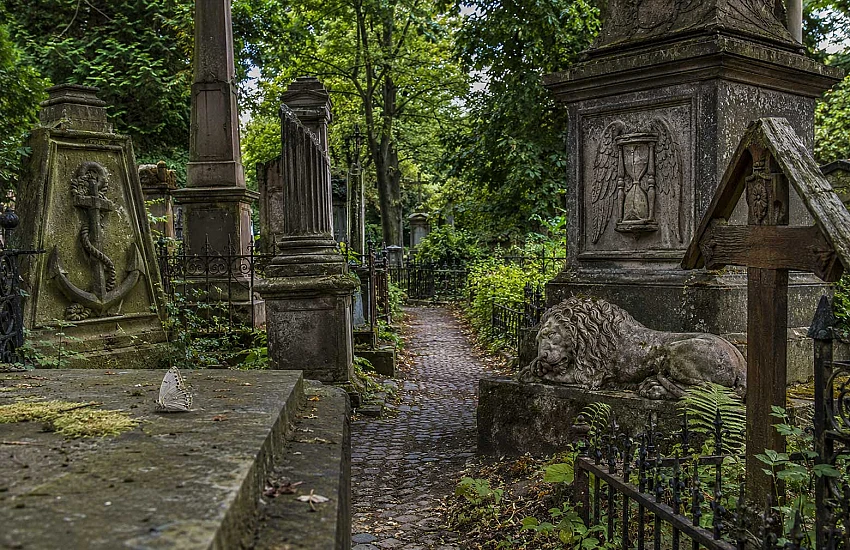
A historic cemetery is one of the few places where the past speaks to us directly – not from the pages of a textbook or the glass of a museum case, but from stone, cast iron and timber, right beside us. Slow your pace along the older avenues and you will notice that almost every gravestone is holding a quiet conversation. A broken column, an anchor wound with rope, a winged hourglass, a butterfly alighting on a slab, a lion drowsing at the foot of a monument – these are not decorative flourishes. They are words set into material, fragments of a language that cemeteries have spoken for centuries.
For hundreds of years, stonemasons, sculptors and iron-founders drew on an established vocabulary of signs, legible regardless of borders or denomination. In an age when much of society could not read, an image carved in stone said more than an inscription ever could. An angel pointing heavenward, a severed flower, a pair of clasped hands – each conveyed information about the deceased, their faith, the hopes of those left behind, and the way they wished to be remembered.
This guide is an invitation to walk attentively. It shows how to read cemetery symbolism and what gravestones really say once we learn to recognise their signs. After reading it, an old cemetery will cease to be merely a place of quiet reflection and become a book you can browse, path by path, headstone by headstone.
Why Gravestones Speak in Pictures
Funerary art – everything to do with the form of the grave and the monument – developed alongside culture, religion and fashion. It reached its golden age in the eighteenth and nineteenth centuries, when burials moved out of crowded churchyards and city centres into the sweeping, park-like grounds of the new garden cemeteries. Highgate and Kensal Green in London, Glasnevin in Dublin, Père Lachaise in Paris, Green-Wood in Brooklyn and Mount Auburn near Boston were conceived not only as places of interment but as landscaped gardens for the living to wander. It was then that the gravestone became not merely a marker of burial but a work meant to move, to instruct and to endure.
At the root of this tradition lies the idea of memento mori – "remember that you must die". The purpose was never the macabre; it was a reminder that life is fragile and worth living well. From this spirit came the skulls, hourglasses and extinguished torches that today are sometimes misread as grim, when in fact they were philosophical reflections on transience. The opposite pole was hope: resurrection, eternal life, reunion. Hence the anchors, butterflies, rising suns and the countless crosses.
The symbol had one further virtue – it was universal. A mourner in London, Vienna, Paris or Dublin understood the same alphabet of signs, though they spoke different languages. That is why a walk through an old cemetery in almost any corner of the Western world resembles reading an international picture-script, one whose rules no one formally taught us, yet which we can still decipher. The Victorians in particular turned this language into a fine art, layering meaning upon meaning until a single monument could tell an entire story to anyone who paused to look.
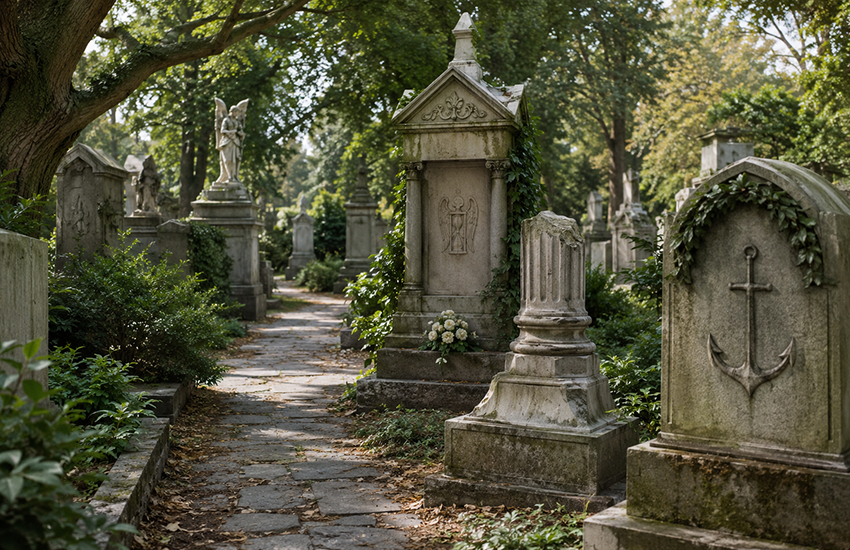
Symbols of Mortality – A Lesson in Stone on the Fragility of Life
The first group of symbols speaks plainly of the impermanence of human life. These are not signs meant to frighten but ones that invite reflection on the passing of time. On the oldest gravestones they form a kind of canon of contemplation, repeated by generations of masons.
The Hourglass – Time That Has Run Out
The hourglass is one of the most common and eloquent signs on older gravestones. It depicts time slipping away, unstoppable – sand runs from the upper chamber to the lower, and when it stops, so does life. Often the hourglass is given wings: one feathered like a bird's, the other membranous like a bat's, underscoring that time flies both by day and by night, never pausing for a moment. The phrase tempus fugit, "time flees", captures exactly the mood these carvings were meant to evoke.
An inverted hourglass carries a subtler message. It suggests that although earthly time has run out for the deceased, in eternity it begins to flow anew. Come upon this sign on a slab and it is worth pausing longer, for it speaks at once of fragility and of the hope of continuance beyond the boundary of death.
The Broken Column – A Life Cut Short
Since antiquity the column has symbolised strength, support and order. When a broken column appears on a gravestone – snapped off partway up its shaft – the meaning reverses dramatically: it becomes an image of a life cut short, ended before it could be completed. Such a monument was most often raised for those who died young or in their prime, full of plans and hopes they were never granted the chance to fulfil.
The broken column is also a sign of a family's loss – of the pillar on which a household rested. Sometimes a wreath lies at its base, or a weeping figure leans against it, reinforcing the note of grief. It is one of those symbols that need no inscription: the shape alone tells the story of something meant to last, severed all at once.
The Inverted and Extinguished Torch – A Flame That Dies
The torch in funerary art plays a game with the fire of life. Turned flame-downward, inverted, it speaks of death, of an existence snuffed out. Yet here lies a beautiful nuance: if the flame still burns despite being inverted, it means life continues – in another form, in eternity, in the memory of loved ones. Only a torch entirely extinguished becomes a sign of the final end.
The symbol descends from antiquity, where the inverted torch was placed on sarcophagi as an expression of belief in the immortality of the soul. On European and American cemeteries alike it appears especially on graves from the turn of the eighteenth and nineteenth centuries, in the company of classical motifs – wreaths, urns and garlands.
The Scythe, the Skull and the Winged Memento
The most literal signs of mortality are those that summon death outright. The scythe recalls the image of death as a reaper who cuts down life like ripened grain. The skull, sometimes with crossed bones, is the classic memento mori familiar from old engravings, chapels and headstones, reminding us of the common fate of all the living. On early New England headstones especially, the death's-head was carved again and again as a stark meditation on mortality.
Particularly moving is the motif of the winged skull, popular above all in the funerary art of earlier centuries. The wings attached to the skull are not meant to terrify – on the contrary, they speak of the soul rising upward, of flight beyond the earthly. It is proof that even the sternest signs in a cemetery conceal hope within them, and not merely dread. Over time the grim death's-head often softened into a winged cherub's face, charting a gentle shift in how communities imagined the fate of the soul.
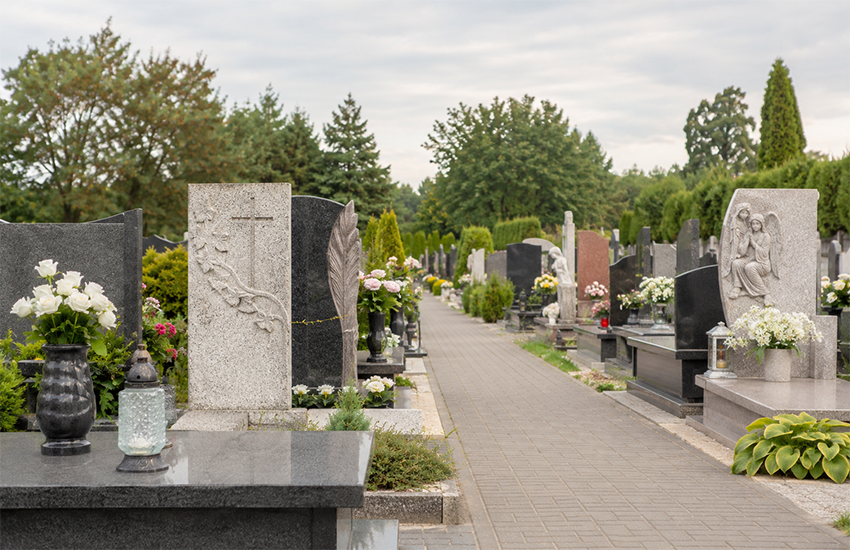
Symbols of Hope and Resurrection
The other side of the cemetery alphabet is filled with symbols of hope. If the hourglass and the column speak of fragility, then the anchor, the butterfly and the rising sun answer them with a message of continuance, transformation and new beginnings. Together they create a balance in which reflection stands beside consolation.
The Anchor – Hope That Holds Fast
The anchor is among the oldest Christian symbols, older even than the widespread use of the cross. In the catacombs of the first communities it already signified the hope and faith that hold a person fast, like a ship on a stormy sea. Its shape is not accidentally reminiscent of a cross – for early Christians it allowed faith to be professed discreetly, in times of persecution.
On gravestones the anchor has kept this double meaning. On the one hand it speaks of unshakeable hope for salvation and eternal life; on the other, it can be a sign of a profession, a sailor, or a person bound to the sea. An anchor entwined with rope, or joined to a cross, underscores that faith is a support which does not fail even in the face of death. In coastal churchyards from Cornwall to New England, the anchor often marks the graves of those who made their living on the water.
The Butterfly – The Soul Transformed
Few symbols convey the idea of resurrection as beautifully as the butterfly. Its life passes through three stages: the caterpillar, the still and silent chrysalis, and at last the winged insect capable of flight. In this metamorphosis people of earlier ages saw an image of the human condition – earthly life, a death resembling the sleep of the chrysalis, and a soul that rises free and transformed.
A butterfly on a gravestone is therefore a sign of hope and release, delicate yet remarkably eloquent. It appears often on the graves of children and the young, underscoring the fragility and beauty of a life cut short. Its presence changes the tone of a monument – it brings lightness where gravity would otherwise reign.
The Phoenix, the Circle and the Rising Sun
Among the signs of rebirth, the phoenix holds a place of honour – the mythical bird that burns itself away only to rise from the ashes. On a gravestone it symbolises resurrection and the triumph of life over death, the hope that an ending is also a beginning. A kindred meaning belongs to the circle or ring, a shape without beginning or end, expressing eternity and unbroken continuance.
The rising sun, often shown above the line of the horizon with rays fanning outward, speaks of a new dawn after the night of death, of hope for resurrection and renewal. These three signs share a single message: death is not an end but a passage towards something that begins anew.
The Garden of the Dead – Plant Symbolism
The world of plants is perhaps the richest chapter of the cemetery alphabet. Leaves, flowers and branches spring from the stone at almost every turn, and each species carries its own meaning. This is no accident – nature, with its cycle of dying back and returning to life, has always been humanity's closest metaphor for its own fate. The Victorian "language of flowers" gave this symbolism a further refinement, assigning a sentiment to each bloom.
Ivy and the Wreath – Memory That Never Fades
Ivy, evergreen and stubbornly persistent even through winter, became a sign of faithful memory, attachment and immortality. It winds around trunks, crosses and columns, suggesting that the bond linking the living to the dead does not perish. Its habit of clinging to a wall is read as a symbol of fidelity that endures beyond death.
The wreath, known already in antiquity as a sign of victory and glory, means on a gravestone a triumph over death and eternal remembrance. Woven into a ring, it joins the symbolism of the circle – it has neither beginning nor end. It often intertwines with laurel, oak leaves or flowers, and each of these elements adds its own shade of meaning.
Lily, Rose and Forget-Me-Not
The lily, white and slender, is the classic symbol of purity and innocence, which is why it appears so often on the graves of children, young women and those whose lives were meant to be remembered as unblemished. It is also a Marian attribute, which further strengthens its religious resonance.
The rose unites love and transience. In full bloom it speaks of affection and beauty, but a rose with a broken stem or a drooping head becomes a sign of a life cut short, especially a young one. The forget-me-not, small and unassuming, carries the most literal message of all – by its very name it pleads: do not forget. It is the flower of memory, a tender gesture left in stone.
Willow, Oak and Palm
The weeping willow, with its drooping branches, is one of the most legible signs of mourning and sorrow. Its silhouette seems to bow over the grave in a gesture of lamentation, which is why it was so readily placed on nineteenth-century slabs and remains a fixture of Victorian and colonial-era headstones alike. At the same time the willow, which regrows even after being cut back, holds within it a note of hope for renewal.
The oak is the willow's opposite – it speaks of strength, endurance, faith and a long, well-lived life. Oak leaves and acorns adorned the graves of those valued for their character and steadfastness. The palm, in turn, reaches back to early Christian tradition, where it was a sign of victory over death and of martyrdom. A palm branch on a gravestone is a triumphant message of spiritual victory and eternal reward.
Poppy and Wheat
The poppy, from which sleep-inducing substances were drawn, naturally became a symbol of sleep – and, in the cemetery context, of eternal rest. Its presence on a slab speaks of the peaceful sleep of the deceased and of solace after the toils of life. It is a gentle, almost soothing sign amid the gravity of the necropolis, and in the twentieth century it took on a further association with remembrance of the war dead.
Ears of wheat carry a richer meaning. On the one hand they allude to the harvest of life – the ripe crop gathered in at the proper time, which can be a consolation on the graves of the elderly. On the other, in Christian tradition wheat is linked to resurrection and the Eucharist, to the grain that dies in order to bring forth new life. Ripe ears therefore often stand as a sign of a life fulfilled and a hope of renewal.
Animals on Gravestones – Guardians and Guides of the Soul
The cemetery bestiary is a fascinating story in its own right. Animals carved in stone act as guardians, guides and emblems of the virtues attributed to the deceased. Some of them rank among the most majestic elements of old funerary sculpture.
The Sleeping Lion – Strength at Rest
The lion drowsing at the foot of a monument is one of the most majestic of cemetery signs. This is not a beast defeated but one at rest – strength that has settled, vigilance that endures even in sleep. The sleeping lion guards the grave and the memory of the deceased, and at the same time speaks of their courage, dignity and force of character.
The symbol was placed with particular readiness on the graves of soldiers, commanders and the brave, as well as on memorials to the fallen. The lion is also a guardian of the entrances to tombs and mausoleums, where it plays the part of a silent sentinel. Its presence lends a monument a gravity and monumentality difficult to find in other signs.
The Dove and the Lamb
The dove is above all a symbol of the soul and of peace. Flying upward, it signifies the soul ascending to heaven; with an olive branch in its beak it summons peace and reconciliation; and as a sign of the Holy Spirit it introduces a religious dimension. A dove at rest on a gravestone speaks of the peace the deceased has attained after death.
The lamb, gentle and defenceless, is a sign of innocence and purity, which is why it appears most often on the graves of children. In Christian tradition it also points to the Lamb of God, that is, to Christ himself, linking the innocence of the deceased with the hope of salvation. It is one of the most tender symbols to be found in any cemetery.
The Serpent, the Pelican and the Dog
The serpent swallowing its own tail to form a ring is the ancient ouroboros – a sign of eternity and of the endless cycle of life and death. In this form there is nothing sinister about it; on the contrary, it speaks of continuance without end. Other depictions of the serpent, however, may point to sin and the temptations of the earthly world.
The pelican, which according to old legend fed its young with its own blood, became a symbol of sacrifice and self-giving love, and in a religious reading of Christ himself. The dog, faithful companion of humankind, signifies on a gravestone fidelity, devotion and watchfulness, sometimes enduring beyond the boundary of death. These less obvious signs enrich the cemetery bestiary with further layers of meaning.
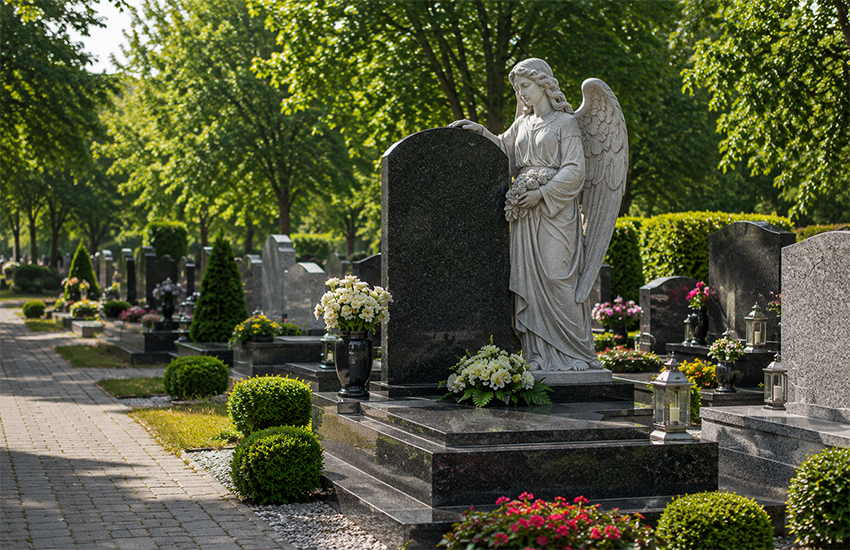
Figures, Hands and Gestures
Alongside plants and animals, human figures and single gestures speak from gravestones too. It is these that give old funerary sculpture its deepest charge of emotion, for they tell of relationships, faith and farewell in a manner that is almost direct.
Angels – Messengers Between Worlds
The angel is perhaps the most recognisable figure in funerary art. As a messenger between the world of the living and eternity, it guides souls, guards the grave and consoles those left behind. Its precise meaning depends on gesture and posture: an angel pointing to heaven directs the thoughts towards salvation, an angel with a trumpet heralds resurrection and the Last Judgement, and an angel bowed in weeping, its face hidden in its hands, is the very embodiment of grief.
A special place belongs to the motif of the guardian angel watching over the one at rest, and to the child-angels, delicate putti, placed on the graves of the youngest. Angelic sculptures, often full of grace and executed with immense craftsmanship, rank among the most precious works in historic cemeteries. The "Angel of Grief", a weeping figure draped over a tomb, became so admired in the late nineteenth century that it was copied in cemeteries across the world.
The Language of Hands
Hands carved in stone are a separate and remarkably eloquent language. Two clasped in a handshake may signify a farewell – the last gesture of parting – or, in another reading, the hope of meeting again on the other side. Sometimes one cuff is a woman's and the other a man's, indicating a marital bond severed by death.
A hand pointing upward with its finger directs the gaze towards heaven and speaks of the soul making its way there. A blessing hand recalls the priestly gesture and God's protection, while hands folded in prayer express piety and trust. Even a small gesture hewn into a slab can convey a whole story of relationship, faith and farewell.
Mourners and Draped Urns
Figures of mourners – women sunk in grief, leaning against a monument or an urn – are among the most affecting motifs of cemetery sculpture. They embody sorrow and lamentation, and their emotive poses lend a monument a human, almost theatrical dimension. They descend from the ancient tradition of mourning and flourished in the art of the nineteenth century.
The urn, in itself a sign of death and of ashes, is often veiled with a stone drapery. This cloth symbolises the veil between the world of the living and the dead, a boundary that the eye cannot cross. The draped urn is a classic element of gravestones in the antique style, uniting gravity with elegance.
The Cross – The Oldest and Most Universal Sign of Hope
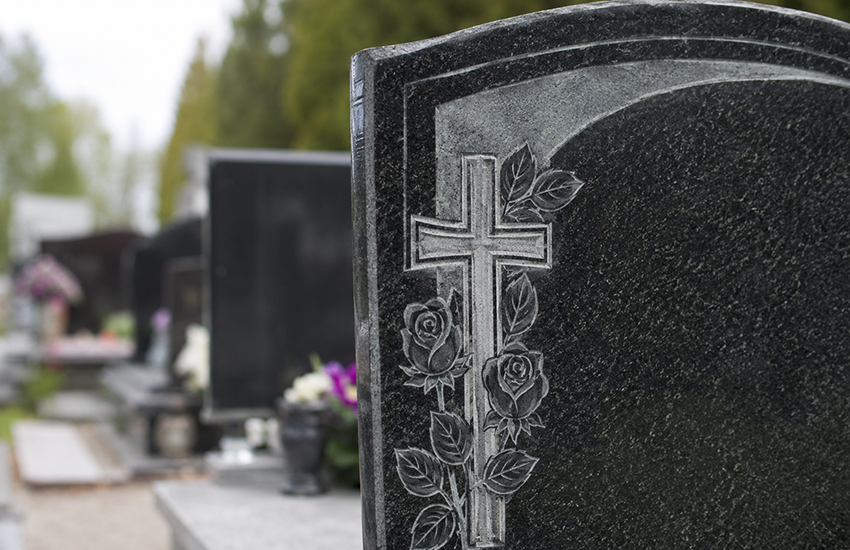
Amid all the wealth of cemetery symbols, the cross remains the most important and the most frequently encountered. For Christians it is above all a symbol of salvation, of the Passion and Resurrection of Christ, and at the same time of the hope of eternal life. Its form, however, can vary greatly, and each variant carries its own meaning and tradition.
Types of Crosses and Their Meaning
The most widespread is the Latin cross, with its elongated lower arm, simple and legible. The Celtic cross, in which a ring binds the arms, unites the symbolism of the cross with the idea of eternity and is often a mark of attachment to tradition; it stands in countless churchyards across Ireland, Scotland and Wales. The Orthodox cross, with its additional bars including the slanted footrest below, points to the Eastern Christian tradition. There are also crosses with arms ending in trefoils or flowers, which soften the austere form and introduce further meanings – the Trinity among them.
In funeral practice the cross also serves as the first, temporary marker on a fresh grave, before a monument of durable material is set in place. Its form and quality of workmanship are far from trivial here, for it is this marker that represents the memory of the deceased and the appearance of the plot through the first months.
An example of a carefully made marker of this kind is the Gravestone Cross No. 4 available in the funeraryaccessories.com range. It is crafted from first-class pine wood, which ensures durability and a refined appearance, while its finish of mirror-polished stainless steel plate gives it an elegant, contemporary character. The cross comes in three shades – light, medium and dark brown – so that it can readily be matched to the surroundings and the style of the plot. At 60 by 185 centimetres it forms a clear, dignified accent, and the option of customisation allows it to be adapted to individual needs. Weather-resistant protection means it keeps its appearance for a long time, which matters especially for a marker exposed to the elements. The pine, drawn from certified sources, also answers the growing wish for materials produced with care for the environment.
Graves of the Youngest – A Separate Alphabet of Tenderness
The burials of children have their own, exceptionally delicate language of signs. There is no harder loss, and funerary art has for centuries sought to answer it with symbols full of tenderness and hope. It is here that we most often meet the lamb, a sign of innocence, and the white lily, which speaks of the purity of a life cut short.
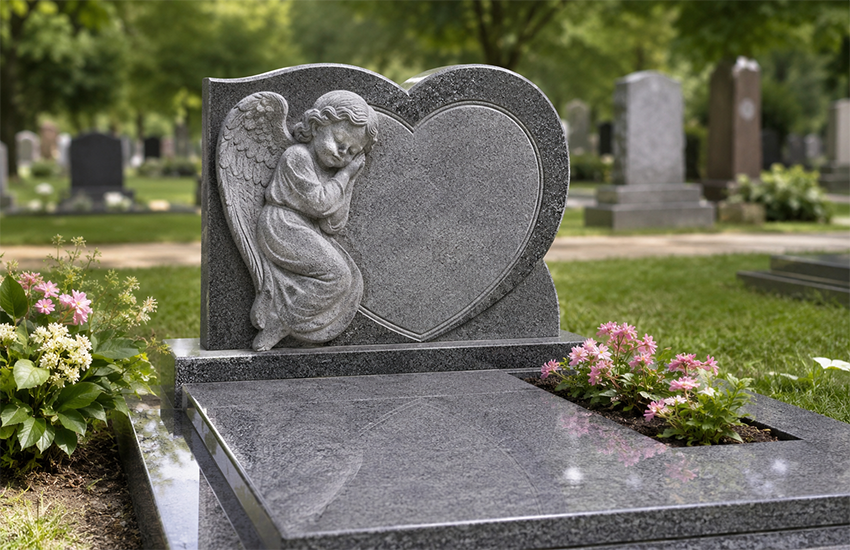
Characteristic of children's graves is the motif of the broken bud or the severed flower – an image of an existence that never had the chance to bloom. There appear too the figures of sleeping children, presenting death as a peaceful slumber, and cherubs keeping watch over a tiny grave. Sometimes one encounters even more moving signs, such as a pair of abandoned shoes, symbolising the child's absence, or an empty cradle. All these motifs share one quality – a gentleness meant to soothe grief and to recall the innocence of the departed. White is the leading colour here, for it has long been associated with purity and innocence, which is why markers intended for children's graves are so often kept in that shade.
This tradition is answered by the Child's Gravestone Cross from the funeraryaccessories.com range. Made of pine wood and kept in white, its colour underscores the innocence and purity that have accompanied children's symbolism for centuries. The cross is adorned with a subtle icon that lends it an individual, warm character, and its careful finish ensures durability despite exposure to the weather. At 50 by 160 centimetres it is a little smaller than the crosses intended for adults, making it a form suited to a child's grave. It is a marker modest yet full of tenderness – precisely what the farewell of the youngest requires.
Farewells Without Religious Symbols – Secular Symbolism
Not every farewell draws on religious symbols. More and more often families choose secular ceremonies, in which the cross and traditional denominational signs give way to universal forms. It is a choice arising from the convictions of the deceased or their loved ones, and funerary art has long been able to meet it. In Britain and Ireland this shift has gone hand in hand with the rise of woodland and natural burial grounds, where markers are deliberately understated and religious emblems are often set aside altogether.
Secular symbolism rests on signs legible regardless of denomination. These may be motifs of nature – a tree, a leaf, the sun – appealing to the cycle of life, or wholly abstract forms built on pure, minimalist composition. The common denominator is gravity and dignity expressed without a religious context, through simplicity of shape and nobility of material. It is an approach in which less means more, and the workmanship itself becomes a form of respect.
In funeral practice, the role of a temporary marker on a secular grave is most often filled by a pole – a slender, upright form free of denominational signs. Its task is to mark the place of burial with dignity, before the final monument is set in place, while maintaining a stance of neutrality. Such a solution is the Secular pole available at funeraryaccessories.com. It is made of high-quality wood and given a simple sail-like form, modern and subtle, free of religious reference, which makes it an ideal marker for secular ceremonies. An elegant accent is provided by a stainless steel strip with a mirrored finish, while a satin lacquer protects the wood against moisture and sunlight. The pole comes in four colour variations – light brown pine, medium brown teak, dark brown wenge and ebony black – so that it can be matched to individual preferences. Its minimalist silhouette proves that a dignified farewell need not rely on elaborate symbolism, and that gravity can be expressed through purity of form alone.
How to Read a Cemetery on Your Walk – A Practical Guide
Reading the signs of a cemetery is a skill acquired on the move. It is best to begin in the oldest part of the grounds, for there the symbolism is richest and most varied. Look not only at the inscriptions but above all at the form – the shape of the monument, the ornament, the plants and figures, which often say more than any carved text.
The first clue is often context. A broken column or a severed flower usually points to an early death, a lamb and a white lily to a child's grave, an anchor to hope or a bond with the sea. The second is gesture: the direction in which a hand or an angel points, the set of a torch or the turn of an hourglass can change the meaning entirely. The third, finally, is period, since certain symbols – draped urns or winged skulls among them – belong to particular eras in the history of funerary art. In a British churchyard, the lychgate at the entrance and the oldest, most weathered stones nearest the church tower are a good place to start.
A walk taken with this awareness turns into a fascinating read. An old cemetery ceases to be merely a place of reflection on transience and becomes an open book in which the hopes, faith and memory of successive generations are inscribed. The more attentively we look, the more clearly we hear what the gravestones really say.
Frequently Asked Questions
What does a broken column mean on a grave?
A broken column symbolises a life cut short before it could be fully completed. Since antiquity the column has stood for strength and support, so its snapping was read as an image of sudden loss, most often of a person who died young or in their prime. It can also signify the loss of a family's pillar – the one on whom the household rested.
Why is a lamb carved on children's graves?
The lamb is a sign of innocence and purity, qualities traditionally associated with children. In Christian tradition it also points to the Lamb of God, that is, to Christ, linking the innocence of the deceased with the hope of salvation. It is one of the most tender symbols in funerary art, which is why it appears so often on the graves of the youngest, alongside the white lily and the motif of the sleeping child.
What does an anchor symbolise on a headstone?
The anchor is above all a sign of hope – of the faith that holds a person fast, like a ship on a stormy sea. It is among the oldest Christian symbols, and its cross-like shape allowed early believers to profess their faith discreetly. On gravestones it can also mark a profession connected with the sea, especially when it is entwined with rope, which is why it is common in coastal churchyards.
Is the hourglass on a grave connected with time running out?
Yes – the hourglass depicts unstoppable, passing time, the running sand that stands for the transience of life. Given wings, it emphasises that time flees without cease, by day and by night alike; inverted, it carries the hope of a new span of existence in eternity. It is one of the central motifs of the memento mori tradition, meant to prompt reflection rather than fear.
What kind of grave marker should be chosen for a secular funeral?
For a secular ceremony, a marker free of denominational signs works best – for instance a pole of simple, minimalist form. Solutions of this kind, such as a secular pole, rely on purity of shape and nobility of material rather than religious reference. They mark the place of burial with dignity while maintaining a stance of neutrality, which suits both civil ceremonies and natural burial grounds.
What does a butterfly carved on a gravestone mean?
The butterfly is a symbol of resurrection and of the soul set free. Its metamorphosis – from caterpillar, through the still chrysalis, to an insect capable of flight – was for people of earlier ages an image of the human condition, in which death resembles the sleep of the chrysalis and the soul rises free and transformed. It is a delicate sign of hope, met especially on the graves of children and the young.
Where should I begin when reading the symbols in an old cemetery?
It is best to start in the oldest part of the cemetery, where the symbolism is richest, and to pay attention not only to inscriptions but above all to the form of the monument. It helps to read the signs in three steps: through context (a severed flower, for example, as an early death), gesture (the direction of a pointing hand or the turn of a torch) and the period from which the gravestone dates. With time, recognising the symbols becomes second nature, and a walk turns into a fascinating read.