Table of Contents
- The Urn Is Older Than the Coffin – A Forgotten Prehistory of Urn Burial
- Decline and Revival – Why Cremation Vanished from Europe for Fifteen Centuries
- The Modern Columbarium – A Vertical Architecture of Memory
- The Urn Grave in the Earth – Continuity of the Oldest Cemetery Tradition
- The Gravity Urn Lowering Device – Technology in the Service of Dignity
- Columbarium or Urn Grave – How Families Decide
- Urn Burial Around the World – Curiosities That Shift the Perspective
- The Future of Memory – Why Both Forms Will Grow Together
- Frequently Asked Questions About Urn Burial
A quiet transformation is reshaping the landscape of remembrance across Europe's cemeteries. Alongside traditional earth graves and family monuments, slender walls with rows of small niches are appearing, together with intimate urn plots – smaller than conventional graves, yet tended with the same devotion. Urn burial, still regarded as a rarity just a few decades ago in many countries, has become a fully established and widely accepted form of farewell. In the United Kingdom, cremation now precedes roughly four out of five funerals, and across much of continental Europe the proportion has long passed the halfway mark. What follows the cremation, however, remains an open question – and it is precisely there that families face one of the most meaningful choices in the entire arrangement.
Behind the statistics lies something far deeper than a change of custom. The choice between a niche in a columbarium and an urn grave in the earth is, in essence, a choice between two philosophies of memory – one rooted in ancient architecture, the other growing directly out of centuries of churchyard and cemetery tradition. Both forms have their own history, their own symbolism and their own distinct ceremonial rhythm. Both also place new demands on funeral directors, because a farewell with an urn, however intimate, deserves the same care and dignity as a traditional burial. In this article we walk both paths of urn burial – from cinerary urns three thousand years old to modern committals in which the urn descends into the grave with an almost liturgical smoothness.
The Urn Is Older Than the Coffin – A Forgotten Prehistory of Urn Burial
Contrary to popular belief, urn burial is neither a modern novelty nor a foreign import to European soil. It is a form older than coffin burial – by whole millennia. Long before Christianity shaped the familiar image of the churchyard with its earthen mounds and headstones, the peoples of Bronze Age Europe bade farewell to their dead through cremation for centuries on end.
Urnfields and Barrows – Three Thousand Years of Tradition
The most eloquent testimony to this tradition survives in the vast urnfield cemeteries of the late Bronze Age, which spread across the continent from around 1300 BC, and in the British Isles in the cremation cemeteries of the Deverel–Rimbury tradition, where coarse bucket-shaped urns holding cremated remains were buried in flat cemeteries and beneath barrows across southern England. Archaeologists have uncovered hundreds of such sites, some containing dozens of vessels grouped together – entire communities of the dead resting side by side in fired clay. On the continent, the so-called face urns of the early Iron Age went a step further: potters modelled the features of the deceased onto the vessel itself, sometimes adding bronze earrings or scenes from life incised on the body of the urn – a portrait in clay created three thousand years before the age of photography.
What is remarkable is that even then, something resembling today's choice of burial form already existed. Some urns were placed in individual burial pits, while others were grouped in stone cists holding the vessels of an entire family. It is hard to imagine a more striking prototype of the modern alternative: an urn grave in the earth, or a shared, architecturally defined space for many urns together.
Columbarium – How a Dovecote Became a House of the Dead
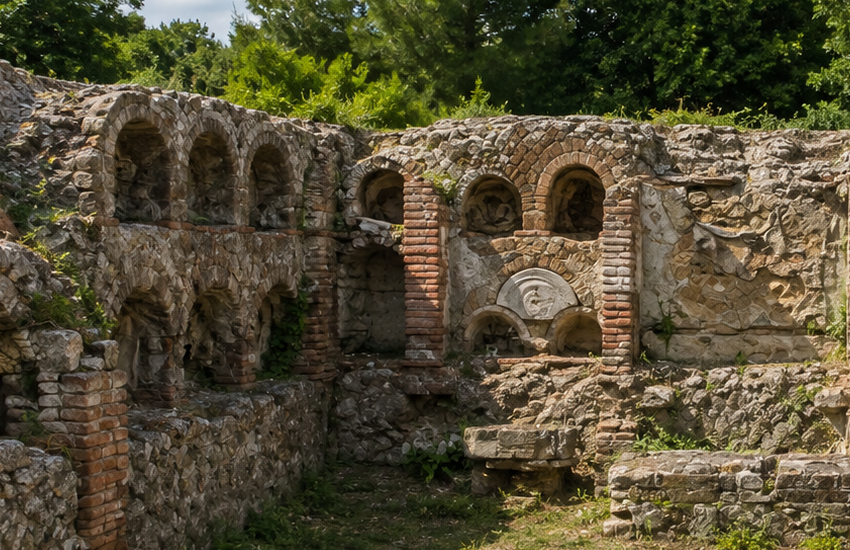
The word columbarium itself has an origin that surprises almost everyone who hears it for the first time. The Latin columbarium literally meant a dovecote – from columba, the dove. The Romans, masters of practical architecture, noticed the striking resemblance between the wall of a dovecote with its rows of nesting holes and the wall of a tomb with its rows of niches for urns. The name stuck, and it has endured for two thousand years.
Roman columbaria were a thoroughly democratic solution. In a city where land was expensive and cremation commonplace, underground chambers with hundreds of niches made it possible to bury freedmen, craftsmen and members of funeral societies with dignity – people who could never have afforded a grand tomb along the Via Appia. To this day, visitors to Rome can explore the columbarium of Pomponius Hylas or the monumental columbaria near the Porta Maggiore, where name plaques, wall paintings and small urns have survived for two millennia. The dove, incidentally, completed a symbolic circle: in Christianity it became the sign of the Holy Spirit and of peace, so that the walls of today's columbaria – often decorated with precisely this motif – unknowingly return to the very root of their own name.
Decline and Revival – Why Cremation Vanished from Europe for Fifteen Centuries
The spread of Christianity brought the twilight of cremation. Belief in the resurrection of the body made inhumation the norm, and Charlemagne's Paderborn capitulary of 785 outlawed cremation outright, on pain of death. For the following centuries the urn all but disappeared from the European funerary landscape, and the churchyard with its grave mound, cross and headstone became the only imaginable resting place.
The revival began only in the Victorian era, and Britain played a leading role in it. In 1658 the physician and essayist Sir Thomas Browne had already devoted one of the most celebrated meditations in the English language – Hydriotaphia, or Urn Burial – to a group of ancient burial urns unearthed in a Norfolk field, pondering the ways in which humanity entrusts its dead to eternity. Two centuries later, in 1874, Queen Victoria's surgeon Sir Henry Thompson founded the Cremation Society of England, arguing on grounds of public health and urban overcrowding. The first crematorium at Woking followed, the pioneering cremation of Jeannette Pickersgill took place there in 1885, and the Cremation Act of 1902 gave the practice a firm legal footing. When Golders Green Crematorium opened in London that same year, it included something that would shape remembrance culture across the anglophone world: magnificent columbaria in Romanesque style, where the ashes of figures such as Sigmund Freud still rest in urns on open shelves – a Victorian echo of ancient Rome.
The Catholic Church, long reserved towards the practice, formally permitted cremation in 1963, provided it is not chosen for reasons contrary to the faith. The instruction Ad resurgendum cum Christo of 2016 clarified that ashes should rest in a sacred or dedicated place – a cemetery, a grave or a columbarium – rather than on a mantelpiece or scattered at will. Paradoxically, that document strengthened the position of both forms of burial described here: the columbarium niche and the urn grave in the earth both answer the call for a lasting, communal place of memory. In Britain, meanwhile, the growth of woodland burial grounds and gardens of remembrance since the 1990s has broadened the picture further – yet the interred urn, whether in a wall or in the ground, remains the form that gives mourners a fixed point to return to.
The Modern Columbarium – A Vertical Architecture of Memory
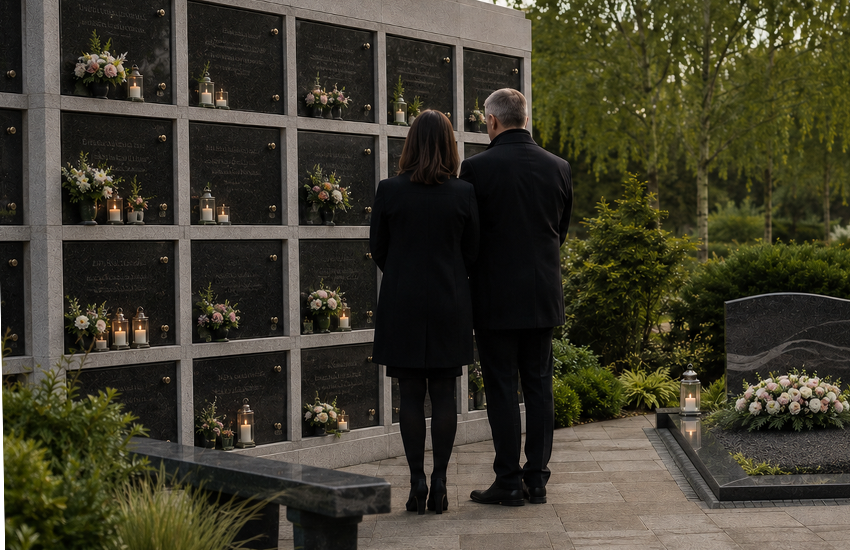
A contemporary columbarium is usually a freestanding wall, or a group of walls, with rows of niches, each holding one or several urns and sealed with a stone tablet bearing an inscription. Some columbaria are plain and austere, resembling minimalist sculpture; others are elaborate compositions – semicircular courtyards, pergolas, walls framing fountains or memorial gardens. From the cloistered columbaria of historic crematoria to the sleek granite walls of new municipal cemeteries, they have become a natural element of the landscape of remembrance.
The strength of the columbarium lies in its communal character. Each niche is personal – it bears a name, dates, sometimes a photograph or a lasting light – yet it stands shoulder to shoulder with dozens of others, forming a kind of stone book of memory which visitors read with their eyes as they walk along the wall. The experience is closer to a chapel than to the open field of a cemetery: concentrated, quiet, vertical. It is no coincidence that columbaria are so often placed against cemetery walls or beside chapels, enclosing the space of the necropolis like the cloisters of a monastery.
How the Ceremony of Niche Interment Unfolds
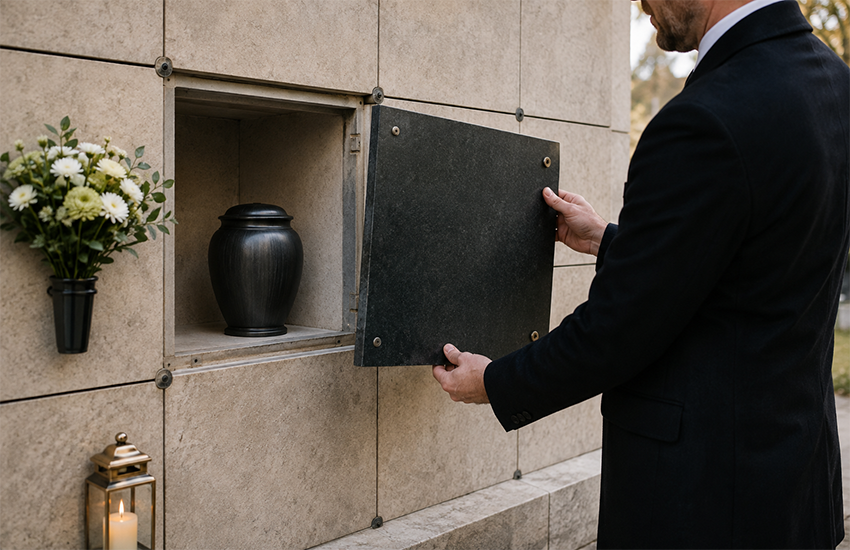
A columbarium ceremony has its own distinct, intimate rhythm. The urn is carried in procession – often by the funeral director, a celebrant or a member of the family – and then placed into the open niche, usually at eye level or slightly above. After the prayers or the secular words of farewell, the niche is closed with its tablet, which cemetery staff fix permanently in place. There is no lowering into the earth here, no sound of soil falling onto a lid – instead there is the gesture of placement, closer to the laying of a relic within an altar than to a traditional burial. Many families value this form precisely for its restraint, and for the assurance that the place of memory will remain cared for regardless of weather and the passing years.
The Symbolism of the Memorial Wall
In European culture the wall has always been a bearer of memory – from Roman epitaph tablets set into the floors of basilicas to modern walls of national remembrance. The columbarium belongs to this lineage: the vertical arrangement of niches calls to mind the shelves of a library, in which every tablet is the spine of a closed book of a single life. At a time when urban cemetery space is shrinking and families are scattered across the world, this compact, vertical form of memory proves not only practical but quietly moving.
The Urn Grave in the Earth – Continuity of the Oldest Cemetery Tradition
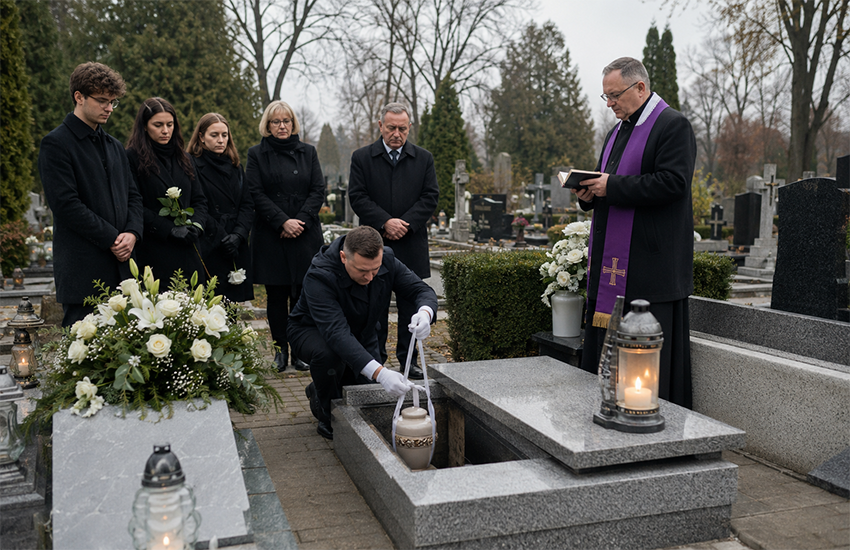
The second path of urn burial leads where funerals have always led – into the ground. An urn grave is a dedicated plot, usually smaller than a traditional grave, in which the urn is committed directly to the earth or placed within a small chamber. Above it stands a headstone; flowers are planted, candles and lanterns are lit – everything exactly as at a coffin grave, only on a more intimate scale. In British practice this form is known as the interment of ashes, and it takes place both in designated ashes sections of cemeteries and in traditional churchyards, where cremated remains may often be interred even when the churchyard has long been closed to full burials.
For many families it is precisely this continuity that proves decisive. The urn grave preserves all the gestures which cemetery culture has refined over the centuries: bending over the grave, tidying it before an anniversary or a holiday, planting heather in autumn and pansies in spring. Earth remains earth – with all its symbolism of return, rootedness and the cycle of nature, expressed in the words earth to earth, ashes to ashes, dust to dust, which at an urn burial ring with particular literalness.
Interring an Urn in an Existing Family Grave
A separate and profoundly important thread is the possibility of interring an urn in an existing family grave. The small dimensions of the urn mean it can be committed to a grave where loved ones already rest – frequently without disturbing earlier burials. For families this means something beyond price: spouses can rest together even when the grave no longer has room for a coffin, and multigenerational plots can continue to serve as the family's house of memory. On older cemeteries, where new earth plots are scarce, such interments today account for a substantial share of all urn ceremonies.
The Moment of Lowering – The Heart of the Graveside Ceremony
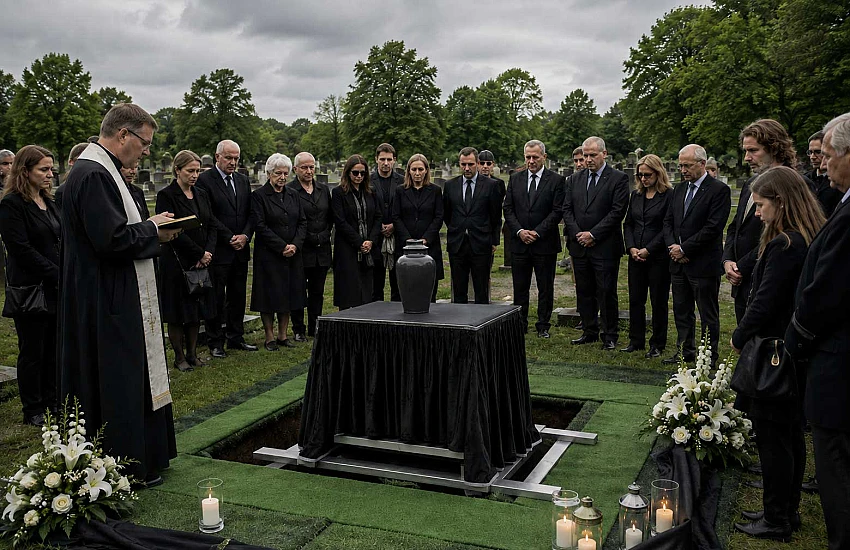
The ceremony at an urn grave has its culminating point, the exact analogue of the lowering of the coffin at a traditional funeral. It is the moment when the urn passes out of the mourners' sight and comes to rest in the earth. No other moment of the funeral commands such attention – conversations fall silent, movement ceases, every gaze converges on a single spot. And no other moment is so technically demanding.
The urn, though incomparably lighter than a coffin, presents the funeral team with challenges of its own. The opening of an urn grave is small, its depth often exceeds a metre, and lowering the urn by hand – on webbing straps, on cords, or by leaning over the excavation – can be awkward and strips the moment of its gravity. An urn may tilt, rotate, or settle with a perceptible jolt, and for a family whose eyes are fixed on this one scene, such a lapse is painful. It is exactly for this reason that professionally conducted ceremonies increasingly rely on a device designed specifically for the task.
The Gravity Urn Lowering Device – Technology in the Service of Dignity
Just as the funeral lowering device transformed the committal of coffins, the gravity urn lowering device is transforming the final act of the urn ceremony. It is a device with a task that appears simple yet is in fact fundamental: to ensure that the urn descends into the grave smoothly, vertically and silently, without haste and without hands reaching over the open grave. Devices of this kind are available through the casket and urn lowering equipment range at funeraryaccessories.com, alongside the full lowering systems used for coffins.
The heart of the device is its gravitational mechanism. The urn rests on a platform which, once released, descends steadily and evenly under the controlled force of gravity – no motor, no cables, no risk of a power failure at the crucial moment. When the platform reaches the bottom, it gently leaves the urn in place and is withdrawn. The whole process lasts exactly as long as it should: long enough for the mourners to accompany the urn with their eyes on its final journey, and smoothly enough that nothing disturbs the concentration of the moment.
The gravitational movement carries an almost symbolic dimension of its own. It is the earth itself – its pull – that guides the urn to its resting place. In a ceremony whose very meaning is the return to the earth, it is hard to imagine a more fitting technical principle.
A Complete Set for Every Ceremony
The device manufactured by Prima-Tech is supplied as a complete set, ready for work in any cemetery conditions. The set comprises the gravity lowering unit itself, a folding stand, an aluminium base plate and a transport cover. The working aperture accommodates the great majority of urns available on the market, from classic brass and ceramic designs to ornamental models with a wider base. The folding stand collapses to a slim, flat profile for transport, so the whole set fits easily into a ceremonial vehicle alongside the rest of the equipment. The aluminium base allows the device to be set up with full stability either on the stand above an earth grave or directly on the slab of a family tomb – a detail of real significance when urns are interred in existing graves.
The aesthetic finish is provided by a decorative drape, available in several colours – from classic black and burgundy to violet, green and navy – so the device can be matched to the character of the ceremony, the colour of the urn, or liturgical custom. The drape conceals the structure, ensuring that only what matters remains in the mourners' field of vision: the urn and its calm, dignified descent. For full specifications and availability, the team at funeraryaccessories.com can advise on the current configuration of the set.
What the Device Means for a Professional Funeral Home
In the funeral profession, reputation is built over years and lost in a single awkward moment. An urn lowering device removes chance from the ceremony: staff no longer balance over the excavation, the urn cannot tilt or drop abruptly, and the conducting director gains complete control over the pacing of the funeral's most important scene. A robust frame and aluminium components guarantee years of service under intensive use, and rapid set-up means preparing the graveside station takes only moments. There is a practical dimension too: manual handling over an open grave is precisely the kind of task that safe-working guidance urges employers to engineer out wherever possible, and a controlled mechanical descent does exactly that. As the share of urn burials continues to grow, such equipment ceases to be an accessory and becomes a benchmark of standards – just as the lowering device has at coffin ceremonies. A funeral home that can conduct an urn burial with the same choreographic care as a traditional funeral sends families an unmistakable message: here, every form of farewell is treated with equal solemnity.
Columbarium or Urn Grave – How Families Decide
There is no single correct answer to the question of which form of urn burial is the better one – and that very diversity is its value. Families who choose the columbarium most often point to the permanence and elegance of the memorial wall, the ease of visiting in any weather, and the reassurance that the niche will remain immaculate even when relatives live far away. The columbarium is also a natural choice in cities where new earth plots are hard to come by, and for those drawn to its restrained, architectural form.
The urn grave, in turn, speaks with the voice of tradition: the ability to tend a grave, to plant flowers, to preserve all the gestures that have accompanied cemetery visits for generations. Of enormous importance, too, is the possibility of interment in a family grave – for many families the deciding argument, since it unites a modern form of burial with faithfulness to the family's place of memory. Finally, the earth grave offers space for an individual headstone, and thus for a personal, sculptural expression of remembrance which the uniform tablets of a columbarium by their nature cannot provide.
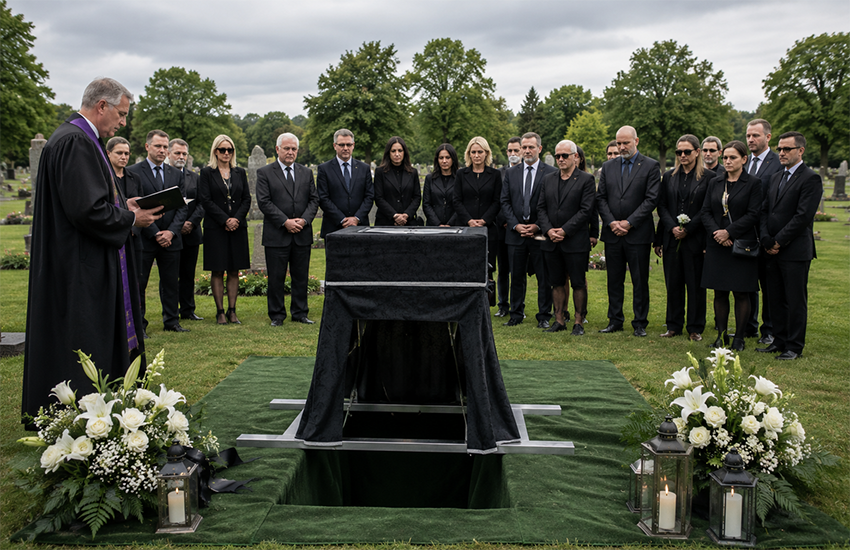
It is worth stressing what both forms share: they require the funeral home to conduct the urn ceremony as a rite of full standing, not an abbreviated version of a traditional funeral. The intimacy of urn burial does not mean lesser rank – on the contrary, at a smaller scale every gesture is more visible and every stumble more keenly felt. Hence the growing importance of specialised equipment, from urn carriers and ceremonial stands to gravity lowering devices.
Urn Burial Around the World – Curiosities That Shift the Perspective
A glance beyond Europe shows how differently the world's cultures resolve the dilemma of columbarium or earth. In Japan, where cremation encompasses virtually all burials, automated columbaria have emerged – in Tokyo's Ruriden temple, hundreds of crystal Buddha figures light up when a visitor presents a card, indicating the niche of a loved one, while in other facilities urns are delivered to a visiting station by a system resembling an automated warehouse. Hong Kong, wrestling with an extreme shortage of space, designs multi-storey columbarium towers – veritable vertical cities of the dead.
At the opposite pole stand traditions that emphasise the bond between ashes and the living earth. In the German-speaking countries, forest cemeteries have won wide popularity: biodegradable urns are committed at the roots of trees, and the tree becomes a living headstone. In Italy, the cradle of the Roman columbarium, urns frequently rest in family chapels and wall recesses, continuing a two-thousand-year tradition of burial within masonry. In the Czech Republic – statistically the most cremation-inclined nation in Europe – all forms coexist at once: columbaria, urn graves and scattering meadows. And in Britain, the garden of remembrance at the local crematorium, with its rose beds and memorial plaques, has become for many families a third way – though even there, a quiet trend back towards interred ashes with a permanent marker has been visible for years, driven by the simple human need for a place to stand beside.
The Future of Memory – Why Both Forms Will Grow Together
Everything suggests that the share of urn burials will continue to rise, and with it the demand for both columbarium niches and urn plots. Cemetery authorities are already planning new memorial walls and setting aside ashes sections, while funeral homes are extending their urn ceremony provision to a full setting: dedicated catafalques, stands, drapery and devices for the dignified committal of the urn. This is not a fashion but a lasting cultural shift, comparable to the one that moved funerals from private homes to cemetery chapels a century ago.
Within this shift lies a beautiful paradox. Urn burial, so often perceived as a mark of modernity, is in truth a return to the oldest form of farewell known on European soil. The columbarium wall has a Roman dovecote of the dead for an ancestor, and the urn grave descends from Bronze Age urnfields three thousand years old. The history of burial has come full circle – and the task of today's funeral profession is to see that this circle closes with dignity: smoothly, calmly and without disturbance, exactly as a well-designed gravity device lowers an urn.
Frequently Asked Questions About Urn Burial
What is the difference between placing an urn in a columbarium and burying it in an urn grave?
In a columbarium the urn is placed in an above-ground niche sealed with a stone tablet bearing an inscription, whereas an urn grave is an earth plot in which the urn rests in the ground beneath a headstone. The columbarium offers a permanent, architectural form of memory requiring no upkeep, while the urn grave preserves full continuity with cemetery tradition – a tended plot, flowers and memorial lights. The ceremonies differ in their final gesture: placement into the niche, or the lowering of the urn into the depth of the earth.
Can an urn be interred in an existing family grave?
Yes, and it is one of the most frequently chosen forms of urn burial. The small size of the urn allows it to be committed to a grave where loved ones already rest – whether an earth grave or a built family tomb – usually without disturbing earlier burials. In many places cremated remains may even be interred in churchyards long closed to full burials. The detailed conditions are set by the cemetery or church authority, so the formalities are best entrusted to the funeral home arranging the ceremony.
Where does the word columbarium come from?
The name derives from the Latin columbarium, meaning a dovecote – from columba, the dove. The ancient Romans noticed the resemblance between a dovecote wall with its rows of nesting holes and a tomb with rows of urn niches, and the name has survived to this day. Roman columbaria were underground chambers holding up to hundreds of urns, serving above all the less affluent inhabitants of the Eternal City.
How is the urn lowered into the grave during the ceremony?
After the final words of farewell, the urn is positioned over the opening of the grave, most often on a dedicated device – an urn lowering device. With a gravity model, the platform bearing the urn descends steadily and evenly under the controlled force of gravity, and on reaching the bottom it gently leaves the urn in place. The entire process is silent and requires no hands over the open grave, allowing the mourners to accompany the urn on its final journey in undisturbed concentration.
How does a gravity urn lowering device differ from an electric one?
A gravity device operates without a motor or power supply – the downward movement of the platform results from the controlled force of gravity, which eliminates the risk of an electrical failure during the ceremony and simplifies operation. The device is lighter, quicker to set up and entirely independent of a power source, which matters on plots far from the cemetery's infrastructure. Electric lowering devices are used chiefly for coffins, where they work under far greater loads.
Will an urn lowering device accommodate every urn?
The working aperture of the gravity urn lowering device offered through Prima-Tech accommodates the great majority of urns on the market – classic brass and ceramic models as well as ornamental designs with a wider base. The aluminium base plate allows the device to be set up on its stand above an earth grave or directly on the slab of a family tomb, so it serves equally well when urns are interred in existing graves. For current specifications, the team at funeraryaccessories.com will gladly advise.
Is urn burial compatible with religious tradition?
Yes. The Catholic Church has permitted cremation since 1963, and its 2016 instruction clarified that ashes should rest in a dedicated place – a cemetery, a grave or a columbarium. The Church of England likewise permits both the interment of ashes in churchyards and their placement in columbaria, and a full funeral liturgy may accompany either form. It is worth remembering, too, that urn burial has a pedigree older than coffin burial itself – reaching back to the urnfields and barrow cemeteries of the Bronze Age, three thousand years ago.