Table of Contents
- A funeral trolley is not a detail – it is the backbone of a smooth ceremony
- Four questions to answer before you buy
- Criterion one – what surface will the trolley travel over?
- Criterion two – load capacity, coffin weight and the safety margin
- Criterion three – folding and transport in a service vehicle
- Criterion four – budget and total cost of ownership
- All trolley types compared in one place
- The scissor trolley – elegance and precision on hard floors
- The off-road coffin cart – proven equipment for difficult ground
- The premium off-road cart – Polish engineering for demanding use
- The hydraulic trolley – the quiet backbone of every mortuary
- Combining trolley types into one coherent workflow
- Frequently asked questions
A funeral trolley belongs to that category of equipment that does its job best when nobody notices it at all. When the coffin glides through the chapel smoothly and silently, when the wheels don't sink into the mud on a rain-soaked cemetery path, and when staff don't have to strain or improvise at the last moment, everything looks natural and effortless. That apparent simplicity, however, is the result of a sound purchasing decision made much earlier – often years before any particular funeral.
The wrong choice of trolley takes its revenge in exactly the opposite way: at the least convenient moment, in front of mourners, precisely when a smooth ceremony matters most. The market today offers at least four distinct constructions that we loosely call a "funeral trolley," even though in practice they answer entirely different needs. The scissor trolley, the off-road coffin cart, its stronger Polish-made premium variant and the hydraulic trolley are not versions of the same product, but four separate tools. This guide sets out their differences and translates them into a concrete purchasing decision built on four practical criteria: the type of surface, load capacity, the ability to fold down for a service vehicle, and budget together with the total cost of ownership.
A funeral trolley is not a detail – it is the backbone of a smooth ceremony
In the day-to-day work of a funeral home, the trolley is often treated as an obvious background prop, a piece of secondary equipment that only comes to mind when it fails. Yet it is precisely the trolley that carries – literally and figuratively – the most demanding part of every ceremony. Its construction determines whether moving the coffin from the hearse to the chapel, and then to the grave, unfolds with proper dignity or turns into a struggle visible to everyone present.
The stakes are threefold. The first is the dignity of the ceremony – the family will remember every stumble, every sudden jolt, every moment when the equipment refused to cooperate. The second is staff safety: a coffin holding the body of an adult frequently weighs well over a hundred kilograms, and in the case of heavy oak constructions even twice that, and carrying it by hand over uneven ground is a direct route to spine and joint injuries. The third is economics – a well-chosen trolley serves for years, while a poorly chosen one generates the cost of repairs, downtime and premature replacement.
Choosing a trolley is therefore an investment decision, not the purchase of an accessory. It is worth approaching it methodically, starting with the question that settles the most: where, and over what, will this trolley travel.
Four questions to answer before you buy
Before comparing specific models, it is worth working through four questions that bring the whole decision into focus. What surface will the trolley move over most often – the smooth floor of a chapel, or a soft, rutted cemetery path? How heavy are the coffins it will need to carry, and what safety margin do you want to keep? Does the trolley have to fold down compactly enough to fit into a service vehicle and a modest storeroom? And finally – what budget are you setting aside, taking into account not only the price but the total cost of ownership over several years? The answers to these four questions point, in practice, to the type of trolley, and often to a specific model.
Criterion one – what surface will the trolley travel over?
This is the most important of the four criteria, because it determines the entire running gear of the trolley. One kind of equipment will excel on the polished floor of a crematorium, and a completely different one on the churned, muddy path of a rural cemetery. Trying to use a single trolley everywhere usually ends in a compromise that satisfies in no conditions at all.
Chapel, funeral home and crematorium – the world of hard, even floors
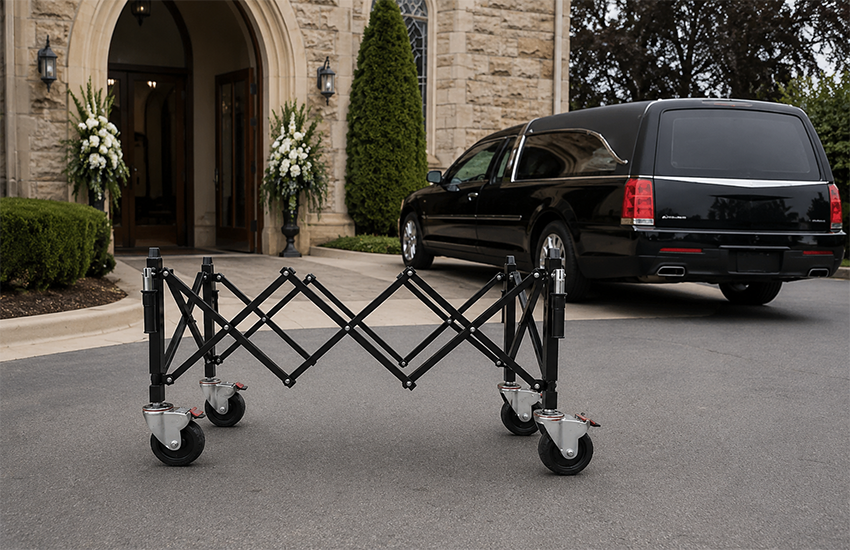
Indoor spaces – chapels, funeral homes, the ceremonial halls of crematoria – are dominated by hard, even, smooth surfaces: porcelain tile, marble, terrazzo, polished concrete. In such conditions, qualities entirely different from grip on mud become decisive. What matters is smoothness of movement, quiet running, aesthetics, and the ability to position the coffin precisely and elegantly. Here the scissor trolley reigns – fitted with a set of smaller, swivel wheels, it offers manoeuvrability in tight passages between rows of chairs and allows gentle, fully controlled handling of the coffin in front of mourners. Its scissor mechanism enables height adjustment, so aligning the trolley with the hearse or catafalque happens effortlessly.
Churchyards, lawn cemeteries and natural burial grounds – soft, uneven ground
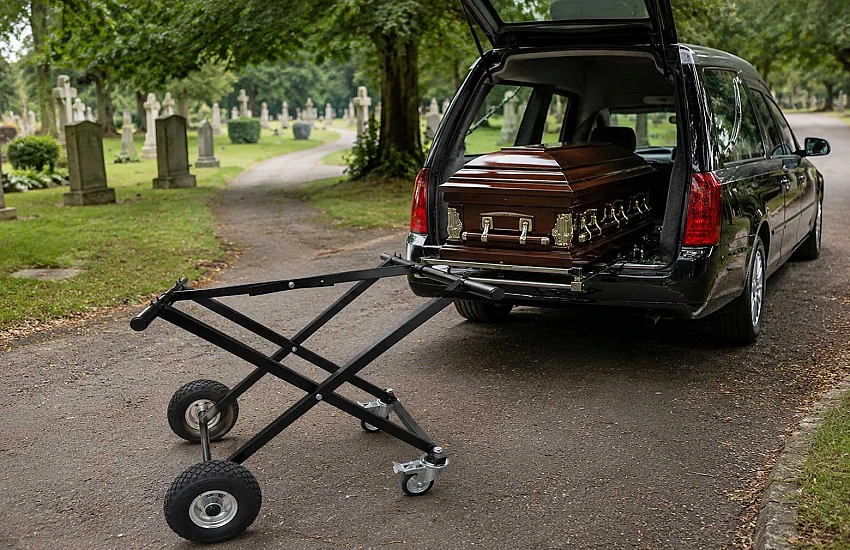
Cemeteries, and older churchyards in particular, place entirely different demands on equipment. Paths are often unsurfaced, leading across slopes, sand, exposed roots and stretches that turn boggy after rain. The small castors of a chapel trolley sink instantly into soft ground or jam on the first stone they meet. In these conditions an off-road cart is essential – with large, thick all-terrain wheels around 26 centimetres in diameter, which spread the load over a greater area and roll over irregularities instead of sinking into them. A solid, thick-walled steel construction together with brakes on the front wheels gives full control of such a cart even on a slope. This is equipment that lets you bring the coffin to the grave smoothly and safely where an ordinary trolley would long since have given up. The rise of woodland and natural burial grounds, where graves sit among trees with no made paths at all, has only made this category more indispensable.
When one trolley isn't enough – a mixed fleet
Many funeral homes serve both ceremonies in modern, fully surfaced premises and burials in difficult, rural cemeteries. In that situation, the search for a single universal trolley is doomed to half-measures from the outset. A more sensible – and, paradoxically, often cheaper – solution is to own two trolleys: a light, elegant scissor model for work in the chapel, and a rugged off-road cart for trips into the field. This division lets each of them work in the conditions it was designed for, which translates into their longevity and into staff comfort. To this is added a third, separate domain – the cold-storage backbone of the facility – which follows its own rules and is covered later in this guide.
Criterion two – load capacity, coffin weight and the safety margin
Load capacity is a parameter on which it is not worth economising or taking risks. A coffin holding the body of an adult is a mass that easily exceeds a hundred kilograms, and in the case of substantial oak constructions with full fittings, for larger individuals, the real load can reach two hundred kilograms and more. Added to this is dynamics – the trolley does not stand still, but negotiates thresholds, kerbs and irregularities, and each such crossing momentarily increases the forces acting on the construction.
This is also where occupational safety law enters the picture. In the United Kingdom, the Manual Handling Operations Regulations 1992, enforced by the HSE, require employers to avoid hazardous manual handling so far as is reasonably practicable, and to reduce the risk of injury where it cannot be avoided; across the European Union, Directive 90/269/EEC sets a parallel framework for the manual handling of loads. In both, the recommended route is the same – using mechanical aids such as trolleys to take the load off the human body. A properly chosen funeral trolley is, in this sense, not merely a convenience but a tool of compliance and injury prevention.
For that reason, a trolley's stated capacity should be treated as a figure to keep a margin below, not a limit to be approached. Trolleys on the market typically offer capacities from 250 to 350 kilograms. A classic scissor trolley with a steel construction will carry as much as 350 kilograms, which makes it a safe choice even for heavier coffins. Off-road carts are designed around a capacity of the order of 300 kilograms – combined with their robust running gear, this gives a safe margin for typical use. The hydraulic trolley, working in the back of house, offers a capacity suited to the safe transfer of a body on its tray.
The practical rule runs as follows: when choosing capacity, start from the heaviest coffin you realistically handle, add a margin for the dynamics of movement, and only then select a model. A trolley working constantly close to its limit wears out faster and loses stability sooner, whereas one with a comfortable capacity reserve will serve considerably longer.
Criterion three – folding and transport in a service vehicle
A funeral trolley spends a surprising amount of its time not in use, but in transit and in storage. It must travel to the place of the ceremony and, afterwards, return to base, most often in the same vehicle that also carries other items of equipment. For that reason, folded dimensions are often as important as working parameters.
Here the differences between types are pronounced. A scissor trolley folds exceptionally compactly – a well-designed model takes up a space of only around 78 by 24 by 24 centimetres when folded, so it fits into practically any boot, leaving room for the rest of the kit. Off-road carts, on account of their larger wheels, are slightly bigger when folded – typically around 27 by 61 by 96 centimetres – but still compact enough to fit without trouble into a standard service vehicle. This is a meaningful advantage, because large wheels usually bring to mind awkward storage, yet a well-designed off-road cart combines all-terrain running with sensible folded dimensions.
A separate category is the hydraulic cold-storage trolley. By design, this is not field equipment – it works in a fixed position, within the mortuary, cold room or facility back of house, and its dimensions are subordinated to working with the cold chamber, not to transport in a vehicle. So if we are looking for a trolley to carry into the field, the hydraulic one is not what we need – and conversely, no folding trolley will replace it for work at the cold chamber.
It is also worth bearing storage space in mind. Funeral homes with modest premises will appreciate models that can be stood upright or slid into a narrow gap when folded. Quick, tool-free folding and unfolding – measured in seconds rather than minutes – has a real effect on the pace of work on every call-out.
Criterion four – budget and total cost of ownership
The purchase price is only one component of the equation, and by no means the most important over the longer term. The real cost of ownership is determined by the durability of the construction, the availability of service and parts, and how long the trolley stays serviceable under intensive use. Equipment that is cheap to buy but made of thin sheet and low-quality components can, within a few seasons, generate repair and downtime costs that exceed the saving made at the moment of purchase.
From a budgetary perspective, the market arranges itself into a clear hierarchy. The most affordable are the basic off-road carts – proven, functional, ideal for funeral homes that need reliable equipment for difficult ground without additional refinements. The middle of the range is occupied by scissor trolleys and premium off-road cemetery carts, offering higher build quality, better components and longer life. On a separate, highest tier sit the specialised hydraulic trolleys, whose price reflects the sophistication of a stainless-steel construction and a hydraulic mechanism.
The origin of the equipment is also a significant factor. Polish, hand-crafted production means not only quality control at every stage, but also genuinely available service and a short response time when needed – a value hard to overstate in an industry where equipment downtime on the day of a ceremony is simply not an option. For funeral homes spreading the investment over time, it is worth adding that professional funeral equipment is often available on lease or instalment terms, which makes it possible to equip the business without a one-off strain on the budget.
All trolley types compared in one place
To make comparison easier, the table below gathers the key features of the four trolley types in one place. Treat it as a quick reference – a detailed discussion of each model follows later in the guide.
A comparison of the funeral trolley types available from funeraryaccessories.com
| Trolley type | Main use | Surface | Capacity | Folded size | Distinguishing feature |
|---|---|---|---|---|---|
| Foldable scissor trolley | Chapel, funeral home, crematorium | Hard, even | up to 350 kg | 78 × 24 × 24 cm | Height adjustment, very compact |
| Off-road coffin cart | Cemeteries with difficult ground | Soft, uneven | up to 300 kg | 27 × 61 × 96 cm | Large 26 cm wheels, brakes, low price |
| Premium off-road cart (New Type) | Demanding ground, intensive use | Soft, uneven | up to 300 kg | 27 × 61 × 96 cm | Polish-made, reinforced running gear |
| Hydraulic trolley with foot pump | Cold room, mortuary, back of house | Back-of-house floor | up to 300 kg | stationary unit | Hydraulic height adjustment, stainless steel |
The table shows clearly that there is no single best trolley – there is the trolley best matched to a particular task. Below, we look at each of them in turn.
The scissor trolley – elegance and precision on hard floors
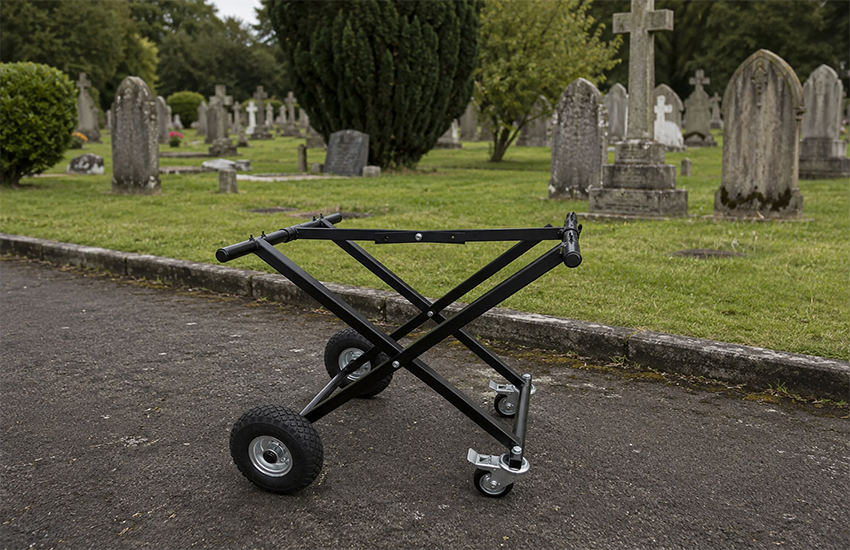
The scissor trolley owes its name to the characteristic mechanism of crossing arms, which works like a concertina: the more the trolley is extended in length, the lower its platform drops, and vice versa. Thanks to this, staff can smoothly adjust the height, matching the level of the coffin to the edge of the hearse, catafalque or platform. This solution is ideal wherever aesthetics and precision matter, and the ground is hard and even.
In the funeraryaccessories.com range, this category is represented by the Foldable Scissor funeral trolley - Black – a solid steel construction in an elegant black finish, created with everyday chapel work in mind. Its greatest asset is the combination of strength and compactness: unfolded it measures 115 by 45 by 64 centimetres, while folded it shrinks to just 78 by 24 by 24 centimetres, so it fits in any boot and takes up minimal space in storage. The steel frame provides a capacity of up to 350 kilograms, a safe reserve even for heavier coffins.
This is a trolley for funeral homes that value ergonomics and discretion during the ceremony. Its construction, resistant to mechanical damage, translates into a long service life, and its small folded dimensions make it a practical choice even as a secondary trolley, accompanying larger off-road equipment. If the main area of work is the surfaced floors of a chapel, funeral home or crematorium, this type of trolley will be the natural first choice.
The off-road coffin cart – proven equipment for difficult ground
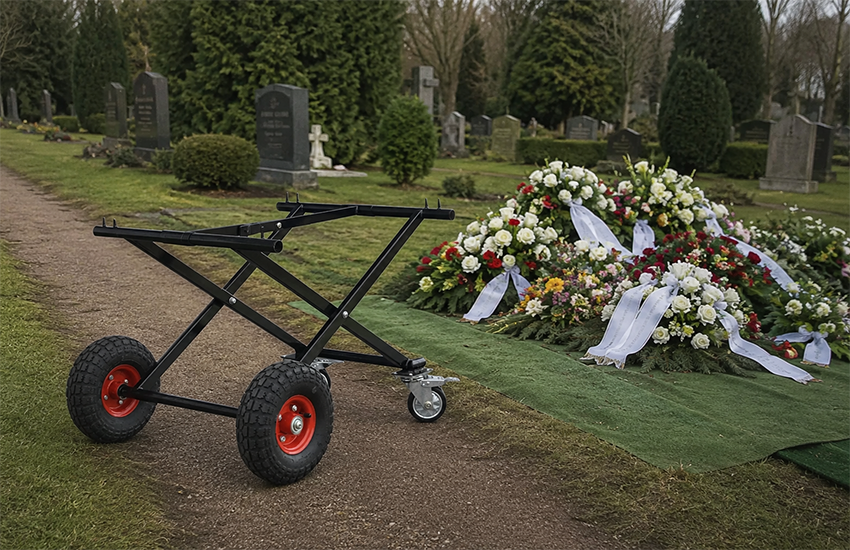
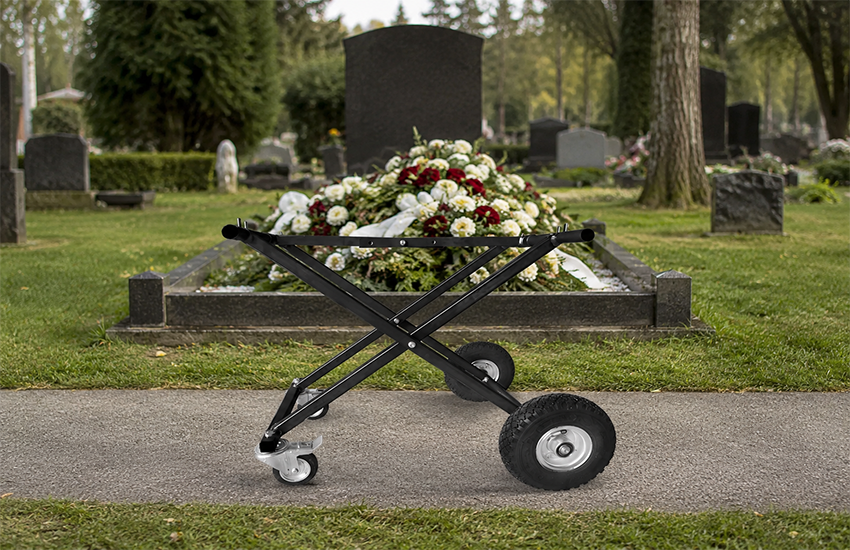
Where the tarmac ends, the world of the off-road cart begins. This type of construction was created to overcome exactly those obstacles that immobilise chapel equipment: mud, grass, gravel, sand, roots and the irregularities of rural and woodland paths. Its heart is a pair of large, thick all-terrain wheels 26 centimetres in diameter, which roll the weight over obstacles instead of sinking into them, and two smaller swivel wheels at the front, responsible for manoeuvrability in narrow passages.
The Off-road coffin cart available from funeraryaccessories.com is the choice for funeral homes looking for a reliable yet affordable solution for difficult ground. Its solid steel construction provides a capacity of up to 300 kilograms at a tare weight of just 16 kilograms, which makes it easy to handle and transport. Brakes mounted on the front wheels give full control during loading, unloading and travel on slopes. Folded, the cart occupies 27 by 61 by 96 centimetres, so it fits without trouble into a service vehicle, and unfolding it takes only a moment.
This is equipment that proves itself in rural churchyards, woodland and natural burial grounds, hillside and military cemeteries – wherever unsurfaced paths and natural obstacles rule out the use of a chapel trolley. For many funeral homes it serves as a sensible entry point into the off-road category: it offers the key running qualities needed in the field without placing an undue burden on the budget.
The premium off-road cart – Polish engineering for demanding use
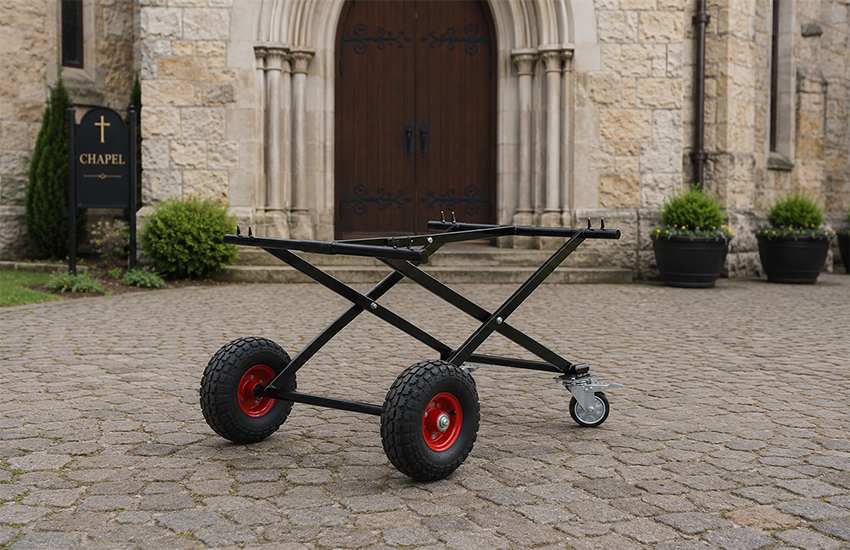
If an off-road cart is to work daily, in the harshest conditions, and for many years, it is worth considering its stronger, refined variant. The Off-road Coffin Cart (New Type) is the premium tier among off-road carts – a construction of Polish, hand-crafted production, known not without reason as the "Mercedes of funeral carts," designed in cooperation with funeral homes that have been testing it in practice for years.
What sets it apart from the basic model is, above all, the refinement of the running gear and the quality of the build. A reinforced, thick-walled steel frame resists corrosion and damage even under extreme use. The large 26-centimetre all-terrain wheels are mounted using a new axle-mounting system with retaining rings, which significantly increases the durability of the whole assembly and ensures the wheels stay firmly seated on the axle even under heavy loads and intensive work. The front swivel wheels are fitted with high-quality bearings guaranteeing quiet, smooth running, and with parking brakes giving full control during loading.
The working parameters remain in line with the lighter variant – a capacity of up to 300 kilograms, a tare weight of 16 kilograms, folded dimensions of 27 by 61 by 96 centimetres – but the difference lies in durability and comfort of work over the long run. This is the choice for funeral homes that accept no compromises and treat the trolley as an investment for years, not equipment for periodic replacement. Its Polish origin also means genuinely available service and the certainty that, should the need arise, the business will not be left with immobilised equipment and no support.
The hydraulic trolley – the quiet backbone of every mortuary
The hydraulic trolley occupies a special place in this comparison, because it answers an entirely different need from the other three constructions. It does not serve to transport the coffin during the ceremony, but to work in the back of house – in the mortuary, cold room and morgue, where moving bodies into and out of cold-storage chambers is a daily routine. It is a back-of-house working tool, invisible to families, yet indispensable to the smooth and safe functioning of the facility.
The Hydraulic trolley with foot pump from funeraryaccessories.com is a professional solution of Polish manufacture, made entirely of stainless steel. This material is crucial here – it provides resistance to moisture and chemical agents and allows easy disinfection, which carries sanitary significance in cold-room and mortuary conditions. The heart of the trolley is a hydraulic lifting system controlled by an intuitive foot pump, which allows the tray height to be smoothly matched to the level of the cold-storage chamber and thereby radically reduces the physical strain on staff.
Safety of work is enhanced by a tray lock preventing the accidental sliding of the body, and by smooth control of the lowering speed, allowing precise manoeuvring. Four swivel wheels, two of them fitted with brakes, provide stability and control even in cramped spaces, while a guiding profile eases entry into the chamber. The unit can also be fully customised – for example, covered entirely in sheet metal, which makes it ideal for crematoria. Its capacity of up to 300 kilograms is matched to working alongside a multi-body mortuary refrigerator. If a facility runs its own cold room or mortuary, then it is precisely this trolley – and not any of the folding models – that it needs in the back of house.
Combining trolley types into one coherent workflow
Reading the descriptions above leads to a conclusion that, for many funeral homes, proves the most important: the four types of trolley do not compete with one another, but complement each other, covering different stages of the same work. A fully equipped funeral home most often uses more than one solution. The scissor trolley handles ceremonies in the chapel and funeral home, the off-road cart or its premium cemetery variant takes over on difficult, rural cemeteries, and the hydraulic trolley works in a fixed position in the cold-storage back of house. Each of them operates in the conditions for which it was designed, which translates into their longevity, staff safety and the smooth organisation of every burial.
When thinking about a trolley, it is worth thinking at once about its surroundings. The aesthetics of the ceremony are completed by a cart drape, or decorative trolley cover, which lends the equipment a dignified, ceremonial character. A full overview of the available constructions can be found in the coffin trolleys category, and funeral homes handling burials in especially demanding conditions can complete their equipment with a casket lowering device. A well-considered set of equipment is not an expense but an investment in the reputation of the business, one that families experience at the most difficult moment of their lives.
The decision to choose a trolley therefore comes down to an honest answer to the four questions from the start of this guide. Once we know the surface, the weight of the coffins, the transport requirements and the budget, the right type – and often the specific model – almost points to itself. And a well-chosen trolley repays the choice for years with what is most valuable in this industry: the peace of mind that, at the decisive moment, the equipment will not let you down.
Frequently asked questions
Is one trolley enough to handle every funeral?
In practice, rarely. If a funeral home serves only ceremonies on the surfaced floors of a chapel or crematorium, a good scissor trolley will suffice. If, however, burials in rural churchyards, woodland or hillside cemeteries are also involved, a single universal trolley will always be a compromise. The best results come from combining a light scissor trolley for chapel work with a rugged off-road cart for trips into the field, and – for facilities with their own cold room – complementing them with a hydraulic trolley for the back of house.
What load capacity should I choose for a funeral trolley?
The starting point should be the heaviest coffin you realistically handle, increased by a margin for the dynamics of travel over irregularities. Coffins holding the body of an adult often exceed a hundred kilograms, and substantial oak constructions can weigh considerably more. Available trolleys offer capacities from 250 to 350 kilograms. A scissor trolley with a steel frame will carry up to 350 kilograms; off-road carts are designed for 300 kilograms. It is never worth choosing a trolley so that it works constantly at the edge of its limit – occupational manual-handling guidance points in the same direction, towards keeping a comfortable margin.
Will an off-road cart work on paved paths?
Yes, large all-terrain wheels travel without difficulty over tarmac, paving or concrete as well. It must be remembered, however, that the off-road cart was designed with difficult ground in mind, so in the elegant interior of a chapel it will not provide the same precision, quiet running and discretion as a scissor trolley, which additionally allows smooth height adjustment. The off-road cart performs superbly in the field, but for representative work in the chapel a scissor construction remains the better choice.
Will every trolley fit in a service vehicle?
Trolleys intended for transport – scissor and off-road – are designed so that, once folded, they fit into a typical service vehicle. A scissor trolley folds exceptionally compactly, to around 78 by 24 by 24 centimetres, and an off-road cart, despite its large wheels, occupies around 27 by 61 by 96 centimetres when folded. The exception is the hydraulic cold-storage trolley, which is a stationary unit and is not intended for carrying in a vehicle – its dimensions are subordinated to working with the cold chamber.
What's the difference between a scissor trolley and a hydraulic trolley?
They are two different tools for two different tasks. A scissor trolley serves to transport the coffin during the ceremony and adjusts its height mechanically, by means of crossing arms working like a concertina. A hydraulic trolley works in the back of house – in the mortuary and cold room – to move bodies into and out of cold-storage chambers, and adjusts its height smoothly by means of a hydraulic system controlled with a foot pump. The first is light and folding; the second is made of stainless steel and stationary. They do not replace one another.
How do I look after a funeral trolley so it lasts for years?
The foundation is regular cleaning after work on difficult ground – removing mud, sand and moisture, which accelerate corrosion and the wear of components. It is worth periodically checking the condition of the wheels, bearings and braking mechanism, and paying attention to the axle mountings. Constructions of powder-coated and stainless steel are resistant to the elements and easy to maintain, but even they last longest when their capacity is not exceeded and they are stored in a dry place. The availability of manufacturer service is an additional guarantee of long operation.
Can a funeral trolley be bought on finance or lease?
Yes, professional funeral equipment is often available in the form of a lease or instalment purchase, which makes it possible to equip a facility without a one-off strain on the budget. This solution is especially useful for the purchase of more expensive constructions, such as hydraulic trolleys or complete equipment sets. The details of the available finance options are best confirmed directly with funeraryaccessories.com before placing an order.