
Table of Contents
- Water at the threshold of life and death
- From hyssop to aspergillum – where the holy water sprinkler came from
- The aspergillum through the year
- Water in the customs of mourning
- When the aspergillum passes from hand to hand
- The water bowl stand – a fixed place for water in the space of farewell
- The funeral sprinkler – a small object, a great gesture
- A set that creates a ritual
- Water that connects generations
- FAQ – frequently asked questions
Some gestures in a funeral are loud and unmistakable – the tolling bell, the hymn, the standards lowered over the coffin. Others are almost silent. A priest lifts the aspergillum, dips it into the water and sprinkles the coffin three times. The drops fall on polished wood, on flowers, sometimes on the hands of those standing closest. Nobody comments, nobody explains – and yet everybody understands.
Behind that small movement lies one of humanity's oldest stories: the story of water that cleanses, protects and carries us across a threshold. The holy water sprinkler and the vessel that holds the water have travelled through the Temple in Jerusalem, Roman altars, medieval monasteries, baroque cathedrals and country cottages, all the way into today's funeral chapels, churches, hospices and homes. In this article we follow that journey – the history, the curiosities and the customs that still give a bowl of water and an aspergillum their place at every important passage of human life.
Water at the threshold of life and death
Why water
Almost every culture that left traces of its rituals gave water a special power. That is no accident. Water is at once the condition of life and a force that can take it away. It washes away dirt, but it also sweeps along whatever falls into the current. For our ancestors it was the natural symbol of a boundary – a river separated worlds, a spring was a meeting place with the sacred, and washing marked the end of one stage and the beginning of the next.
In mythology the border between the living and the dead almost always takes the form of water. The Greeks imagined the Styx and the Acheron, across which Charon ferried the souls of the dead. The Slavs believed that the land of the ancestors lay beyond the water and that the soul had to cross it to reach its new home. Celtic tradition placed the Otherworld on islands in the western sea, reached only by boat. Folk tales across Europe speak of a narrow plank or bridge over a river that the dead must cross. Water was not only a means of purification – it was the road itself.
Traces of this way of thinking survive in many traditions to this day. In Judaism, those leaving a cemetery wash their hands before entering a home, and a vessel of water often stands at the gates of Jewish cemeteries for exactly this purpose. In Japan, mourners at a funeral are sometimes handed a small packet of salt for symbolic purification, and before entering a Shinto shrine visitors rinse their hands with water drawn from a stone basin. The meanings of these gestures differ, but they share one thing: moving between the realm of death and the realm of everyday life calls for a pause, a touch of water and a conscious crossing of the threshold. A bowl of water standing beside a coffin belongs to the same family of objects, shared by all of humankind.
The washing that begins and ends the journey
Christianity took up this intuition and gave it new meaning. The water of baptism stands for birth into new life, and the holy water sprinkled on a coffin is a direct reminder of that first washing. The Catholic funeral rite says so plainly. In the Order of Christian Funerals, the body is sprinkled with holy water when it is received at the church door, in remembrance of baptism, and again at the final commendation, with the prayer that the work begun at the font may be brought to completion. The person who was once washed in water at the beginning of life is touched by it again at the end of the earthly road.
There is something profoundly human in that symmetry. Even people who do not think about ritual in theological terms sense that the sprinkling closes the story of a life. It is a gesture that joins the cradle and the coffin, the beginning and the end, the first welcome into a community and the last farewell.
From hyssop to aspergillum – where the holy water sprinkler came from
A bunch of hyssop and the water of purification
The oldest description of a tool that we can regard as the ancestor of the aspergillum is found in the Hebrew Bible. The Book of Numbers describes the water of purification, prepared from the ashes of a red heifer mixed with spring water. A clean person dipped a bunch of hyssop – a small, aromatic plant with dense, bushy stems – into the water and sprinkled the tent, the vessels and the people. What makes this especially striking for our subject is that the rite served to purify those who had come into contact with the dead. Some three thousand years ago, water and sprinkling were already closely bound to the experience of death.
Hyssop returns in one of the best-known texts of the Bible – Psalm 51, the Miserere. The verse "Purge me with hyssop, and I shall be clean" accompanied Christian worship for centuries, and its Latin version, opening with the words Asperges me, gave its name to the whole rite of sprinkling. From the same root, the Latin verb aspergere, "to sprinkle", come the words aspergillum, for the sprinkler itself, and aspersion, the formal term for sprinkling with holy water.
Roman lustrations and the olive branch
The ancient Romans also practised ritual sprinkling with water, known as lustration. Priests used sprigs of laurel or olive for the purpose, and in time special implements made of metal. The sprinkler was such an important priestly attribute that it appeared on coins – alongside the sacrificial ladle, the axe and the priest's pointed cap. A set of symbols of this kind can be seen on denarii struck by Julius Caesar, who held the office of pontifex maximus, the chief priest of Rome.
For the history of funeral customs, a passage from the sixth book of Virgil's Aeneid is particularly valuable. The poet describes the funeral of Misenus, a companion of Aeneas. After the body has been burned and the bones laid in an urn, one of the company walks three times around those gathered, sprinkling them with clear water from an olive branch. In this way he purifies the mourners before they return to everyday life. Threefold repetition, water, a branch as the instrument and a direct link with burial – all these elements have survived two thousand years, and we can still recognise them in any modern chapel.
Asperges me – the medieval Sunday sprinkling
In Christian Europe, sprinkling with holy water developed into a rite of its own. From the ninth century, in many churches, the priest would walk through the nave before the principal Sunday Mass, sprinkling the congregation while the choir sang the antiphon Asperges me. In Eastertide it was replaced by the joyful Vidi aquam, which tells of water flowing from the right side of the temple. For medieval people, the Sunday Asperges was a weekly reminder of baptism and, at the same time, a prayer for protection in the days ahead.
During the same period holy water stoups appeared at church entrances – stone basins from which the faithful drew water to bless themselves as they came in. Many of them, carved from granite, limestone or sandstone, still survive in the oldest Romanesque and Gothic churches across Europe, including countless English parish churches, where empty stoups set into porch walls quietly recall a practice that the Reformation swept away. The stoup and the aspergillum became the two poles of the same practice: the first allowed people to reach for the water themselves, the second carried the water to the people.
From a green sprig to a metal globe
Over the centuries the aspergillum changed its form. At first it was simply a bunch of herbs or a single branch – hyssop, olive and, in northern climates, box, juniper or myrtle. Later came brushes of horsehair or bristle set into a wooden handle. Eventually the metal aspergillum with a perforated head became the norm, with a sponge or fibre inside to hold the water. This proved the most practical design of all – it retains the water, does not drip when carried, and a flick of the wrist releases exactly as many drops as needed.
The aspergillum through the year
Easter baskets, house blessings and harvest herbs
Although this article is mainly concerned with saying farewell to the dead, the aspergillum is above all a companion of life. In Poland it is hard to imagine Holy Saturday without the priest sweeping his sprinkler over baskets of eggs, bread, salt, sausage and horseradish – the custom known as święconka, which Polish communities in Britain, Ireland and North America have carried with them and keep to this day. For many children it is their first conscious encounter with an aspergillum and one of their happiest Easter memories. Drops of water on ribbons and lace covers were once a matter of friendly rivalry – whoever caught the most could boast about it all day.
In winter the aspergillum travels from house to house when the parish priest blesses homes after Christmas, a custom known in many Catholic countries and still common in Central Europe. Holy water touches walls, doorframes and people. In the past, many households kept holy water all year round in small vessels, and the woman of the house would sprinkle the rooms herself during a thunderstorm, an illness or before a long journey. In rural Poland a twig from the palm blessed on Palm Sunday served as a household sprinkler, used to bless cattle on their first day out to pasture and fields before the first ploughing.
Another chapter belongs to the bunches of herbs blessed in August on the Feast of the Assumption. Herbs, ears of grain and flowers were kept in the house all year, and in some regions they were placed in the coffin beneath the head of the deceased. Blessed plants, water and the final journey were tied together in folk custom in one dense knot of meaning.
Blessing fields, boats and vehicles
The aspergillum also travels beyond church and home. On the Rogation Days before Ascension, processions went out into the fields to pray for a good harvest – in medieval England the custom was tied to "beating the bounds", when the parish walked its boundaries, and in Catholic Europe the priest sprinkled the young crops and wayside crosses. The blessing of the fleet, held in fishing communities from the Kashubian coast of the Baltic to harbours in Ireland, Italy and New England, sees priests sprinkling boats and their crews before the season begins. Around the feast of St Christopher, patron of travellers, queues of cars, motorcycles and even bicycles form outside many churches so that their drivers can receive a blessing for the road. Fire crews ask for their engines to be sprinkled, and newly opened schools, hospitals and bridges often begin their working life with a short rite involving holy water.
In each of these situations the same pattern repeats itself: there must be a vessel to hold the water safely, and a sprinkler to carry it to people and objects. This simple pair of tools is one of the most universal pieces of equipment for any community that marks the important moments of its life.
The aspergillum in the English language
English vocabulary preserves the history of these objects remarkably well. Aspergillum is a learned Latin borrowing, but the rite itself has long been known simply as the Asperges, after the first word of the antiphon. The vessel that holds the water carried in procession is called an aspersorium, or holy water bucket, while the basin fixed by a church door is a stoup – an old word for a drinking vessel, which also gave English its "stoup of wine". The plainer name, holy water sprinkler, had a surprising second life. Medieval soldiers used it, with grim humour, for the spiked war club known as the morning star, whose globe-shaped head resembled the perforated head of the liturgical sprinkler. The most peaceful object in the sacristy lent its name to a weapon that differed from it only in purpose.
Water in the customs of mourning
The vigil beside the dead and the vessel by the coffin
Before funeral homes and chapels of rest became common, the dead usually lay at home, and neighbours and relatives gathered there to pray. Beside the coffin stood a crucifix, candles and a vessel of holy water, often with a sprig of box or juniper or a household sprinkler. The Irish wake followed the same pattern – a saucer of holy water by the body, and every visitor sprinkling the deceased on arrival before kneeling to pray. This was a gesture of greeting and farewell at once, an expression of community and the simplest form of prayer available to everyone, including those who did not know the words of the litany.
The vessel of water was therefore not a decorative extra but the centre of the vigil. It drew the attention of those who came and gave order to the space – it showed where to stop, how to behave, what to do with one's hands and one's emotions when words failed. Modern funeral chapels, however different they look from a farmhouse parlour, still take over this role from the old family home.
Water after a death – folk prohibitions and warnings
European folk culture treated the water in a house of mourning with particular caution. In many parts of Poland and Central Europe, all standing water in the house was poured away immediately after a death. Explanations varied – that the soul might have washed in it before leaving, or that Death had rinsed its scythe there. A strikingly similar custom exists in Ashkenazi Jewish tradition, where standing water is poured out after a death, with an explanation that also points to the Angel of Death. Water used to wash the body was poured out in a place where nobody walked – under a hedge, in the corner of the garden, beneath a tree – so that no one would step over it by accident.
These customs show how closely folk belief linked water with the boundary between worlds. It could protect, but it could also hold the soul in the house or carry something that no longer belonged to the world of the living. Holy water, by contrast, was safe water – tamed by blessing, giving protection both to the deceased and to those left behind. That is why, at the moment of death, one vessel of water was emptied while another, filled with holy water, was set beside the bed or the coffin.
Three stations and three sprinklings
The traditional Catholic funeral unfolded in three stations: at the home of the deceased, in church and at the cemetery. The aspergillum appears at each of them. At home the priest sprinkles the body, in church he sprinkles the coffin on its arrival and again at the final commendation, and at the graveside he blesses the grave – particularly when it lies outside consecrated ground – and the coffin before it is lowered. In many places these moments are accompanied by words that regular mourners know almost by heart, a prayer that God may let the departed drink from the spring of the water of life.
In that image the whole symbolism comes together. Water is no longer only a means of purification – it becomes a promise. Just as a spring in the desert means survival, so in the funeral liturgy water announces life that continues. It is no wonder that funeral directors take particular care over these three moments, and over the procession that links them, which we explored in our article on biers, coffin roads and the history of bearing the dead.
Pomp, plumes and a simple gesture
Funeral fashion has swung between extremes. In Catholic Europe of the seventeenth and eighteenth centuries, aristocratic funerals could last for days, with the castrum doloris – monumental baroque structures of columns, canopies and hundreds of candles – rising over the coffin. In England, the story took a different turn. The Reformation removed holy water from the Church of England's rites, and the empty stoups in parish porches date from that time. The great heraldic funerals of Tudor and Stuart nobility, marshalled by the heralds of the College of Arms, and later the Victorian way of death, with its black crape, mutes, ostrich plumes and glass-sided hearses, were spectacles without an aspergillum.
Yet the gesture returned. After Catholic Emancipation in 1829 and the restoration of the Catholic hierarchy in England and Wales in 1850, Catholic funerals once again took place openly, with aspersion at their heart, and the Anglo-Catholic revival brought holy water stoups back into some Anglican churches. Fashions changed from one era to the next; the water stayed the same. That is its strength – it is democratic and timeless. A sprinkling over the coffin of a duke looks exactly like a sprinkling over the coffin of a farm labourer.
When the aspergillum passes from hand to hand
In many parts of Europe the aspergillum does not remain only in the hands of the clergy. In Silesia, in German-speaking countries, in the Czech Republic and in Italy, there is a custom whereby, after the priest, the mourners sprinkle the coffin or grave one by one. First the closest family, then relatives, friends and neighbours. Each person steps up to the water, takes the sprinkler, makes the sign of the cross over the coffin and passes it on to the next. In Italian funeral homes a small holy water stoup with an aspergillum stands beside the coffin almost as a matter of course, and visitors sprinkle the deceased much as mourners once did at an Irish wake.
There is something deeply moving about this custom. It turns mourners from spectators into participants. A person who cannot find a single word can still make a gesture – and the gesture is enough. For children and teenagers, who often feel lost at a funeral, being able to sprinkle the coffin of a grandparent can be their first active, personal farewell. Bereavement counsellors often point out that small, physical acts like this help people come to terms with loss and express feelings that are hard to put into words.
For the rite to unfold calmly and with dignity, however, something easily forgotten is needed – a fixed, stable place for the water. A bucket held by an altar server works well when a single priest does the sprinkling. When dozens of people approach the coffin, the bowl must stand on its own, at a comfortable height, so that everyone – from an elderly person with a walking stick to a small child – can reach it without bending down and without fear of knocking it over.
The water bowl stand – a fixed place for water in the space of farewell
A form that stands beside the coffin
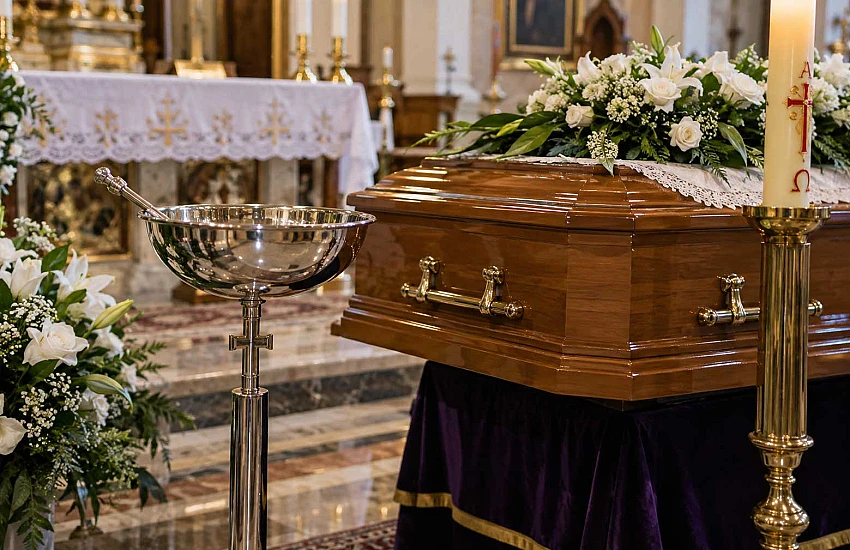
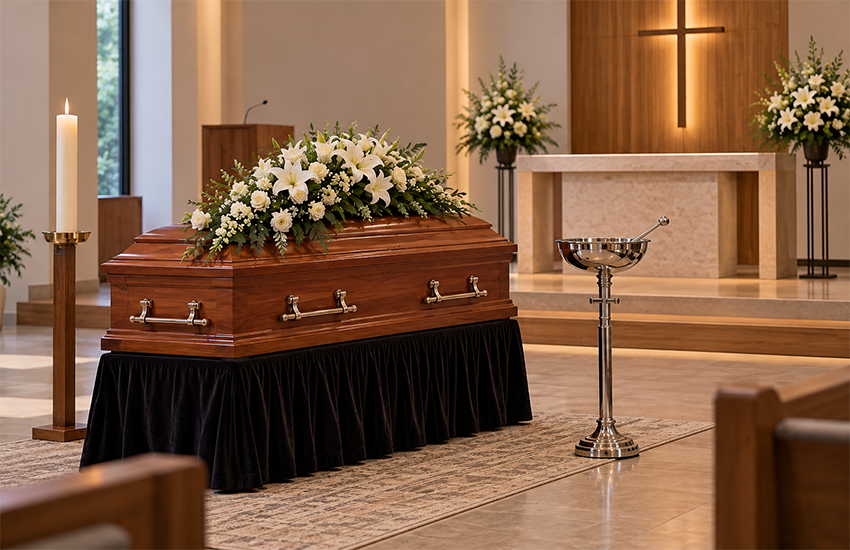
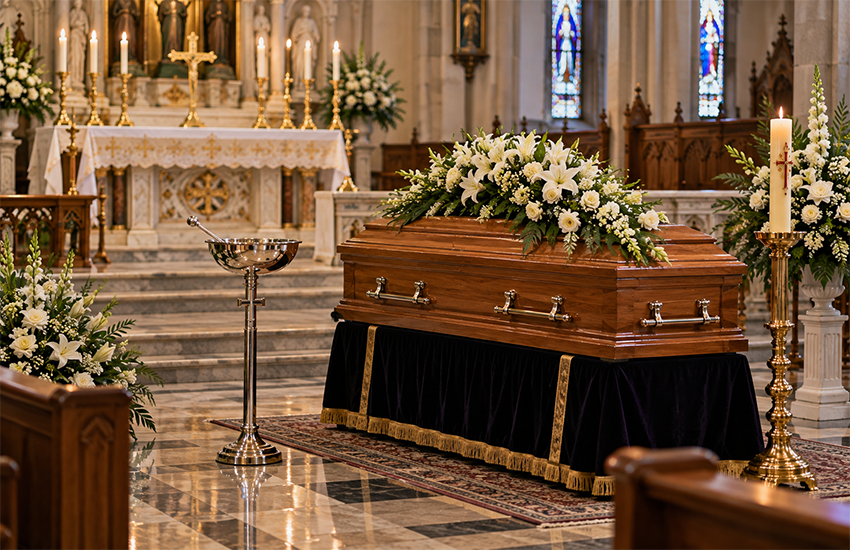
This is exactly the situation for which the water bowl stand available at funeraryaccessories.com was designed. It is a free-standing piece that works in practice as a portable holy water stoup. At 100 cm (about 39 in) tall, it holds the bowl at the level of a standing adult's hand – there is no need to stoop or to reach up. At just 21 cm (about 8 in) wide, it takes up very little room and can be placed at the head of the coffin, beside the catafalque or at the entrance to the chapel without narrowing the path for mourners.
The slim yet solid base is well balanced, and the stand weighs 3.3 kg (about 7.3 lb). This is a detail whose value only becomes clear in use. During a service someone always passes too close, someone catches it with a coat, a child leans on the nearest object. A stand designed for stability stays where it is and prevents the most embarrassing moment imaginable in a chapel – water spilled across the floor right beside the coffin.
A removable bowl and everyday hygiene
The key feature of the product is its removable bowl. It can easily be filled at a sink, carried to the place of the ceremony and set into the stand, then lifted out, emptied and washed afterwards. Water touched by many hands and sprinklers should be changed regularly and the bowl kept clean – the removable bowl means these tasks take a moment and do not require the whole stand to be moved.
The stand is made of chrome-plated metal that resists moisture and cleaning agents. It does not absorb water, does not discolour on contact with it and keeps its appearance through long years of use. In chapels where services take place several times a week, that durability matters a great deal.
Chrome, black and gold, or a colour of your choice
The stand is available in a chrome finish, which suits the light, contemporary interiors of modern chapels and farewell rooms, and in black with gold details, which recalls the more traditional and ceremonial aesthetic of mourning. Black and gold have long belonged to funeral decoration, from the palls laid over coffins to the fittings of Victorian hearses. A custom colour can also be ordered, making it possible to match the stand to existing furnishings such as wreath stands or candlesticks. We wrote about why vertical elements need to work together in the ceremonial space in our article on the role of the funeral wreath stand.
The funeral sprinkler – a small object, a great gesture
Metal in the hand
The second element of the set is the funeral sprinkler, made of high-quality metal. At 17 cm (about 6.7 in) long, it is easy to handle both for the celebrant and for mourners passing it from one to another. A shorter aspergillum gives better control over the movement – the drops land where they should rather than spattering the clothes of people standing nearby or the photograph of the deceased. The ergonomic handle sits securely in the hand, including the hand of an elderly person or a child.
The classic design echoes the forms familiar from churches and chapels, so it feels natural both to those attached to tradition and to those who rarely attend religious services. On request, the sprinkler can be made in a different size – a longer one, for example, for sprinkling a larger space or a big congregation during outdoor services.
Care that keeps the shine
To keep the sprinkler looking its best, it is enough to wipe it regularly with a soft, dry cloth and use a metal polish from time to time. After each ceremony it should be laid down so that it can dry – this prevents water marks and dulling of the surface. It is a simple care routine that allows the object to serve for many years and look equally dignified at every service.
A set that creates a ritual
Two objects, one story
The water bowl stand and the funeral sprinkler were designed to form a coherent set. They match in style and complement each other in function: the stand provides a fixed, safe place for the water, while the sprinkler carries it to the coffin, the urn or the grave. Together they recreate an arrangement that has existed in churches for centuries – the stoup and the aspergillum, the water that waits and the water that is carried.
For funeral directors and chapel managers, such a set is above all a way of bringing order to the ceremony. When the stand is in place beside the coffin from the start, mourners understand intuitively that they will be able to use it. Nothing needs explaining, and nobody has to improvise at the last minute, searching the sacristy for a suitable bowl. For cremation services the set works just as well – holy water accompanies the farewell to an urn too, whether it is placed in a columbarium niche or an urn grave.
Not only for the funeral chapel
Although funeral homes and chapels of rest are the natural setting for the stand and the sprinkler, their uses are much wider. Parishes without a free-standing stoup can place the stand by the door for patronal feasts, weddings and baptisms, when more people come to church than usual. Hospital and hospice chapels need an attractive, easy-to-clean vessel for holy water that takes up little space. Religious houses, retreat centres and care homes with their own chapel often look for exactly this kind of solution – simple, durable and suited to a variety of interiors. The stand fits naturally alongside the furnishings in our chapel sets.
The stand also works well at outdoor ceremonies – open-air Masses, the blessing of memorials, plaques or new buildings, and the blessings of boats and vehicles mentioned earlier. Its stable base allows it to stand on level ground outdoors, and the removable bowl makes refilling easy where there is no tap close by. In such settings the sprinkler becomes a tool the celebrant can dip into the water again and again without returning to the sacristy.
How to place the stand in the ceremonial space
A few simple principles make holy water a natural part of the farewell rather than an obstacle. The stand is best placed at the head or to the side of the coffin, on the side from which mourners will approach, but positioned so that it does not hide the photograph of the deceased or the wreaths from the closest family. It is worth leaving some free space around it, so that people can pause for a moment without blocking those behind them. If a large number of mourners is expected, a clear direction of movement helps – approach from one side, leave from the other.
Before the service the bowl should be filled with fresh water, ideally blessed by the priest who will lead the rite. The sprinkler can be laid beside the bowl or placed in the water so that it is ready for use. After the ceremony the water should be disposed of respectfully – tradition holds that holy water is not poured down a sink but returned to the earth, for example onto a garden bed or a lawn. It is a small gesture of respect that closes the rite in the same spirit in which it began.
Water that connects generations
Looking at a bowl of water and an aspergillum standing beside a coffin, it is easy to see them as ordinary pieces of equipment – alongside the catafalque, the candlesticks and the flower stands. Yet these two objects hold a history that reaches back to the days when a priest dipped a bunch of hyssop into the water of purification, when a Roman mourner sprinkled his companions with an olive branch, when a medieval monk walked through the church to the sound of the Asperges, and when a countrywoman sprinkled her home with a twig from the Palm Sunday palm.
Holy water accompanies people at baptism, at the blessing of Easter food, at the blessing of homes, cars and boats. At the end of that road it also accompanies them in farewell. It is one of the few things that remain unchanged while everything else changes – fashions in wreaths, the shape of coffins, the look of chapels. That is why it deserves a dignified place: stable, beautiful and within reach of everyone who wishes to make that one simple gesture.
The last sprinkling needs no words. It needs only water, a vessel and a hand that reaches for it. Tradition says the rest.
FAQ – frequently asked questions
What is the difference between an aspergillum and a holy water stoup?
A holy water stoup is a basin for holy water, usually fixed near the entrance to a church or chapel, from which people take water themselves to make the sign of the cross. An aspergillum is the instrument used to sprinkle the water – the priest or the mourners dip it into the vessel and sprinkle people, objects, the coffin or the grave. A free-standing water bowl stand combines both functions: it can serve as a portable stoup, and together with a funeral sprinkler it forms a complete set for the rite of sprinkling.
Where does the custom of sprinkling a coffin with holy water come from?
The custom has very ancient roots. The Hebrew Bible already describes the water of purification, sprinkled with a bunch of hyssop on those who had been in contact with the dead, and in ancient Rome mourners were sprinkled with clear water from an olive branch after a funeral. In Christian liturgy the sprinkling of the coffin is above all a reminder of baptism – the water that began a Christian life accompanies it at its end as well.
Can mourners sprinkle the coffin themselves?
In many parts of Europe – Silesia, German-speaking countries, the Czech Republic and Italy among them – it is customary for the mourners to sprinkle the coffin or grave one after another, following the priest, and the Irish wake has a long tradition of visitors sprinkling the deceased. It is worth agreeing this form of farewell in advance with the celebrant and the funeral director, so that a stable water bowl stand and a sprinkler can be placed within easy reach.
How should a holy water bowl and a sprinkler be cared for?
Care of the water bowl stand from funeraryaccessories.com is made easy by its removable bowl, which can be emptied, washed and dried after every service. The chrome-plated metal resists moisture and cleaning agents. The funeral sprinkler only needs wiping with a soft, dry cloth and an occasional polish with a metal cleaner – just remember to lay it down to dry after use.
Is a water bowl stand useful outside a funeral chapel?
Yes. A free-standing bowl works well in parishes during services attended by large congregations, in hospital, hospice and convent chapels, and at outdoor ceremonies such as open-air Masses or the blessing of memorials, buildings, boats and vehicles. Its height of 100 cm and stable base mean that the bowl is comfortably within reach and safe in every one of these settings.
How often should the water in the bowl be changed?
Ideally, the bowl should be filled with fresh water before each service, and emptied and washed once it is over. During long vigils, or in chapels where services follow one another closely, it is worth checking the level and cleanliness of the water between ceremonies. In keeping with tradition, holy water is not poured down the sink – a good custom is to return it to the earth, for example in the garden beside the chapel.
What does sprinkling the coffin three times mean?
Threefold gestures have featured in ritual since antiquity – in Virgil, the mourners are circled three times and sprinkled with water. In Christian tradition a triple sprinkling is linked above all with the Holy Trinity, in whose name baptism is given. The gesture is therefore a symbolic completion of the journey that began at the font, and an expression of hope that the deceased will be welcomed into eternal life.