Table of Contents
- A Crown, Not a Bouquet. What the Wreath Was Before It Reached the Graveside
- The Victorian Century and the Invention of the Floral Tribute
- Vertical and Horizontal. The Two Languages of Funeral Display
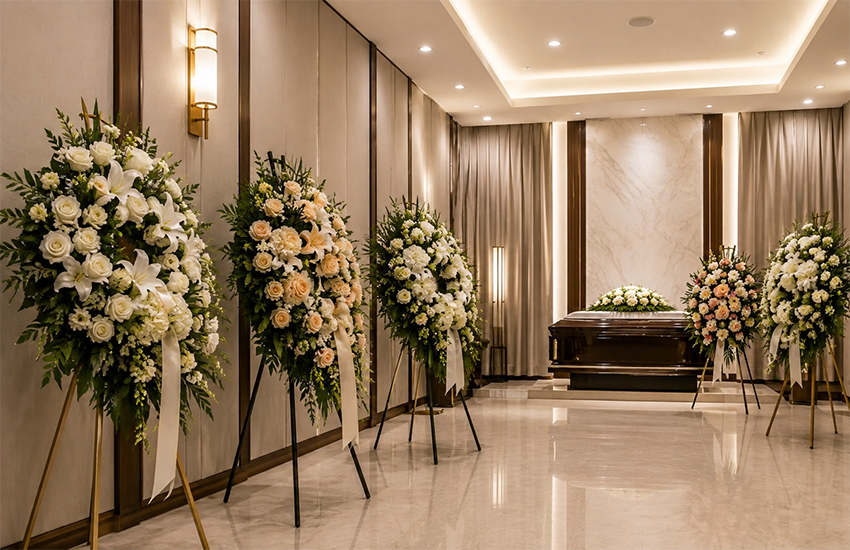
- The Guard of Honour. How Wreaths Are Arranged Around a Service
- Height That Speaks. From Eighty to One Hundred and Sixty Centimetres
- Black, Silver and Gold. Frame Colour as Part of the Setting
- The Wreath in Transit. Cortège, Hearse and the Logistics of Flowers
- Chapel, Church, Graveside. Three Different Stages for One Object
- Wind, Rain and Ground. The Cemetery as a Hostile Environment
- The Life of a Stand Between Funerals
- The Calendar of Remembrance. When Wreaths Stand Outside a Funeral
- The Wreath Stand Range at funeraryaccessories.com
- The Detail That Builds a Firm's Authority
- Frequently Asked Questions About Funeral Wreath Stands
There is a moment in every funeral when the space suddenly changes. It is not when the coffin is carried in, and not when the organ begins. It happens earlier, when the funeral director's staff set out a row of wreaths along the chapel walls or around the grave. A moment ago the room was empty. A moment later there is a wall of flowers looking back at the mourners from the height of their own eyes, turning ribbons and named cards towards them, forming a corridor through which the cortège will shortly pass. That corridor did not appear by itself. It exists because someone positioned a dozen metal stands at measured intervals, matched their height to the size of each tribute, and made certain that none of them would go over at the first gust of wind.
The wreath stand belongs to that category of objects whose task is to disappear. It must be invisible aesthetically and entirely present structurally. A mourner will never say the wreaths were beautifully displayed. They will say the chapel looked dignified. That sentence about dignity is, in practice, a sentence about geometry – about height, spacing and stability. And the geometry of mourning has a long and surprisingly rich history, one worth telling, because it explains why the vertical has meant honour for thousands of years while the horizontal has meant rest.
A Crown, Not a Bouquet. What the Wreath Was Before It Reached the Graveside
The wreath did not begin as an object of mourning. It began as an object of victory and distinction, and the journey it made from the head of a champion to the base of a stand beside a grave is one of the more remarkable stories in European material culture.
From Victor's Crown to Funeral Tribute
In the Greek world the wreath – the stephanos – was a prize. The winner at Olympia received a circlet of wild olive, the victor at the Pythian Games a laurel crown, the Isthmian champion a wreath of pine. It carried no material worth, and that was precisely its power: it was a pure sign, a mark identifying the person who had been singled out. It was placed on the head, at the highest point of the human silhouette, where a sign is visible from the greatest distance.
Rome expanded this into an entire system of honours. There was the corona civica of oak leaves for the soldier who saved a citizen's life, the corona muralis for the first man over the wall of a besieged city, the corona navalis for distinction at sea. The wreath was to Rome what the medal is today – a visible summary of a biography. And it was exactly that summarising function which allowed the wreath to pass so naturally into funeral custom. If a ring of leaves could say who a person had been in life, it could say the same after death.
Roman funerary practice knew wreaths laid at the pyre, wreaths hung on the door of a house in mourning, and wreaths carried to the tomb during the annual festivals of the dead. That last custom proved extraordinarily durable in Europe, surviving Christian reinterpretation and arriving, essentially intact, in the modern floral tribute. The wreath remained what it had always been – a sign that someone was publicly remembered.
A Circle Without End
To the function of honour, Christianity added the function of symbol. The wreath's shape is a circle, and a circle is a line with no beginning and no end. In a culture that thinks of death as a passage rather than a terminus, such a form could not remain neutral. The wreath came to signify eternity, continuity, existence beyond the boundary that biology draws. English still carries the trace of this: the crown of life, the victor's wreath, the laurels one does not rest on.
That symbolic circle, however, makes a technical demand. For a circle to be legible as a circle, it must be seen face-on, which means it must stand upright before the viewer. A wreath laid flat loses its geometry – from the perspective of a standing person it becomes an ellipse, and at a shallower angle a narrow band of greenery. The symbol of eternity only works when it is presented vertically. This sounds like aesthetic speculation, but in the daily practice of a funeral home it is a firm working principle, and it explains why the wreath stand entered the trade's equipment and never left it.
The Victorian Century and the Invention of the Floral Tribute
Anyone looking for the origin of the modern funeral flower display finds it, unmistakably, in the nineteenth century. The Victorian funeral was an elaborate public performance with its own codified language of mourning dress, mourning jewellery, mourning stationery and mourning flowers. Death had a grammar, and everyone was expected to know it.
Two developments made the Victorian floral tribute possible. The first was horticultural: heated glasshouses, improved transport and a booming trade in cut flowers meant that lilies, chrysanthemums and roses could be obtained out of season and in quantity. The second was social: the rise of an urban middle class that expressed status and sentiment through visible expenditure of effort and care. Flowers, being perishable, were the ideal medium – a tribute that could not be hoarded, only witnessed.
By the later decades of the century, the sent tribute had become a distinct social object with its own conventions. It arrived with a card. It carried the name of the sender – a family, a workplace, a regiment, a chapel congregation, a friendly society. It was expected to be seen, read and acknowledged, and in many households the cards were kept and the senders thanked individually afterwards. This is the crucial point: from the Victorian period onward the wreath was not only decoration but correspondence. And correspondence has to be readable.
Anyone who has walked the paths of Highgate, Kensal Green, Brookwood or the Glasgow Necropolis has seen the built consequence of this culture – monumental, theatrical, designed for public viewing. The floral tribute belonged to that same visual world. It was never intended to lie quietly out of sight.
Vertical and Horizontal. The Two Languages of Funeral Display
Every funeral works in two planes. The horizontal is the coffin, the catafalque, the lid, the grave, the ground. The vertical is the cross, the candles, the standards and colours, the portrait of the deceased and the wreaths on their stands. These two planes say different things, and an experienced funeral director knows this instinctively, even if they have never put it into words.
The Theatre of the Vertical
The most elaborate vertical funeral display Europe ever produced was the castrum doloris, the castle of grief – a towering, multi-storey structure raised inside a church for the obsequies of monarchs, bishops and magnates. Baroque examples reached a dozen metres and more, assembled from columns, canopies, pyramids of candles, heraldry, allegorical figures and inscriptions. The coffin stood at the centre, and everything around it climbed.
The logic was simple and brilliant. A person lying in a coffin can no longer say anything about themselves. What surrounds them speaks instead – and speaks the louder the higher it reaches. Britain's own tradition of the state funeral, the lying-in-state and the heraldic achievements hung above tombs in parish churches belongs to precisely this family of practice.
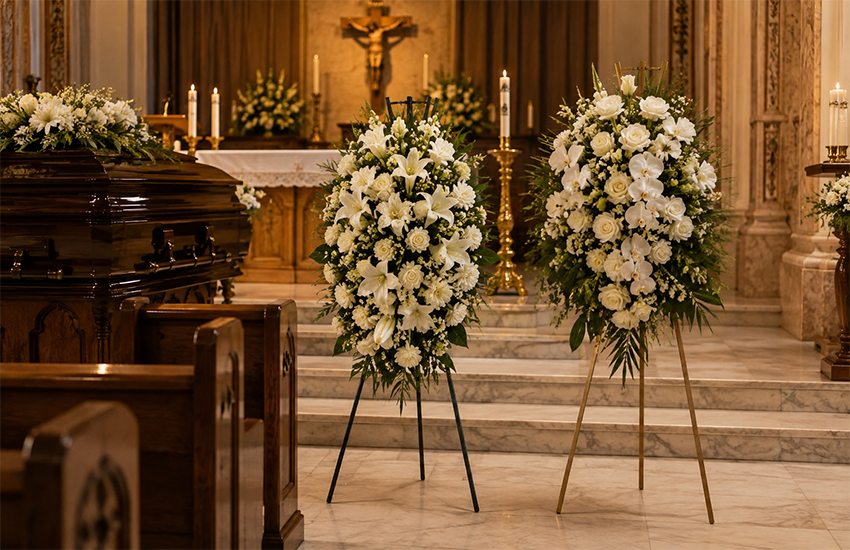
A modern chapel of rest builds no castles of grief. But when a dozen wreaths stand along its walls on stands 140 centimetres tall, the same effect is produced in austere modern language. The vertical wall of flowers is the direct, if unconscious, descendant of baroque funeral architecture. The materials changed; the grammar did not.
Why the Eye Reads Height as Respect
There is a simpler explanation too, entirely physiological. A standing person looks ahead, not at their feet. Whatever occupies their eye level is registered first and remembered longest. A wreath on a 120-centimetre stand, with the arrangement reaching around 160 centimetres, sits squarely in the natural field of vision of an adult. A wreath lying on the ground sits in peripheral vision – the same zone in which we register kerbs and paving.
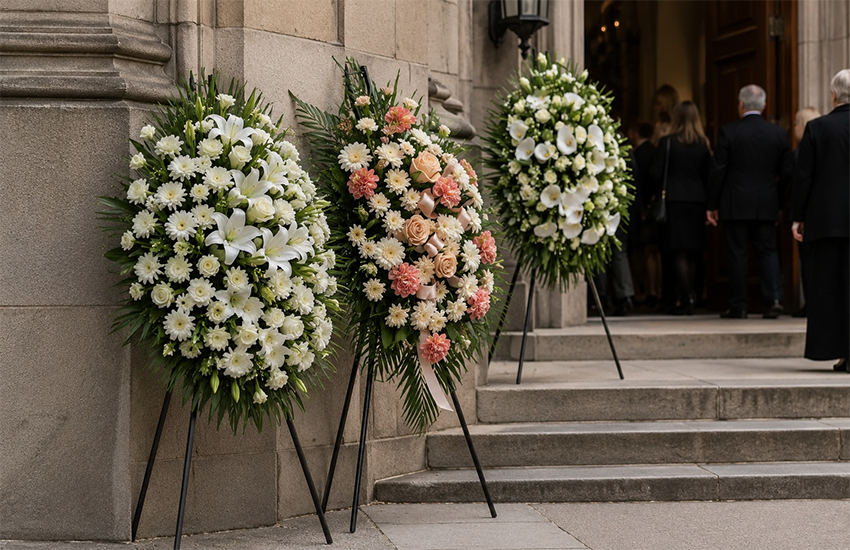
Then there is the card. The message on a tribute – a family name, a company, a single word such as Mum or Grandad spelled in chrysanthemums – is text meant to be read by those attending. Text is read from the front. A wreath laid flat requires the reader to stoop over it, which during a service is simply not possible. The stand converts the message from ornament into communication that actually arrives. In this sense the stand is not merely a support; it is the device that allows the wreath to perform its social function at all.
The Guard of Honour. How Wreaths Are Arranged Around a Service
Setting out wreaths looks from the outside like a technical chore. In reality it is a directorial decision. Where each tribute stands, and at what interval, determines how mourners move through the space, what they look at, and in what order the information reaches them.
The Hierarchy of Position
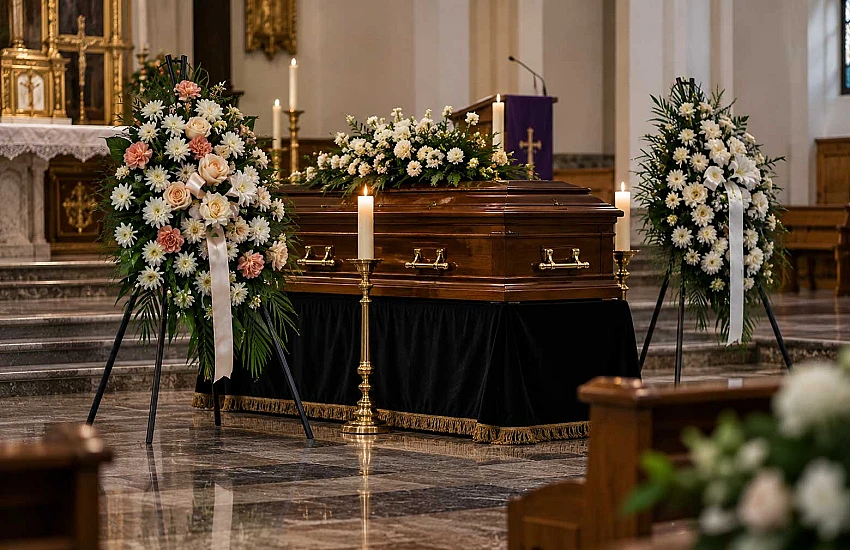
An informal but keenly felt hierarchy governs placement. The position nearest the coffin, or nearest the head of the grave, belongs to the tributes of the immediate family. The next ring is wider family, then the sent tributes – the workplace, the school, the parish, the regimental association, the bowls club, the union branch, the neighbours. None of this is written down anywhere, and yet it is read with great precision, and a family may remember a misplacement for years.
The practical instrument of this hierarchy is the stand itself. Placing the family tribute on a 160-centimetre frame and the sent tributes on 100-centimetre frames creates a legible gradation without a word being spoken. Height becomes syntax. Firms handling services with numerous delegations – service funerals, civic funerals, funerals with a strong occupational or fraternal element – use this consciously, building the row of tributes into a composition that rises towards its centre.
Rhythm and Interval
The second and less obvious element is spacing. Wreaths set too close merge into a single band of colour in which no individual gesture of farewell remains legible. Wreaths set too far apart look accidental, as though they had been left wherever there happened to be room. An interval of roughly 60 to 80 centimetres between the axes of the stands produces a rhythm in which each arrangement keeps its identity while the whole reads as a sequence.
That rhythm is also functional. Space must remain between the stands for people to pass, for a microphone to stand, for a photographer or videographer to work, and above all for elderly and less mobile mourners to move freely. A service in which people must edge sideways between flowers will never be experienced as dignified. Circulation is part of the display, as much as the tribute itself.
Height That Speaks. From Eighty to One Hundred and Sixty Centimetres
The range of heights offered is not arbitrary. It follows from the proportions of the human body and from the sizes of floral tribute encountered in everyday practice.
A stand of 80 centimetres suits lower, more intimate arrangements – posy tributes, small hearts, displays set close to an urn or in a compact chapel. Placed beside a catafalque it does not obscure the coffin or compete with it visually. In cremation and urn services, where the whole scale of objects is smaller, 80 centimetres is often exactly right: enough for the tribute to be noticed, not so much that it overwhelms a modest plinth.
One hundred and 120 centimetres form the most versatile range, covering the standard circular wreath and the mid-sized open-ring design. An arrangement at this height has its centre roughly at chest level and its upper edge near the eyes. It photographs best and reads best from the second or third row of mourners.
The 140 and 160 centimetre frames are for large tributes – elongated designs, lettered tributes and substantial sent arrangements. At this height a wreath stops being decoration and becomes part of the architecture of the room: it builds a wall, defines a corridor, closes a frame. At a graveside, where the backdrop is open landscape and nothing limits the perspective, taller stands are the only way to keep tributes from being lost visually among the memorials.
One point escapes those outside the trade: a funeral home almost never buys a single height. It buys a set, because every service has a different scale, a different room and a different number of tributes. Flexibility matters more here than any single specification.
Black, Silver and Gold. Frame Colour as Part of the Setting
A stand is meant to be subordinate to what it carries, but complete neutrality does not exist. Every colour signifies something, liturgically and socially alike.
Black is mourning in its most recognisable Western form. A black frame vanishes into the shadow of a chapel, reflects no light and draws no attention – the wreath appears to float unsupported. It is the most restrained and the safest choice, working in every type of service, including civil and non-religious ceremonies. Within the wreath stands range, black is available across the full span of heights, from the 80 cm stand through 100 cm and 120 cm to the 140 cm and 160 cm frames, which allows a uniform ceremonial set to be assembled without mixing finishes.
Silver introduces a different register. It is cool, bright, associated with the nobility of the material yet less formal than gold. It sits well in the light interiors of modern funeral homes, in pale stone surroundings, in cremation services and in humanist ceremonies where overtly sacral elements are avoided. The silver stand at 120 cm is among the most frequently chosen all-round options, sitting at the midpoint of the range and working equally well in a chapel and at a graveside, with 80 cm, 100 cm and 140 cm completing the line.
Gold carries the strongest ceremonial and sacral associations. In Christian tradition gold is the colour of glory and of light – hence gilded vessels, gilded frames and the gold grounds of icons. A gold frame, particularly in the taller sizes such as the 140 cm and 160 cm models, is the natural choice for church services, clergy funerals and public or commemorative occasions where the setting is meant to underline the standing of the event. Smaller 80 cm and 100 cm gold frames serve the same register at a domestic scale.
The working rule applied by experienced firms is this: the frame should echo the dominant metal note of the service – the coffin furniture, the candlesticks, the fittings of the chapel – rather than appear as an unrelated addition. A gold stand beside a coffin with silver handles creates a dissonance nobody will name but everybody will register as carelessness.
The Wreath in Transit. Cortège, Hearse and the Logistics of Flowers
A British funeral is rarely confined to one location. The funeral home, the church or crematorium chapel, the journey, and finally the place of burial – at each of these points the tributes must arrive on time, complete and in the condition in which they left the florist. This logistical task is among the more demanding parts of the work.
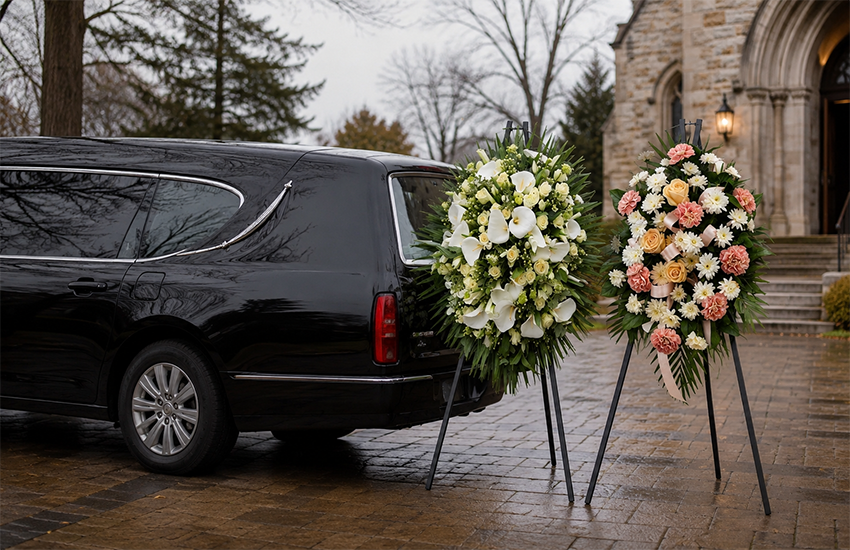
Transport is the main threat to an arrangement. Tributes carried flat and stacked arrive crushed. Tributes carried loose in a load space slide under braking and shed flowers. The professional answer is to carry arrangements as close to upright as possible and to secure them properly, including externally where custom and regulation allow.
Here British practice has a particularly strong tradition. The floral display in and on the hearse is a familiar sight on any high street: tributes ranged along the deck behind the glass, lettered tributes propped against the windows, and a principal wreath carried on top. The cortège is the public phase of a funeral. It passes people who are not attending but who stop, and in many towns still remove their hats as it goes by. The tribute visible on the hearse is, at that moment, the only clear signal of what the vehicle is and that something requiring a moment of gravity is taking place. A wreath hanger for hearse serves exactly this purpose – a fitting that holds the arrangement upright during the drive and protects it from shifting and damage. It joins a purely technical function to a ceremonial one in a way nothing else quite replaces.
Chapel, Church, Graveside. Three Different Stages for One Object
The same stand behaves quite differently depending on where it is placed, and an experienced director allows for this when planning.
A chapel of rest is an enclosed room with controlled lighting and usually limited floor area. Tributes are ranged along the walls, framing the centrally placed catafalque. What matters here is economy of space and a narrow footprint that does not obstruct movement. It is worth remembering that in a chapel everything is seen close up – every detail of finish, every chipped coating, every trace of rust will be noticed. This setting demands equipment kept in immaculate condition.
A church imposes an entirely different scale. The interior is tall and open, and the distance between congregation and chancel can be considerable. Arrangements set low simply vanish into the perspective. Here the 140 and 160 centimetre heights come into their own, along with finishes that speak to the fittings of the building. An additional constraint is the incumbent's own preference about where flowers may and may not stand – something the director should establish beforehand rather than discover on the day.
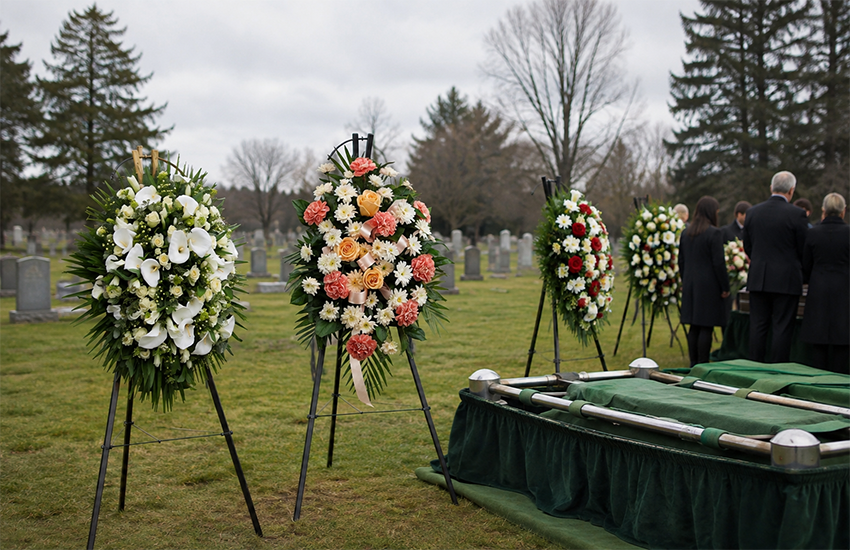
The graveside is the hardest stage of all. The ground is uneven and often soft, paths are narrow, and there is little room between plots for a wide-based frame. Weather deserves its own discussion. Many firms treat the setting out of tributes as part of organising the whole graveside area, drawing also on funeral tents and barrier posts, which mark the boundary between the ceremonial space and the rest of the cemetery. In that arrangement the wreaths on their stands form the walls, the canopy forms the roof and the posts draw the line – together they create a temporary architecture that exists for forty minutes and then disappears.
Wind, Rain and Ground. The Cemetery as a Hostile Environment
A wreath a metre across is, in physical terms, a sail. Wind acting on that surface generates a force that will readily topple a frame with an inadequate base. A tribute going over during a committal is not merely a spoiled arrangement – it is a break in concentration, a noise, a scramble, and a memory the family will carry for years. In this trade there is no second attempt. The service happens once.
Hence the importance of specifications that look secondary in a catalogue: the width and construction of the base, the mass of the frame, the way weight is distributed. Stability here is simultaneously a matter of participant safety and of respect for the deceased, and under British health and safety practice the risk assessment for graveside work covers exactly this sort of hazard alongside slips, trips and manual handling. Coating quality matters for the same reason – a stand used at the graveside several times a week, year round, exposed to rain, frost and road salt, needs a finish that resists corrosion, or within two seasons it will begin leaving rust marks on pale memorial stone.
Uneven ground is a separate problem. A cemetery path is rarely a level plane, and a freshly opened grave is surrounded by a band of disturbed soil. A frame with a properly distributed base finds purchase even there, whereas a narrow point-loaded foot sinks and tilts. Experienced staff test a placement with a brief press of the hand before setting an arrangement on it – a gesture no mourner ever notices, and one that decides how the next hour will go.
The Life of a Stand Between Funerals
Ceremonial equipment spends most of its life outside ceremonies: in the store, in the back of a vehicle, in transit between chapel and cemetery. That is precisely when it sustains most of its damage, unobserved. Stands carried loose knock against one another, scuffing coatings and scratching the gold and silver finishes, which are the most vulnerable of all.
The answer is the transport cover, a modest item that in practice determines whether a set still looks new after three years or looks like equipment that has seen many seasons. The range includes covers in small black and large black, with matching versions in red, small and large. The split between sizes follows the split of a set into shorter and taller frames, so a full complement can be moved without improvisation.
There is a second, less technical aspect. Staff carry equipment in and out in full view of the family and mourners. The manner in which they do it is part of how the whole service is received. Stands drawn from proper covers and returned to them afterwards communicate care. Stands carried in a fistful, clattering against each other, communicate the opposite, even if the funeral itself was conducted faultlessly. The detail that happens at the margin shapes the impression at the centre.
The Calendar of Remembrance. When Wreaths Stand Outside a Funeral
Display does not end on the day of the funeral. The British calendar of commemoration provides several occasions on which the wreath returns to its stand.
The most visible by far is Remembrance. The poppy wreath laid at the Cenotaph, at a village war memorial or at a regimental plot is the single most widely recognised act of public wreath-laying in the country, repeated in thousands of towns on the same November morning. Anniversaries of a death, particularly the first, bring tributes back to the grave in many families. Civic commemorations, memorial services for disasters, and the marking of a company's or an institution's own losses do the same.
The Remembrance case is especially instructive, because it shows the stand in its most public role. A wreath laid at a memorial must stand upright: it has to be visible in photographs, in broadcast coverage and to passers-by for the days that follow. The inscribed card naming the regiment, the council or the school must be legible from several metres. The whole scene – a rank of wreaths upright against a plinth, cards turned towards the viewer – is a living inheritance of the Roman crown as a public sign of memory. The political context has changed and so have the materials, but the grammar of the gesture has survived two thousand years.
The Wreath Stand Range at funeraryaccessories.com
The wreath stands category is put together so that a funeral firm can assemble a complete, coherent ceremonial set from it, rather than simply buy a single item.
The foundation is a full span of heights across three finishes. Black runs from 80 through 100, 120 and 140 to 160 centimetres. Silver covers 80, 100, 120 and 140 centimetres, and gold runs the whole span from 80 cm to 160 cm. The frames are powder-coated steel, chosen for the combination of weight and corrosion resistance that outdoor ceremonial work requires, and they assemble and break down quickly, which matters when a team is turning a chapel around between services.
This structure has direct consequences for how a service can be staged. A firm can build a set that is uniform in colour and varied only in height, producing an ordered, rising composition, or a mixed set matched to the character of an individual farewell. It can also keep two complements in different finishes for religious and civil ceremonies respectively – increasingly common among firms serving a mixed community.
Completing the set are the wreath hanger for hearse, covering the cortège stage, and transport covers in small and large sizes and in black and red, protecting the frames between services. These are worth considering alongside other categories of ceremonial equipment – coffin stands and catafalques and photo stands – because it is their combined, deliberate arrangement that creates the impression of a space that was planned rather than assembled from whatever came to hand.
The Detail That Builds a Firm's Authority
A funeral business operates under conditions with no parallel in any other service trade. The client arrives in the worst week of their life, has no time to compare providers, no working knowledge of the products, and will not be using the service again within any foreseeable period. Judgements of quality therefore rest almost entirely on impression – on whether everything looked the way it should.
That impression is built from details the family could not name. An even row of tributes. Arrangements at a consistent height, or in a legible gradation. Cards facing the right way and readable. No stray objects in the frame. Nothing wobbles, nothing falls, nothing needs adjusting mid-service. Afterwards nobody will say a word about the stands – and that is precisely the result being aimed at.
In this sense the wreath stand is a paradoxical object. Its excellence is measured by how completely it managed to go unnoticed. Yet behind that invisibility lie two and a half thousand years of cultural history – from the Greek olive circlet, through the Roman crown of merit, the baroque castle of grief and the Victorian sent tribute, to the metal frame being set out this morning on a wet cemetery path. The wreath must stand, because the vertical has always meant honour. Someone has to make sure it does. That, in the end, is the work.
Frequently Asked Questions About Funeral Wreath Stands
What height of wreath stand should I choose for a typical service?
The most versatile heights are 100 and 120 centimetres, because they match the standard circular wreath and place the arrangement in the natural field of vision of a standing adult. Eighty centimetres suits smaller posy tributes and cremation or urn services, where the whole scale of objects is reduced. The 140 and 160 centimetre frames are reserved for large sent tributes, lettered designs and services held in churches or in the open, where lower frames disappear into the perspective. In practice a firm rarely works with a single height – a set covering several sizes allows the team to respond to the actual dimensions of what arrives from the florist.
What is the difference between a wreath stand and a flower stand?
In trade usage the two terms describe the same type of frame, and the distinction is largely one of finish and intended use. Frames described as flower stands most often appear in black and are used more broadly, including for posies and smaller arrangements. Frames described as wreath stands appear in silver and gold finishes and tend to be used for services with a more formal setting. The selection principle is identical in both cases: match the height to the size of the arrangement and keep the finish consistent with the rest of the ceremonial equipment.
Why are wreaths displayed upright rather than laid on the grave?
Several reasons reinforce one another. The wreath's form is a circle symbolising eternity, and a circle is only legible face-on – laid flat it collapses into a narrow ellipse for anyone standing. The card, which identifies who sent the tribute, needs a frontal position to be read without stooping. And since antiquity the vertical has functioned in European culture as a gesture of honour, while the horizontal signifies rest. Tributes are usually laid on the grave only after the committal, once their communicative function has been fulfilled.
How do you stop a wreath blowing over at a graveside service?
Three things matter: a base of adequate width and stability, a height matched to the actual size and weight of the arrangement, and a check of the placement before the service begins. A large-diameter wreath acts as a sail, so in windy conditions it is worth positioning tributes closer to shelter – a chapel wall, a memorial, the side of a graveside canopy – and avoiding exposed open positions. The disturbed soil around a freshly opened grave is soft, which is why staff customarily test stability with a brief press of the hand before placing an arrangement on the frame.
How many wreath stands should a funeral home keep?
The number depends on the scale of services handled, but it is best judged against the most demanding funeral rather than the average one. A service with numerous sent tributes – from a workplace, a school, a service association, a club – can require a dozen or more positions at once. A practical approach is to hold a set spanning the full range of heights in one finish, supplemented by several frames in an alternative finish for services of a different character. Shortfalls are visible immediately and cannot be disguised.
Does the colour of the stand affect the character of the service?
It does, though it is seldom stated aloud. Black is the most restrained and universal, receding into shadow and never competing with the arrangement. Silver is cool and contemporary, suiting light interiors, cremation services and humanist ceremonies. Gold carries the strongest ceremonial and sacral associations and therefore belongs naturally to church services, clergy funerals and civic or commemorative occasions. The overriding rule concerns consistency: the finish of the stands should relate to the coffin furniture and the fittings of the chapel, because a mismatched combination reads as carelessness even when nobody articulates why.
How should stands be stored and transported to keep their appearance?
Most damage occurs not during services but in transit and storage, where frames knock against one another and against vehicle fittings. Gold and silver finishes are especially vulnerable, and a scratched coating is visible from several metres. The answer is transport covers matched to the height of the frames, available in small and large sizes and in black and red. Beyond protecting the coating they also carry a presentational weight: equipment drawn from covers and returned to them after the service signals to the family a level of care that forms part of how the whole occasion is judged.