Table of Contents
- The Preparation Room – More Than a Workspace, a Space of Respect
- Sanitary and Technical Requirements – What Must the Room Provide?
- The Embalming Table as the Centre of the Preparation Space
- Embalming Table Models Available at funeraryaccessories.com
- How to Choose the Right Embalming Table for Your Funeral Home
- Other Elements of a Modern Preparation Room
- Workflow Organisation – The Preparation Room as Part of a Larger System
- Materials, Hygiene and Everyday Sanitary Standards
- Trends and Directions in Preparation Room Development
- Conclusion – An Investment in a Space That Matters
- FAQ – Frequently Asked Questions
The way a funeral home organises its working environment says a great deal about its relationship with the profession and the people it serves. The preparation room – also known as the embalming room or the mortuary suite – is the place where professionalism and dignity meet within a single space. It is here, away from the eyes of the grieving family, that funeral home staff invest their time, knowledge and attention to ensure that the deceased looks their best before the final farewell. Yet across the industry, this area is still too often treated as a secondary concern, equipped according to the principle that something is better than nothing. That way of thinking is slowly but steadily becoming a thing of the past.
A modern funeral home understands that a properly planned and equipped preparation space is not a luxury but a foundation of service quality. It has a direct impact on the comfort and safety of staff, on the hygiene of the entire premises, on the results of post-mortem cosmetology, and ultimately on the satisfaction of families who entrust their loved ones to the funeral home's care. In this article, we take a comprehensive look at how such a space should be designed, what equipment meets today's standards, and why choosing the right embalming table is a decision that affects every aspect of daily work.
The Preparation Room – More Than a Workspace, a Space of Respect
It is difficult to speak of a dignified farewell without the facilities that make a thorough preparation of the body possible. In many Western countries – particularly the United States, the United Kingdom and the Scandinavian nations – standards governing the so-called preparation room are strictly regulated by law and represent one of the conditions for obtaining a professional licence. Sanitary and building regulations set out a range of requirements for premises where post-mortem activities are carried out, though the level of detail in these regulations varies depending on the jurisdiction and the type of services offered.
Regardless of the letter of the law, a well-designed preparation room is above all an expression of commitment to service quality. It means a space in which ergonomics and hygiene are treated as priorities rather than obstacles to be worked around. It means the right materials, the right equipment and the right practices – all in service of ensuring that every person who comes into the funeral home's care is prepared with the thoroughness and respect they deserve.
It is also worth viewing the preparation room through the eyes of the staff who spend many hours there each week. An ergonomic, well-lit and properly equipped space reduces the risk of physical strain, limits exposure to hazardous substances and simply makes the work less exhausting. This in turn leads to lower staff turnover and a consistently higher standard of service delivery.
Sanitary and Technical Requirements – What Must the Room Provide?
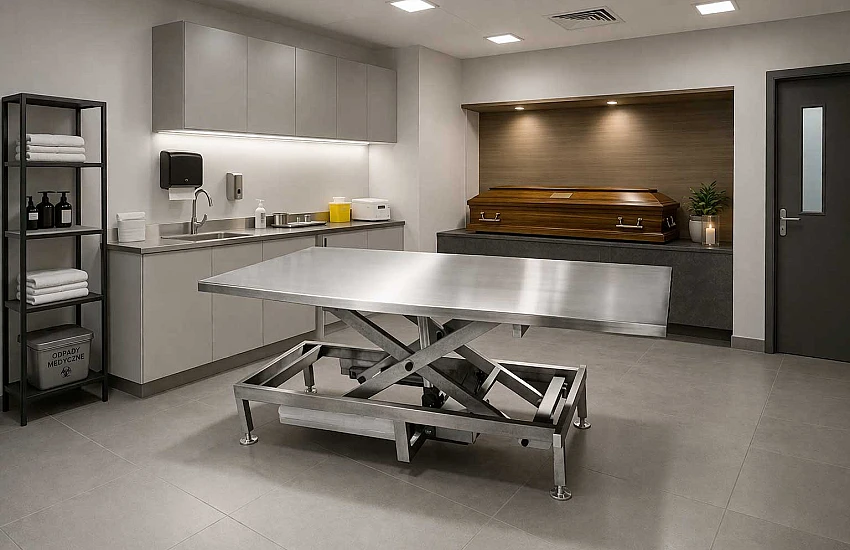
Before turning to equipment, it is worth considering the requirements for the room itself. The preparation room must above all be impermeable and easy to disinfect. This means floors and walls finished with materials resistant to chemical agents – ceramic tiles, specialist epoxy coatings or industrial resin screed perform significantly better here than any porous materials. Joints between tiles should be sealed with antifungal and antibacterial grout.
Ventilation is another absolutely critical element. The room must have an air exchange rate that complies with applicable standards – both general ventilation and local extraction, particularly where chemical preparations are used. The correct air pressure and directional flow – negative pressure relative to the rest of the building – prevents potentially hazardous substances from migrating into other areas of the premises.
Adequate lighting is equally essential – both general illumination and precise task lighting focused on the working area. The colour temperature of the light matters considerably here: overly warm light can distort the assessment of skin tone and cosmetic results, which is why preparation rooms are best served by lighting with a colour temperature close to natural daylight, in the region of 5,000–6,500 K. Electrical and plumbing installations must be executed to standards appropriate for spaces exposed to moisture and chemical agents.
A separate consideration is the provision of sinks with hot and cold water, systems for disposing of liquid waste in accordance with local sanitary regulations, and an adequate number of gas or oxygen supply points if the funeral home carries out more advanced preservation procedures. In a well-planned preparation room, every element of the infrastructure was considered at the design stage rather than retrofitted piecemeal as needs arose.
The Embalming Table as the Centre of the Preparation Space
In the hierarchy of preparation room equipment, the embalming table occupies a singular position. The entire space is organised around it, the layout of all other equipment depends on its dimensions, and its quality has a direct bearing on the comfort and efficiency of daily work. A good embalming table is not merely a flat surface in stainless steel – it is a thoughtfully engineered system that supports every stage of working with the body: from initial reception and condition assessment, through preservation and post-mortem cosmetology, to dressing and placing in the coffin.
Modern embalming tables combine several essential qualities. First, they are made from high-grade stainless steel – a material resistant to corrosion, disinfectants, acids and alkaline solutions used in funeral work. Second, they offer a working surface large enough to allow comfortable work with the body of an adult. Third, they incorporate drainage systems – a sloped top with a drain collar is standard, and it dramatically simplifies the maintenance of hygienic conditions. Fourth, they allow for height adjustment, which is indispensable for protecting the spines of staff who work at the table for many hours.
The funeraryaccessories.com range includes four embalming table models that address different funeral home needs – from those taking their first steps towards professionalising their back-of-house facilities, to those seeking the most technically advanced solution available on the market.
Embalming Table Models Available at funeraryaccessories.com
Standard Embalming Table – A Solid Foundation for Every Funeral Home
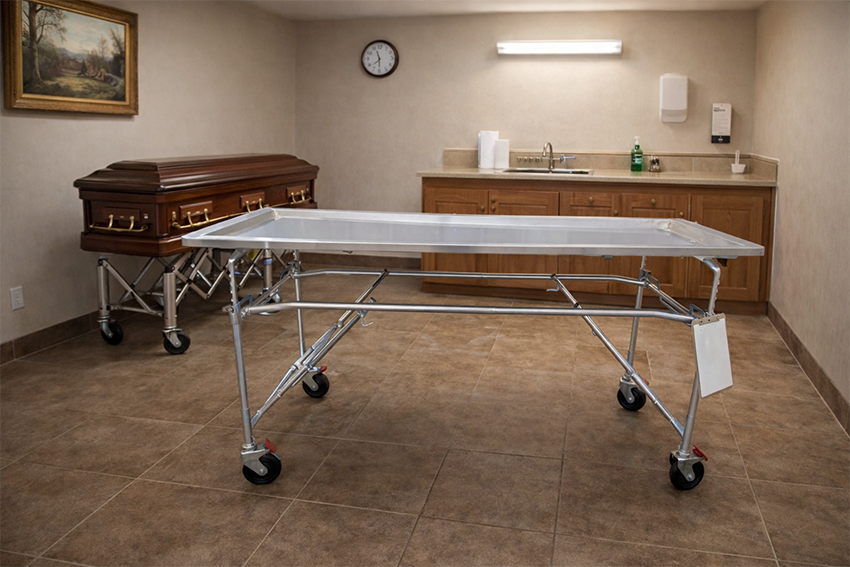
The entry-level model in the range is the Standard Embalming Table. It offers everything required for professional day-to-day work without unnecessary complexity. The table measures 208 × 90 × 78 cm, providing a generous working surface sufficient for work with the body of an adult. The maximum load capacity is 200 kg, and the table's own weight is approximately 40 kg – making it stable in the working position while still manageable to move with one or two people.
The stainless steel top has a sloped cross-section that allows effective fluid drainage – a feature that is absolutely essential from a hygiene standpoint. A dedicated mounting collar enables connection to the building's drain system, making the table ready for direct integration with the room's infrastructure. Rounded edges on the top and frame are a detail appreciated by anyone spending long hours at the table: they eliminate sharp corners that could cause injury and are easier to clean.
Four swivel casters with brakes give the table full mobility while ensuring stability during use. The table can be moved freely around the room and, once positioned and locked, remains stationary even under more demanding working conditions. This is particularly valuable in funeral homes where the preparation room serves multiple purposes or where limited space requires regular reorganisation.
Height-Adjustable Embalming Table – Ergonomics as a Priority
A step up in the equipment hierarchy is the Height-Adjustable Embalming Table. This model addresses one of the most significant ergonomic challenges in funeral work: the need to adapt the working surface height to the stature of the person using it. At a fixed-height table, shorter staff are forced to work with raised arms, while taller colleagues must stoop over the work surface. Both postures, sustained over long periods, lead to muscle strain and chronic pain.
This table offers height adjustment across a range from 82.5 cm to 99.5 cm, allowing it to be set to the requirements of a specific individual or the nature of the task at hand – a standing work position calls for a different setting to certain cosmetology procedures. Adjustment is manual but straightforward and quick. The work surface measures 204 × 76.5 cm and the maximum load capacity is 200 kg, as with the standard model. The table's construction combines stainless steel on the work top with aluminium structural elements, giving the working surface durability while keeping the overall weight manageable.
The table is equipped with the same hygiene-focused features as the standard model: a sloped top with a drain collar and swivel casters with brakes. The deciding difference in choosing this model is the height adjustment function, which in practice delivers measurable protection for staff health. It is worth noting that back and shoulder problems are among the most common occupational complaints of people working at embalming tables, and investment in ergonomics pays for itself through reduced sick leave and longer working careers.
Electric Embalming Table – Precision and Convenience at the Highest Level
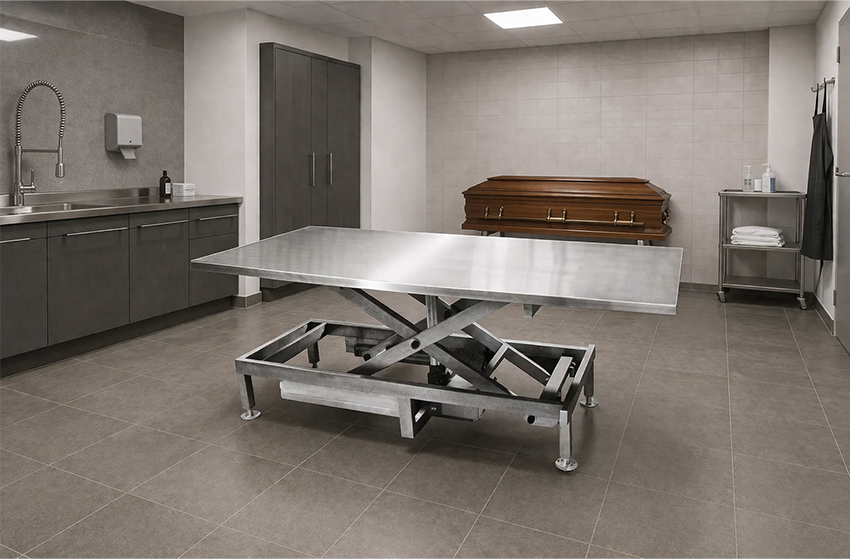
Where maximum convenience and precise adjustment are the priority, the answer is the Electric Embalming Table. This model represents a clear step towards fully professional equipment comparable to the standards used in the finest funeral homes internationally. Electrically powered height adjustment via a remote handset allows smooth, continuous change in the table top level across a range of 74 to 114 cm – a significantly wider range than the manual model, accommodating both a low position that makes body transfer easier and a high position suited to taller staff or procedures requiring work from above.
The working surface measures 200 × 90 cm, one of the largest available in this category. The entire construction is made from stainless steel – both the top and the tubular steel frame. The table connects to a standard 230 V socket with no need for any specialist electrical installation. The remote handset enables quiet, smooth height adjustment, which is particularly valuable during a procedure when one wishes to make a subtle correction without interrupting the work.
The electric model also offers flexibility in terms of stabilisation: the table can be fitted with swivel casters with brakes for funeral homes that value mobility, or permanently anchored to the floor by securing the legs – an option preferred by those seeking a static, uncompromisingly stable work station. This latter configuration is especially appreciated during more complex procedures where the table's stability has a direct bearing on the precision of the work.
Electric Embalming Table with Sink – A Complete Workstation in One
The most fully specified model in the funeraryaccessories.com range is the Electric Embalming Table with Sink. It combines all the advantages of the electric table with an integrated washing area – a built-in sink measuring 34 × 34 cm with a draining surface. This solution is designed for funeral homes that want a complete, self-contained work station without the need to move between different parts of the room during procedures.
The working surface measures 220 × 90 cm – the longest model in the range, with the additional 20 cm of length compared to the electric model without a sink accommodating precisely the integrated sink unit. Height adjustment is identical: a range of 74–114 cm, remote handset control, 230 V power supply. The sink connects to the building's water and drainage system, ensuring that all hygiene-related tasks – from washing instruments and rinsing the table top to handwashing and disinfection – take place directly at the work station.
The manufacturer, Prima-Tech S.C., also offers the possibility of individual configuration of this model: at the customer's request, the table can be produced with casters or fixed legs, and the arrangement of additional elements can be adapted to the specifics of the room. This is an important advantage for funeral homes adapting existing spaces with non-standard dimensions or particular plumbing layouts. The full range of embalming tables can be found in the Embalming Tables category at funeraryaccessories.com.
How to Choose the Right Embalming Table for Your Funeral Home
Selecting a specific embalming table model should be the result of analysing several factors simultaneously. The first is the space available. A table 220 cm in length requires a well-planned room layout – there should be adequate clearance for free movement on both sides of the table, a minimum of 90–100 cm on each side, and more still if more than one person works in the space at the same time.
The second factor is the range of services the funeral home offers. If the business is limited to basic post-mortem hygiene and simple cosmetology procedures, the standard table or the manually height-adjustable model will be more than adequate. If, on the other hand, the funeral home provides full arterial embalming, long-term preservation, reconstruction or advanced post-mortem cosmetology, it is worth considering the electric or electric-with-sink model – their specifications are simply better suited to intensive, multi-hour work.
The third factor is the makeup of the team. In funeral homes where the table is used by people of significantly different heights, or where it is used in rotation by several staff members, height adjustment – particularly electric adjustment – becomes an investment in the health of the entire team rather than a convenience for a single individual. It is also worth remembering that a table with electric adjustment is more accessible for people with mobility limitations or recovering from injury, which has implications for the funeral home's staffing approach.
Finally, it is worth bearing in mind that an embalming table is a long-term investment. A solid steel construction – with proper care and regular disinfection – will give decades of service. When making a purchasing decision, it is better to think in terms of the funeral home's long-term needs rather than the immediate budget alone.
Other Elements of a Modern Preparation Room
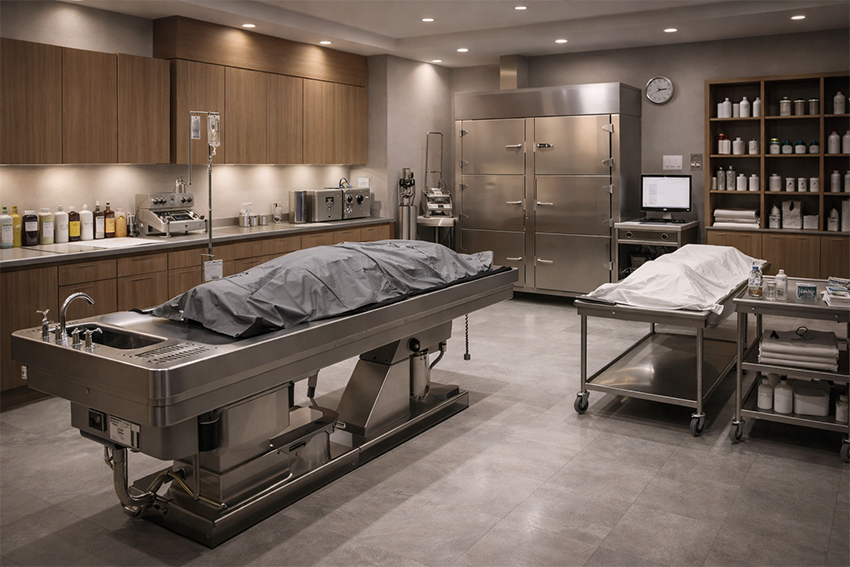
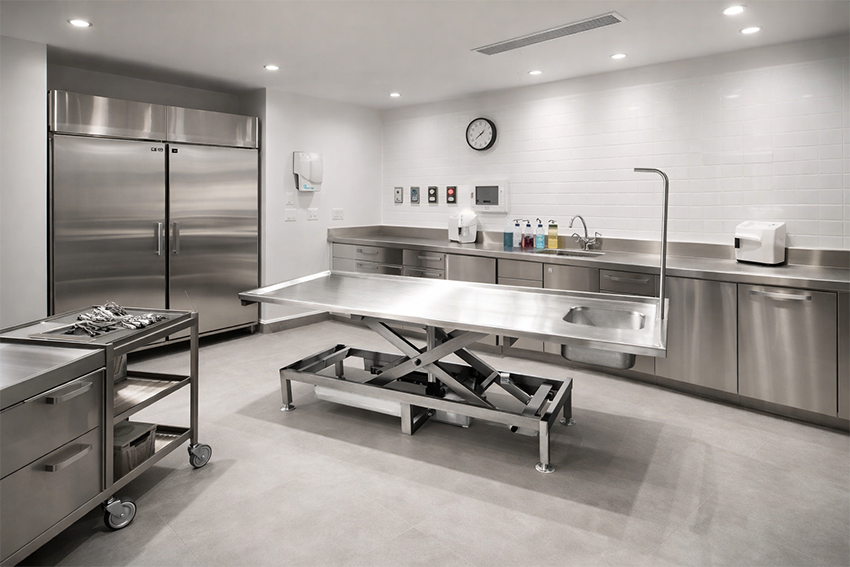
The embalming table is the centre of the preparation room, but it is not the only piece of equipment it requires. A modern preparation space should incorporate several further elements that together create a coherent, functional working environment.
Refrigeration units are the next most important category of equipment after the table. Mortuary refrigerators allow for the safe storage of remains prior to preparation or while awaiting the ceremony. Maintaining the body at the correct temperature is both a hygienic and an ethical requirement, and it directly affects the funeral home's capacity to plan its work schedule.
Supplementary equipment for the preparation room includes appropriately specified task lighting, local extraction ventilation positioned over the table, instrument and preparation holders, containers for clinical waste and used textiles, and personal protective equipment – disposable overalls, nitrile gloves, protective masks and safety eyewear. Each of these elements has a defined place in the equipment hierarchy and a direct impact on staff safety and the quality of the work carried out.
Stretchers, trolleys and transfer capsules are used to move the body safely – both within the funeral home and during collection from the place of death. The smooth flow of remains through the various zones of the funeral home – from reception through refrigerated storage and the preparation room to the chapel and release – is a logistical consideration that in practice distinguishes small, poorly organised funeral homes from large, professionally run funeral businesses.
Workflow Organisation – The Preparation Room as Part of a Larger System
The preparation room does not exist in isolation. Its effectiveness depends to a significant degree on how it connects to the rest of the funeral home. Thoughtful workflow organisation means that remains arrive in the preparation room as directly as possible – without unnecessary intermediate steps or transfers. The entrance to the preparation room should be linked to the body reception area in a way that allows discreet and hygienic transfer, ideally via a dedicated corridor not accessible to members of the public.
Once preparation is complete, the deceased should be able to move to the chapel or viewing room as efficiently as possible and without exposure to spaces not intended for family visitors. The functional layout of the funeral home – reception area, refrigerated storage, preparation room, chapel – should form a logical sequence that minimises the intersection of staff-only routes with those used by bereaved families.
Equally important is equipping the preparation room with appropriate documentation systems. A growing number of funeral homes are implementing procedures for photographic documentation of the body's condition on reception and after preparation, as well as detailed records of embalming procedures. This requires space for a computer or tablet, and the preparation room should be set up to accommodate such a system – both technically and spatially. A well-designed working environment also means clearly defined clean and dirty zones, properly positioned waste disposal points and an organised, logical layout for instruments.
Materials, Hygiene and Everyday Sanitary Standards
Day-to-day hygiene in the preparation room is not a one-off effort but a system of procedures that must be followed consistently. Every work session at the embalming table should begin and end with a disinfection protocol covering the table top, all instruments and all contact surfaces. The stainless steel from which the table tops in the funeraryaccessories.com range are made is an ideal material in this respect: it is non-porous, it does not react with most disinfectants and it tolerates the use of stronger preparations without risk of lasting surface damage.
Flooring is another important aspect of hygiene. Even the best table with an integrated drainage system cannot substitute for a properly designed floor with drain gullies and a sealed junction with the walls. Daily disinfection of the floor using agents effective against bacteria, viruses and fungi should be a standard element of the end-of-shift procedure for the preparation room.
Staff working in the preparation room should always use a complete set of personal protective equipment – disposable overalls or protective aprons, nitrile gloves, protective masks and safety glasses. This is not only a regulatory requirement but above all a matter of common sense: exposure to biological substances is a genuine occupational hazard that can be effectively minimised with the right equipment and procedures. A regular audit of hygiene procedures, ideally based on a written protocol, helps maintain standards regardless of team composition or staff turnover.
Trends and Directions in Preparation Room Development
Looking at how preparation room equipment and organisation are evolving internationally, several clear trends can be identified. The first is growing automation and electrification of equipment: tables with electric height adjustment, integrated ventilation systems, environment control from a touchscreen panel – everything that a decade or two ago was a luxury available only to the largest funeral homes is gradually becoming a standard that is accessible and cost-effective for a widening range of operators.
The second trend is growing interest in environmentally responsible solutions and in reducing the use of aggressive chemical substances. Embalming preparations based on less toxic compounds, air purification systems targeting volatile organic compounds, systems for separating chemically contaminated wastewater from grey water – these are features that are beginning to appear in the design briefs for new preparation rooms conceived with sustainable and responsible operation in mind.
The third, and perhaps most significant, trend is a shift in attitude towards the preparation room itself. A growing number of funeral homes treat it as a space they can be proud of – they describe it in their informational materials, open it to student visits and are happy to present it at industry trade fairs and conferences. This is a cultural shift that reflects the maturing of the profession and a growing understanding that service quality begins precisely here – in quiet, away from mourners' eyes, but with a full awareness of the responsibility involved.
Conclusion – An Investment in a Space That Matters
A modern preparation room is more than an equipped workspace. It is a philosophy of practice: a conviction that every person, regardless of the circumstances of their death or their social standing, deserves careful, professional preparation for their final farewell. A funeral home that understands this invests in the right tools – and begins with the embalming table, which is the centre of the entire space.
The choice between a standard model, a table with adjustable height and the electric versions is a decision worth making with full awareness of the funeral home's scale of operation, the needs of its staff and its development plans. All four models available in the funeraryaccessories.com range share a high standard of construction and considered technical solutions that translate into everyday comfort and safety. The full range, including detailed technical specifications, can be found in the Embalming Tables section at funeraryaccessories.com.
FAQ – Frequently Asked Questions
What are the key differences between the standard embalming table and the electric height-adjustable model?
The standard table is a fixed-height solution at 78 cm, fitted with locking casters and a sloped drainage top – a response to fundamental hygiene and functional requirements. The electric model with a remote handset offers height adjustment across a range of 74–114 cm, providing far greater flexibility to accommodate staff of different heights and the specific demands of different procedures. In practice, this difference is most significant in funeral homes where several staff members use the table, or where a wide range of procedures requiring different ergonomic positions is regularly performed.
Does the embalming table with a sink require special plumbing connections?
The electric embalming table with a sink features a 34 × 34 cm basin with a drainage surface, which requires connection to the building's water supply (hot and cold) and to the drainage system. These are standard plumbing connections of the kind found in any room with a water point – no specialist installations are required. The only prerequisite is that water supply valves and a drain outlet are located sufficiently close to the table, which should be taken into account when designing or adapting the room.
What materials are embalming tables made from, and why is stainless steel the industry standard?
All embalming tables available at funeraryaccessories.com are made from high-grade stainless steel on the working top, with steel or aluminium structural elements. Stainless steel dominates this equipment category for several reasons: it is resistant to corrosion caused by biological fluids and disinfectants, it is non-porous – preventing the accumulation of bacteria and contaminants – it is easy to clean, and when properly maintained it gives decades of service without any degradation of its properties. Other materials, such as wood or standard plastics, simply do not meet the rigorous hygiene requirements expected of professional funeral equipment.
Can an embalming table be permanently anchored to the floor, and why might this be worth considering?
The electric models available at funeraryaccessories.com can be fitted with four fixed legs designed for permanent floor anchoring as an alternative to the standard locking casters. Permanent floor fixing provides uncompromising stability – the table will not shift even under significant lateral forces, which is particularly important during more intensive procedures or when two members of staff are working at the table simultaneously. This option is worth considering for funeral homes where the table occupies a fixed, predetermined position in the room and does not need to be moved on a regular basis.
How often should an embalming table be serviced, and what should attention be paid to?
The daily procedure should include thorough cleaning and disinfection of the entire top surface, edges, drain collar and side surfaces of the table after each use. Weekly or monthly – depending on the intensity of use – a more detailed inspection is advisable: checking the condition of the casters and brakes, lubricating moving parts and verifying that the drainage system is functioning correctly. On electric models, the condition of the power cable and remote handset should be checked regularly. The manufacturer recommends avoiding abrasive cleaning agents, which could scratch the stainless steel surface and create areas that are harder to clean and disinfect effectively.