Table of Contents
- Why body storage conditions matter more than most funeral directors realise
- The mortuary refrigerator as the centrepiece of cold storage equipment
- The hydraulic trolley with foot pump — ergonomics and workplace safety
- The mortuary tray — the underestimated component that ties the system together
- The system as a whole — why coherent equipment selection matters
- The regulatory framework for body storage
- Planning the mortuary space before purchasing equipment
- Maintaining cold storage equipment in proper condition
- Frequently asked questions
More than three million funerals take place across Europe every year. Behind each one is a funeral home that must meet not only the emotional expectations of grieving families but also a demanding set of legal, hygienic and logistical obligations. Among the most critical — and most frequently underestimated — aspects of that work is the organisation of the mortuary and cold storage area. A reliable mortuary refrigerator, a well-designed loading trolley and the right transport trays are not optional extras. They are a legal requirement, a cornerstone of workplace safety and a fundamental expression of professional responsibility.
This article is a comprehensive guide to equipping the mortuary and cold storage room of a funeral home. We will look at how to choose the right mortuary fridge for your actual throughput, why a hydraulic trolley with a foot pump fundamentally changes the daily working conditions of your staff, and how stainless steel transport trays complete the system. We will also cover the key regulatory frameworks applicable to funeral businesses across Europe and what "proper body storage" really means in practice.
Why body storage conditions matter more than most funeral directors realise
The preservation of a body is a biological process that begins whether or not you have adequate equipment. Cellular enzymes trigger autolysis within hours of death, and at room temperature visible changes are apparent within 24 to 48 hours. Lowering the temperature to near 0°C — or slightly below — dramatically slows these processes, allowing the body to be maintained in a dignified condition for several days.
This is not purely an aesthetic concern. Across Europe, health regulations place clear obligations on those responsible for storing human remains. In the United Kingdom, the Health and Safety at Work etc. Act 1974 and the associated Management of Health and Safety at Work Regulations 1999 require funeral businesses to assess and control risks to employees handling bodies, while Public Health (Control of Disease) Act provisions govern the conditions under which remains may be held. Across the EU, national transpositions of workplace safety directives — most significantly Council Directive 89/391/EEC — establish equivalent obligations for all member states. The absence of appropriate refrigeration equipment can result in regulatory action, reputational damage and, most importantly, an unacceptable standard of care for the deceased.
A funeral home that invests in professional mortuary equipment sends a clear message: it takes its work seriously at every stage, not just the stages visible to families. It is an investment that pays back through staff peace of mind, regulatory compliance and a reputation built on quiet, consistent professionalism.
The mortuary refrigerator as the centrepiece of cold storage equipment
Among all the elements of cold storage equipment, the mortuary refrigerator is the foundation. Without it the rest of the system is meaningless. A well-chosen unit maintains stable thermal conditions, is straightforward to operate, resists the demands of a challenging working environment and fits the physical space actually available.
Matching the refrigerator to your operational needs
Choosing a mortuary fridge should take into account several variables simultaneously: the average number of bodies held at any one time, available floor area and the nature of the business. A small independent funeral home handling a handful of services each month has very different requirements from a hospital mortuary or a large multi-branch funeral group.
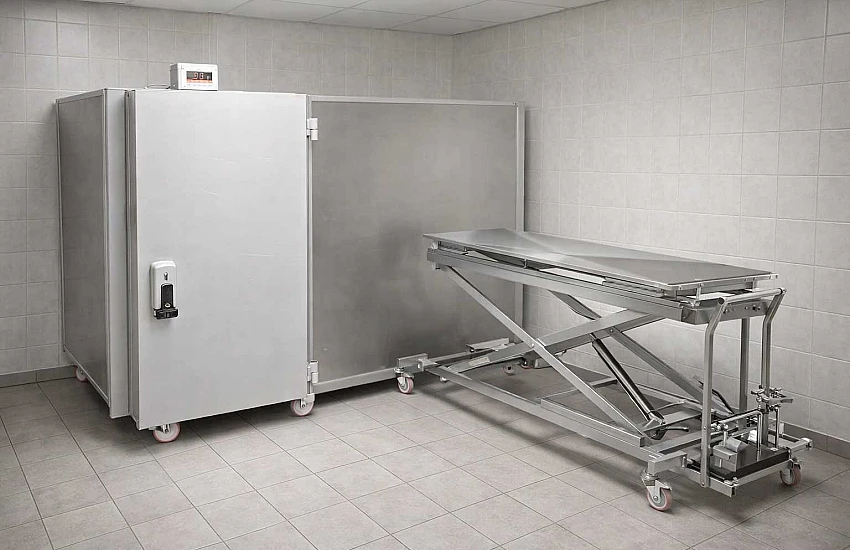
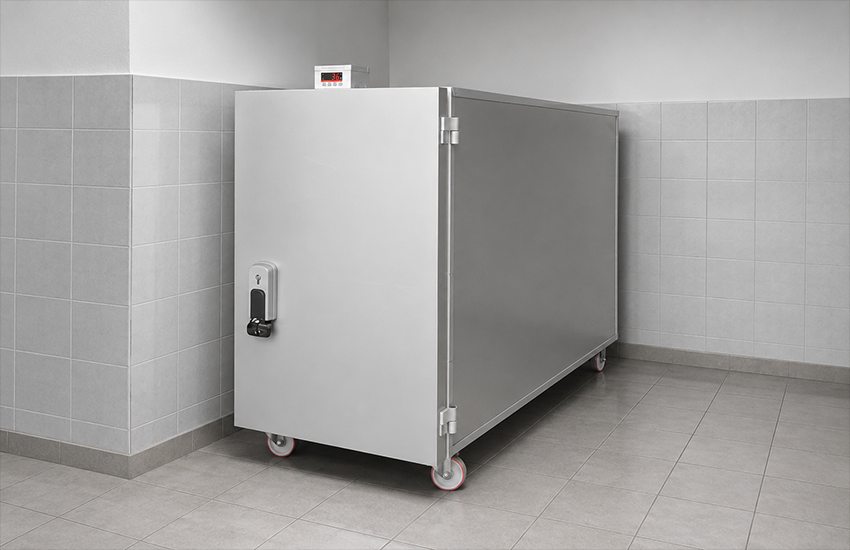
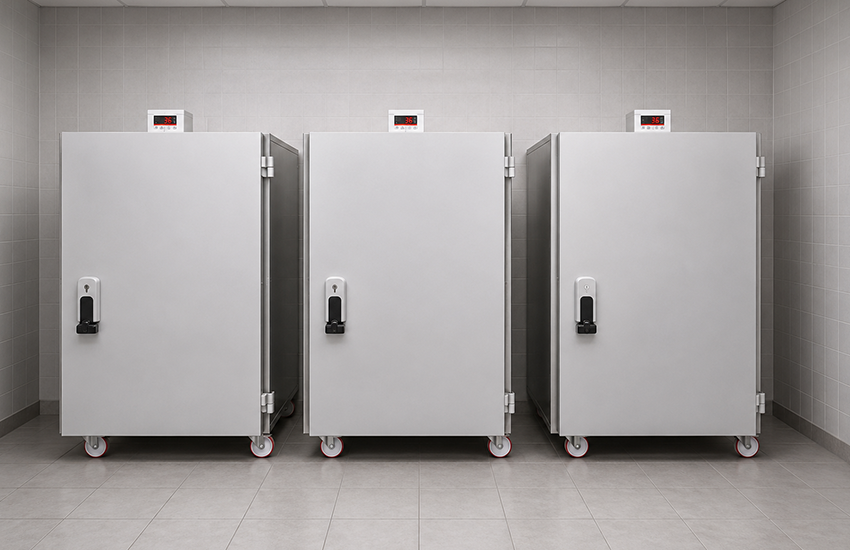
For lower-capacity operations, the ideal choice is the mortuary fridge for 2 bodies from Prima-Tech. This unit measures 260 × 90 × 140 cm, runs on a standard 230V supply and maintains a temperature range of 0°C to +10°C. On request — at an additional cost — the manufacturer offers versions capable of reaching -3°C or -5°C, which is valuable when longer storage periods or specific medical instructions require lower temperatures.
A particularly useful practical feature is the flexibility of refrigeration unit placement: the compressor can be positioned on top of the cabinet or at the rear, allowing the unit to fit into constrained spaces. Installation is carried out by a Prima-Tech technician on site — no need to organise a separate installation crew.
Materials and construction — what makes the difference
The walls of the mortuary fridge are constructed from insulating panels clad externally in lacquered galvanised steel and internally in stainless steel. This combination serves a clear technical purpose: the external cladding provides durability and a clean appearance, while the internal stainless steel resists moisture, is simple to disinfect and does not absorb odours.
The doors are secured with a snap-lock keyed closure — but, critically for safety, can also be opened from the inside. This detail, sometimes dismissed as a formality, is a standard safety requirement in industrial and healthcare environments. The unit rides on castors with brakes, allowing it to be repositioned within the room without additional equipment. The manufacturer's warranty runs to 24 months on the cabinet itself and 12 months on the refrigeration system.
Storage temperature — what the evidence and regulations say
Best practice guidance published by the UK's National Association of Funeral Directors (NAFD) and similar professional bodies across Europe consistently recommends storing bodies at between 2°C and 4°C. At this temperature range, decomposition is effectively arrested for five to seven days without the use of embalming. The WHO's guidance on the dignified management of the dead following mass casualty events cites a target of 4°C or below for temporary storage, a benchmark widely adopted as the baseline standard for professional mortuary practice. For extended storage periods, or in cases where embalming is not undertaken, temperatures at or below 0°C — and optionally down to -5°C — provide additional margin and are the right choice for any facility aiming to meet the highest standard of care.
The hydraulic trolley with foot pump — ergonomics and workplace safety
Even the best mortuary fridge becomes difficult to use effectively without a proper loading tool. Moving bodies without mechanical assistance is not simply physically demanding — it is a documented occupational hazard. Back injuries, slips, falls and accidental damage to the body are all real risks, and they feature regularly in occupational health data for the funeral sector across Europe.
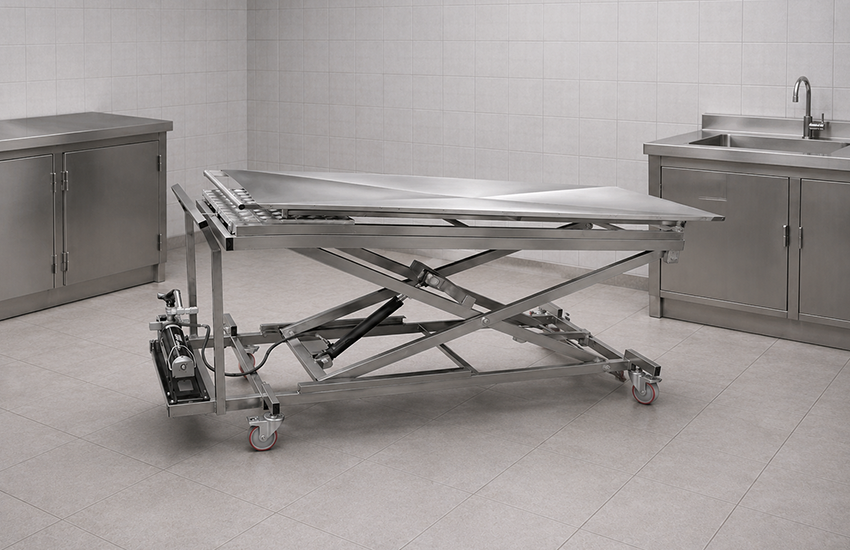
The solution that eliminates these risks is the hydraulic trolley with foot pump from Prima-Tech. It is designed specifically for the mortuary and cold storage environment, with hygiene, ergonomics and operational safety built into every design decision.
How the hydraulic lifting system works
The foot pump mechanism is intuitive and reliable: the operator activates the hydraulic system by pressing a foot lever, which builds pressure to lift the platform smoothly and without jerking. Height adjustment is continuous, allowing the platform to be aligned precisely with the fridge opening — no lifting, no dragging. The lowering speed is adjustable, which is particularly important when handling heavier loads.
The maximum load capacity is 300 kg — comfortably above any real-world requirement. The platform dimensions of 190 cm × 70 cm match standard tray sizes and fridge openings. The maximum lift height of 150 cm corresponds to the loading height of a three-body mortuary unit.
The guide rail — a small detail with a large operational impact
One of the most practically significant construction features is the guide profile that assists entry into the fridge opening. Mortuary work demands precision: the cabinet opening must be hit accurately and the tray must slide onto the runners without repeated positional corrections. In a narrow room with limited manoeuvring space, this guide rail shortens the time of each operation and reduces the risk of equipment damage or injury. Four swivel castors — two with brakes — give full control of movement, with the braked pair locking the trolley firmly in position at the fridge opening during loading and unloading.
Stainless steel construction — the only workable choice
The entire trolley is fabricated from stainless steel. In an environment where aggressive chemical disinfectants are used routinely, biological moisture is a constant presence and hygiene standards are non-negotiable, this is the only sensible material choice. Stainless steel does not react with chlorine-based or aldehyde-based disinfectants, does not corrode under biological fluids and does not retain odours. The surface is smooth and non-porous — ideal for rapid cleaning and disinfection between uses.
From a compliance perspective, the Manual Handling Operations Regulations 1992 (applicable in the UK) and equivalent EU member-state legislation transposing Council Directive 90/269/EEC on manual handling require employers to reduce manual handling risks to the lowest level reasonably practicable. Providing a hydraulic trolley is the most direct and documentable measure available to a funeral home operator for this specific task.
The mortuary tray — the underestimated component that ties the system together
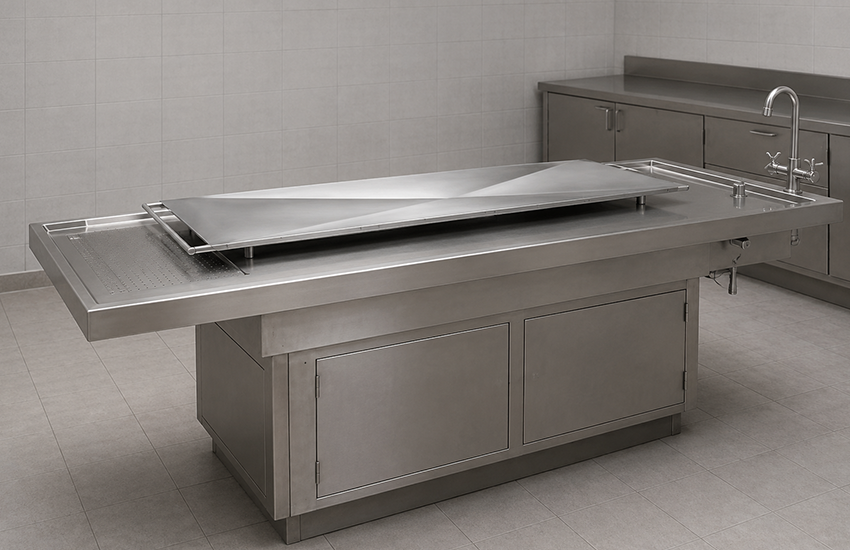
Discussion of cold storage equipment tends to focus on refrigerators and trolleys. Yet the tray to mortuary fridge is the element that connects the whole system and determines the smoothness of every operation — from receiving the body to preparation for the service.
The Prima-Tech tray is fabricated from stainless steel and measures 65 × 215 cm. The 65 cm width is matched to the internal runners of the mortuary fridge and to the trolley platform, eliminating play and ensuring stable, precise movement as the body transfers between equipment. The 215 cm length provides adequate margin for bodies of any height.
Compatibility — the system approach to mortuary equipment
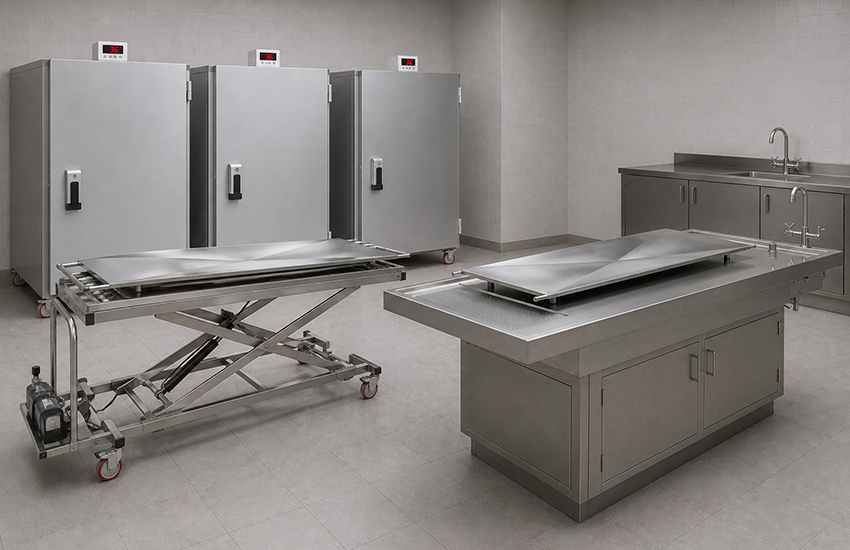
Designing cold storage equipment as a coherent system rather than a collection of separate purchases is an approach that significantly improves both safety and workflow efficiency. The tray, the hydraulic trolley and the mortuary fridge are dimensionally and functionally compatible: the tray fits the fridge runners, the trolley platform carries the loaded tray, and the lifting height of the trolley is calibrated to the fridge opening. Loading and unloading become single, fluid operations — the tray carrying the body is placed on the trolley, the trolley is moved to the fridge, the platform rises to the correct height and the tray slides in without any manual lifting, without the need for additional staff.
The smooth, weld-free stainless steel surface retains nothing — no biological fluids, no chemical residue. Disinfection takes a matter of minutes. This sounds trivial until it is the end of a long shift and the difference between a five-minute clean-down and a twenty-minute one matters considerably.
The system as a whole — why coherent equipment selection matters
A funeral home that purchases cold storage equipment component by component, from different suppliers, frequently runs into compatibility problems or inefficient workflows. A trolley whose dimensions do not match the fridge cabinet, a tray that binds on the runners, a fridge whose compressor placement prevents access with the trolley — these are the standard consequences of piecemeal purchasing. They are also, in many cases, the hidden contributors to workplace injuries and equipment damage claims.
Choosing a complete system from a single manufacturer — mortuary fridge, hydraulic trolley with foot pump and transport tray — eliminates these risks. Prima-Tech designs its products as a coherent ecosystem in which every element accounts for the dimensions and operating requirements of the others. The result is a smooth operational workflow, reduced staff fatigue and a measurably lower risk of incidents.
There is also a reputational dimension worth considering. Families increasingly ask about the conditions in which their loved one has been held — and they are right to do so. A funeral home that can show a clean, modern, professionally equipped mortuary builds trust in a way that no marketing material can replicate. A well-equipped cold storage room is visible evidence of standards that extend beyond the service itself.
The regulatory framework for body storage
The rules governing body storage vary by jurisdiction, but a number of common frameworks apply across much of Europe. In the United Kingdom, funeral homes are subject to the Health and Safety at Work etc. Act 1974, the Management of Health and Safety at Work Regulations 1999 and the Manual Handling Operations Regulations 1992. Public health legislation — including Public Health (Control of Disease) Act 1984 provisions and associated regulations — governs the conditions under which human remains may be held and transported. Local authorities retain powers to inspect premises and issue notices requiring improvements to facilities.
Across the European Union, workplace safety obligations derive from the Framework Directive 89/391/EEC and a series of specific directives, most relevantly the Manual Handling Directive (90/269/EEC) and the Biological Agents Directive (2000/54/EC), which applies to workers who may be exposed to biological agents in the course of their work. Funeral home operators in EU member states must assess and document these risks and demonstrate that they have taken appropriate technical measures — of which providing a hydraulic trolley is the clearest and most immediately effective example.
For funeral homes involved in international repatriation, the Strasbourg Agreement of 1973 (Council of Europe Agreement on the Transfer of Corpses) sets out conditions — including requirements for hermetic coffins and appropriate refrigerated storage prior to transport — that must be met before remains can cross international borders. IATA's Dangerous Goods Regulations also contain provisions relevant to the air transport of human remains, with temperature management requirements that make mortuary refrigeration infrastructure a practical necessity for businesses active in this area.
In all jurisdictions, the documented use of professional-grade equipment — refrigerators with accurate temperature control, ergonomic loading equipment and cleanable stainless steel surfaces — provides the most straightforward evidence of compliance with both the letter and the spirit of applicable regulations.
Planning the mortuary space before purchasing equipment
Before investing in equipment, it is worth conducting a careful assessment of the available space and the intended workflow. The mortuary room must be large enough to allow the hydraulic trolley to be manoeuvred with the fridge doors open. Doorways must be wide enough to admit the fridge cabinet during installation — standard 90 cm openings may be too narrow for two- or three-body units and should be measured before ordering.
Adequate ventilation and convenient access to power supply are also essential. The mortuary fridge runs on a 230V supply and requires a correctly positioned outlet, ideally with surge protection. Flooring should be non-slip, easy to clean and resistant to the disinfectants used in the room — a requirement consistent with health and safety regulations in virtually every jurisdiction.
The placement of the compressor unit deserves separate consideration. The 2-body fridge offers a choice between top-mounted and rear-mounted compressor configurations — this decision should be made with the room height and the planned layout of equipment in mind. The manufacturer's technician will install the compressor on site, allowing the configuration to be adapted to actual site conditions.
Maintaining cold storage equipment in proper condition
Every piece of equipment operating in a mortuary or cold storage environment requires regular maintenance. For the mortuary fridge, the refrigeration system requires periodic inspection: seals, valves, compressor and thermostat should be checked in accordance with the manufacturer's schedule. Prima-Tech provides a 24-month warranty on the cabinet and 12 months on the refrigeration system — sufficient time to develop a maintenance plan before the warranty period expires.
The hydraulic trolley with foot pump requires primarily a regular check of the hydraulic fluid level and the condition of seals. Castors should be lubricated periodically and brake function verified. Both the trolley and the trays should be disinfected after each use with products appropriate for stainless steel. High-concentration chloride-based products should not be left in contact with the surface for extended periods, as prolonged exposure can cause pitting corrosion even in certified stainless steel grades.
Transport trays should be inspected periodically for scratches or mechanical damage that might create micro-spaces resistant to effective disinfection. Where the integrity of the surface is in any doubt, replacement is the correct course of action.
Frequently asked questions
What temperature should a mortuary refrigerator maintain?
Professional guidance from bodies including the UK's National Association of Funeral Directors and the WHO consistently recommends storing human remains at between 2°C and 4°C. At this range, decomposition is effectively arrested for five to seven days without embalming. The Prima-Tech 2-body mortuary fridge operates by default within the 0°C to +10°C range, with optional cooling to -3°C or -5°C available on request for cases requiring extended storage or where specific medical instructions call for lower temperatures.
Is a funeral home required to have its own mortuary refrigerator?
Requirements vary by jurisdiction, but in most European countries the regulatory framework effectively requires funeral businesses holding bodies on their premises to provide conditions that meet prescribed hygiene and temperature standards. Whether that is achieved through owned equipment or a formal arrangement with a licensed facility depends on local licensing rules. In the UK, local authority environmental health officers increasingly expect documentary evidence of appropriate storage conditions as a condition of licensing, and the absence of suitable refrigeration is a common basis for improvement notices.
What does the hydraulic trolley with foot pump do, and why is it necessary?
The hydraulic trolley with foot pump provides the means to load and unload bodies from the mortuary fridge safely and without manual lifting. The foot-operated hydraulic system raises the platform to match the fridge opening exactly, allowing the tray to slide in on its runners with no carrying, no dragging and no risk of the body shifting unexpectedly. This eliminates the primary source of back injuries in the mortuary environment and constitutes the most direct technical measure available for compliance with manual handling regulations. The tray lock prevents uncontrolled movement and the guide profile ensures accurate alignment with the fridge opening first time, every time.
Why do the dimensions of the mortuary tray matter so much?
The Prima-Tech tray measures 65 × 215 cm. The 65 cm width is calibrated to the internal runners of the fridge cabinet and the trolley platform, ensuring stable, play-free movement every time a body is transferred. The 215 cm length accommodates remains of any height. A tray purchased separately from a different supplier may differ by even a few centimetres — enough to cause binding on the runners or instability during transport. Buying the tray, trolley and fridge from the same manufacturer is the straightforward way to ensure dimensional compatibility from day one.
How should stainless steel mortuary equipment be disinfected?
Stainless steel is an excellent material for mortuary use precisely because it resists most disinfectant chemistries. Alcohol-based, glutaraldehyde-based or appropriately diluted hypochlorite-based products are all suitable. The critical point is not to leave high-concentration chloride solutions in prolonged contact with the surface, as this risks pitting corrosion even in quality stainless steel grades. After disinfection, surfaces should be rinsed with water and dried. The smooth, seamless surface of Prima-Tech stainless steel significantly reduces the time required for effective decontamination between uses — an advantage that compounds meaningfully over thousands of cycles of use.
Does the mortuary fridge require professional installation?
The 2-body mortuary fridge is supplied by Prima-Tech with on-site installation of the refrigeration unit carried out by a company technician. The compressor is installed in whichever configuration — top-mounted or rear-mounted — suits the room. DIY installation of refrigeration circuits is not appropriate, as it requires F-gas certification under EU Regulation 517/2014 (or equivalent national provisions in non-EU countries) and specialist knowledge of refrigeration systems. Correct installation is a condition of the warranty and is critical to the unit's long-term efficiency and reliability.
What financing options are available for mortuary equipment?
Prima-Tech offers leasing and instalment purchase options for its equipment. This is particularly relevant for newly established funeral homes or existing businesses undertaking a mortuary upgrade, where the upfront capital cost can be significant. Leasing spreads the cost over a period of manageable monthly payments while keeping the business's working capital available for operational needs. Detailed financing terms are available directly from the manufacturer by telephone at +48 34 328 51 48 or by email at primatech@op.pl.