
Table of Contents
- How a cemetery loader differs from construction machinery
- What tasks does a loader actually perform at a cemetery
- Technical specifications that genuinely matter
- The TOSH JC45 – a compact loader built with cemetery operations in mind
- Assessing the needs of a specific cemetery before purchasing
- Health and safety requirements and legal obligations
- Financing and procurement options
- Operating and maintaining a cemetery loader
- Frequently asked questions
- Conclusion
Managing a cemetery is one of the most demanding tasks within the municipal and funerary services sector. In the United Kingdom alone, more than 600,000 deaths are registered each year, each one generating a direct and immediate need for burial or cremation – and the groundwork that goes with it. Whether a cemetery is operated by a local authority, a parish, or a private operator, it must maintain continuous operational readiness across all twelve months of the year, regardless of weather or season. In this context, appropriately selected mechanical equipment is not a luxury or a nice-to-have: it is the operational foundation on which reliable cemetery management is built.
For generations, cemetery work was almost entirely manual. Grave digging, earth removal, path grading, clearing after burials – all of it depended on physical labour. Today that picture is changing. Rising labour costs, persistent staffing difficulties, and increasingly high service standards are prompting cemetery operators to invest in compact machinery that genuinely reduces the time taken to complete tasks and relieves staff of unnecessary physical strain. At the centre of this shift is the wheeled compact loader – a versatile, mobile machine that, in a cemetery setting, outperforms every other category of heavy equipment.
How a cemetery loader differs from construction machinery
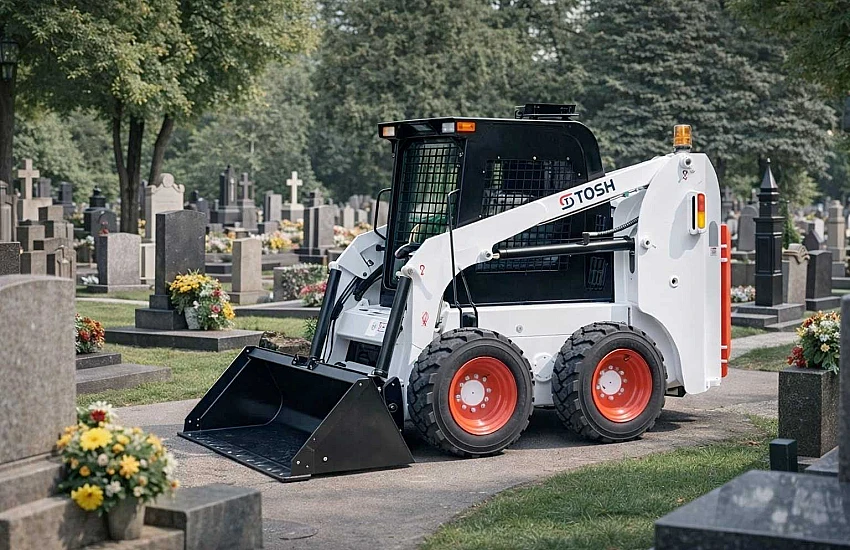
Loaders used on building sites and in industry are engineered for wide open spaces, intensive continuous use, and maximum volumetric output. A cemetery places entirely different demands on a machine. Pathways between grave sections are typically 2.5 to 3.5 metres wide, the density of headstones requires precise manoeuvring, and the varied ground – grass, gravel, paved paths, soft or waterlogged sections – calls for an even distribution of ground pressure to avoid damaging surfaces and disturbing existing graves.
For these reasons, loaders intended for cemetery use are generally compact or mini wheeled loaders with an operating weight not exceeding three tonnes. They have narrower track widths, reduced overall dimensions, and a smaller turning radius than their industrial counterparts. At the same time – and this is the critical point – they retain sufficient lifting capacity and bucket volume to manage real-world tasks: transporting spoil from a grave excavation, levelling ground in a new section, loading rubble after a headstone repair, or clearing snow from paths after an overnight fall.
Noise and exhaust emissions matter equally. A cemetery is a place with a very particular character – funerals in progress, private grief, quiet reflection. A loud machine working in close proximity can undermine the dignity of the space and generate complaints from visiting families. A well-chosen cemetery loader should operate as quietly as possible, and its engine should comply with current emission standards. In Europe, Stage V non-road engine legislation has been in force since 2019, setting strict limits on particulate matter and nitrogen oxide emissions that now represent the benchmark for any new machine purchased by a professional operator.
What tasks does a loader actually perform at a cemetery
Before any manager commits to a particular model, it is worth defining precisely what tasks the machine will be required to carry out day to day. The range of applications for a compact loader at a cemetery is considerably broader than is commonly assumed, and it extends well beyond supporting grave excavation – a task that in most countries is carried out using a compact excavator rather than a loader. A loader is fundamentally a transport and materials-handling machine.
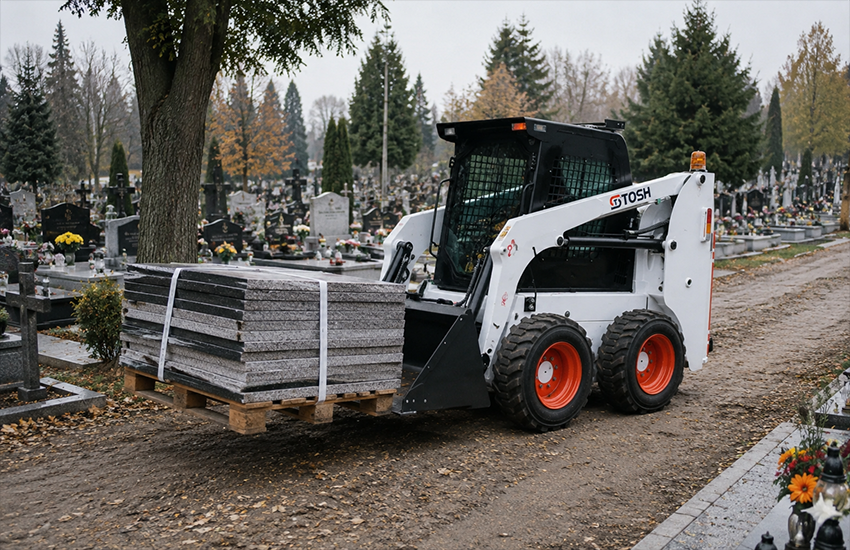
The most frequent tasks include loading and moving spoil from grave excavations, levelling and grading ground ahead of new burial sections, transporting construction materials – paving slabs, kerbing, sand, and aggregate – during path or infrastructure repairs, removing cemetery waste (dead flowers and wreaths, broken memorials, storm debris), and winter maintenance, which on larger burial grounds becomes a logistically critical operation. During peak periods – particularly in autumn and spring – a reliable loader can support the preparation of a dozen or more graves in a single working day, operating continuously from morning to afternoon.
It is also worth remembering maintenance tasks that are rarely listed in sales literature. A loader with sufficient lifting height can assist with the restoration of taller monuments and memorial structures, reaching elements at heights of three metres or more without the need for additional access equipment. This is a capability that becomes genuinely useful when managing large historic cemeteries, where imposing Victorian and Edwardian monuments require periodic conservation work.
Technical specifications that genuinely matter
When comparing loader specifications, marketing materials tend to be dense with figures and model designations. Not all of them carry equal practical weight. The following are the parameters that make a real difference when selecting a machine for cemetery use.
Lifting capacity and bucket volume
Lifting capacity is the maximum load a loader can safely raise and carry. In a cemetery context, the practical optimum sits between 600 and 900 kg. Too low a figure means multiple return trips to move meaningful quantities of earth or heavier memorial elements – wasting time when a burial ceremony is waiting on the prepared grave. Too high a nominal capacity in a small machine can equally be misleading: if the machine's own operating weight is insufficient relative to its claimed lift, it loses stability under load. A bucket volume of 0.35 to 0.45 m³, with a width of around 170 to 180 cm, allows a single pass to shift between 500 and 700 kg of loose earth – sufficient to work efficiently alongside a compact excavator at a standard grave size.
Overall dimensions and ground clearance
At older cemeteries with established infrastructure, pathways can be exceptionally narrow – sometimes less than two metres in the most restricted sections. The working width of the machine, measured with the bucket in the folded or raised transport position, is therefore a critical figure: if it reaches 1.8 metres or beyond, significant parts of the cemetery may be effectively inaccessible. Ground clearance – the distance between the lowest point of the undercarriage and the surface – directly affects the machine's ability to cross kerbs, drainage channels, and softened ground. Values below 150 mm typically result in the machine grounding out on common obstacles, which accelerates wear on the drive system and generates additional service costs over time.
Engine power and drive system
Most cemeteries do not have electrical supply points distributed across the working areas, which means battery-electric machines – however attractive from an environmental standpoint – remain limited in practical use by charging requirements and shift duration. Diesel engines in the 30 to 40 kW range continue to be the most practical choice for cemetery operations: they deliver the torque needed for working in difficult terrain without excessive fuel consumption. Equally important is the availability of service support and spare parts. Not every manufacturer maintains a strong service network in the UK and Ireland, and in an application where the machine may be needed every working day, unplanned downtime during a busy period carries a direct operational cost.
Cab comfort and ergonomics
An operator spending six to eight hours a day in the machine will appreciate a well-designed cab. An enclosed cab with heating is a practical necessity in northern European conditions – cold, rain, and wind are the daily reality of cemetery work for most of the year. Air conditioning extends working comfort during summer months, when the interior of a metal cab exposed to direct sun can reach temperatures that affect concentration and judgement. A hydraulic joystick rather than a mechanical linkage significantly reduces hand fatigue during intensive cycles, with direct benefits for manoeuvring precision and a measurable reduction in incident risk.
The TOSH JC45 – a compact loader built with cemetery operations in mind
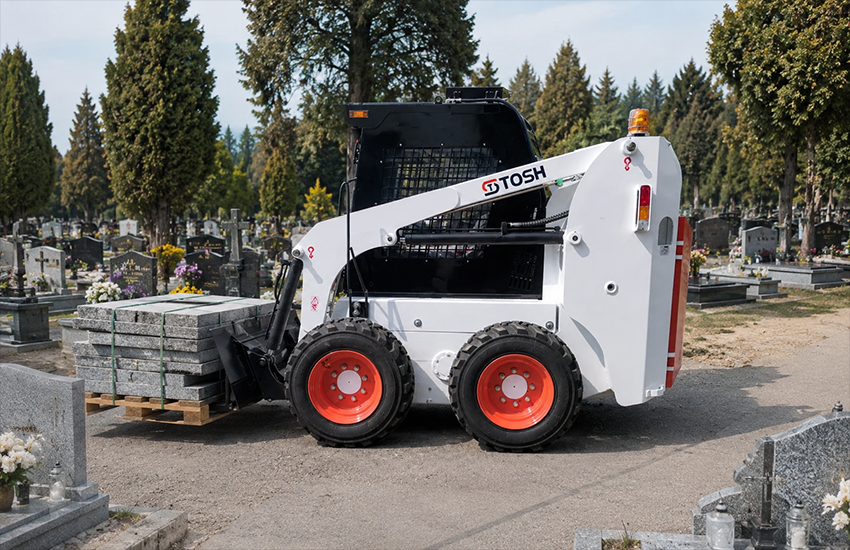
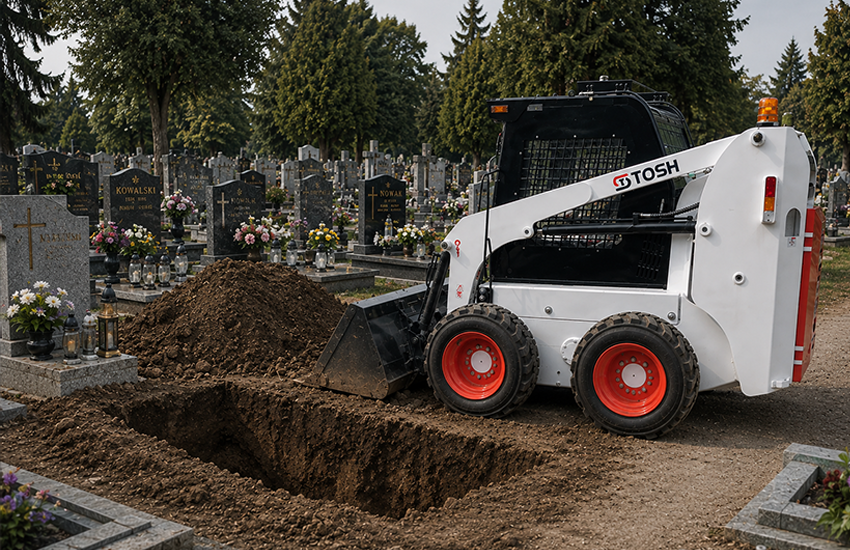
Among the compact loaders available to the professional cemetery and funerary market, the TOSH JC45 – distributed by Prima-Tech S.C. and available through funeraryaccessories.com – stands out as a machine that combines genuinely compact dimensions with working parameters more typical of the medium class.
The machine is powered by a four-cylinder, water-cooled Xinchai diesel engine producing 37 kW. The Xinchai unit has a well-established reputation in demanding operational environments, valued for low fuel consumption and relatively straightforward servicing requirements. At an operating weight of 2,700 kg, the TOSH JC45 is heavy enough to maintain stability at its rated lifting capacity of 700 kg, yet agile enough to navigate narrow cemetery paths without risk to adjacent memorials.
The bucket – 0.4 m³ capacity, 174 cm wide – allows a single pass to move a substantial quantity of earth. For cemeteries with demanding burial schedules, where the time available to prepare a grave directly determines whether the agreed ceremony time can be met, this efficiency has real operational value. A maximum dumping height of 2,380 mm, combined with a maximum working height of 3,980 mm, opens up the possibility of working at taller memorials and monuments without resorting to additional access equipment.
The standard specification of the TOSH JC45 includes an enclosed cab, LED working lights, a mechanical joystick, and 10-16.5 tyres. For operators requiring enhanced working comfort, four factory options are available: hydraulic joystick, cab heating, air conditioning, and a radio. The bucket's 40-degree dump angle allows precise material placement and even distribution – a detail that noticeably improves the quality of ground finishing after a burial. Ground clearance of 185 mm and robust all-terrain tyres ensure the machine can handle the typical challenges of cemetery terrain: uneven ground, kerb crossings, soft post-rain conditions, and winter ice and snow. A travel speed of up to 12 km/h allows rapid movement between sections without additional transport vehicles.
Assessing the needs of a specific cemetery before purchasing
Every cemetery is different. A small village churchyard with a few hundred graves has entirely different requirements from a large municipal burial ground processing several dozen funerals a week. A genuine needs analysis before purchase should take several key factors into account.
The first is burial volume: the annual and monthly number of interments. Cemeteries handling upwards of 500 burials per year – typically larger urban and municipal sites – can generally expect a reasonable return on investment within a few years, provided the machine replaces or substantially supplements the physical work of at least two staff members. At lower volumes, it is worth calculating whether purchase is more cost-effective than hiring equipment on demand.
The second factor is ground layout and path width. The narrowest passages on the site should be measured and compared with the machine's working width in its actual operating configuration – not just the figure given in the brochure. The ground surface should also be assessed: grass and soil, gravel, and hardstanding all place different demands on tyres and ground pressure distribution.
The third element is service availability. A loader at a cemetery is a mission-critical piece of equipment – a mechanical failure on a day when several funerals are scheduled is a serious operational event. It is worth asking the supplier directly about service response times, parts availability, and warranty terms. The TOSH JC45 comes with a 12-month manufacturer warranty, and leasing or instalment financing options – details of which are available directly through the funeraryaccessories.com team – reduce the capital outlay required to get started.
Health and safety requirements and legal obligations
Operating a compact loader at a cemetery is subject to health and safety legislation that any responsible manager needs to understand clearly. In the United Kingdom, the primary frameworks are the Provision and Use of Work Equipment Regulations 1998 (PUWER), the Lifting Operations and Lifting Equipment Regulations 1998 (LOLER), and the Management of Health and Safety at Work Regulations 1999. Together, these require that work equipment is suitable for its intended purpose, properly maintained, and that operators are adequately trained and assessed as competent before being permitted to use it.
There is no single mandatory qualification certificate for compact loader operators in the UK in the way that exists in some other European countries – however, the PUWER requirement for demonstrated competence is effectively met through training delivered by accredited providers such as NPORS or CITB, which issue operator cards recognised across the industry. For cemetery operators outside the UK, equivalent national frameworks apply – and it is worth verifying the current requirements with the relevant regulatory body before placing an operator on the machine.
Separately, working zones should be clearly defined and segregated whenever a machine is operating in an area open to the public. A cemetery where families are visiting graves while groundworks are in progress presents a real safety risk that requires active management. Temporary barriers and retractable-tape posts are the standard solution for delineating working areas quickly and visibly – funeraryaccessories.com stocks a range of barrier posts with retractable tape that are well suited to this purpose and can be deployed and retrieved in a matter of minutes.
Environmental considerations also merit attention. Cemeteries located near water sources or within designated conservation areas may be subject to restrictions on the use of diesel-powered equipment. The local planning authority's conditions and any relevant environmental permits should be reviewed before committing to a particular machine specification.
Financing and procurement options
A compact cemetery loader represents a capital investment that typically falls in the range of £80,000 to £130,000 depending on specification and optional equipment. For many cemetery operators – particularly those working within parish structures or smaller local authority budgets – committing that sum as a one-off capital purchase may not be realistic in a single financial year.
Leasing is by far the most common financing route for cemetery and municipal machinery in this bracket. An operating lease allows the machine to be in use from day one in exchange for regular monthly payments, without a large initial capital outlay. Lease payments can often be structured as an operational expense rather than a capital item, which has accounting advantages for many organisations. Finance lease and hire purchase arrangements offer alternative structures for operators who wish to own the machine at the end of the agreement. For public sector operators – district and borough councils, parish councils, and burial authorities – the route may instead lie through capital programme budgets, with the possibility of external funding via rural development or community infrastructure schemes depending on location.
Whatever the financing route, the key practical step is to contact the funeraryaccessories.com sales team directly to discuss the available options for the TOSH JC45. Pricing varies depending on optional equipment and delivery arrangements, and the team can advise on the most suitable configuration for a specific site and budget.
Operating and maintaining a cemetery loader
The long-term reliability and value of any machine depend as much on the quality of day-to-day care as on the quality of its construction. A loader working at a cemetery is used in conditions that are genuinely demanding in ways that are easy to underestimate: high dust levels during dry periods of earthwork, sustained contact with moisture and ground salt used on winter paths, and relatively short but intensive working cycles that place intermittent stress on all mechanical systems.
Daily pre-use checks by the operator should cover engine oil and hydraulic fluid levels, tyre condition and pressure, visual inspection of the bucket and lifting arms for cracking at welds, and confirmation that lights and the horn are working. Scheduled service intervals – typically every 250 to 500 machine hours, depending on the manufacturer's specification – represent the minimum maintenance programme necessary to keep the machine in reliable condition throughout its service life. Skipping or deferring service visits is a false economy: the cost of unplanned component failures almost always exceeds the cost of the maintenance that would have prevented them.
Appropriate storage makes a material difference to the rate at which a machine ages. A loader kept under cover in a dry garage or agricultural building deteriorates far more slowly than one left outdoors through a British winter. Corrosion on structural members, degradation of hydraulic seals, and deterioration of electrical connections are the predictable consequences of inadequate weatherproofing – all of them avoidable with modest investment in sheltered storage.
Frequently asked questions
What training and certification does a compact loader operator need in the UK?
UK law does not prescribe a single mandatory licence for compact loader operators, but PUWER 1998 requires that any person using work equipment is demonstrably competent to do so safely. In practice, competence is established through training with an accredited provider – NPORS and CITB are the most widely recognised bodies in the UK – resulting in an operator card that is accepted across the construction, groundworks, and civil engineering sectors. Cemetery operators should document all training and keep records of operator assessments on file, as these would be the first items inspected by the Health and Safety Executive in the event of an incident.
What is the practical difference between a compact loader and a compact excavator for cemetery work?
They are complementary machines that serve different purposes, rather than alternatives to each other. A compact excavator is designed for precision vertical work – digging graves to the correct depth and profile. A compact loader is primarily a horizontal transport and materials-handling machine – moving spoil, delivering aggregates, clearing waste, grading ground. Loaders travel faster between sections, carry larger loads, and are more efficient in surface-level operations. On larger burial grounds, both machines are frequently used together: the excavator digs the grave while the loader immediately moves the spoil to a designated tipping point.
Will the TOSH JC45 fit on cemeteries with narrow pathways?
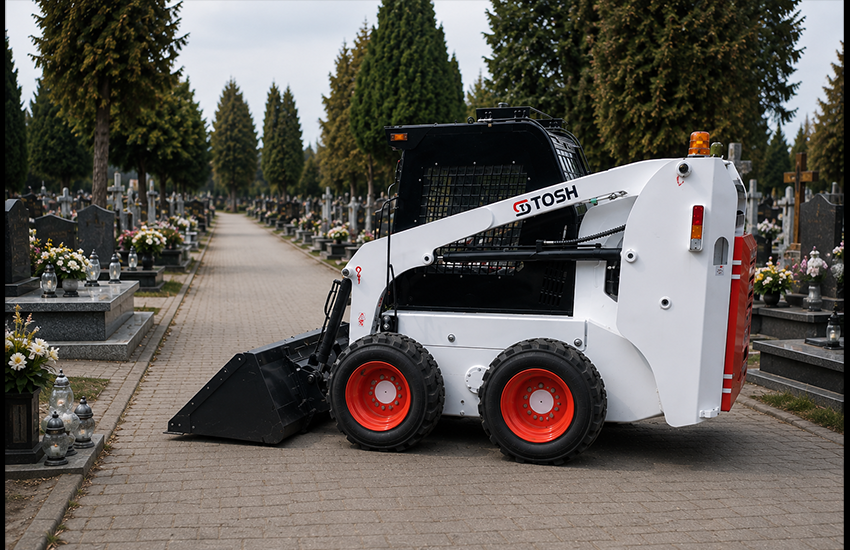
The TOSH JC45 has an overall working width of 1,740 mm with the bucket, which means it can move freely along pathways of at least two metres. Before purchasing, the narrowest passages on the site should be measured and compared with the machine's dimensions in the configuration that will actually be used in practice. The manufacturer gives overall dimensions of 3,420 x 1,740 x 2,140 mm including bucket, placing the JC45 firmly in the compact class suitable for most modern municipal and church cemeteries.
How often does a cemetery compact loader need servicing?
At a typical cemetery workload of four to eight hours per day for most working days, scheduled service intervals fall every 250 to 500 machine hours. In practical terms, this works out to roughly two or three services per year. Each service covers oil and filter changes, a hydraulic system check, and inspection of the drive and lifting systems. Keeping to the service schedule is a condition of maintaining the warranty – the TOSH JC45 carries a 12-month manufacturer warranty from the date of delivery.
Can the TOSH JC45 be purchased on a leasing or finance arrangement?
Yes. The TOSH JC45 is available with leasing and instalment financing options, making it accessible to operators who prefer to spread the investment rather than commit a large capital sum upfront. Contact the funeraryaccessories.com sales team directly to discuss the available financing structures, as the most suitable arrangement will depend on the type of organisation – private cemetery operator, local authority burial service, or religious organisation – and its accounting requirements.
What optional equipment can be added to the standard TOSH JC45 specification?
The base machine comes with an enclosed cab, LED lighting, and a mechanical joystick. Four factory options are available: a hydraulic joystick (which substantially improves control precision and reduces operator fatigue during intensive use), cab heating (essential for comfortable winter operation), air conditioning (recommended wherever summer temperatures make extended cab work uncomfortable), and a radio. Each option can be specified independently, allowing the machine to be configured precisely to the requirements and budget of the individual buyer.
Is the TOSH JC45 suitable for working on sites with natural stone memorials and granite headstones?
Yes, but with important caveats around operator training and situational awareness. The loader is not designed for work in direct contact with memorials – its role is to service the working areas, pathways, and earth zones around burial plots. Where it is used to transport heavy natural stone elements during restoration projects, appropriate protective packing and lifting attachments should be used, and the operator must maintain full control of bucket movement throughout. Sites with particularly dense memorial layouts should assign an operator with a minimum of one year's experience working in cemetery environments, and ideally appoint a banksperson to guide the machine in congested sections.
Conclusion
The mechanisation of cemetery operations is an increasingly unavoidable direction of travel for any organisation that takes the management of a burial ground seriously. Rising labour costs, service quality expectations, and the day-to-day reality of staffing make the compact loader less of a discretionary investment and more of an operational necessity – one that typically begins to repay itself within a few years through reduced manual labour requirements and faster turnaround on grave preparation. The key to a successful purchase is selecting a machine with the right balance of compact dimensions and genuine working capability.
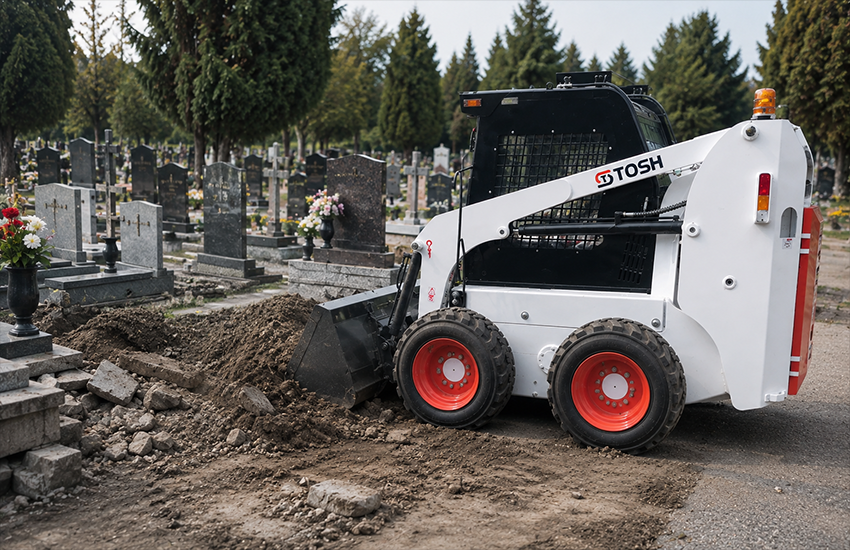
The TOSH JC45 available through funeraryaccessories.com brings together 37 kW of engine power, 700 kg of lifting capacity, a 0.4 m³ bucket, 185 mm of ground clearance, and a flexible equipment configuration in a package that suits both large municipal burial grounds and smaller parish or private cemeteries equally well. With financing options available and a 12-month warranty included as standard, it represents a credible, well-specified choice for any operator ready to invest in the equipment that modern cemetery management demands.