Table of Contents
- Underwater necropolises – when the ocean becomes the final home
- Vertical cities of the dead – cemeteries reaching for the clouds
- Hanging coffins – graves suspended on cliff faces
- Catacombs and ossuaries – architecture built from human bones
- The City of the Dead in Cairo – a necropolis where the living dwell
- The Merry Cemetery in Săpânța – when mourning gives way to joy
- Okunoin – the forest labyrinth of Mount Koya
- The cemetery in Longyearbyen – where no one is allowed to die
- The Old Jewish Cemetery in Prague – twelve layers of history
- Woodland cemeteries and natural burials – greenery instead of marble
- What modern funeral providers can learn from the world's necropolises
- Frequently asked questions
Cemeteries are one of the oldest and most universal inventions of human civilisation. While every culture confronts the subject of death in its own way, burial sites reflect not only religious belief but also geography, social status, and even the economics of the places where they are built. While most of Europe and North America still associates cemeteries with the familiar pattern of headstones arranged in rows beneath a cross or memorial plaque, elsewhere in the world there are burial places that defy every expectation – necropolises sunk to the ocean floor and high-rise buildings that house tens of thousands of crypts on dozens of floors.
Exploring these unusual solutions matters beyond mere cultural curiosity. For funeral directors, cemetery administrators, and architects designing memorial spaces, these examples are above all a source of inspiration and a window onto global trends that may sooner or later reach the markets in which they operate. Vertical necropolises in Brazil, ecological forest cemeteries in Germany, underwater memorial reefs off the coast of Florida – each emerged as an answer to a specific challenge: lack of land, climate change, maintenance costs, ecological awareness. Each of these solutions carries lessons worth knowing, even where local traditions remain firmly rooted in conventional forms of burial.
In this article we take you on a journey through twelve of the most extraordinary cemeteries and necropolises in the world. We will see how differently humanity treats its dead and how deeply funerary tradition is woven into local landscapes, religions, and histories.
Underwater necropolises – when the ocean becomes the final home
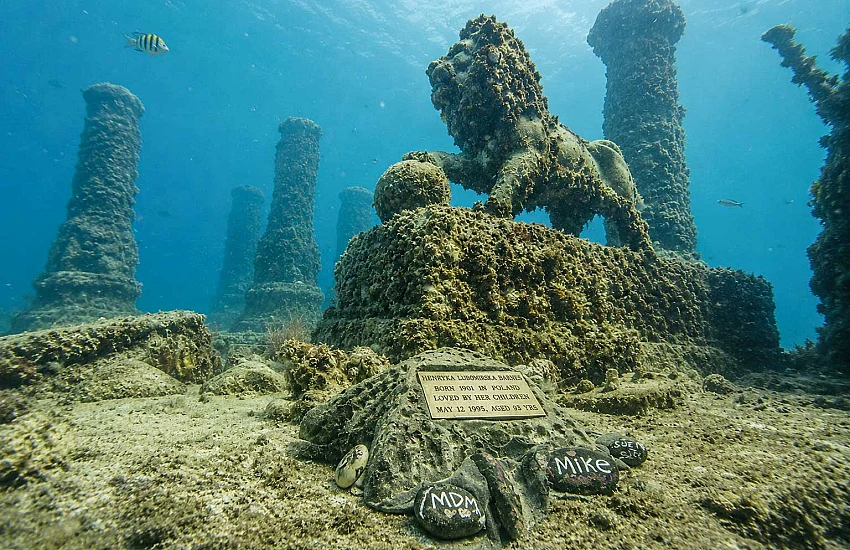
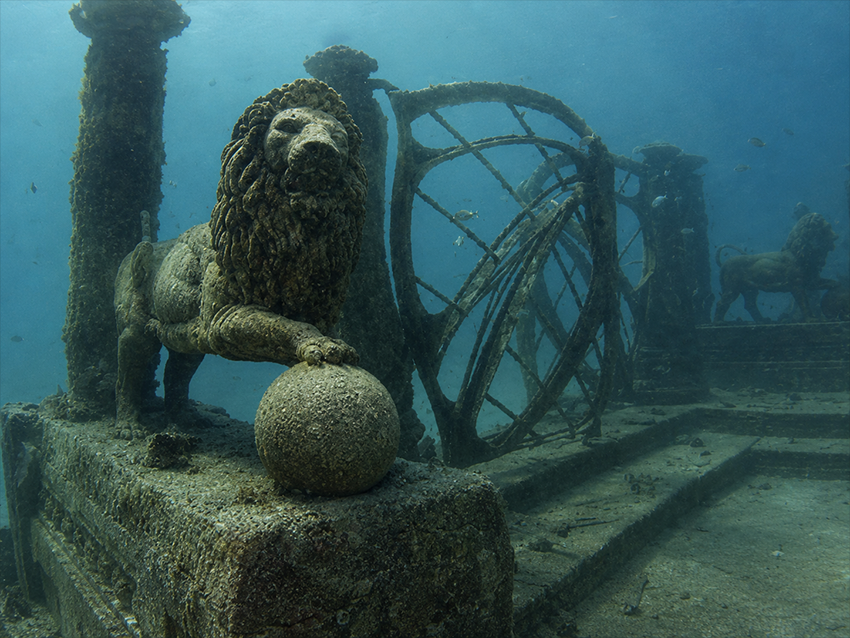
In 2007, just off the coast of Key Biscayne in Florida, a place opened that redefines the very idea of a cemetery. The Neptune Memorial Reef is the first commercial underwater necropolis in history, designed simultaneously as a burial site for human cremated remains and as an artificial coral reef. The complex covers approximately six hectares at a depth of twelve metres and is intended to accommodate more than one hundred thousand individuals over time. Its architectural inspiration comes from the legendary lost city of Atlantis – divers who descend to the seabed encounter columns, archways, stone lions, and a vast gateway, as if they had just stumbled upon the ruins of an ancient civilisation hidden beneath the Atlantic.
How underwater burial works
The cremated remains of the deceased are mixed with a marine cement biocompatible with the reef ecosystem and shaped into an object – a shell, a sphere, a starfish, or an architectural element – which is then placed within the development. Over time the structure becomes colonised by corals, sponges, anemones, and other marine organisms, eventually becoming a permanent part of the ecosystem. Loved ones can visit the burial site during recreational dives, and each object carries a plaque bearing the name and dates of the deceased. From an ecological standpoint the solution has indisputable advantages – artificial reefs provide shelter for fish, crustaceans, and molluscs, helping to restore degraded marine biotopes. For families with emotional ties to the sea – sailors, divers, lifeguards, fishing communities – this form of burial also becomes an expression of the deceased's personal bond with the water.
Followers in other parts of the world
The success of Neptune Memorial Reef has inspired similar projects in other countries. In Massachusetts, Eternal Reefs has been creating "memorial reef balls" scattered along the eastern coast of the United States since 1998. Similar projects have appeared off the coasts of Italy, where Europe's first underwater necropolis was established near Genoa, and along the shores of Spain and Thailand. Importantly, this type of burial is fully compliant with international maritime conventions, including the 1996 London Protocol regulating the dumping of waste at sea – provided suitable biocompatible materials are used and the appropriate distances are maintained from protected areas and shipping lanes. In the United Kingdom, sea burial is permitted at three designated sites: off the Needles on the Isle of Wight, off Newhaven, and off Tynemouth, subject to a licence from the Marine Management Organisation.
Vertical cities of the dead – cemeteries reaching for the clouds
The traditional European conception of a cemetery is horizontal – avenues, sections, rows of graves. In rapidly urbanising countries of South America, however, this model has become economically unsustainable. The solution? Vertical necropolises – high-rise buildings where, instead of flats, one finds burial niches, chapels, and crematoria.
Memorial Necrópole Ecumênica – the tallest cemetery in the world
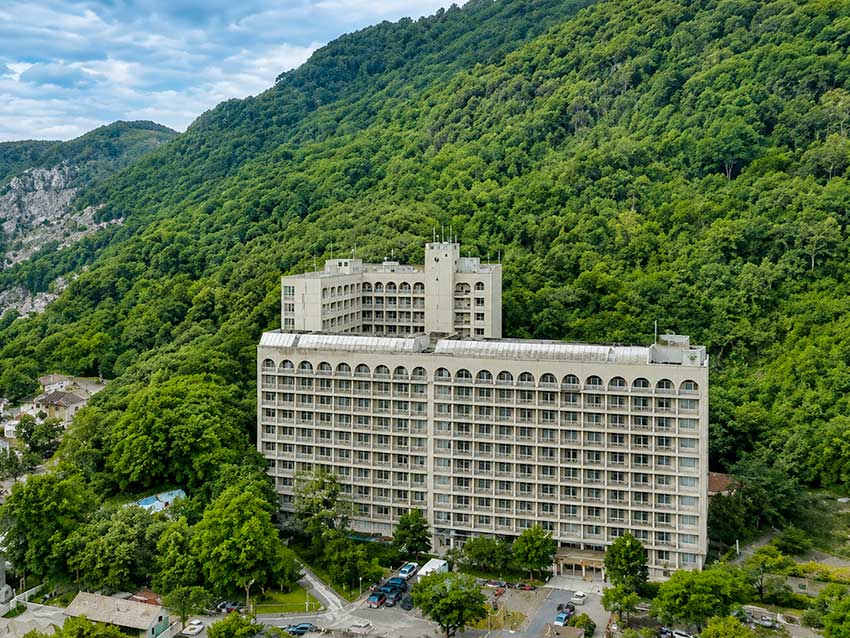
In the Brazilian city of Santos, in the state of São Paulo, stands the Memorial Necrópole Ecumênica – an object recorded in the Guinness Book of Records as the tallest cemetery in the world. The thirty-two-storey building rises 108 metres into the sky and accommodates close to fourteen thousand burial niches. Each floor has its own character; certain levels function as a crematorium, a mortuary, or chapels. From the rooftop terrace one can admire a panorama of the port, and the complex also houses ceremony halls, a restaurant, a multi-faith chapel, and family rooms.
The building's emergence in 1983 responded to very real problems. Santos – a port city with limited land – had no room to bury its dead in the conventional manner. The vertical cemetery allowed a single small plot to hold as many interments as a traditional cemetery covering several hectares. The solution has also been praised on ecological grounds – a smaller footprint means less conversion of green areas and reduced maintenance costs, which in conventional necropolises consume substantial budgets devoted to looking after lawns, paths, and fencing.
Vertical necropolises beyond Brazil
Although Memorial Necrópole Ecumênica remains the record holder, other countries are experimenting with the format. In Valencia, Spain, the multi-storey Cementerio Nuevo San José operates with burial niches arranged in tall, multi-tier walls. In Hong Kong – a city where, due to severe shortages of land, the cost of a single burial plot can exceed the price of a flat – vertical columbaria have become the dominant form of interment. Government programmes for new vertical facilities are an attempt to respond to a crisis in which families sometimes wait several years for a place for their loved ones. In Tel Aviv, Israel, a multi-level underground cemetery has opened – tunnels carved into rock hold thousands of niches, with the site planned to expand to as many as eight levels.
Hanging coffins – graves suspended on cliff faces
Far from urban civilisation, in remote regions of Southeast Asia and southern China, one can encounter a burial practice so astonishing it is hard to believe it is still being carried out. This is the tradition of suspending coffins on vertical rock faces, sometimes several dozen metres above the ground.
Sagada in Mountain Province, Philippines
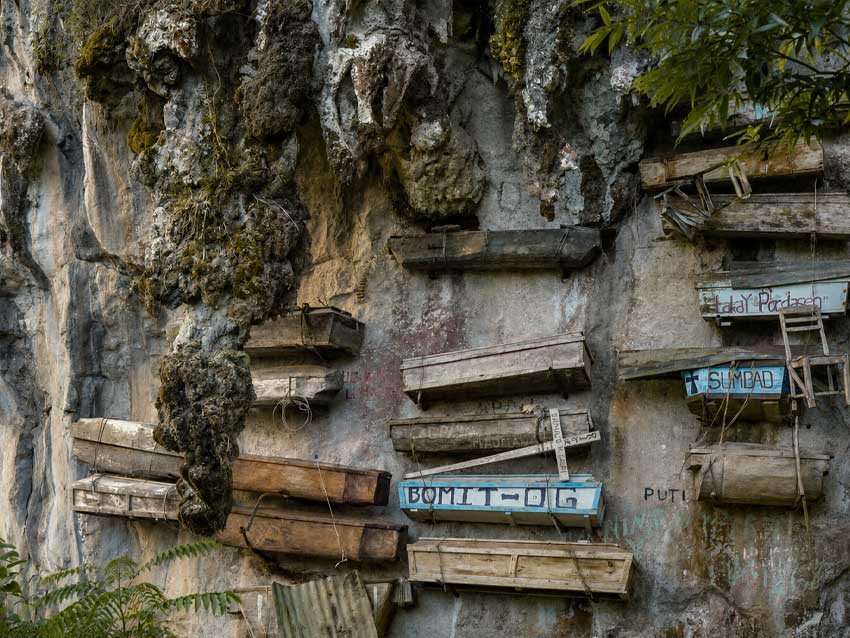
In the mountains of Mountain Province, in the northern part of the island of Luzon, lies the small town of Sagada – known worldwide for the hanging coffins of the Igorot people. The tradition stretches back more than two thousand years. While still alive, the deceased carves their own coffin from a pine trunk, treating it as one of the most important tasks of old age. After death, the body is placed in a foetal position, and the coffin is fixed to the rock face using wooden pegs or suspended within caves. The higher the coffin is placed, the closer – in Igorot belief – the soul comes to heaven and to the ancestors. The tradition has endured despite the Christianisation of the region, and some Catholic families in Sagada still combine a church ceremony with the placing of a coffin on the family cliff.
Tana Toraja in Indonesia
More dramatic in form is the tradition of the Toraja people in South Sulawesi province, Indonesia. Here a funeral is a process lasting many months – and sometimes many years – during which the body of the deceased is embalmed and kept in the home, treated essentially as if still alive. Only after sufficient funds have been gathered for the funeral ceremonies, which involve the entire village, is the body placed in a coffin and interred – in a cave, on a rocky shelf, or in a wooden balcony hewn into the cliff face. A distinctive feature of this tradition is the tau-tau – wooden effigies resembling the deceased, placed on rock ledges beside the graves. From an outside observer's perspective, the entire mountain seems to gaze with sightless eyes upon the tourists who come to visit.
Catacombs and ossuaries – architecture built from human bones
Few traditions inspire as much fascination – and unease – as ossuaries: structures in which the bones of the dead have been used as finishing material. In Western and Central Europe such places arose primarily in the medieval and early Baroque periods, when churchyards were regularly cleared and the disinterred remains transferred to dedicated rooms or chapels.
The Catacombs of Paris
The most famous example is the Catacombs of Paris – a network of underground tunnels approximately 320 kilometres in total length, in which the remains of more than six million people lie. They were created in the late eighteenth century in response to the catastrophic state of Parisian cemeteries, particularly the notorious Cimetière des Innocents, whose soil had become so saturated with burials that decomposing remains had begun to seep into the cellars of neighbouring buildings. Between 1786 and 1788 the Parisian authorities ordered the exhumation and transfer of the remains to disused quarries on the southern outskirts of the city. The bones were later arranged in geometric patterns – walls of skulls, columns of tibiae, compositions of femurs. Today a small portion of the catacombs is open to visitors and ranks among the most popular tourist attractions in Paris.
The Sedlec Ossuary – the chapel of skulls
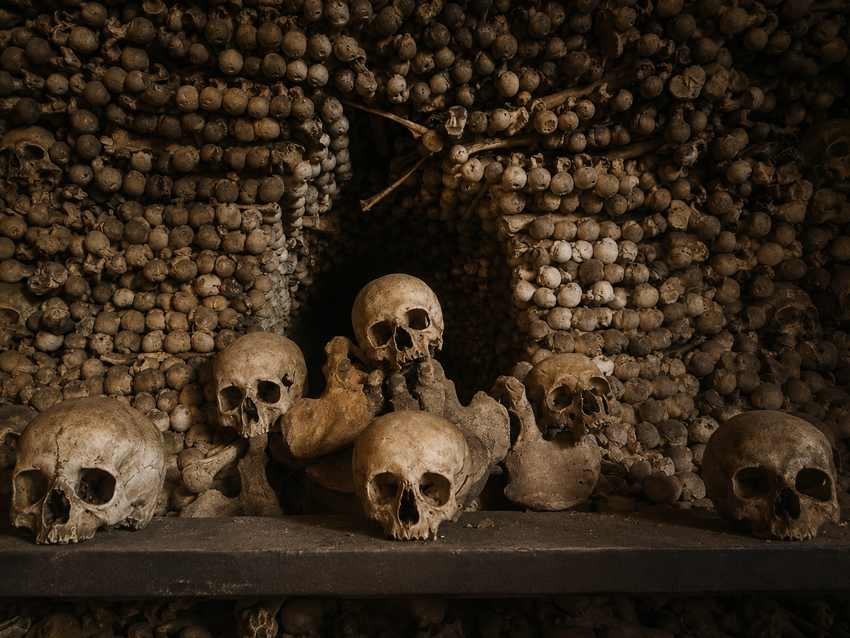
In the Czech town of Kutná Hora, in a small chapel attached to the cemetery in Sedlec, stands one of the most arresting sites in Europe. The Chapel of All Saints holds chandeliers, decorations, chalices, and even the Schwarzenberg family coat of arms, all crafted entirely from human bones. The tradition of placing remains here began in the thirteenth century, when the abbot of the Cistercian monastery brought back a handful of earth from Golgotha in Jerusalem and scattered it on the Sedlec cemetery. From that moment the area gained the status of especially sacred ground, and demand for burial there was so great that the cemetery had to be expanded repeatedly, with the previously buried bones being moved into the chapel. In 1870 a local woodcarver, František Rint, was commissioned to organise the bones – and it was he who created the present arrangement, which includes an ornamental chandelier said to contain every bone in the human body. Beneath the chapel rest an estimated forty thousand individuals.
Capela dos Ossos in Évora
In the Portuguese city of Évora, within a Franciscan monastery, stands the Capela dos Ossos – the Chapel of Bones. Its walls are lined with the remains of approximately five thousand people, and above the entrance is inscribed an unsettling motto: Nós ossos que aqui estamos pelos vossos esperamos – "We bones, lying here, await yours." The purpose of such a composition was pedagogical – the monks sought to remind the living of the impermanence of earthly existence and the need for spiritual preparation. From an art-historical perspective, the Capela dos Ossos is one of the most important examples of Baroque memento mori aesthetics, in which death was not a taboo but a constant element of daily reflection.
The City of the Dead in Cairo – a necropolis where the living dwell
On the outskirts of historic Cairo lies an area known as El Arafa – the Arabic word for cemetery, though the more evocative name is the City of the Dead. This is an enormous necropolis covering roughly six square kilometres, in which sultans, warriors, scholars, and ordinary inhabitants have been buried for more than a thousand years. The oldest tombs date back to the seventh century.
What makes El Arafa unique is the fact that it is not merely a cemetery. Among the tombs and mausoleums live anywhere between two hundred thousand and half a million people – the exact number is difficult to estimate because much of the settlement is not officially registered. Residents occupy rooms originally intended for the rest of visiting families (in Muslim tradition it is customary to visit the dead on specific days of the year) and adapt them for everyday life. Within El Arafa there are shops, schools, electrical wiring, and water mains. Some families have lived there for generations, caring for specific tombs in return for the right to remain – a kind of informal cemetery work without parallel anywhere else in the world.
In recent years the Cairo authorities, as part of urban modernisation and the construction of new motorways, have carried out extensive demolitions within the necropolis. These decisions have provoked controversy – El Arafa is inscribed on the UNESCO World Heritage List and represents an invaluable testimony to a thousand years of Egyptian history. Activists are fighting to preserve the oldest tombs, arguing that their loss would mean the irrevocable destruction of a unique archive of Islamic culture.
The Merry Cemetery in Săpânța – when mourning gives way to joy
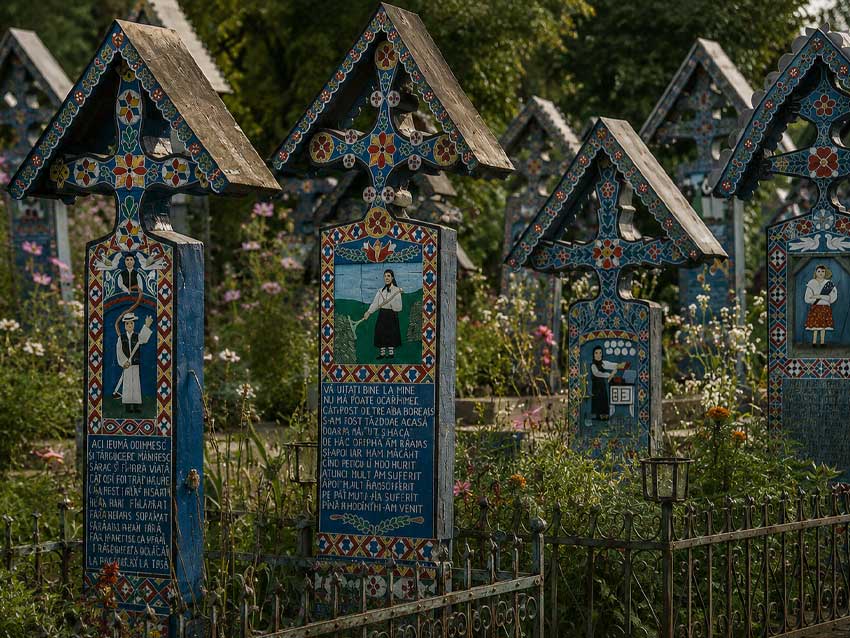
For anyone seeking a counterpoint to the stereotype of cemeteries as places of gravity and sorrow, the destination is northern Romania, the village of Săpânța in the Maramureș region. Cimitirul Vesel – the Merry Cemetery – is a burial ground whose headstones are painted in bright colours, and each one bears a short verse, often humorous, describing the life and even the flaws of the deceased.
The tradition began in 1935, when the local woodcarver Stan Ioan Pătraș started carving wooden grave crosses and decorating them with naïve paintings showing the deceased engaged in their characteristic activity – a woman with a wooden spoon cooking dinner, a man tending his sheep, a soldier in uniform, even a drinker at his table with a bottle. Each headstone is also accompanied by a versed epitaph, most often in the first person, in which the deceased speaks about themselves. The cemetery today contains more than eight hundred such crosses, and the tradition is continued by the master's apprentice, Dumitru Pop Tincu. The cemetery attracts visitors from around the world and is listed as part of Romania's national cultural heritage.
From the standpoint of European mourning traditions, the Merry Cemetery is interesting not only for its artistry but as a manifestation of an entirely different relationship with death. The folk beliefs of the Maramureș region associate death not with an ending but with passage to another world in which the deceased continues to exist. That is why the headstones portray a specific person with their personality, weaknesses, and talents, rather than an idealised, monumental version.
Okunoin – the forest labyrinth of Mount Koya
On the island of Honshu, in the mountains of Wakayama Prefecture, lies the sacred Mount Koya – seat of the Shingon school of Buddhism, founded in 819 by Kūkai, posthumously known as Kōbō-Daishi. At the foot of the mountain extends Okunoin – the largest cemetery in Japan, in which more than two hundred thousand individuals rest, including members of the most famous samurai clans: the Tokugawa, the Oda, and the Toyotomi.
The cemetery has something of the fairy tale about it. The avenue leading to Kūkai's mausoleum, two kilometres long, runs through an old cedar forest in which some trees are over a thousand years old. Among the trunks stand thousands of stone memorials – traditional gorintō pagodas, stone lanterns, and family tombs. On a misty morning the place feels otherworldly, as if it existed outside time. The Shingon Buddhists believe that Kūkai did not die but merely entered eternal meditation in his mausoleum, and so every day, twice a day, monks bring him a meal – the Shōjingu ceremony, performed without interruption for over twelve hundred years.
Okunoin is a cemetery that combines religious contemplation with natural harmony. For those managing burial space elsewhere in the world, the inspiration here lies above all in the integration of the cemetery with a natural forest – an idea to which European tradition is increasingly returning through the so-called woodland burial movement.
The cemetery in Longyearbyen – where no one is allowed to die
On the Svalbard archipelago, in Norwegian Longyearbyen – the world's northernmost town – there is a cemetery where no one has been buried since 1950. The reason is extraordinary: the permafrost does not allow bodies to decompose. The remains of the deceased are preserved practically in pristine condition, and predators, polar bears in particular, can dig the bodies out of the ground.
What is more, in 1998 scientists exhumed one of the bodies from the time of the Spanish flu epidemic and found active viruses from 1918 within it – a discovery that confirmed Arctic soil to be a near-perfect preservative for both microbiology and organic matter. For this reason, the terminally ill are flown by aeroplane to the mainland, where they ultimately die and are buried. In practice this means that in Longyearbyen one "is not allowed to die" – though of course this is not legally prohibited, the social system simply rules it out. The remarkable situation of Svalbard shows how strongly climatic conditions shape funerary traditions, and how thoroughly even fundamental cultural assumptions must be adapted to local geography.
The Old Jewish Cemetery in Prague – twelve layers of history
In Prague's Josefov, at the heart of the former Jewish ghetto, lies one of the oldest preserved burial sites in Europe. The Old Jewish Cemetery was founded in the first half of the fifteenth century and remained in use until 1786. Throughout this period it was impossible to physically expand its boundaries – Prague did not permit the Jewish cemetery to extend beyond the designated ghetto. The solution? Multi-layered burials.
It is estimated that in some places the cemetery contains up to twelve layers of graves. Each successive layer was covered with earth, and the earlier matzevot – the stone gravestones – were brought up to the surface and placed alongside the new ones. Today, on an area of roughly one hectare, more than twelve thousand gravestones stand, while the number of people resting beneath the ground is estimated at one hundred thousand. The most famous person buried here is Rabbi Judah Loew ben Bezalel – mystic master and creator of the legendary Golem – whose tomb is visited daily by thousands of pilgrims who leave small stones upon it as a gesture of remembrance. The Prague cemetery offers a splendid lesson in how spatial and religious constraints can produce solutions unparalleled elsewhere – verticality understood not as a high-rise, as in Brazil, but as the layered superimposition of generations one upon another.
Woodland cemeteries and natural burials – greenery instead of marble
Over the past two decades, particularly in Scandinavian, German-speaking, and Anglophone countries, the idea of natural burials has spread rapidly. Memorial forests, ecological meadows, and biological zones offer an alternative to the conventional cemetery, founded on the principle that the body of the deceased should return to nature without unnecessary intervention.
The first modern memorial forest was established in 1993 in Carlisle, England, where Ken West – then bereavement services manager at the local council – proposed the concept of "green burial": interment in a textile coffin or entirely without one, in a forest where the deceased is marked not by a headstone but by a planted tree. Today the United Kingdom has more than three hundred such sites, registered with the Association of Natural Burial Grounds and supported by the Natural Death Centre. In Germany, the RuheForst and FriedWald networks together comprise close to 250 woodland cemeteries, in which the ashes of the deceased are interred at the roots of mature trees. In the United States, the Green Burial Council certifies a growing number of natural burial sites across more than thirty states. The trend reflects rising environmental awareness and a generational shift in attitudes toward the ceremony of farewell.
What modern funeral providers can learn from the world's necropolises
Each of the cemeteries described above came into being in response to a specific combination of conditions – geographical, religious, economic, or social. The funeral market in Europe and North America, while rooted in well-established tradition, is likewise responding to certain global currents. Families increasingly ask about cremation, ecological burial, and solutions that allow them to bid farewell to loved ones in a less formal and more personal way.
This does not mean, however, that traditional forms of commemoration are losing their significance. On the contrary – amid this growing diversity, the choice of a classic, well-crafted funeral cross remains for many families the strongest expression of respect and faith. The cross as a symbol accompanies the deceased from the moment of farewell in the chapel, through the funeral procession, all the way to the place of final rest. For funeral directors, having the right range of products in this category is one of the most important elements of their offer. In our category of funeral crosses you will find classic Latin crosses in several variants of finish, the Orthodox cross for families of Orthodox and Eastern Catholic tradition, the urn cross designed specifically for cremation burials, the child's gravestone cross, and the secular pole for civil and humanist funerals. Each of these symbols answers a specific tradition and a specific need on the part of the family.
A second lesson from the world's necropolises concerns the management of space. In densely populated urban areas across Europe, cemeteries are already struggling with the problem of overcrowding – the same challenge that Brazil resolved through vertical necropolises and that Paris addressed with its catacombs. Although such models are unlikely to be transplanted wholesale into other cultures, it is worth thinking about the efficient use of existing space, about columbaria, about multi-occupancy family graves. A third lesson concerns the cemetery's relationship with nature – Okunoin in Japan, the memorial forests of Germany, and even the Merry Cemetery in Săpânța demonstrate that a necropolis need not be a place detached from the landscape but one that grows organically out of it.
The fourth, and perhaps most important, lesson concerns memory itself. Whether we are speaking of coffins suspended on Filipino cliffs, the bone garden of Portuguese Évora, or the Prague cemetery with its twelve layers of graves, all these places came into being because people wished their loved ones not to be forgotten. It is a universal need that unites every culture and every era – and it lies at the heart of funerary tradition everywhere. A well-designed cross on a grave, fresh flowers, a candle lit on All Souls' Day – these are our equivalents of the long processions in Sulawesi and the pebbles on Rabbi Loew's tomb. The form differs; the substance remains the same.
Frequently asked questions
Are there unusual cemeteries in the United Kingdom or Ireland?
While British and Irish funeral traditions remain comparatively conservative, several distinctive burial sites do exist. Highgate Cemetery in London is famous for its Victorian Gothic architecture and notable burials, including Karl Marx and George Eliot. Greyfriars Kirkyard in Edinburgh contains seventeenth-century mortsafes – iron cages designed to prevent body-snatching. Newer woodland burial grounds, certified by the Association of Natural Burial Grounds, can be found across both countries, offering interment beneath trees in protected landscapes. In Ireland, the early Christian monastic sites such as Clonmacnoise contain richly carved high crosses and slab graves dating back over a thousand years.
Are underwater burials legal in Europe?
Yes, subject to compliance with the 1996 London Protocol and local maritime regulations. Underwater necropolises already operate off the coasts of Italy (near Genoa) and Spain. In the United Kingdom, full-body sea burial is permitted at three designated locations – off the Needles on the Isle of Wight, off Newhaven in East Sussex, and off Tynemouth – but requires a free licence from the Marine Management Organisation, biodegradable shrouds, and a coffin meeting specific design criteria. The scattering of cremated remains at sea is permitted more broadly but should still follow Environment Agency guidance to avoid disturbing protected habitats.
How long does decomposition take in permafrost?
Under permafrost conditions, such as those on Svalbard, bodies essentially do not decompose. The constant sub-zero temperatures (even in summer), low humidity, and presence of an ice layer create near-ideal conditions for the preservation of organic matter. This is precisely why the cemetery in Longyearbyen was closed to new burials – both because of the risk of disturbance to the bodies and because of the survival of pathogens, which on thawing could once again become active. The phenomenon is now being studied by virologists as a potential biological hazard linked to ongoing climate warming and the gradual loss of permafrost across the Arctic.
What is a secular pole and when is it used?
A secular pole is a wooden or metal post of roughly the same height as a traditional grave cross but without the cross-arm. It is used during civil – secular, non-religious – funeral ceremonies as a memorial symbol without confessional connotation. Across Europe and North America, secular poles are increasingly chosen by non-religious families and by organisations conducting humanist funerals. They also offer an alternative to the conventional cross in situations where the family of the deceased does not belong to any specific religious community. It is worth every funeral provider including this item in their range, since the gradual secularisation of society continues to increase demand for such solutions.
How does the Orthodox cross differ from the Latin cross?
The Orthodox cross – also called the three-bar or Byzantine cross – has three horizontal bars instead of one. The top, shorter bar represents the INRI inscription that Pontius Pilate ordered to be placed above Jesus's head. The middle, longest bar is the classic arm of the cross on which the hands of the condemned were stretched. The lower, smaller bar, usually set at a slant, is the footrest – its tilted position holding symbolic meaning in Orthodox tradition: the right side raised toward heaven represents the good thief, the left side lowered represents the bad. Orthodox crosses are chosen for burials of members of the Eastern Orthodox and Eastern Catholic Churches and are particularly common in communities of Eastern European, Greek, and Slavic heritage.
How can a green funeral be arranged?
An increasing number of countries permit various forms of ecological burial. The most popular solution is cremation combined with the interment of a biodegradable urn in a specially designated area of a cemetery or memorial woodland. In the United Kingdom, the Association of Natural Burial Grounds lists more than 300 sites where green burial is available, often beneath a tree rather than a conventional headstone. Coffin alternatives such as wicker, willow, or bamboo are widely accepted, and shrouds made of natural fibres are permitted at most natural burial grounds. Worth noting: rules on the scattering of ashes vary by country and even by local authority, so families should always check with the relevant cemetery management before proceeding.
Are catacombs still used as burial places today?
Classic catacombs – such as those of Paris or Rome – are no longer used for new burials. They serve a historical and tourist function, and in some cases a religious one. However, the idea of multi-level underground burial facilities does have its modern successors. In Tel Aviv, Israel, a multi-storey underground cemetery has been operating since 2014, with corridors carved through rock to provide thousands of burial niches. Similar projects are being considered in other densely populated cities where limited land availability is forcing innovative solutions. Several major European cities are also examining the feasibility of multi-level columbaria, which represent a contemporary echo of the ancient catacomb idea.