Table of Contents
- An object in waiting – why an empty coffin stirs such feeling
- A coffin in the loft – the custom of preparing one's coffin in life
- The joiner's workshop – the measure, the shavings and the quiet of the bench
- Coffins in crypts and catacombs – the order of the dead
- From the coffin warehouse to the selection room
- The moment of choice – the culture of showing a coffin to a family
- The mobile casket rack for three coffins – a modern heir to a tradition of order
- Order as a form of respect
- Frequently asked questions
Of all the objects connected with a funeral, the coffin holds a place apart. Once it receives the deceased, it becomes the centre of the ceremony – candles, flowers and mourners gather around it, it leads the cortège, and it is the coffin that is lowered into the grave. Yet every coffin also has a second, far less familiar life. Before it ever reaches the catafalque, it waits – for days, for weeks, sometimes for years. It waits in a joiner's workshop, in a farmhouse loft, in a Victorian undertaker's back room, in the storeroom of a modern funeral home, or in the quiet room where a family comes to choose.
That waiting has never been a neutral matter. For centuries people surrounded the empty coffin with beliefs, superstitions, rules of decorum and a particular kind of care. They understood that an object meant to receive the body of someone loved could not simply be left anywhere, in any state. This article follows that rarely told story – from English village carpenters and their measuring rods, through Chinese longevity coffins, the coffin furniture of Birmingham and the shelved catacombs of London's Victorian cemeteries, to the funeral home of today. At the end of that road stands an object that looks simple but is in fact the heir to a long tradition of order – the modern steel casket rack.
An object in waiting – why an empty coffin stirs such feeling
An empty coffin hangs between two worlds. It is no longer an ordinary box of boards, because from the moment it is made everyone knows what it is for. Yet it is not yet the final dwelling of any particular person, because no one lies in it. Anthropologists, following Arnold van Gennep and Victor Turner, call such states liminal – thresholds between one condition and another. Births, weddings and bereavement are liminal; so are certain objects that stand on the border between everyday life and the sacred. A coffin waiting in a storeroom is exactly such a threshold object, which is why people have always handled it with care.
The empty coffin in folk belief
Folklore across Britain and Europe is rich in beliefs about the coffin that has no occupant yet. It was widely held that an empty coffin should never be left open, because it was "waiting for someone" and might call another death to the house. One did not lie in it for a joke, knock on its lid without reason, or put it to any use that might make it ridiculous. Folklorists of the nineteenth and early twentieth centuries – in England, Scotland, Ireland and across the Continent – recorded whole networks of such prohibitions, from how the dead should be measured to what became of the shavings left after the planing of the boards.
Beneath the superstitions lay a perfectly rational core. The coffin deserved respect before anyone rested in it. Tossed aside, left in a corner, knocked about and scuffed, it became a sign of disregard for the person it was meant to carry. Keeping order around an empty coffin was therefore a promise of respect – rather like preparing a room for a guest before he crosses the threshold.
The last house – a coffin as a home that waits
Language itself reveals how deeply this idea runs. In several Eastern Slavonic dialects the coffin was called domovina – literally "the little house", the final dwelling of a person. English has its own echoes: the grave as a "long home", a phrase that runs from the Book of Ecclesiastes through centuries of epitaphs. If the coffin is a house, then the time before it receives its occupant is like the time when a home is made ready – cleaned, put in order, prepared to welcome someone. Seen this way, the place where coffins stand before a ceremony is no mere storeroom. It is the vestibule of a house whose door will open only once.
A coffin in the loft – the custom of preparing one's coffin in life
To a modern reader it may sound macabre, but for a long time preparing one's own coffin while still alive was, in many cultures, an act of prudence, piety and even peace of mind. A person who already had a coffin ready was – as the saying went – "prepared for death", not only spiritually but in practical terms.
The rural coffin kept in store
In rural Poland, Slovakia and other parts of Central Europe, ethnographers repeatedly recorded elderly farmers who ordered a coffin from the village joiner long before their death. They chose good, seasoned boards, often from a tree felled on their own land. The finished coffin was placed in the loft, a storeroom or the granary – and, remarkably, it was seldom left empty. Grain, flour, dried fruit or best clothes were kept in it, including the outfit in which the owner wished to be buried.
Such a coffin became part of the household landscape. The grandchildren knew that grandfather "already had his", and the old man would look in on it now and then to see that the boards had not split. Ethnographers stressed that the custom sprang not from a fascination with death but from a deep familiarity with it. Death was part of the order of the world, and preparing a coffin was not so different from preparing a dowry or laying in stores for winter. One rule never changed – the coffin had to stand somewhere dry, quiet and dignified, where it would not deteriorate or be damaged by accident.
The Chinese longevity coffin
An even more elaborate tradition of this kind is known from China. A coffin prepared in life was called a longevity coffin. It was often commissioned by grown children for their ageing parents, an act regarded as an expression of filial piety – one of the central virtues of Confucian culture. The coffin could stand in the family home for decades and was not considered an ill omen at all. On the contrary, its presence was believed to bring good fortune and long life, and old people would proudly show guests the fine timber from which it had been made.
Whether in a Chinese courtyard house or a Central European farmstead, the same principle applied: a coffin that waits must be cared for. It was inspected regularly, protected from damp, and raised on a platform so that it did not rest directly on the floor. In that simple gesture – lifting the coffin off the ground and setting it on a stable base – lies the seed of the idea that professional casket racks fulfil today.
Curiosities – those who were not afraid of their coffins
History offers more colourful cases too. The great French actress Sarah Bernhardt reputedly slept in a silk-lined coffin, and she certainly posed in it for photographs that circulated widely in the press of her day. She claimed it helped her understand the tragic roles she played on stage. In many contemplative monasteries, meanwhile, monks cultivated the practice of memento mori, and a coffin or skull in a cell served as a daily reminder of transience. In all these stories the coffin is not an object of horror but a teacher of humility.
The joiner's workshop – the measure, the shavings and the quiet of the bench
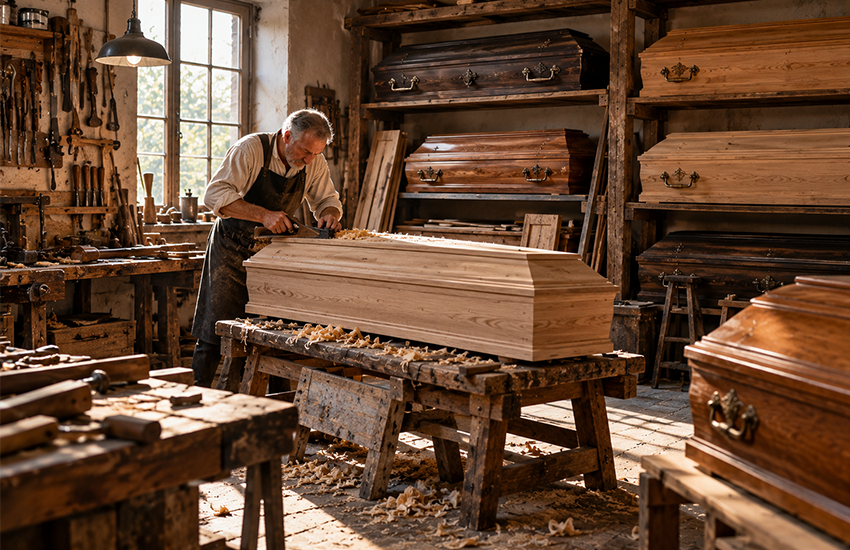
Before coffins were produced in factories, they were made at the bench. In English towns and villages, the coffin was usually the work of the local carpenter or joiner, who was frequently also the undertaker – the origin of so many family funeral businesses that still bear the name of a building or joinery firm. The workshop where a coffin was born was a place with an atmosphere all its own. Here the object came into being, and here it first waited.
The measure of the dead
Traditionally a coffin was made only after death, and made to measure. The joiner came to the house and measured the body with a rod, a stick or a length of string. In folk belief across much of Europe that measure possessed an unusual power. It was not to be thrown away or used for anything else; very often it was placed inside the coffin to go with the deceased. Left behind in the house, it was feared, it might "measure" death for someone else.
The custom shows how closely the coffin was bound to a particular person. It was not an anonymous product but something fitted like a garment – made for the one who would lie in it. A modern funeral home keeps coffins of different sizes, styles and finishes for precisely this reason: so that a family can choose one that "fits" not only in its dimensions but in character, taste and faith.
Shavings for a pillow
The shavings and sawdust left over from planing the boards were treated with similar respect. They were not burned in the stove or thrown on the midden. In many regions they filled the pillow on which the head of the dead would rest, or were spread along the floor of the coffin. Everything that came from work on a person's last house was meant to stay with them. This care for the smallest curl of timber says a great deal about how the coffin was regarded from the first moment of its existence.
Coffins that knock – the joiners' superstitions
Workshops where a few finished coffins always stood gathered stories around them. Joiners told of boards set aside for a coffin that would creak or knock before someone in the parish died, as though they sensed their purpose. Behind such tales stood perfectly natural causes – timber moving, changes in humidity, the silence of night. But the fact that they were told at all shows how exceptional a coffin-maker's workshop was. Even seasoned craftsmen made sure that finished coffins stood level, apart, away from tools and offcuts, separated from the rest of the shop. It was the forerunner of the dedicated display space we know from funeral homes today.
Where a whole community shared the duty of burying its dead, the waiting coffin could even be common property. In many English parishes of the Middle Ages and early modern period, a parish coffin was kept in the church to carry the shrouded poor to the graveside, after which it was returned to its place – carefully stored, covered and ready for the next funeral. Guilds and burial societies, likewise, held their own palls, candles and equipment in trust for their members, so that none of them would go to the grave without fitting honour.
Coffins in crypts and catacombs – the order of the dead
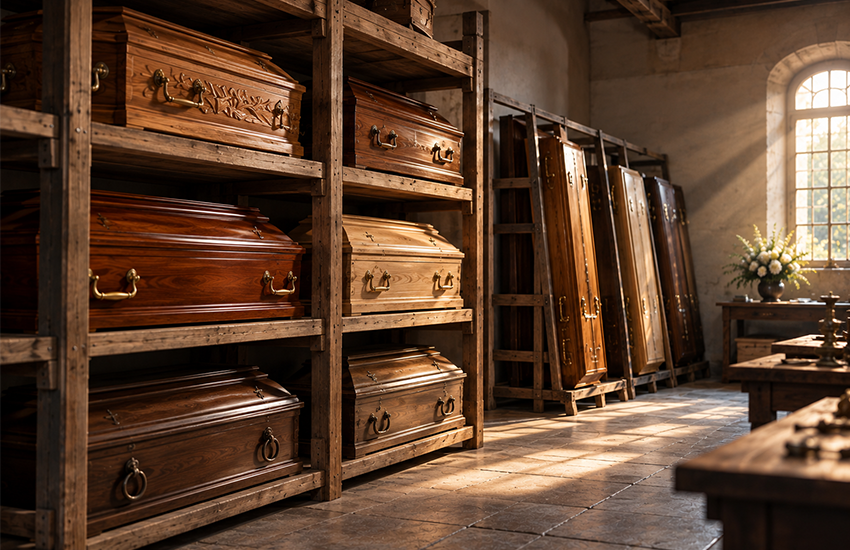
A coffin does not only wait before a funeral. In some traditions it goes on waiting afterwards – in vaults and catacombs, where instead of entering the earth it is placed on a shelf, a bench or a stone ledge. These spaces are a fascinating record of how people arranged coffins when many had to be kept in one place.
The coffin portrait – a coffin made to be seen
The Polish-Lithuanian Commonwealth produced something unique in Europe: the coffin portrait. In the seventeenth and eighteenth centuries, when the funerals of the nobility unfolded as Baroque theatre, a portrait of the deceased painted on sheet metal was fixed to the head end of the coffin. Cut to a hexagonal or octagonal shape, it matched the end board exactly. From it the dead "looked out" at the mourners throughout the ceremony, often beneath a lavish castrum doloris. Before the coffin was taken down into the crypt, the portrait was removed and hung in the church, where many can still be seen.
The coffin portrait reminds us of something important: the coffin was an object meant to be looked at. Its appearance, its ornament and the way it was set out mattered to the community. Preparing a coffin to be seen – from the Baroque age to today's selection room – is part of the culture of farewell.
Shelves of the dead – from the Kaisergruft to Kensal Green
In church vaults across Europe, coffins were set on trestles, timber bearers and stone benches, often in several rows or tiers. One of the best-known examples is the Imperial Crypt in Vienna, kept by the Capuchin friars, where more than a hundred and forty members of the Habsburg dynasty rest in sarcophagi arranged by lineage and generation. Visitors walk between them as through a library of history.
Victorian London gave the idea its own form. The great garden cemeteries of the nineteenth century – Kensal Green, Highgate, Norwood and their companions – built catacombs beneath their chapels and terraces, where coffins were placed on shelves within brick-lined bays rather than being buried. Highgate's Terrace Catacomb and the catacomb beneath the Anglican chapel at Kensal Green are among the most famous. Rows of lead-lined coffins, resting one above another, were not considered undignified; they expressed permanence and family continuity. The conditions were always the same: a solid structure, a secure place for every coffin, and each one clearly visible and identifiable.
These underground spaces show that storing coffins one above another, or in neat rows, is neither new nor improper. For centuries it has been a way of reconciling two values – sensible use of limited space and the preservation of dignified order.
From the coffin warehouse to the selection room
The Industrial Revolution changed almost everything, including how coffins were made and how they waited. In the nineteenth century, large towns saw the rise of specialist coffin warehouses and furnishing undertakers – premises with signboards, windows and interiors where finished coffins in various sizes and styles stood ready. The customer no longer simply ordered a coffin made to measure; increasingly, he chose one.
Birmingham, coffin furniture and the birth of choice
In English, the metal handles, breastplates and ornaments that adorn a coffin are known, quite literally, as coffin furniture. Birmingham became the world centre of its manufacture. The firm of Newman Brothers produced coffin fittings there from 1894 until 1998, and its preserved factory in the Jewellery Quarter now operates as a museum, the Coffin Works – a place where visitors can see the catalogues, dies and pattern books from which Victorian and Edwardian undertakers made their selections. The fittings for Winston Churchill's funeral are among the commissions associated with the firm.
Across the Atlantic, another linguistic shift told the same story. In nineteenth-century America the word casket – originally a small box for jewels – came into general use for the coffin, suggesting a precious container for what was most precious of all. Nathaniel Hawthorne mocked the euphemism, but the word took hold. Both developments reflect a new attitude: the coffin had become an object to be selected, examined and compared, and therefore something that needed to be displayed properly. So the culture of coffin display was born – a culture funeral homes continue to this day.
Joseph II and the reusable coffin – a lesson about dignity
History also records an attempt to go in exactly the opposite direction. In 1784 Emperor Joseph II, an Enlightenment reformer, introduced a reusable coffin throughout the Habsburg lands. It had a hinged base: the body, wrapped in a linen sack, was released into the grave, and the coffin was used again. Public reaction was so fierce that within months the emperor had to withdraw the decree. An example of such a coffin survives in Vienna's funeral museum.
The episode remains an instructive lesson. People of the Age of Reason, weary as they were of Baroque funeral splendour, would not accept that the coffin should become an anonymous, interchangeable tool. They wanted every person to have a coffin of their own – an object belonging to them alone. That conviction is still alive, and it is precisely why every coffin in a funeral home deserves careful keeping until it goes to the one person for whom it is intended.
The workshops of Teshie – coffins made to be viewed
At the other end of the world, in Teshie near Accra in Ghana, the Ga people have since the mid-twentieth century developed a celebrated tradition of figurative coffins. They take the form of a fish, an aeroplane, a lion, a favourite tool or an object linked to the deceased's working life. The workshops where they are made double as galleries, with finished coffins standing inside and out so they can be viewed from every side. Exotic as the example is, it illustrates a universal truth: wherever a coffin carries a story about a person, the way it is presented becomes part of the ritual.
The moment of choice – the culture of showing a coffin to a family
For many families today, a funeral begins in the arrangement office of a funeral home. One of the first and most emotional steps is choosing the coffin. It is a moment many people dread. They stand before objects that, within days, will receive the body of a mother, a father, a husband, a child. Everything matters in that moment – light, silence, order, distance, and the way the coffins have been set out.
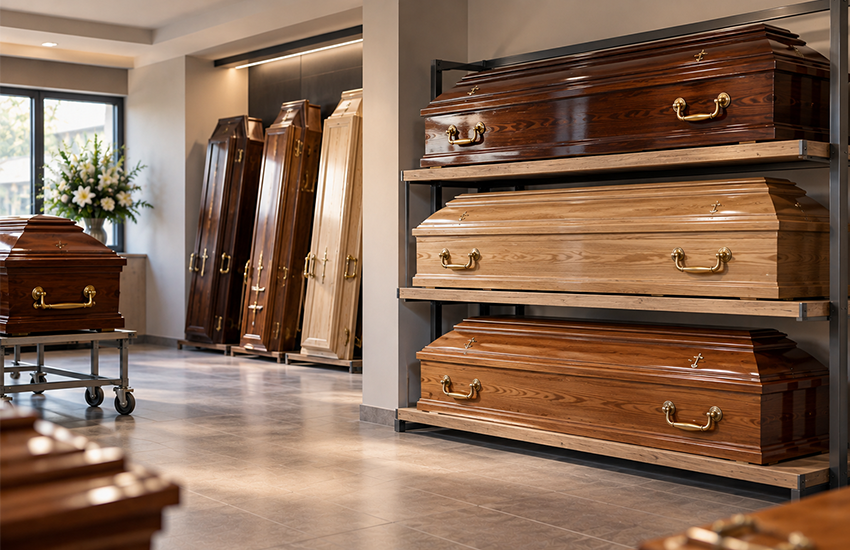
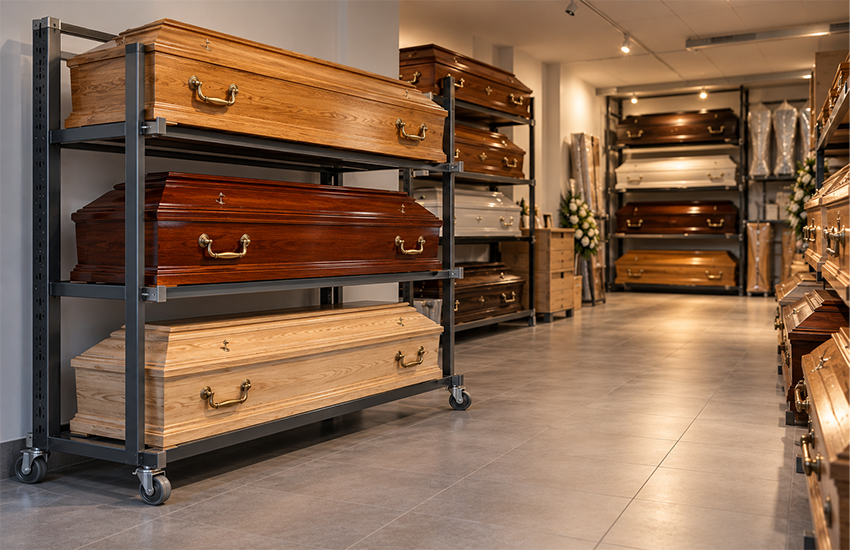
Experienced funeral professionals know that clutter in a selection room robs the moment of its dignity. Coffins standing haphazardly on the floor, leaning against a wall or half hidden behind other items suggest a warehouse, not a place of respect. Coffins arranged evenly, on a stable structure, at a comfortable height and with space around them allow a family to look calmly, compare finishes, touch the wood and talk. In this way the selection room continues the tradition of the old coffin warehouses and the master joiners' workshops.
Tiers, angles and light
How coffins are presented carries almost symbolic weight. A coffin displayed on a slightly inclined shelf "turns" towards the viewer, showing the lid, the fittings, a cross or other symbols. Coffins set on several levels allow different models to be shown side by side without filling the whole room. An arrangement in which the lower shelves are longer and the upper ones shorter recalls the classic triangular composition of Baroque altars and catafalques – a calm, ordered silhouette that is restful to the eye. Solutions worked out intuitively by generations of joiners and undertakers are today built into the design of professional casket racks.
Quiet and distance – the unwritten etiquette of the selection room
The room in which a family chooses a coffin has an etiquette of its own. A good funeral director does not steer people between coffins as if around a shop, but lets them pause, fall silent and return to the conversation at their own pace. Coffins should not stand too close together, because crowding overwhelms and makes it hard to concentrate. Nor should they sit too low, forcing mourners to stoop over them – a gesture that, at such a moment, can feel too heavy for many people. Ideally a coffin rests at roughly eye level or a little below, so it can be seen without effort while standing beside one's family.
Light matters too. Victorian showrooms relied on the warm glow of gas and oil lamps, which drew depth and lustre from polished timber. Today, funeral homes favour warm, diffused lighting that neither dazzles nor casts hard shadows. In such a setting a stable, orderly display becomes the backdrop to the most important conversation of all – how the family wishes to say goodbye. Choosing a coffin then ceases to be a transaction and becomes the first conscious gesture of farewell, made in an atmosphere of calm and respect.
The mobile casket rack for three coffins – a modern heir to a tradition of order
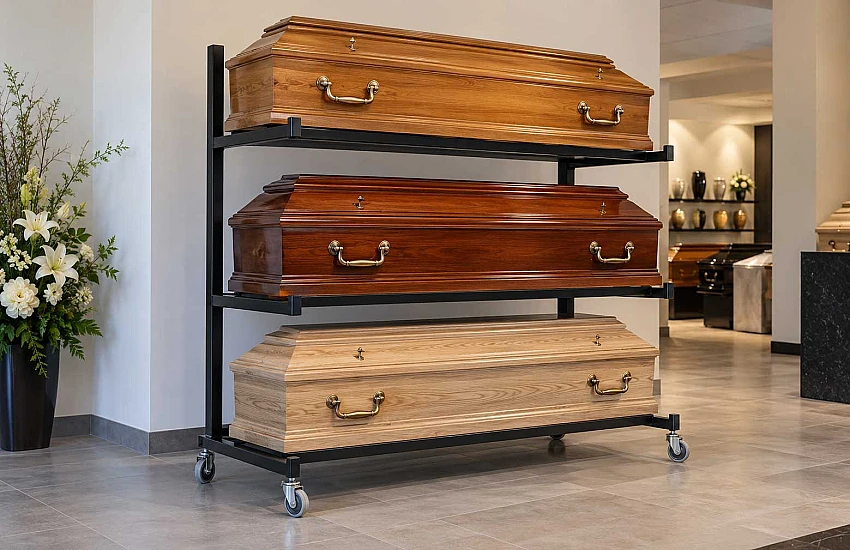
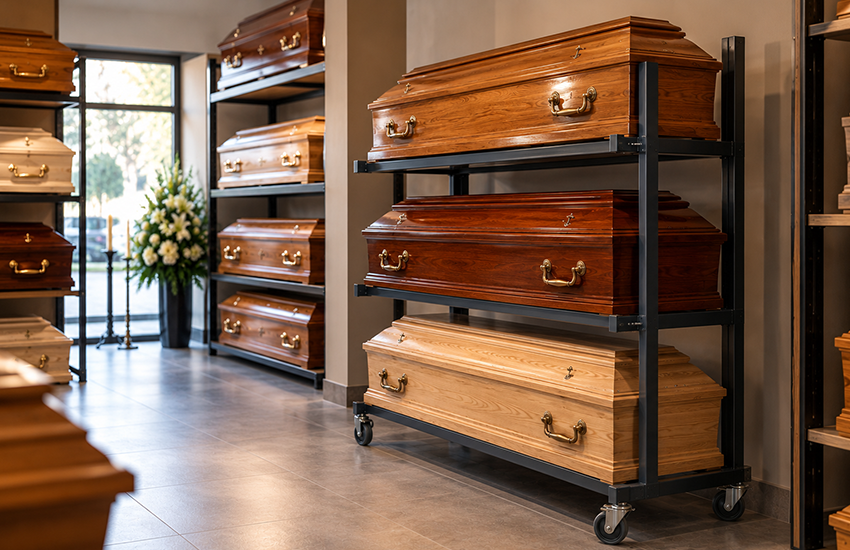
After this long journey through lofts, workshops, catacombs and coffin warehouses, we can look at the object that has taken over their role in the modern funeral home. The mobile casket rack for three coffins, manufactured in Poland by Prima-Tech and available through our casket racks range, brings together everything that mattered most in the history of keeping coffins – stability, lifting the coffin off the floor, order and good visibility – with something the old workshops never had: complete mobility.
A solid frame that carries a weight of responsibility
The rack is built from thick-walled, powder-coated steel sections. It holds three coffins on three levels and remains fully stable even when completely loaded. Its standard dimensions are 164 cm wide, 78 cm deep and approximately 174 cm high (about 64.5 × 30.7 × 68.5 in) – proportions that allow three coffins to occupy roughly the floor area a single coffin would take up on its own. One user's review singles out exactly what matters most to funeral staff: the rack stands firm and nothing in it wobbles.
Here it is worth returning to the old beliefs. An empty coffin should not be knocked, tipped or exposed to damage – and not merely out of superstition. Every scratch on a lid or split in a corner is a flaw in an object meant to receive someone's loved one. A solid steel rack is thus a modern expression of an old rule: a coffin that waits must wait safely.
Straight shelves, angled shelves and the tiered layout
From the point of view of display culture, the rack's greatest strength is the choice of shelf configuration. A funeral home can opt for shelves set at a right angle – classic, and ideal for back-of-house storage – or for angled shelves that tilt the coffin towards the viewer, making the lid, fittings and ornament clearly visible. The latter is especially valuable in a selection room.
The second choice concerns shelf length. All shelves may be equal, or they may form a tiered, "Christmas tree" layout in which the top shelf is shortest and the bottom one longest. This layout lets coffins of different sizes be shown in the harmonious triangular composition described above. The rack can also be built to custom dimensions – with height, width and number of levels adapted – so that it fits a particular room exactly.
Mobility with brakes – order that can be moved
The coffins of the past stayed where they were put. Moving them took several pairs of hands and always carried a risk of damage – and, as modern health and safety practice rightly stresses, a risk to the people doing the lifting. In the UK, the Manual Handling Operations Regulations 1992 ask employers to avoid hazardous manual handling wherever reasonably practicable. The three-coffin rack runs on four swivel castors with brakes, so the whole structure can be moved with little effort – from storeroom to selection room, from one wall to another, for cleaning or rearrangement. Once the castors are locked, the rack is completely stable and will not shift even while a coffin is being lifted off.
This mobility has a ceremonial dimension as well. A funeral home can quickly prepare a room to receive a family, tidy the space before an arrangement meeting, or move the display aside when the room is needed for something else. Order ceases to be rigid; it can be adapted to the moment, the people and the occasion.
Colour and finish – the rack as part of the interior
As standard, the rack carries a durable black powder coat in a matt or semi-gloss finish. Black has been the colour of mourning in European culture since the late Middle Ages, and the Victorians raised it to an elaborate art of crape, jet and black-edged stationery. The coating resists abrasion, scratches and moisture, so the rack keeps its appearance for many years. On request it can be finished in any RAL colour, to harmonise with the décor of a selection room or the visual identity of the funeral home. It then becomes not just a storage fixture but a genuine part of the interior, much like the draped platforms of the old coffin warehouses.
Storeroom and selection room – two roles for one piece of equipment
Throughout the history of keeping coffins there have always been two spaces: the back room, where coffins waited in peace, and the place where they were shown. The three-coffin rack serves both. In storage it keeps stock in order and protects coffins from damage; in the selection room it presents them with dignity. Thanks to its castors, the same rack can switch between the two roles. It is manufactured in Poland directly by the maker, which allows it to be adapted to the needs of a particular funeral home, chapel of rest or showroom.
Completing the display
Funeral homes that need more capacity can choose from other models in the casket racks category – for example the Casket Rack no 2, single-sided with tiered shelves, or the Casket Rack no 1, double-sided, accessible from both sides. For the next stage – placing the coffin for the ceremony itself – see our guide to coffin stands and catafalques, and for moving it safely around the premises, our range of coffin trolleys. A wider view of how equipment shapes the ceremony can be found in our article on personalising the funeral ceremony.
Order as a form of respect
Looking back over the history of keeping coffins, a single thread runs through the Central European loft, the Chinese home with its longevity coffin, the joiner's workshop with its measuring rod, the imperial crypt, the Victorian catacomb and the modern selection room. That thread is the conviction that a coffin deserves respect before anyone rests in it. It was lifted off the ground, protected from damage, set in a quiet place, and made clearly visible when the time came to choose.
The modern funeral home pursues the same idea by other means. Instead of boards in the loft and trestles in the vault, it has a steel rack with braked castors and angled shelves. Instead of tales of knocking coffins, it has procedures and a commitment to safety. But the meaning remains the same. Order around the coffin is the first gesture of farewell, made long before the first words of prayer are spoken. It is one more chapter in the story we told in Carried by the Parish – the story of how communities have always cared for their dead.
Frequently asked questions
What is a casket rack used for in a funeral home?
A casket rack is used to store coffins safely and to display them attractively. In the storeroom it keeps stock in order and protects coffins from damage; in the selection room it lets families view and compare different models calmly. Because it holds coffins on several levels, it takes up far less floor space than coffins placed on the ground.
How many coffins does the mobile three-coffin rack hold, and what are its dimensions?
It holds three coffins on three levels. Standard dimensions are 164 cm wide, 78 cm deep and approximately 174 cm high (about 64.5 × 30.7 × 68.5 in). Height, width and the number of levels can be adapted to order.
What is the difference between straight and angled shelves?
Straight shelves, set at a right angle, are best suited to back-of-house storage. Angled shelves tilt the coffin towards the viewer so that the lid, fittings and ornament are more visible – the recommended choice for a room where families select a coffin.
What does a tiered or "Christmas tree" shelf layout mean?
It is a configuration in which the shelves differ in length – the top shelf is shortest and the bottom one longest. It makes it easy to display coffins of different sizes and creates a harmonious triangular silhouette that recalls the classic composition of altars and catafalques.
Is a casket rack on castors stable when fully loaded?
Yes. The rack is built from thick-walled steel sections and its four swivel castors are fitted with brakes. With the brakes applied, the structure remains completely stable, including while coffins are being placed on or lifted off the shelves – something users highlight in their reviews.
Can the casket rack be ordered in a colour other than black?
As standard the rack has a black powder coat in a matt or semi-gloss finish, but on request it can be painted in any RAL colour, so that it matches the décor of the selection room or the colour scheme of the funeral home.
Where does the custom of preparing a coffin in one's lifetime come from?
In the rural traditions of Central Europe, and in many other cultures such as China, preparing a coffin in life expressed familiarity with death and a wish for a dignified departure. In the countryside the coffin was kept in the loft or storeroom, sometimes holding grain or best clothes. In China, grown children often gave their parents a longevity coffin as a mark of filial respect, and its presence in the home was considered a good omen.