Table of Contents
- Why winter outdoor ceremonies are harder than they seem
- What a funeral tent gives you in winter - practical benefits for the ceremony
- How to choose a funeral tent for a winter outdoor ceremony
- Winter logistics step by step: a plan that saves the ceremony
- How to position the tent to block wind and drifting snow
- Winter assembly: faster, but without cutting corners
- Heating, moisture and winter 'traps' inside a tent
- Winter ceremony styling: how to handle details without overdoing it
- Communicating with the family: setting expectations for a calmer ceremony
- 3x3 or 3x4.5: how to decide quickly and confidently
- A winter kit for the funeral home: small things that make a big difference
- Day-of checklist: calm routine instead of improvisation
- Summary: a winter outdoor ceremony can be calm and dignified
- FAQ
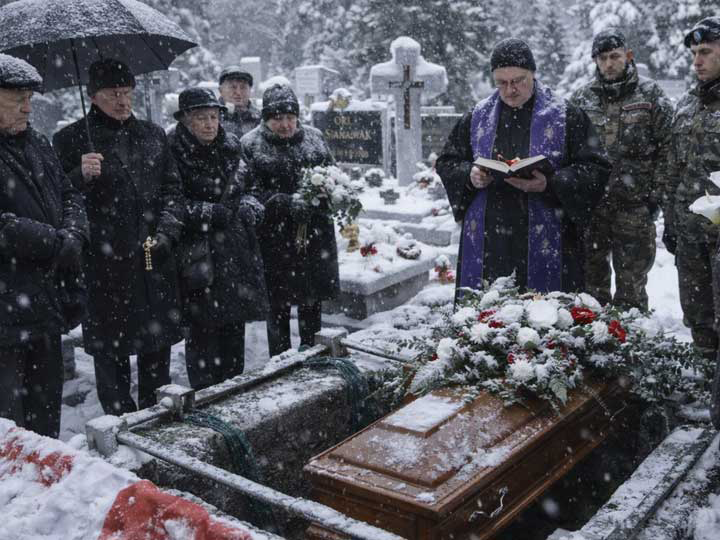
Winter can turn even the simplest outdoor ceremony into a logistical challenge. Frost shortens the time guests can stand still comfortably, snow covers paths and makes access difficult, and wind can literally 'pull' ribbons from hands, knock over lightweight elements of the setting, and steal the speaker's voice. In these conditions, a funeral tent stops being an optional add-on and becomes a tool that organizes the space, improves safety, and helps preserve the dignity of the occasion.
This guide shows how to prepare an outdoor ceremony in winter - practically, step by step, with the family's comfort and the attendees' experience in mind. Along the way, you'll also see when a compact urn tent is the best choice, and when larger 3x3 or 3x4.5 structures make more sense.
Why winter outdoor ceremonies are harder than they seem
A winter ceremony has a different rhythm than an event held in mild conditions. It's not just about whether it's 'cold'. In winter, several factors overlap and affect the flow of the ceremony, the guests' reactions, and the organizer's image.
Frost and a shorter 'tolerance window'
In low temperatures, people lose patience and strength faster. You'll notice it especially with elderly guests, children, and those experiencing grief very intensely - standing still, in silence, with tension in their body. For them, even a dozen minutes in the wind can be the limit. Frost also has a practical side: hands go numb, it's harder to handle small items (strings, ribbons, fasteners), and staff are more likely to make mistakes if they don't follow a clear procedure.
Snow and ice - a hazard that appears 'suddenly'
A cemetery in winter can change from hour to hour. In the morning, paths may be reasonably passable; by midday - after a slight thaw and another freeze - it can become an ice rink. This matters because attendees often move slowly, in elegant footwear, focused on emotions rather than footing. Add uneven ground near the grave, and the risk of slipping increases.
Wind - the toughest enemy of dignity
Snow and frost can be 'managed' with preparation. Wind is unpredictable and gusty. It can blow snow sideways, push it under clothing, topple lightweight items, reduce audibility, and make guests instinctively turn their backs to the ceremony area. That breaks focus. This is why winter planning should assume wind may arrive - even if the forecast looks calm.
What a funeral tent gives you in winter - practical benefits for the ceremony
A winter funeral tent plays three roles at once: it shields, it organizes, and it calms. It creates a sense of preparedness and control, which is invaluable to families in a difficult moment.
Protecting the focal point: urn, speaker, the ritual itself
The most important elements of the ceremony shouldn't be 'fighting' the weather. If snowfall intensifies during the farewell and wind tugs at coats, people lose contact with what's happening. A canopy over the focal point (urn, speeches, prayer) keeps attention where it belongs. Even if the entire group remains outside, a sheltered center becomes an anchor.
Comfort and flow - less chaos, fewer nerves
In winter, chaos arrives faster: someone looks for a spot with less wind, someone steps back into snow, someone tries to rush the ending. A tent reduces these micro-movements and provides a natural gathering point. As a result, the ceremony feels more orderly, transitions are smoother, and there are fewer stressful pauses.
A professional impression
In winter, details are more visible. When everything is prepared, stable, and neat, the family feels they can rely on the funeral home's experience. If something flaps, tips over, or needs improvisation in front of mourners, tension rises. A tent is one of those elements that quickly communicates professionalism - as long as it's well chosen and properly secured.
How to choose a funeral tent for a winter outdoor ceremony
It's best to base your choice on two questions: what exactly needs to be sheltered, and how much space you have near the grave. In winter, assembly time, anchoring options, and transport logistics matter too.
Urn tent - a compact solution for an urn ceremony
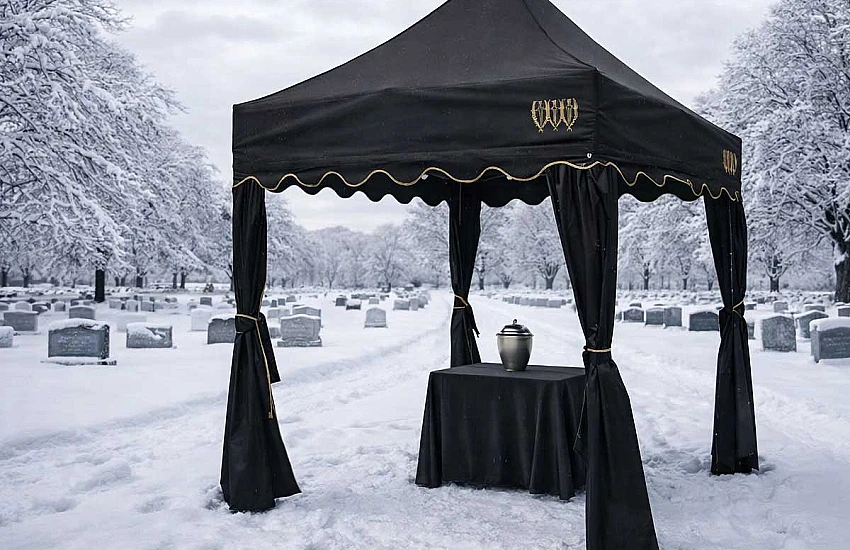
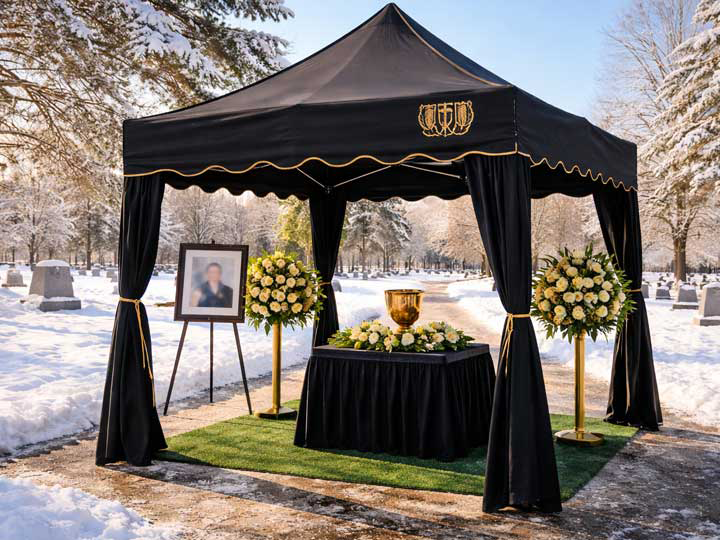
If the priority is to protect the urn, the speech area, and a few closest family members, a compact tent does the job beautifully. It's easier to set up in narrow cemetery lanes and tight grave sections - and in winter that can be decisive: it simply fits where a larger structure would get in the way.
In practice, this kind of tent functions as an elegant shelter for the ceremony's focal point. In winter, the biggest difference is that the urn and the immediate area around it are not exposed to direct precipitation and drifting snow. It's a small detail that greatly affects how the ceremony is experienced.
3x3 funeral tent - a universal standard for most winter jobs
A 3x3 format is often the safest choice for a funeral home that wants one tent for many scenarios. It provides a clearly larger working zone: you can shelter the speaker, the urn or casket (depending on the layout), and part of the closest family. At the same time, it's not so large that it becomes difficult to position in an average cemetery.
In winter, you'll appreciate that 3x3 creates enough room to calmly arrange the 'stage': who speaks, where the officiant stands, where flowers and accessories sit. As a result, fewer people get in each other's way, and staff can work discreetly.
3x4.5 funeral tent - more space when conditions are harsh or the group is larger
When you expect more attendees, a longer ceremony, or the need to shelter a larger area (speaker + family + equipment), a 3x4.5 tent offers noticeable comfort. In winter, extra square meters are not a luxury - they're often how you avoid crowding at the edge of the canopy, where drifting snow is the worst.
In practice, a larger tent also helps when some guests want to step closer for a moment of farewell and then step back without squeezing past others. On slippery ground, this matters: less friction between people means a lower risk of a fall.
Winter logistics step by step: a plan that saves the ceremony
In winter, the winner isn't the one with the most strength, but the one with the best procedure. It's worth preparing a simple workflow that the team knows by heart. That way, even if the weather suddenly deteriorates, there's no frantic searching for solutions.
The three-scenario rule
The easiest way to think about a winter outdoor funeral is through three variants.
Scenario A is acceptable conditions - cold, but without strong wind and heavy snowfall. You run the standard outdoor setting.
Scenario B is deterioration - wind and snow start interfering. Here you shorten speeches, reduce movement, and shift attention to protecting the focal point. The tent's job is to shelter the 'heart' of the ceremony.
Scenario C is extreme conditions - gusty wind, intense precipitation, very slippery ground. Then you consider moving most of the ceremony to the chapel or limiting the outdoor part to the absolute minimum. This is not a 'failure'. It's a decision about safety and dignity.
Arrival and timing - plan a buffer in winter
If in summer 30-40 minutes is enough, in winter you often need more. Why? You may need to clear snow near the grave, treat slippery sections, adjust the tent angle to the wind, or simply work slower in thick gloves. A good practice is to arrive early enough that the tent and the area can be prepared without time pressure.
Ground conditions and anchoring - no shortcuts here
The biggest winter mistake is assuming 'it will hold somehow'. Wind doesn't care that the ceremony should be calm. The tent must be anchored in a way that matches the surface: one approach for soft soil, another for hard paving, another for compacted snow. That's why it's essential to have anchoring elements and guy lines and to use them whenever conditions are uncertain.
From a ceremony UX perspective (how the family experiences it), a stable tent means no 'moving background'. If the structure is solid, nobody keeps glancing around, worrying, or commenting. Everything can remain quiet and focused.
Snow on the roof - control instead of surprise
Snow can accumulate on the canopy and increase the load, especially wet snow around 0°C. The best practice is discreet roof checks: you don't wait until it's heavy, you remove excess at the right moment. The key is to do it calmly, without shaking the structure and without creating a 'scene' in front of mourners.
Access to the grave and safe movement
In winter, guests move slower, yet at the same time they often hurry to 'get closer'. That paradox increases the risk of slipping. A simple rule works well: designate one, as-safe-as-possible approach route, clear it, and treat the most slippery spots. Then position the tent so it doesn't block movement and doesn't force people to pass right next to the tent legs.
If you use a larger tent, you can also create a clear flow: entry from one side, exit from the other. It sounds like a minor detail, but in winter the layout can make or break the ceremony's smoothness.
How to position the tent to block wind and drifting snow
Tent positioning shouldn't be based only on where there is 'free space'. In winter, priority is wind direction and how snow gets blown under the canopy.
Wind direction - the open side matters
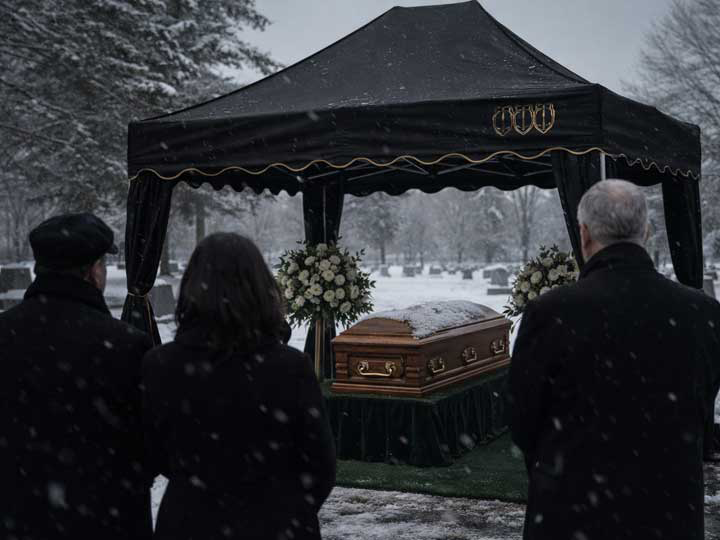
If you face the open side of the tent into the strongest wind, snow will blow under the roof and the speaker will struggle. It's better to rotate the tent so wind hits a side or the back, and the focal area is sheltered. Even a slight rotation can drastically improve conditions.
The focal point should not sit at the edge
A common mistake is placing the urn or the speaker right at the front so 'everyone can see'. In winter, that's how you invite drifting snow. A better solution: move the focal point one or two steps deeper inside. Even if wind picks up, precipitation is less bothersome, and people standing outside still see what is happening.
Layout for an urn ceremony
An urn ceremony has the advantage of a compact focal point. An urn tent allows you to create a dignified, sheltered 'stage' without taking up much space. In winter it matters most that the urn is protected from direct precipitation and that the closest family can approach without rushing.
Link to a suitable option:
https://www.funeralne.com/pl/produkt/namiot-pogrzebowy-pod-urne
Layout for a larger group
If you expect more attendees, a 3x3 or 3x4.5 tent can shelter not only the focal point, but also part of the closest family. In winter this noticeably improves comfort: the most important people don't stand fully exposed the entire time. In practice, it's often enough that the speaker, officiant, and a few family members can stand under the canopy, while the rest form a semicircle in front.
Winter assembly: faster, but without cutting corners
Winter assembly tempts people to skip steps because everyone wants to get their hands back into pockets quickly. The problem is that shortcuts return at the worst possible moment - while the ceremony is underway and there's no time for fixes.
A simple winter assembly procedure
First, check wind and decide on orientation. Then set the legs and choose height so the roof is stable and the canopy is well tensioned. Next, install the top and immediately anchor: secure the feet and add guy lines if wind is even moderate.
Only then place ceremony items: urn, flowers, accessories. This matters because anchoring and tensioning lines around already-set decor increases the risk of knocking something over or splashing it with snow.
Teamwork - winter roles
In winter, a role split works best. One person handles the structure and anchoring, another prepares the area (snow clearing, treating slippery spots), and a third focuses on ceremony details. This keeps assembly time reasonable and avoids chaotic task switching.
Packing after the ceremony - don't postpone to 'tomorrow'
In winter it's easy to say: 'We'll pack quickly and dry later'. But wet snow and moisture left in a bag can lead to odor and more difficult maintenance. Ideally, at least shake off snow, wipe key areas, and only then pack. After returning, open and dry the tent in a dry space.
This sounds technical, but it affects how the tent will look at the next service. In the funeral industry, the equipment's appearance is part of trust.
Heating, moisture and winter 'traps' inside a tent
A tent protects from precipitation and wind, but it also creates a specific microclimate. In winter, two things can appear: condensation (moisture settling on the material) and frosting.
Condensation - where it comes from
Under the canopy you have breath moisture, wet outerwear, and sometimes steam from melting snow. If temperature drops, moisture starts condensing on the fabric. Usually it's not a 'visual' problem, but it can cause dripping or light frost. A tight canopy and good housekeeping help: less snow carried under the roof, fewer wet items placed inside.
Heating - when it makes sense
Not every ceremony needs heating. Often it's better to shorten exposure time, shelter the focal point well, and maintain smooth flow. If you do plan heating, use controlled solutions and avoid creating risk near the canopy. Safety and calm always come first.
Winter ceremony styling: how to handle details without overdoing it
In winter, details carry more weight because conditions quickly reveal weak points. It's not about more decor; it's about durability and sensible placement.
Flowers, wreaths and ribbons in wind
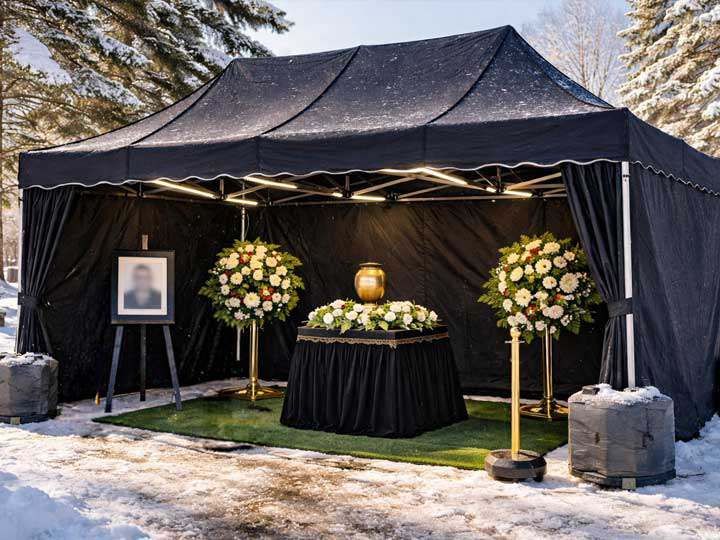
Wind can twist ribbons and ruin neat arrangements. In winter, limit light elements that catch gusts, or place them in more sheltered spots (closer to the center of the tent rather than at the fully exposed edge).
Light and dusk
Days are shorter, and dusk can 'surprise' a ceremony. Have discreet work lighting for staff - not for effect, but for safety during approach, setup, and closing.
Acoustics - the tent as a frame for the voice
Even without advanced sound equipment, a tent helps by shielding the speaker from wind and reducing sound dispersion. If you use a microphone, position the speaker deeper under the canopy, not at the edge. In winter, this can be crucial: listeners don't have to guess the words, and the speaker doesn't rush nervously.
Communicating with the family: setting expectations for a calmer ceremony
In winter, good communication is part of the service. Families often don't want to think about weather, yet conditions can change the flow. It's worth speaking clearly, but gently.
A short briefing before the ceremony
A simple explanation is enough: where the outdoor part will happen, what the tent will shelter, how long it should take, and what the fallback plan is. This builds a sense of safety. In winter, people calm down when they hear someone anticipated difficulties and has a plan.
Winter tips for attendees
You don't need a long instruction list. Sometimes one sentence passed to the family is enough: 'We recommend warm footwear and gloves; the outdoor part will be brief; the key moment will be under the canopy.' This improves comfort and reduces the risk of someone arriving unprepared and suffering in silence.
3x3 or 3x4.5: how to decide quickly and confidently
In winter, the tent size decision usually comes down to two variables: the number of people and the expected length of the farewell moment.
If it's an urn ceremony, space is limited, and you mainly want to shelter the focal point, a compact urn tent is the most practical.
If you want a universal solution that works for most services and provides a zone for the speaker and a few people, 3x3 is a safe choice.
If you expect a larger group, a more extensive setting, or you simply know winter calls for extra 'calm space', a 3x4.5 tent offers comfort and reduces crowding.
It's helpful to think of it this way: in winter, extra square meters are not about 'show' - they're about letting people stand naturally, without squeezing, and without being forced to stand at the canopy edge where wind and snow hit hardest.
A winter kit for the funeral home: small things that make a big difference
In winter it's smart to keep a standard emergency kit, but it doesn't have to be large. A few items help you work calmly even if weather worsens.
It's useful to have something for quick snow clearing and treatment of slippery areas, spare anchoring elements and guy lines, towels for wiping equipment before packing, solid work gloves for staff, and discreet work lighting. This prevents weather from 'taking over' the ceremony and eliminates the need for improvisation.
Day-of checklist: calm routine instead of improvisation
To make winter easier, build a routine. Let it be a short team ritual before every service.
First, assess wind and ground: are paths slippery, do you need to clear and treat the grave area, can the tent be set safely. Next, assembly and anchoring: no shortcuts, even if 'it's not windy yet'. Then, place the focal point deeper under the canopy to reduce drifting snow. Finally, do a quick check: is the route clear, will attendees have a safe approach, and does the team have Plan B if snowfall intensifies.
These are small things, but they add up to the feeling that everything has been 'taken care of'.
Summary: a winter outdoor ceremony can be calm and dignified
A winter outdoor ceremony doesn't have to mean nerves and fighting the weather. Good organization, stable shelter, and a simple procedure can turn harsh conditions into background noise rather than the main story. A funeral tent in winter protects what matters most, organizes the space, and gives families the sense that they are in good hands.
If you want to match a tent to specific scenarios, these three options cover different needs:
- urn tent: Funeral tent - the funeral urn
- 3x3 PRO tent: Funeral tent 3x3m
- 3x4.5 PRO tent: Funeral tent 3x4,5m, PRO
FAQ
Does a winter funeral tent make sense if the outdoor part lasts only a few minutes?
Yes, because in winter the challenge isn't only duration but also wind, drifting snow and rapid cooling. Even a short outdoor segment can feel chaotic without shelter for the focal point. A tent helps keep the ceremony calm and orderly, which matters greatly during mourning.
Which tent should I choose for an urn ceremony when there is little space near the grave?
Most often, a compact urn tent works best because it's easier to fit into narrow lanes and small sections. In winter, compactness is an advantage: you can set up faster and find a better position relative to wind. A good starting point is: https://www.funeralne.com/pl/produkt/namiot-pogrzebowy-pod-urne
In winter, what matters more: a larger tent size or faster setup?
It depends on the scenario. If you mainly need to shelter the focal point and space is tight, fast setup and compact size are the priority. If you expect more attendees and risk crowding at the canopy edge, a larger tent (such as 3x4.5) provides better comfort and a calmer flow.
How should I position the tent to reduce snow blowing under the roof?
Two steps are key: avoid aiming the open side into the strongest wind, and move the urn and speaking area deeper under the canopy. Even a small positioning adjustment can significantly improve conditions and reduce sideways snow.
Do I always need a contingency plan to move the ceremony indoors in winter?
It's worth having one, even if you never use it. A contingency plan reassures the family and the team because everyone knows what happens if weather suddenly worsens. In winter, it's a standard of professional service: better to have Plan B and not need it than not have it at all.