Table of Contents
- Why Photo and Obituary Display Matters in the New Year
- The "Simple, Stable, Aesthetic" Standard in Chapel Practice
- Photo Stand – Foundation of Dignified Display
- Photo Base – Stability and Elegance
- Chapel Space Arrangement at the Beginning of the Year
- Practical Aspects of Choosing Display Solutions
- Cultural and Symbolic Meaning of Photo Display in American Tradition
- Staff Role in Maintaining Display Standards
- FAQ
The beginning of the year is a time when funeral homes often organize their procedures, update equipment, and introduce fresh service standards. In this natural cyclicality of improvement lies the space to reflect on what constitutes the fundamental framework for a dignified farewell in a funeral ceremony. The display of the deceased's photograph and obituary content in the ceremonial chapel is a seemingly simple matter, yet its proper execution requires a conscious approach to aesthetics, functionality, and symbolism. In the context of New Year industry resolutions, it's worth examining how simplicity of form, stability of construction, and visual elegance combine into a coherent whole that serves both families experiencing loss and professionals caring for every detail of the ceremony.
The photograph of the deceased in the chapel space serves a role far beyond mere visual communication. It becomes the center of memory, a point of reference for all gathered, a place of focus for thoughts and emotions. The obituary, in turn, provides information about life, dates significant to the family and loved ones, as well as the course of the ceremony. Both these elements require presentation that does not distract attention with unnecessary complications but allows them to exist in the space with appropriate solemnity. The New Year standard we speak of is the pursuit of ensuring that every display is executed simply, with respect for technical stability and awareness of aesthetic impact.
Why Photo and Obituary Display Matters in the New Year
Moment of Reflection and Modernization of Establishment Practices
The new year in funeral home practice is often associated with rethinking existing solutions. It's a moment when one analyzes experiences from previous months and draws conclusions about what requires improvement or modernization. In the context of photo and obituary display in the chapel, it's not just about the equipment itself but also the entire philosophy of presentation. Families increasingly expect that ceremonies will be conducted thoughtfully, with attention to details and in accordance with the spirit of the times, which requires both respect for tradition and openness to contemporary aesthetic standards.
Impact of Proper Display on Ceremony Atmosphere
Proper display of photo and obituary affects the atmosphere of the entire ceremony. When the photograph is positioned stably, at the appropriate height, in good lighting and without risk of falling, participants can fully focus on experiencing the moment of farewell. There's no room for unnecessary distraction caused by a wobbly stand, poorly chosen base, or illegible obituary. Professionalism in this regard is not a whim but an expression of respect for the dignity of the deceased and the family's feelings. From the funeral home's perspective, it's also a matter of image and the trust that clients place in the institution accompanying them in the most difficult moments.
Unification of Standards Throughout the Establishment
The beginning of the year is also a time to consider standardization. If the establishment uses different display solutions depending on equipment availability or individual employee decisions, this can lead to unnecessary inequalities in ceremony perception. Introducing a unified, thoughtful system based on simplicity, stability, and aesthetics allows building a consistent experience for all families. This also facilitates staff work, who don't have to improvise each time but can rely on proven, functional solutions.
Contemporary Aesthetic Sensitivity of Families
It's worth remembering that contemporary aesthetic sensitivity differs from that of years past. Families pay attention to details that previously might have gone unnoticed. The materials from which equipment is made, the finishing method, color scheme, proportions – all contribute to the overall image of the establishment's professionalism. The New Year standard is not a revolution but an evolution toward solutions that combine proven functionality with thoughtful form. It's a response to the needs of contemporary families who expect both respect for tradition and openness to a modern approach to ceremony organization.
The "Simple, Stable, Aesthetic" Standard in Chapel Practice
Simplicity as the Foundation of Functionality
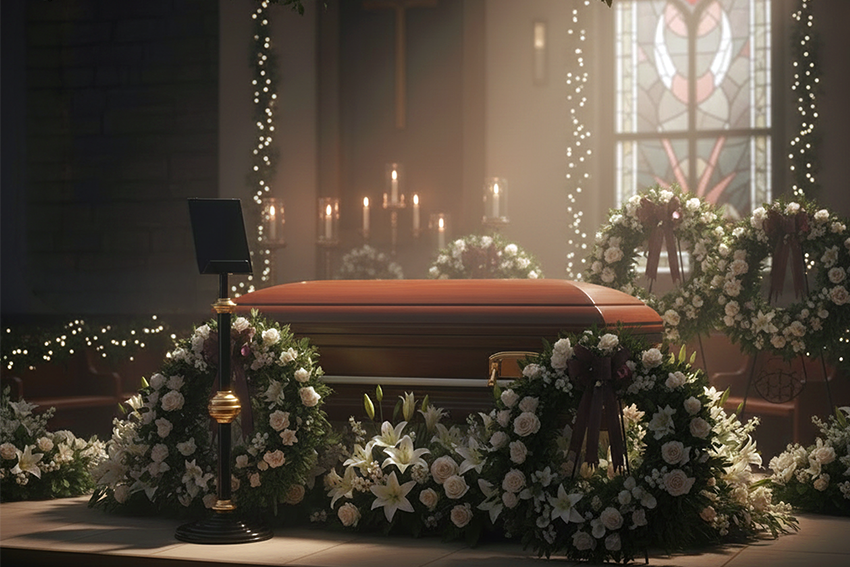
The motto "simple, stable, aesthetic" is not just a slogan but a set of values that should guide every funeral home in the context of ceremonial space arrangement. Simplicity means giving up unnecessary decorations, complications, and elaborate constructions in favor of solutions that are functional and clear. In chapel practice, simplicity translates to the fact that the deceased's photo and obituary should be visible but not overwhelming. It's not about special effects but about properly exposing what's essential in a spontaneous manner harmonious with the rest of the arrangement.
Technical and Psychological Stability
Stability is both a technical and psychological issue. From a technical standpoint, it's about ensuring that every element of the display is securely positioned, regardless of conditions in the chapel. Doors opened by entering guests, gentle air currents, accidental movements during the ceremony – all this should not affect the stability of the positioned photograph or obituary board. From a psychological perspective, stability provides a sense of security and certainty. The family, seeing that everything is solidly prepared, can trust that the ceremony will proceed calmly and without unpleasant surprises.
Restrained and Harmonious Aesthetics
Aesthetics is the dimension concerning visual harmony. This is not about ostentatious splendor but about ensuring that every element of the display harmonizes with the character of the chapel space. Colors, materials, proportions – everything should create a coherent whole. Aesthetics in the funeral industry context has its specificity. It departs from commercial brightness, is based on restraint, class, and delicacy. Good design in this context is one that doesn't demand attention loudly but discretely supports achieving the proper ceremony atmosphere.
Application in Daily Establishment Practice
In chapel practice, these three values – simplicity, stability, and aesthetics – should be present at every stage of ceremony preparation. Already at the equipment selection stage for display, it's worth following these criteria. Solutions that seem visually attractive but are unstable or complicated to operate may prove problematic in daily work. On the other hand, equipment that is functional but lacks aesthetic care can negatively affect the perception of the entire ceremony. The golden mean is products that combine all these features in a thoughtful form adapted to the requirements of working in a funeral home.
Role of Staff Awareness
The "simple, stable, aesthetic" standard is also a matter of staff training. Employees should understand why these values are important and how they translate into daily work. It's not just about technical skills in setting up a stand or base but also awareness that the way of presenting the photo and obituary has a real impact on the family's comfort and ceremony success. Staff who act according to these principles can work more confidently, knowing that the standard they follow is thoughtful and effective.
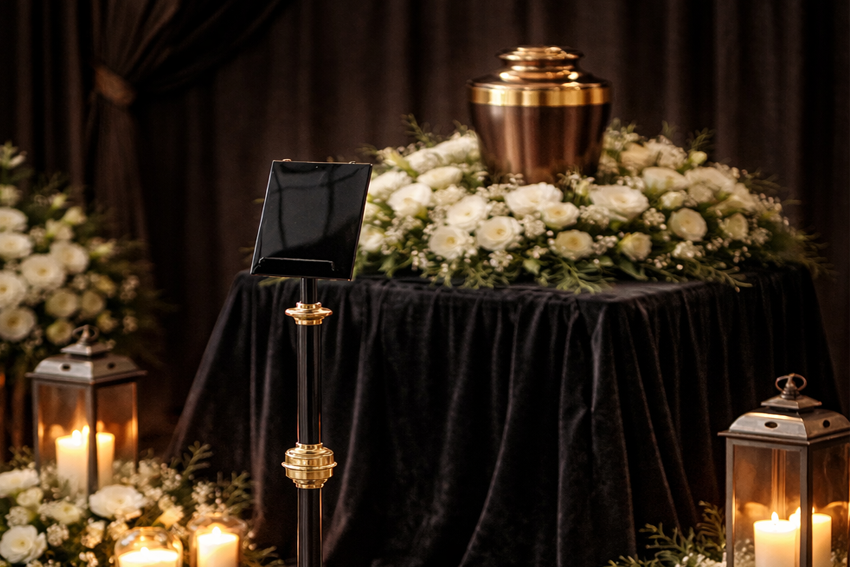
Photo Stand – Foundation of Dignified Display
Construction Ensuring Stability
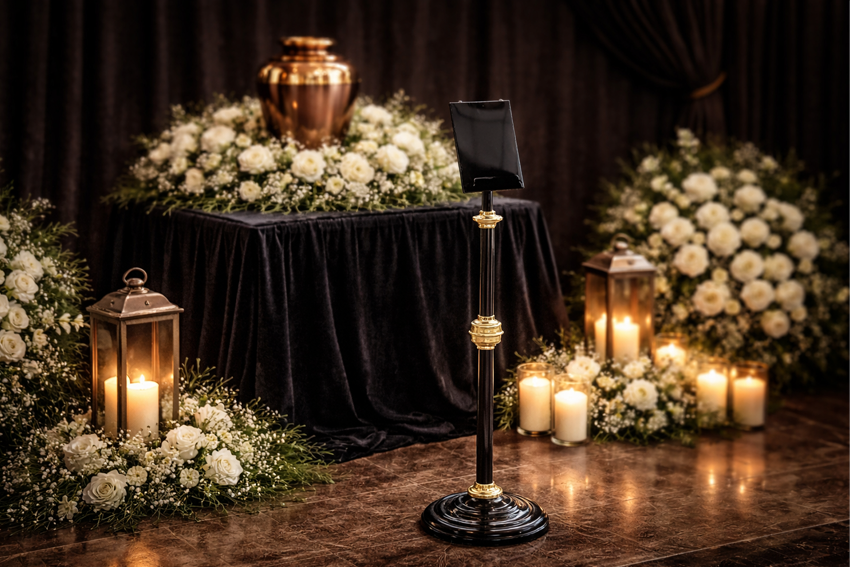
The central element of visual display in the ceremonial chapel is the deceased's photograph, and its proper presentation requires an appropriate stand. The choice of this equipment should not be random but result from consideration of functionality, stability, and aesthetics. The photo stand is a solution that responds to the needs of funeral homes seeking professional, reliable equipment for displaying photographs in chapel space.
The construction of this stand is based on a solid base and stable pole, which ensures secure positioning of the photograph regardless of its size and format. In the daily practice of a funeral home, it's crucial that equipment can be quickly prepared for use, without the need for complicated adjustments or lengthy assembly. A stand made with a thoughtful balance between durability and weight enables efficient handling and at the same time provides certainty that during the ceremony there will be no unpleasant incidents related to the photograph tipping or tilting.
Appropriate Display Height
The issue of display height is extremely important. The photograph should be positioned at a height that makes it clearly visible to all ceremony participants, both those sitting in the front rows and those located at the back of the chapel. A photograph positioned too low may be obscured by décor elements or other participants, while one placed too high may seem distant and difficult to perceive. A stand that allows height adjustment or is designed with optimal display level in mind is added value that directly translates into the comfort of ceremony reception.
Materials and Aesthetic Finish
Materials used in stand construction matter not only from a durability perspective but also aesthetics. In the funeral industry, solutions maintained in subdued coloring are preferred, most often in shades of black, dark brown, or gray, which harmonize with the ceremony's solemnity and don't introduce unnecessary contrast. Surface finishing should be matte or delicately satin, avoiding shiny, tacky accents. Elegance in simplicity is the key definition here – the stand should be present but not dominating, support the display but not distract from it.
Universality of Application in Different Chapels
Stand functionality also includes the possibility of its use in different spatial configurations. Chapels differ in size, pew arrangement, access to natural light, and other parameters. A stand that works well in one space should be equally functional in another. Thoughtful construction takes these variables into account, offering universality of application without loss of stability or aesthetic character. This is particularly important for funeral homes serving several chapels of various sizes and character.
Equipment Transport and Storage
It's also worth paying attention to ease of transport and storage. A stand that after the ceremony can be quickly disassembled or folded, then safely stored, is a practical solution from the establishment's internal logistics perspective. It doesn't take up unnecessary space, doesn't hinder space organization before the next ceremony, and doesn't require special storage conditions. Simplicity of operation is a feature that affects daily staff work efficiency, allowing them to focus on other equally essential aspects of ceremony organization.
Long-term Investment in Quality
When choosing a photo stand, it's worth following the opinions of other industry professionals and one's own experiences. A well-proven product is an investment that serves for years, without the need for frequent replacements or repairs. It's also certainty that in any situation, regardless of circumstances, photo display will proceed according to the highest standards. In the context of New Year resolutions regarding improving the funeral home's service quality, precisely such equipment constitutes the foundation on which one can build client trust and company reputation.
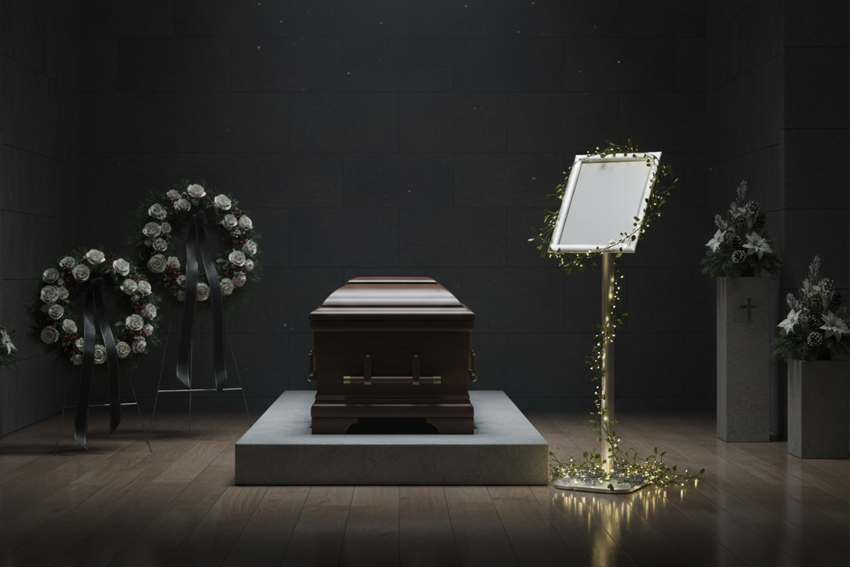
Photo Base – Stability and Elegance
Role of the Base in the Display System
While the photo stand handles the vertical construction of the display, the photo base constitutes the fundamental element on which the entire system's stability depends. The base is often an underestimated yet crucial component of chapel equipment. Its role is to ensure solid positioning of the photograph on a horizontal plane, which is particularly important in situations when the display takes place on a table, countertop, platform, or other surface, without using a tall stand.
Weight and Mass Distribution for Stability
Choosing the appropriate photo base requires considering several important aspects. The first is weight and mass distribution. The base must be stable enough to hold the photograph in a frame, which can vary in size and construction material. A base that's too light can easily tilt at the slightest air current or accidental touch, leading to unpleasant situations during the ceremony. On the other hand, a base with properly positioned center of gravity ensures certainty that the photograph will remain in place throughout the ceremony.
Construction Materials and Their Properties
The material from which the base is made impacts both functionality and aesthetics. Most commonly used are metals with appropriate weight and durability, sometimes also stone or wood in the case of more classical arrangements. Surface finishing should be consistent with the general character of chapel décor. In practice, dark, neutral tones work best, which don't attract excessive attention but subtly compose with other decorative elements. Matte surfaces are preferred due to the absence of undesired light reflections that could distract ceremony participants' attention.
Universality for Different Photo Formats
Photo base construction should account for the variety of photo formats. Frames in sizes from standard portraits to larger formats require appropriate support. The base may have a universal slot or groove in which the lower edge of the frame is stably positioned, or a flat surface with slight inclination, allowing convenient display of the photo at an angle facilitating its reception. A thoughtful construction solution is one that doesn't require staff to figure out how to position the photo for a long time but ensures intuitive operation and immediate effect of stable display.
Discreet Elegance in Detail
In the context of aesthetics, the photo base should be discreet but not devoid of class. It's an element that remains visible, though usually not the main point of attention. However, its construction quality and matching with other accessories matter for the overall impression made by the chapel arrangement. A funeral home that cares about coherence of all details – from wreaths, through floral decorations, to small accessories like bases – builds the image of a professional who can be trusted in every aspect of ceremony organization.
Multifunctionality Beyond the Chapel
Practical application of the photo base extends beyond the ceremonial chapel. It can be used also in the funeral home, during casket viewing in the salon, and also in various forms of farewell ceremonies organized in other locations. The universality of such a solution is another advantage that speaks for investing in high-quality equipment. A base that works in different contexts is a time and resource saver and guarantee that regardless of ceremony location, photo display will meet the highest standards.
Durability as Long-term Value
A good photo base is also a long-term investment. Durable materials, solid construction, and thoughtful design ensure it serves for many years, maintaining its functional and aesthetic properties. It doesn't require frequent replacements or repairs, which translates into savings in the establishment's budget and certainty that it can be relied upon at any moment. In the context of New Year plans for establishment equipment modernization, precisely such products constitute the foundation on which one can build a stable, professional company image.
Chapel Space Arrangement at the Beginning of the Year
Comprehensive Review of Chapel Décor
The beginning of the year is a natural moment to examine the overall chapel space arrangement and consider whether it requires refreshing, modernization, or rethinking the layout of individual elements. Photo and obituary display is part of this broader whole that constitutes the ceremony space. Proper arrangement is one that harmonizes all décor components – from seating, through floral decorations, lighting, to details like stands, bases, and information boards.
Harmonious Placement of Key Elements
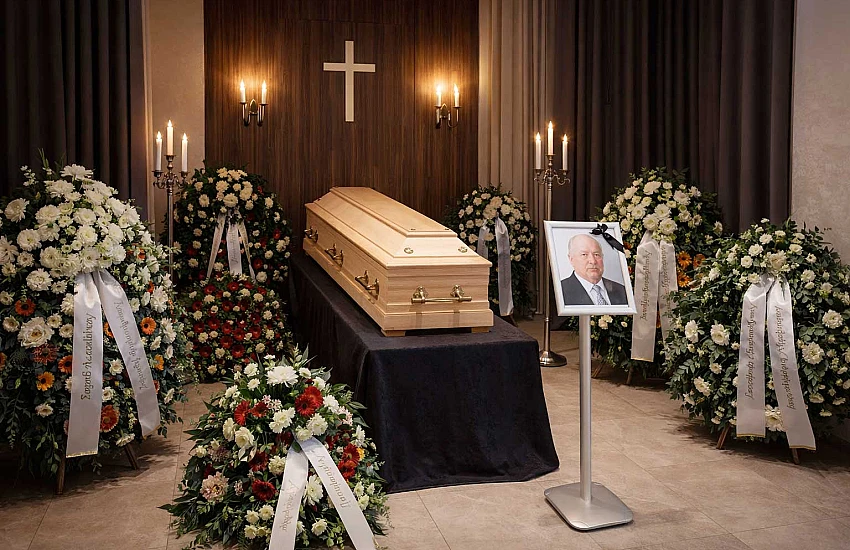
Chapel space should support ceremony experience, not distract from its essence. In practice, this means that each element should have its place and function. The deceased's photograph is most often placed in the central point, where it can be visible to all participants. The obituary may be located nearby, on a separate stand or board, or be incorporated into a more elaborate composition with flowers and candles. It's crucial that these elements don't compete for attention but create a coherent whole.
Importance of Proper Lighting
Lighting plays an important role in display perception. Even the best stand and most beautiful photograph won't deliver the intended effect if they're located in a too-dark place or in a zone with strong light reflections. When planning arrangement, it's worth considering natural light sources such as windows, and artificial lighting that can be modified according to needs. Gentle illumination of the photograph that doesn't blind but discretely emphasizes its presence is a solution often used in modern chapels.
Spaciousness and Visual Hierarchy
Placement of decorative elements such as flowers, candles, or wreaths should account for ergonomics and space readability. Too dense a composition can overwhelm, hinder access to key ceremony points, and introduce unnecessary visual chaos. Spaciousness, restraint, and thoughtful hierarchy are values worth cultivating. In the context of photo and obituary display, this means that the area around these elements should be free from unnecessary additions that could distract attention or hinder reception.
Accessibility for All Participants
The issue of space accessibility is equally important. The chapel should be arranged so that elderly people, those with mobility problems, or using wheelchairs can freely participate in the ceremony. This means appropriate width of passages, absence of unnecessary barriers, and thoughtful placement of elements that don't block movement. Photo and obituary display should be positioned to be visible from different points of the chapel, also for people sitting at the back or side.
Modernization and Optimization Process
New Year analysis of chapel space arrangement can also include review of existing practices and their optimization. It may turn out that certain solutions that worked previously today require updating due to changing family expectations or new technical possibilities. This may concern replacement of outdated equipment with more modern, changing seat arrangement, introducing additional lighting elements, or reorganizing the photo display location. The modernization process doesn't have to be radical – often small changes bring significant effects in terms of better participant comfort and higher ceremony quality.
Flexibility for Different Types of Ceremonies
It's also worth considering the specificity of different ceremony types. Religious funerals, secular ones, farewell ceremonies of different character may require a slightly different approach to space arrangement. Flexibility of equipment that can be easily adapted to specific needs is therefore an important asset. Stands, bases, and other display elements that can be quickly moved, modified, or supplemented with additional accessories allow creating individual arrangements consistent with the family's expectations, without the need to completely rebuild the chapel space.
Practical Aspects of Choosing Display Solutions
Analysis of Establishment Needs and Client Expectations
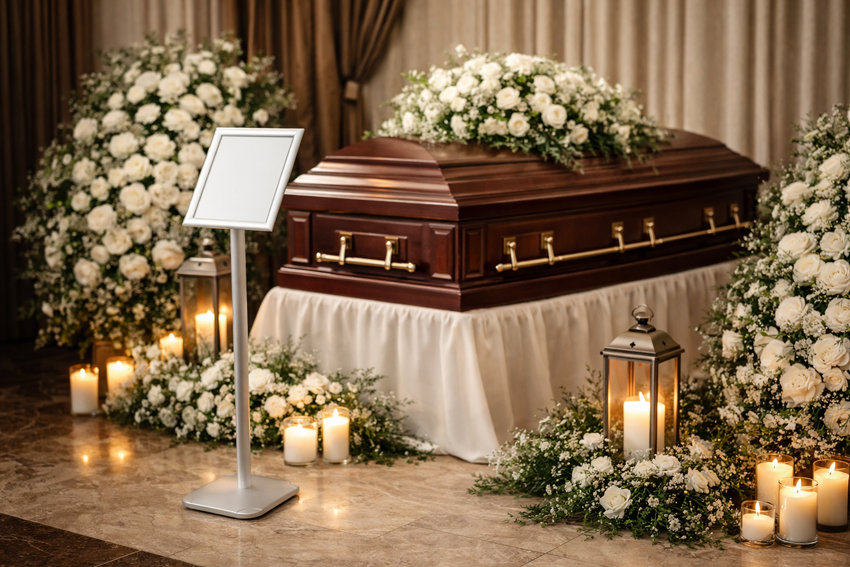
The decision to choose specific display solutions should be preceded by analysis of the funeral home's needs and its clients' expectations. Practice shows that the best results come from solutions that are simultaneously functional, durable, and aesthetic, while not requiring complicated operation. In the context of photo stands and photo bases, key questions concern technical parameters, long-term costs, and possibilities of integration with the rest of chapel equipment.
Format Definition and Solution Flexibility
The first step in selection is determining what photo formats most frequently appear in the chapel. The variety of frame sizes requires solution flexibility. If the establishment serves both modest ceremonies with small photographs and more elaborate ceremonies with large portraits, it's worth considering equipment that can handle this entire spectrum. Universality doesn't mean compromise in terms of stability – quite the contrary, it's precisely wide functionality while maintaining positioning certainty that constitutes the value of a good stand or base.
Ease of Use and Intuitiveness of Operation
Another aspect is ease of use. Funeral home staff often work under time pressure and in emotionally demanding situations. Equipment that can be quickly prepared, set up, and disassembled, without the need to use tools or complicated instructions, is real time and nerve savings. Intuitive construction, thoughtful adjustment mechanisms, and clear structure are features that translate into daily work comfort. It's worth paying attention to opinions of other establishments already using a given solution – the experience of practicing professionals is an invaluable source of information.
Long-term Perspective and Cost Balance
The cost issue should be considered in a long-term perspective. Cheaper products may tempt with purchase price, but if they require frequent repairs, replacement, or don't meet expectations in daily use, the final financial balance may prove less favorable. Investment in high-quality equipment that serves for years without problems is long-term savings and certainty that establishment standards won't decline. It's also worth considering indirect costs – staff time spent fighting defective equipment, risk of incidents during ceremonies, or loss of good image in clients' eyes are factors difficult to convert to dollars but have real significance.
Materials and Finish versus Durability
Materials and finish are aspects affecting both durability and aesthetics. Steel, aluminum, wood, composites – each of these materials has its advantages and limitations. Steel ensures stability and longevity but can be heavy. Aluminum is lighter but requires appropriate construction reinforcement. Wood introduces a warmer, more classical character but requires regular maintenance. Surface finishing should be scratch-resistant, easy to clean, and maintained in neutral tones. Aesthetics must go hand in hand with functionality – beautiful equipment that doesn't fulfill its role is an illusion of value.
Transport and Storage Logistics
Transport and warehousing are additional elements worth considering. The funeral home may serve several locations, which requires moving equipment between chapels. Stands and bases that can be folded or are lightweight while not losing stability are practical solutions. Safe storage protects equipment from damage and ensures it's ready for use at any time. Thoughtful construction solutions allow arranging several stands in limited warehouse space without risk of destroying them.
Visual Coherence with Other Equipment
Compatibility with other equipment elements is an often overlooked aspect with great significance. If the photo stand visually composes with other accessories used in the chapel – tables, candelabras, boards, decorations – this creates a coherent, professional image. Lack of coherence can give an impression of negligence or randomness in equipment selection, which negatively affects ceremony perception. A funeral home planning equipment modernization should strive to create a coherent aesthetic line that will be recognizable and consistently implemented in all chapels it serves.
Thinking About the Future and Timelessness
It's also worth thinking about the future. Display solutions should be universal enough to serve for a long time, regardless of changing trends or expectations. Classic, timeless designs that don't follow fashions are a safe choice. Modernity doesn't mean showiness but thoughtful consideration of functionality and aesthetics in a way that will be current also in several years. In this sense, the New Year display standard is not only a response to current needs but also an investment in the funeral home's future.
Cultural and Symbolic Meaning of Photo Display in American Tradition
Photograph as Memory Carrier and Prayer Center
The deceased's photograph in American funeral tradition has deep symbolic meaning. It's not just facial documentation but a memory carrier, a point of reference for all gathered, allowing ceremony participants to remain in mental contact with the person who passed. In American culture, with its diverse religious traditions, the deceased's image serves a function similar to an icon – it becomes a place of thought concentration, prayer, and reflection. Its presence in the chapel is not just custom but a deeply rooted practice expressing respect for the deceased person and the need to preserve their image in the community's memory.
Obituary as Written Memory Form
The obituary is a form of written communication informing about birth and death dates, sometimes about life achievements, family, and burial place. In American practice, obituaries are often elaborate, containing poetry quotes, religious hymn fragments, or personal farewell words. Obituary presentation in the chapel is the fixing of this information, which can be read by ceremony participants, providing additional context for prayer and memories. The combination of photograph with obituary creates a fuller picture of the deceased person, understandable both for loved ones and for participants who perhaps didn't know the deceased personally.
Symbolism of Inclusion and Shared Farewell
In the symbolic context, photo and obituary display is also a gesture of inclusion. Ceremony participants who couldn't participate in the deceased's final life moments, through contact with their photograph, can feel included in the farewell process. The deceased's image becomes a bridge between past and present, between life and death, between memories and the current moment of mourning. In this sense, proper display is not a technical detail but a gesture with spiritual and emotional dimension.
Dignity and Solemnity in American Ceremony
American tradition also emphasizes dignity and solemnity of the funeral ceremony. Everything happening in the chapel should be executed with due respect and care. Carelessly positioned photograph, wobbly stand, illegible obituary – these are signals that may be perceived as lack of respect for the deceased and their family. In this context, care for details such as display stability and aesthetics is an expression of deeper engagement in conducting the ceremony consistent with the spirit of American funeral tradition.
Coexistence of Tradition and Modernity
It's also worth mentioning contemporary changes in approaches to funeral ceremonies. Although tradition remains strong, there's also growing openness to new forms of grief expression. Photographs displayed on screens, multimedia presentations, video recordings – these are elements increasingly appearing in chapels. However, this doesn't mean abandoning classical photo display on a stand or base. Quite the contrary, these traditional solutions often coexist with modern ones, creating a multilayered memory space. A funeral home that can combine tradition with modernity responds to diverse client needs.
Staff Role in Maintaining Display Standards
Training and Awareness of Detail Importance
Even the best equipment won't fulfill its function if funeral home staff aren't aware of its capabilities and don't use it thoughtfully. Training, instructions, and experience exchange among employees are the foundation on which high service standards are built. In the context of photo and obituary display in the chapel, this means not only the technical ability to set up a stand or base but also understanding why these elements matter for ceremony conduct.
Flexibility in Responding to Various Situations
Staff should be familiar with the variety of situations that may occur during ceremonies. Sometimes the family brings a photograph in non-standard format, other times the obituary is exceptionally long and requires appropriate presentation. An employee who can flexibly respond to such situations has the chance to ensure every ceremony proceeds smoothly. Knowledge of available equipment capabilities, ways to adjust and adapt it to specific needs is a competence that builds establishment professionalism.
Empathetic Communication with Families
Communication with the deceased's family is another aspect where staff play a key role. Often it's establishment employees who advise what solutions will be best, what photo size to choose, how to formulate the obituary, where to place the display in chapel space. A competent conversation where the employee doesn't impose ready solutions but helps the family make informed decisions is an expression of respect and empathy. Staff who know their work tools and can adapt them to individual needs build client trust and loyalty.
Daily Quality Control Procedures
Attention to detail is a characteristic that should distinguish every funeral home employee. Checking whether the stand is stable, whether the photograph is clearly visible, whether the obituary is legible – these are activities taking a moment but having enormous significance for the final effect. Routine equipment inspections, regular cleaning and maintenance are actions that prevent failures and ensure everything is ready for use at any time. Staff working according to clear procedures and knowing what to pay attention to are guarantors of maintaining high standards.
Team Collaboration and Experience Exchange
Team collaboration also matters. If several people responsible for chapel space preparation work in the establishment, information exchange, action coordination, and joint development of best practices are important. Regular meetings discussing experiences from recent ceremonies, problems that occurred, and improvement ideas are a way to continuously raise service quality. Staff who feel part of a team and have the opportunity to influence the work method are more engaged and motivated.
New Year Training as Quality Investment
The New Year period is a good time to organize training or workshop dedicated to photo and obituary display in the chapel. One can invite external specialists, equipment suppliers, or use the experience of establishment seniors who have rich practical knowledge. Such initiatives not only raise staff competencies but also build a sense of community and care for high standards. Investment in people is as important an investment as purchasing new equipment – it's precisely people who decide how this equipment will be used and what results it will bring.
FAQ
What photo dimensions are most commonly used during chapel ceremonies?
The most commonly used photo formats in American ceremonial chapels are portraits with dimensions close to A4 or A3 standards, though this is not a rigid rule. Many families choose photographs framed in dimensions of about thirty by forty centimeters, which ensure good visibility from various chapel locations while not overwhelming the space. However, families sometimes bring larger portraits, especially if the ceremony takes place in a spacious chapel or when they want the photograph to be visible also for people sitting at the back. It's important that the stand or photo base can accommodate various formats without loss of stability. When choosing photo size, it's worth considering chapel size, number of participants, and the place where the display will be positioned. Experienced funeral home staff usually advise the family on the optimal solution combining aesthetics with practicality and ensuring proper ceremony reception.
Are there special requirements regarding material from which stands and bases are made?
There are no formal regulations imposing the use of specific materials for producing photo stands and bases, however industry practice has developed certain preferences. Most commonly used are metals such as steel or aluminum, due to their durability, stability, and elegant appearance. Steel ensures solidity and longevity, which is important with intensive use in a funeral home. Aluminum is lighter, which facilitates transport and equipment moving, though it requires appropriate construction to maintain stability. In classical arrangements, wood also appears, introducing a warmer, more traditional character, however wood requires careful maintenance and protection from moisture and mechanical damage. Surface finishing should be scratch-resistant, easy to clean, and maintained in neutral tones. Matte or satin coatings are preferred because they avoid undesired light reflections. In the context of material choice, the combination of functionality with aesthetics is crucial – equipment should be both durable and visually harmonious with chapel décor.
How often should stands and photo bases be replaced in a funeral home?
The frequency of replacing stands and photo bases depends on several factors, including equipment quality, usage intensity, and care for its maintenance. High-quality products made from durable materials and solidly constructed can serve for many years without need for replacement, provided they're regularly inspected and properly maintained. In practice, an annual chapel equipment review is recommended, during which the technical condition of stands, bases, and other accessories is assessed. If equipment shows signs of wear such as wobbling, scratches weakening durability, difficulties in height adjustment, or loss of aesthetic appearance, it's worth considering its replacement or repair. Investment in high-class equipment already at the purchase stage translates into longer lifespan and lower long-term costs. A good practice is maintaining spare equipment elements allowing quick replacement of worn equipment in case of sudden needs, ensuring uninterrupted ceremony operation at the highest level. The New Year equipment review is the ideal moment to conduct equipment condition assessment and make a decision about potential replacements.
Should establishment staff consult with the family about photo display location and method?
Consultation with the deceased's family regarding photo display location and method is not only good practice but an expression of respect and empathy that should characterize every funeral service. Many families have their own preferences regarding how they want to commemorate the deceased – some prefer traditional stand display in the chapel's central point, others may have special wishes related to positioning the photograph in a specific place or in company with particular floral decorations. Experienced staff can propose various solutions, considering both chapel spatial capabilities and the family's individual needs. Such conversation allows avoiding misunderstandings and ensures the ceremony proceeds according to expectations. At the same time, staff can gently advise if family proposals would be difficult to implement for technical reasons or could negatively affect ceremony perception by other participants. Finding balance between respect for family wishes and ensuring the display is aesthetic, stable, and functional is crucial. Communication based on trust and openness is the foundation of successful cooperation.
What are the most common mistakes in positioning photo display in the chapel?
The most common mistakes related to positioning photo display in the chapel result from both haste and lack of awareness of detail importance. The first widespread problem is inappropriate display height – a photograph positioned too low may be obscured by décor elements or ceremony participants, while one placed too high becomes difficult to perceive, especially for seated people. Another mistake is lack of stand or base stability, leading to photograph wobbling, and in extreme cases its falling. Sometimes the cause lies in poorly chosen equipment not adapted to the frame's weight or format. Another problem is inappropriate lighting – a photograph located in shadow or in a place with strong light glare loses readability and aesthetics. Neglect of surrounding aesthetics is another trap – if disorder reigns around the display, too many decorative elements, or space damage is visible, the whole loses dignity. It also happens that staff don't check positioning before ceremony start, which can lead to last-minute surprises. To avoid these mistakes, thoughtful preparation, regular staff training, maintaining high-quality equipment, and consistent application of proven procedures are crucial.