Table of Contents
- Why Winter Is the Most Difficult Period for Funeral Organization
- What Are Barrier Posts and How Do They Work in Practice
- How Barrier Posts Solve Specific Problems at Winter Funerals
- Golden Post with Black Tape – Why This Variant Works Best in Winter
- Practical Application Scenarios in Winter
- How to Choose the Right Number of Posts for Your Funeral Home
- Maintaining Barrier Posts in Winter Conditions
- Barrier Posts as an Element of Funeral Home Professionalism
- Complementary Equipment for Winter Funerals
- FAQ
- Summary
Winter transforms the face of every funeral ceremony. Snow covers pathways leading to the grave, frost makes it difficult to maintain order at the cemetery, and shortened days mean that organizing a funeral in darkness or poor lighting becomes an additional challenge. For funeral homes, this is a period that requires significantly more attention to organizational details than in other seasons. One of the key elements that can transform a winter ceremony from chaotic to controlled and dignified is the retractable tape barrier post. It would seem like a minor, secondary piece of equipment – yet in snowy conditions and bad weather, its role becomes exceptionally important.
This article is dedicated to precisely this: how proper selection and use of barrier posts can fundamentally improve funeral organization in winter. Many funeral homes face this problem cyclically – every year winter brings the same organizational difficulties, and solutions that work in spring or summer conditions cease to be sufficient. This article is dedicated to precisely this: how proper selection and use of barrier posts can fundamentally improve funeral organization in winter. We'll go through practical situations that arise at cemeteries during January, February, and December, as well as any other period when weather doesn't cooperate. We'll show how specific product parameters affect its effectiveness in difficult conditions, and why it's worth choosing a proven and reliable solution.
Why Winter Is the Most Difficult Period for Funeral Organization
A funeral is an event that should never appear insufficiently prepared. Families immersed in grief pay attention to every detail – not because they want to criticize, but because the ceremony is their last contact with a loved one. Every organizational imperfection can cast a shadow over the entire ceremony.
In winter, the list of potential difficulties lengthens significantly. Snow covers previously marked zones, people have difficulty maintaining balance on slippery surfaces, and the procession of funeral participants can form in a completely unpredictable way. Strong wind causes lightweight equipment elements to be blown to the other side of the cemetery. Low temperatures make people want to end the outdoor ceremony as quickly as possible, leading to crowding at entrances and exits from the ceremonial space.
Another aspect is limited visibility. December and January are months when the sun sets early and mornings are dark. Funerals organized in the afternoon can occur in weak natural lighting, making it difficult for participants to orient themselves in space. In these conditions, clear zone marking – using visible, contrasting elements such as posts with dark tape – becomes not so much a useful addition as an essential tool.
Finally, winter is a period of increased funeral frequency. Mortuary statistics show that the number of deaths increases in winter months, meaning funeral homes handle more ceremonies in a shorter time. Fewer hours of daylight mean we have even less time to prepare each ceremony, and organizational errors can multiply.
Another challenge that's rarely discussed openly is the emotional state of ceremony participants. A funeral is always a difficult event, but a funeral in the middle of winter, at freezing temperatures, in rain or snow, is something else. People are tired, cold, sometimes disoriented. In such conditions, space organization must be so clear and intuitive that participants can move without unnecessary cognitive effort. Every element that requires deciphering – something whose meaning must be guessed during the ceremony – leads to frustration and disrupts the course of the ceremony. This is precisely why clear, unambiguous space marking using barrier posts has such great significance.

What Are Barrier Posts and How Do They Work in Practice
Retractable tape barrier posts are one of the most versatile tools in a funeral home's arsenal. Their operating principle is simple: the post stands on the ground on a stable base, and from a special mechanism at the top, tape is pulled out that connects to the next post, creating a barrier marking zone boundaries. The tape is retracted automatically using an internal spring, so after being released from the next post, it automatically returns to rest position.
This solution is extremely practical precisely because it doesn't require any tools or special technical knowledge to operate. A funeral home employee can mark out an entire zone for family, separate the procession path from guest standing areas, or designate technical space where ceremony support equipment is located in just a few dozen seconds. In winter conditions, when every minute of outdoor preparation is valued, this assembly speed has tremendous significance.
Key parameters to pay attention to when choosing a barrier post are primarily post height, base diameter, and tape length and width. A post with a height of 35 inches (90 cm) is perfectly visible even with snow reaching several dozen centimeters, and a base with a diameter of 12.5 inches (32 cm) ensures stability on various substrates – from packed snow, through ice, to wet ground. Tape with a length of 78 inches (200 cm) allows zone designation of reasonable size without needing to place too many posts in one line, and a width of 1.9 inches (4.8 cm) makes it clearly visible even from a distance and in poor lighting.
How Barrier Posts Solve Specific Problems at Winter Funerals
Problem One: People Don't Know Where to Stand
Space organization at a funeral is a task that seems simple until weather changes the rules of the game. At a summer funeral, cemetery space is usually sufficiently clear – paths are distinct, lawn differs from walkways, and natural space boundaries help participants understand the layout. In winter, this natural order doesn't exist. Snow levels the terrain relief, hides edges, and changes the character of space in a way that leaves people with no idea where they should stand, where to approach the ceremony from, and how to reach the place where the grave is.
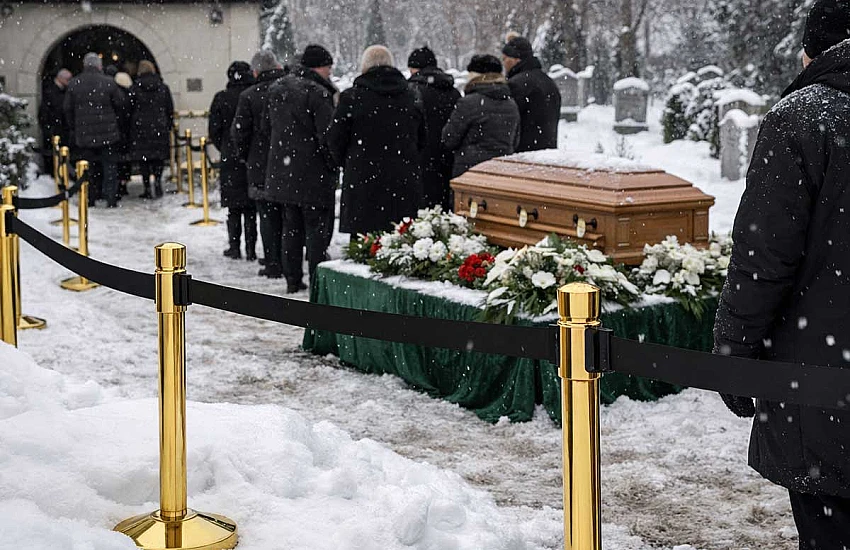
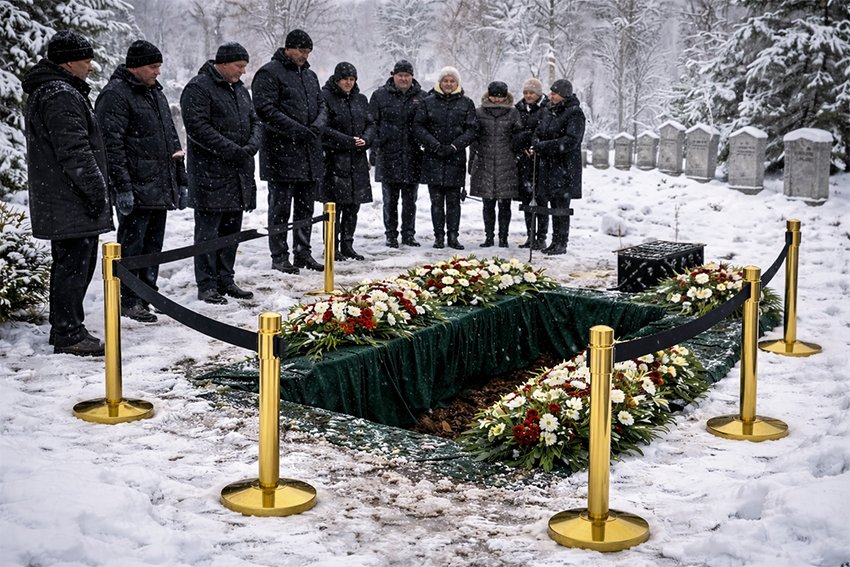
Barrier posts with tape create a clear, three-dimensional barrier that acts as a signpost. Simply place several posts along the path leading to the grave, and funeral participants are directed almost automatically in the right direction. Black tape on white snow creates a strong contrast that's visible even from dozens of feet away and in poor lighting.
Problem Two: Crowding at the Burial Site
A cemetery funeral in bad weather is an event where people want to end the ceremony as quickly as possible. This leads to situations where participants squeeze around the grave, getting too close to places that should be reserved for closest family. Without clear boundary marking, this space is impossible to control, especially when acting under stress and in unfavorable conditions.
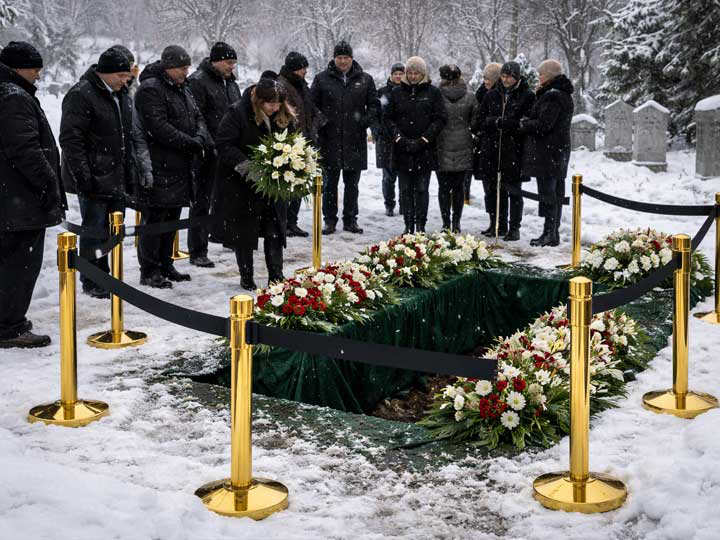
Barrier posts solve this problem in a way that's both discreet and effective. Tape stretched between posts creates a clear boundary that every participant respects regardless of how busy or frustrated they are by conditions. No one needs to be told that a given zone is reserved – the physical barrier itself is a sufficient signal.
Problem Three: Safety on Slippery Surfaces
Wet snow and ice on cemetery walkways are a constantly appearing problem in winter. People stumble, rub against each other in crowds, and the danger of falling is real, especially among elderly people or those in poor emotional states who have difficulty concentrating. Designating a safe standing zone – away from edges and potentially dangerous sections – can significantly reduce accident risk.
Barrier posts enable creation of corridors that direct participant traffic along safe walkway sections. The idea is simple but extremely effective – people naturally follow visible barriers and don't try to cross boundaries that are clearly marked. In the context of a winter cemetery, where danger comes from invisible obstacles hidden under snow, such traffic direction is one of the most effective ways to prevent accidents. If a particular section of the cemetery is especially slippery or dangerous, simply separate that zone with tape, and participants will naturally be directed along an alternative route. This solution works especially well when applied from the very beginning of ceremony organization – participants then move along a pre-planned, safe path from the moment they arrive at the cemetery.
Problem Four: Technical Space Organization
Every funeral requires technical space – a place where wreaths, sound equipment (if used), additional chairs, or other equipment elements are located. In summer, technical space can be hidden behind trees or other landscape elements. In winter, such natural camouflage is much harder to achieve.
Barrier posts allow technical zone designation in a way that's both evident to funeral home personnel and discreet for ceremony participants. Personnel know where equipment is, guests don't see it in a way that disrupts ceremony flow, and tape creates a boundary that prevents accidental entry into this space.
Golden Post with Black Tape – Why This Variant Works Best in Winter
Choosing barrier post color scheme may seem like a secondary detail, but in winter conditions it has practical significance. The golden retractable tape barrier post with black tape combines two important aspects: elegance of golden post finish and maximum visibility of black tape against white snow background.
The golden post looks professional and dignified in the context of funeral ceremony, and moreover creates coherent aesthetics with other golden equipment elements – such as candelabras or urn bases – which are popular in chapels and cemeteries. Gold has a long tradition in funeral culture – it's associated with respect, with solemnity, with something valuable and precious. In a winter cemetery, where surroundings are white and stark, a golden post adds warmth and refinement that accompany the ceremony.
Black tape, on the other hand, is a purely practical matter. On white snow, a black strip 1.9 inches (4.8 cm) wide is visible from a great distance and immediately catches the eye. It's a contrast that works even in poor lighting, even when temperature is so low that people have difficulty concentrating attention on surroundings. It's worth adding that black tape is also coloristically consistent with the rest of typical funeral equipment – the black of participants' clothing, the black of funeral trolleys, and other equipment.
This post is made of stainless steel, meaning there won't be problems with it corroding in damp, winter conditions. A base with a diameter of 12.5 inches (32 cm) ensures stability regardless of substrate – on wet snow, on packed surfaces, on ice covered with a thin layer of snow. A height of 35 inches (90 cm) makes the barrier visible even when snow reaches several dozen centimeters.
Tape with a length of 78 inches (200 cm) is an amount that in practice allows zone designation of serious size without needing many posts. If we want to designate a corridor with width allowing passage of a single crowd of participants – 78 inches of tape between two posts is sufficient length. If we need a longer barrier, simply set up more posts in a line and stretch tape between them.
Stainless steel, from which the post is made, is a material with exceptional properties in contact with moisture and low temperature. Unlike galvanized steel or aluminum, stainless steel doesn't require additional corrosion protection and doesn't change its appearance under atmospheric conditions. This means the golden post will look just as elegant after dozens of winter ceremonies as on the day of purchase. The tape retraction mechanism spring is also moisture-resistant, guaranteeing reliable operation across the entire temperature range encountered during winter.
Practical Application Scenarios in Winter
Funeral at Cemetery with Moderate Snowfall
In a situation where snow covers the cemetery with a layer of several dozen centimeters, but conditions aren't extreme, barrier posts can be set up along the path leading to the grave and around the burial site. Optimal setup is an arrangement where tape creates a corridor from the entrance gate to the grave and clearly marks zones for closest family. Six to eight posts are enough to achieve clear space organization.
In this scenario, it's worth paying special attention to base stability. Wet snow, which most often occurs at temperatures close to zero, isn't the best substrate for heavy bases. However, a base with a diameter of 12.5 inches (32 cm) has a sufficiently large contact surface to maintain stability even on wet snow. If conditions are extremely bad, the base can be lightly pressed into the snow layer, which increases settling.
It's also worth remembering the sequence of setting up posts. The best approach is to start by marking the main corridor – from cemetery entrance to grave – and then designate subsequent zones (for family, for guests, technical space). This work order ensures that even if we have a limited number of posts, the most important barrier is always in place, and additional space organization elements are added in order of their urgency.
Funeral in Bad Weather and Strong Wind
Strong wind is a situation requiring special attention. Lightweight equipment elements can be blown away, and tape stretched between posts can assume an unwanted position under wind influence. In the case of retractable tape barrier posts, the key is that tape is pulled to the post by internal spring, so even in strong wind it won't flutter in a way that disrupts ceremony. The barrier itself will move somewhat, but won't lose its function of marking boundaries.
A base with mass sufficient to keep the post in vertical position is a necessary condition in this case. The golden post with black tape meets this condition thanks to a solid steel base that has sufficient mass to maintain position even in dense wind. It's worth remembering that the best effects are achieved when posts are set up so that tape creates lines perpendicular to wind direction – then air resistance on tape is distributed evenly across both posts and neither is excessively loaded.
Funeral in Poor Lighting
As mentioned earlier, in winter months ceremonies can occur in weak natural lighting or even after dusk. In these conditions, black tape on white snow is visible much better than any other color variant. The golden post, meanwhile, thanks to metallic coloring, reflects light – even weak, diffused light of winter morning – which makes it visible in space. If lighting points are available at the cemetery – even diffused walkway lamps or lighting at the gate – the golden post surface will reflect them in a way that strengthens visibility of the entire barrier. This is an effect that works regardless of how weak the light source is, and which makes the golden post one of the best choices for ceremonies organized in limited visibility conditions.
Another issue is what happens after dusk. Funerals after dark are rare, but they do occur – especially in December and January, when the day is very short, and funerals organized in the afternoon can extend to the moment when natural light almost disappears. In such situations, barrier posts with contrasting tape are one of the elements that remain visible in space longest, even without additional lighting.
How to Choose the Right Number of Posts for Your Funeral Home
The number of barrier posts a funeral home should have depends on several factors. First, on how many ceremonies are organized simultaneously – if the home services funerals at several cemeteries, it needs sets that can be divided between locations. Second, on the typical size of ceremonial space – at a large cemetery with extensive walkways, more posts are needed than at a small one.
As a reference point, one can assume that organizing one typical cemetery ceremony requires six to twenty posts, depending on ceremony scale and number of zones that need to be designated. It's worth starting with a smaller set – for example, twelve posts – and supplementing them as needed. Twelve units is a number that in practice works for most ceremonies and allows flexible space organization in various configurations. For a smaller funeral, with one grave and a group of up to several dozen participants, only six to eight posts are sufficient to designate a corridor and family zone. A larger ceremony, with several hundred participants, requires twelve to twenty pieces to designate corridor to grave, guest standing zones, closest family places, and technical space.
At a price of approximately $20 per unit, purchasing a set of twenty posts is an expenditure slightly exceeding $400. This is a one-time investment that will serve for years – stainless steel posts don't rust, tapes retract automatically and don't wear with normal use. Comparing this to the cost of disposable alternatives – such as adhesive tapes, plastic ropes, or improvised solutions with stakes and strings – barrier posts offer significantly higher quality and professional appearance at a price that in the perspective of several years of use is many times lower than cumulative expenditure on disposable solutions.
Purchasing posts in packages is recommended for funeral homes that service several ceremonies weekly. Having sufficient numbers of posts for simultaneous handling of two or three funerals at different locations is then key to operational flexibility. Funeral suppliers offer the possibility of ordering products in wholesale quantities, which is a convenient solution for professional funeral homes.
Maintaining Barrier Posts in Winter Conditions
Stainless steel is a material that doesn't require complicated care, but it's worth knowing basic maintenance rules, especially during winter. After each use in damp conditions, it's worth drying posts with a dry cloth, especially the base and tape retraction mechanism area. Moisture persisting in the retraction mechanism can over time affect spring action smoothness, although in the case of quality products, the mechanism is designed with outdoor condition resistance in mind.
Storing posts in a dry place between ceremonies is another good practice. Even if we have limited space available at the funeral home, barrier posts are compact enough that they can be stored vertically in a special corner of the room or in a cabinet.
Barrier Posts as an Element of Funeral Home Professionalism
Organizing a funeral ceremony isn't just logistics – it's also a message to family and participants. When a funeral home takes care of every organizational detail, even in difficult weather conditions, it sends a strong signal: that this is a professional and responsible enterprise that places ceremony dignity first.
Retractable tape barrier posts are one of those equipment elements that are barely visible in daily life but are very noticeable when they appear at a funeral. Ceremony participants notice that space is organized, that they know where to stand, that zone boundaries are clear – and this translates to a sense of order and calm that are so important in such a difficult time.
It's therefore worth treating barrier posts not as unnecessary luxury but as a fundamental element of funeral home equipment, just as essential as funeral trolleys or tents that protect participants from rain.
Professional funeral home standards are measured not only by transport equipment quality or chapel furnishings but above all by how well space is organized at the cemetery. The cemetery is public space over which the funeral home doesn't have full control – it can't change grave arrangement, can't remove ice from walkways, nor make weather improve. It can, however, ensure that this space is organized in a way that makes participants feel safe, orient themselves in terrain, and can focus on participating in ceremony rather than solving logistical puzzles. And this is precisely the role of barrier posts – a quiet but important role of space organizer that every time improves every funeral participant's experience.
Complementary Equipment for Winter Funerals
Barrier posts are of course only one element of a well-organized winter funeral. For the ceremony to proceed in a dignified and safe manner even in the worst weather, it's worth considering other products as well.
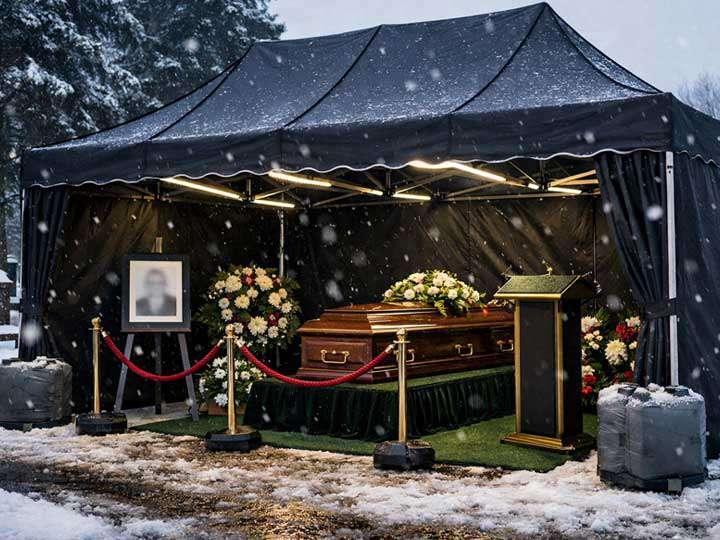
Funeral tents are an essential element at any cemetery funeral organized during snow or rain. They protect participants from atmospheric conditions and create space where ceremony can proceed in a dignified manner, even when it's very cold outside. Funeral tents are available in various sizes – from 3x3 m to 3x4.5 m models – in pro and premium pro variants that are adapted to difficult winter conditions.
Funeral trolleys, such as terrain trolleys, are essential for transporting coffins around the cemetery, especially when walkways are covered with snow or ice. Terrain trolleys are equipped with wheels that handle uneven substrates, which is especially important in winter.
Wreath stands are another element requiring consideration in winter. Wreaths placed on the grave can be blown away by wind or weighed down by snow, so stable stands allow their safe display even in difficult conditions. Photo stands are another product that gains special significance in winter. A photo of the loved one placed at the grave is one of the most personal ceremony elements – and one of those that can most easily be destroyed by weather. Solid photo stands made of materials resistant to moisture and low temperatures ensure that this unique ceremony element will be safely presented throughout the funeral.
Grave crosses, being a permanent element of every cemetery's equipment and many ceremonies, also require proper placement in winter. Snow and ice can make it difficult to set up a cross at the burial site, so early preparation of this element and adapting it to prevailing conditions is key to maintaining the grave's dignified appearance. A comprehensive approach to winter funeral equipment – including barrier posts, tents, terrain trolleys, and stands – ensures that the entire ceremony will be organized at a level that every participant will appreciate.
FAQ
Will Barrier Posts Stay Stable on Wet Snow Without Additional Anchoring?
Yes, retractable tape barrier posts with a 12.5-inch (32 cm) diameter base made of stainless steel provide sufficient stability on wet snow. The base is heavy enough not to be blown by wind and wide enough not to sink into soft snow. In extreme cases – on very packed or icy substrate – the base can be lightly pressed into snow layers, which further increases its grip. Additional anchoring, such as stakes in the ground, isn't needed in standard conditions.
How Many Posts Do I Need for a Typical Cemetery Funeral in Winter?
For a typical cemetery funeral during winter, six to twenty posts are sufficient, depending on ceremony scale. A smaller funeral, with one grave and a group of up to several dozen participants, requires only six to eight posts to designate a corridor and family zone. A larger ceremony, with several hundred participants, requires twelve to twenty pieces to designate corridor to grave, guest standing zones, closest family places, and technical space. It's worth remembering that each post is reusable, so a one-time investment in an appropriate set will serve for hundreds of subsequent ceremonies.
Will Retractable Tape Function Properly in Low Temperatures?
The tape retraction mechanism in barrier posts is designed to work regardless of weather. Tape is retracted using an internal spring that isn't sensitive to low temperatures to a degree that could disrupt its proper operation. Of course, at temperatures below minus 4°F (-20°C), springs may work somewhat slower than at positive temperatures, but they don't stop or refuse to cooperate. In practice, at typical winter temperatures ranging from 23°F to 5°F (-5°C to -15°C), the mechanism works without any difficulties.
How to Care for Barrier Posts After Winter Use?
Caring for stainless steel posts is simple and doesn't require specialized products. After each use in damp conditions, simply dry the post with a dry cloth, especially the base and tape retraction mechanism area. If any contaminants or snow appear on the post surface, they can be removed with warm water and a soft cloth. Stainless steel doesn't rust in contact with water, but keeping it dry prolongs retraction mechanism life and ensures tape always works smoothly. Storing posts in a dry place between ceremonies is sufficient preventive care.
Does the Golden Post with Black Tape Suit Every Type of Funeral Ceremony?
The golden post with black tape is one of the most versatile color variants in barrier post offerings. The golden color of the post is associated with dignity, elegance, and respect – values that are key in funeral ceremony context, regardless of style, form, or size. Black tape is so neutral and subdued that it fits practically any decor – from classic ceremonies to more modern ones. In practice, this variant works at funerals organized both in chapels and at cemeteries, both in summer and winter. The only situation where it might seem less ideal is a ceremony where the organizer wants to direct participants' attention to some specific element – in that case, additional markings besides tape could be considered.
Summary
Winter makes funeral organization significantly more complicated than in other seasons. Snow, ice, strong wind, and short days are challenges that can lead to organizational chaos if not considered in advance in ceremony planning. Retractable tape barrier posts are one of those tools that can dramatically change the course of a winter funeral – from organizational chaos to a calm, dignified, and safe ceremony.
The golden retractable tape barrier post with black tape is a product that combines all characteristics needed for effective operation in difficult winter conditions: stable base, reliable tape retraction mechanism, color contrast ideal for snowy surroundings, and elegance appropriate to funeral ceremony context. At a price of approximately $20 per unit, this is one of the most cost-effective investments in professional funeral home equipment – an investment that pays off with each subsequent ceremony.
Barrier posts are a product that in practice works every year, in all weather, and in every ceremony context. Don't wait for the next winter to notice how much you're missing this ceremony organization element. We invite you to visit the product page where you can familiarize yourself with complete technical specifications and place an order. Fast and secure delivery is available nationwide, so winter preparation can begin at any time of year. Contact us or visit our website – we're here to help.