Table of Contents
- Why Proper Ceremony Lighting Becomes Particularly Important in Winter Months
- Specifics of Lighting on Short Winter Days – Challenges of the Burial Season
- Types of Lighting Used in Organizing Ceremonies in Winter Low-Visibility Conditions
- LED Lighting – Efficiency and Convenience in Modern Funeral Ceremonies
- Practical Application of Halogen Lighting in Winter Funeral Ceremonies
- Planning Light Source Placement Under the Ceremonial Tent in Winter Conditions
- Mounting and Preparing Lighting – Step by Step in Winter Practice
- Electrical Safety During Winter Ceremony – Rules and Good Practices
- Adapting Lighting to Different Types and Sizes of Ceremonial Tents in Winter
- Logistics of Transporting and Storing Lighting Equipment in Winter Period
- Energy Savings and Operational Efficiency in Long-Term Perspective
- Communication with the Deceased's Family Regarding Winter Ceremony Conditions
- Questions and Answers Regarding Winter Funeral Ceremony Lighting
- Summary
The winter months bring particular challenges for funeral ceremony organizers. It's not just about frost or snow, but primarily about the specific character of light during this time of year. Even in the middle of the day, around one or two o'clock, the sun hangs low above the horizon, and cloudy skies absorb most of the rays, creating a gray, oppressive atmosphere. For families saying their final goodbyes to loved ones, for priests conducting the last prayers, for all those gathered – the ability to see faces, gestures, symbolic objects has profound meaning. In a profession that demands perfection in every detail, knowledge of practical lighting solutions and the ability to implement them effectively represents a sign of professionalism for a funeral home.
Organizing a funeral ceremony is a process in which every element combines to provide the family with an appropriate setting for the final farewell. In warm, sunny months, natural light supports this setting, but when the calendar shows December, January, or February, professional technical equipment gains primary importance. Funeral homes managing ceremonies on cloudy winter days know well how weak natural lighting can be and how essential every planned source of artificial light becomes. It's not just about allowing ceremony participants to move safely – it's also about creating an atmosphere of focus, solemnity, and warmth that helps the family get through the most difficult moment.
Why Proper Ceremony Lighting Becomes Particularly Important in Winter Months
A funeral ceremony is a special type of event that cannot be rescheduled to a more favorable time of day or moved to a location with better lighting conditions when these prove insufficient. The date and time of the funeral result from many factors – cemetery availability, the schedule set by the parish, time needed for family to arrive from different parts of the country. In practice, this means that winter ceremonies often take place at times when natural lighting leaves much to be desired. A December morning is gloomy and gray, an afternoon ceremony unfolds in conditions where the sun barely breaks through dense clouds, and rainy days of late autumn or early spring bring grayness that drastically limits the amount of available light.
The characteristics of winter sun differ fundamentally from summer. Even when the sky is clear, the sun in December or January moves along an arc so low that its rays fall at an acute angle, travel a longer path through the atmosphere, and lose a significant portion of their power. This physical phenomenon means that a winter afternoon at three o'clock can be darker than a July evening at seven. When the sky is additionally covered with a layer of clouds – which happens extremely frequently in winter – the natural lighting level drops to values that require the space under the ceremonial tent to be supplemented with artificial light.
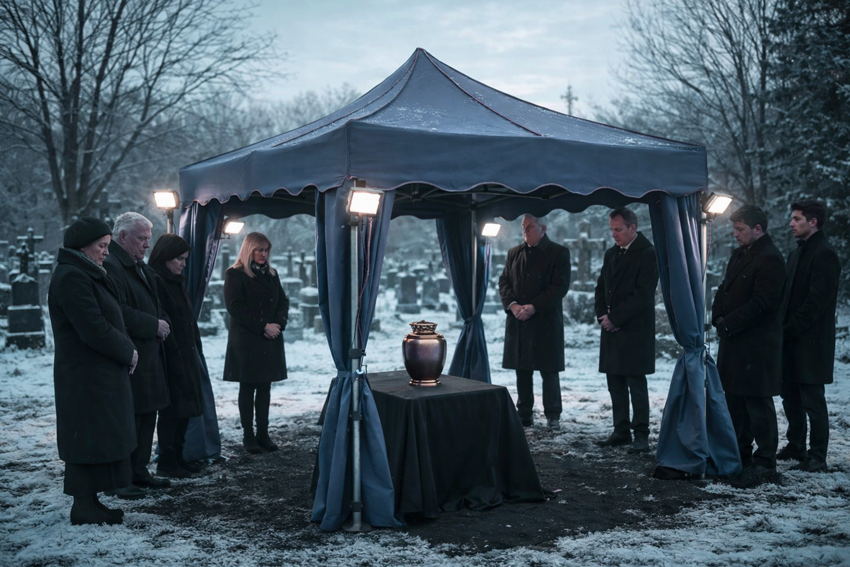
In such circumstances, the ceremonial tent serves not only as shelter from wind or precipitation but becomes a space requiring its own independent lighting. Under the tent roof, even in the theoretical middle of the day, natural light arrives in very limited quantities – the mosquito net or tarp material absorbs part of the already weak sunlight, the dark colors of the arranged space around the grave also don't favor light dispersion. For the priest conducting prayers, for the person delivering the farewell speech, for the family following every gesture of the ceremony, the ability to see details has emotional and symbolic meaning. Funeral liturgy contains many gestures that gain full meaning when visible – sprinkling with holy water, incensing, blessing. Dim light limits perception of these actions and can thereby diminish the sense of participation in the farewell.
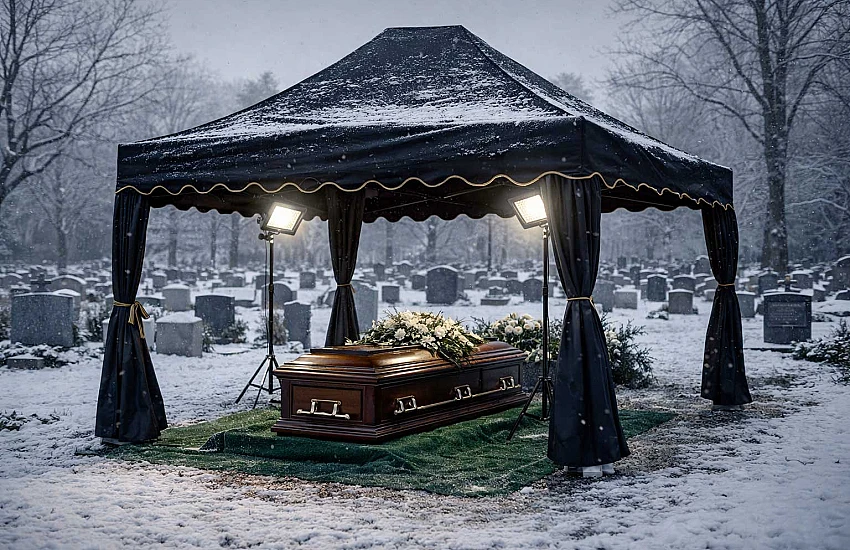
Professionally installed lighting under the ceremonial tent allows for conducting ceremonies regardless of weather conditions. It doesn't replace natural light but effectively supplements it, creating a space where every ceremony participant feels safe and can fully participate in the farewell. Well-planned lighting illuminates the space evenly, not creating strong shadows or blinding reflections, but providing enough light to distinguish faces, the celebrant's gestures, decorative elements. In this way, the technical solution supports the emotional and spiritual dimension of the ceremony.
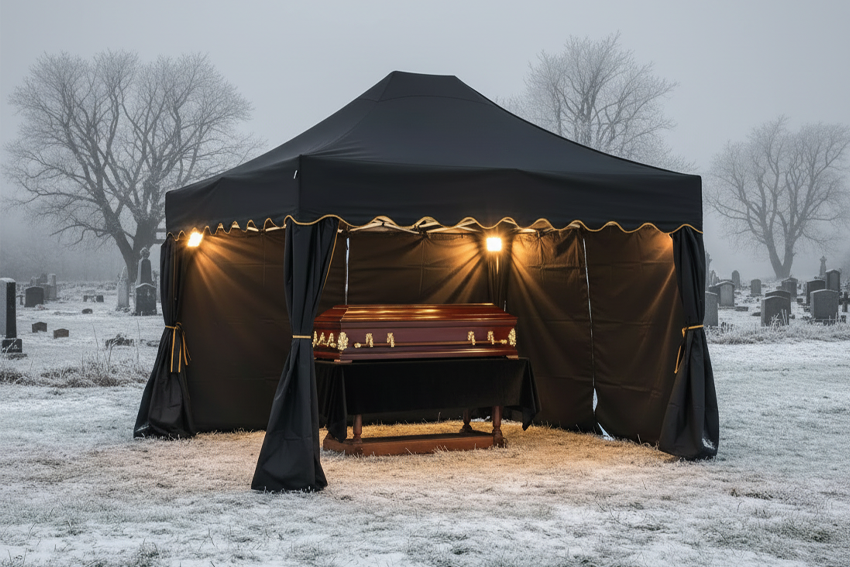
Specifics of Lighting on Short Winter Days – Challenges of the Burial Season
Organizing a funeral ceremony in winter differs from summer in many ways, but the lighting issue manifests particularly clearly in months of short days and dominant cloudiness. At the height of summer, ceremonies taking place at any time of day benefit from abundant natural light, and even cloudy skies don't dramatically change this situation. Different is the reality of December or January, when from early morning the sky often resembles a gray, uniform sheet that remains so throughout the day. For funeral homes, this means the necessity of systematically planning lighting actions at practically every winter ceremony, regardless of the formal time of day.
Particularly difficult are days when the sky is covered with dense, low-hanging clouds bringing snowfall. Falling snow has the extraordinary property of absorbing light – white fluff swirling in the air creates a kind of curtain that further limits already poor visibility. In cemeteries surrounded by trees, in pathways between graves, where surrounding headstones additionally obscure the space, the lighting level can drop to values requiring activation of artificial lighting even at noon. Organizing a ceremony in such circumstances, funeral home staff must be prepared for situations where daylight practically doesn't reach under the tent.
December and January are also the months when the day is shortest in the year. The sun rises late and sets early, but even during those few hours of nominal daylight, its position in the sky is so low that effective lighting remains very limited. Ceremonies planned for two or three o'clock, which in summer would take place in full sun, in winter unfold in conditions resembling pre-evening twilight. This isn't a matter of approaching dusk but simply the normal conditions prevailing in the middle of a winter day at our geographic latitude.
February, though formally still a winter month, brings gradual improvement in lighting conditions – days lengthen, the sun climbs higher above the horizon. Nevertheless, February is often a very cloudy month, with dense clouds and frequent snow-rain precipitation that neutralize the benefits from lengthening days. Early March can also be surprisingly gloomy when winter weather systems persist longer than the calendar would suggest. Therefore, professional funeral homes treat the entire period from November to March as a time requiring full readiness in terms of ceremonial lighting.
Rain mixed with snow and fog additionally complicate the situation, as they require particular caution with electrical installation while simultaneously making lighting even more necessary. During intense precipitation, even at one or two o'clock, lighting conditions can be very poor. Raindrops refract light, creating an unclear gray curtain, and snow manages to absorb sunlight while simultaneously reflecting artificial light in ways that can cause visual discomfort. Planning lighting in such conditions requires considering both the need for sufficient brightness and the necessity of avoiding blinding reflections from white snow cover.
Types of Lighting Used in Organizing Ceremonies in Winter Low-Visibility Conditions
The modern market offers funeral homes various lighting solutions that can be adapted to specific needs and conditions prevailing at a given cemetery. Choosing the appropriate type of lighting depends on many factors – from tent size, to power source availability, to preferences regarding light character and color temperature. In industry practice, two main types of lighting are most commonly encountered: modern LED systems and proven halogen lighting. Each of these solutions has its advantages and distinctive features that make it appropriate in specific situations.
The choice between different lamp types isn't just a technical matter – it relates to what impression one wants to evoke, how long the ceremony should last, what logistical capabilities the facility has. Some ceremonies require only moderate lighting, others need strong, clear light for an extended time. Spaces under tents differ in size and shape, which also affects equipment selection. Understanding the specifics of individual solutions allows for making informed decisions that translate into comfort and dignity of the ceremony.
An important aspect of lighting choice also remains its practicality in winter terrain – equipment used in cemeteries must be resistant to low temperatures, moisture from snow, easy to install with frozen hands, safe to operate by people performing work often in stressful circumstances. Modern technological solutions allow for significant simplification of this process, but at the same time traditional lighting methods work equally well in many situations, and sometimes even better. Therefore, it's worth knowing both innovations and classic solutions used in the industry for years.
LED Lighting – Efficiency and Convenience in Modern Funeral Ceremonies
LED technology has brought revolution to many fields, and the funeral industry has not remained indifferent to the benefits from its application. LED lighting is characterized primarily by very low energy consumption while simultaneously generating a large amount of light, making it an ideal solution in situations when the lamp must be powered from a generator or when available power is limited. LED diodes produce minimal amounts of heat compared to traditional light sources, which increases safety of use, especially in confined spaces under the tent where people move close to equipment.
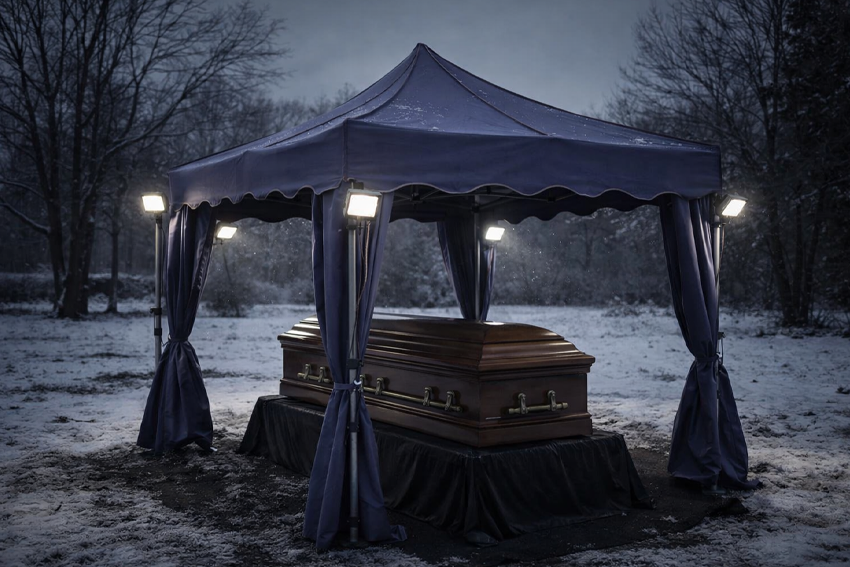
One of the most practical solutions available on the market is LED lighting for funeral tents with two strips and 230V power supply, which was designed specifically with the needs of cemetery ceremonies in mind. The system consisting of two LED strips allows for flexible placement of light sources along the tent structure, enabling uniform illumination of the entire ceremonial space. The 230V power supply ensures simple installation – just access to a standard electrical outlet, without the need for complicated transformers or special installations. Such an arrangement works well with both smaller tents and larger constructions, where two strips placed along the sides or at opposite ends create harmonious lighting free of harsh shadows.
Characteristic of LED technology is also their long life – diodes can shine for tens of thousands of working hours, which in practice means years of trouble-free operation even with intensive use. For a funeral home, this is a significant advantage because it eliminates the need for frequent bulb replacements and limits operating costs. Additionally, LED diodes turn on instantly, reaching full brightness without a warm-up period, which can be important when lighting needs to be activated quickly after arriving at the cemetery. The ability to react quickly to worsening weather conditions – for example when heavy snow suddenly starts falling – constitutes a real advantage in dynamic situations.
Another advantage of LED lighting is its thermal neutrality. During prolonged ceremonies, especially in enclosed or partially sheltered spaces, traditional light sources can emit considerable heat, which in winter paradoxically introduces discomfort through local excess heat with simultaneous overall cold. LED lamps remain cool, which is also important from a safety standpoint – the risk of burns or accidental ignition of materials is minimal. This is particularly important when lighting is installed in haste or when near the lamps are ceremonial decoration fabrics, which in winter often include thick flannel or felt materials.
In terms of light quality, modern LED diodes offer different color temperatures, allowing the character of lighting to be matched to the ceremony's atmosphere. Warm light with a hue similar to traditional bulbs creates a more intimate, cozy atmosphere, which is desirable during intimate family farewells on a gloomy winter day. Neutral white light provides better visibility and works in situations where it's important to clearly distinguish details – for example during ceremonies with many people, where the priest or celebrant must read liturgical texts and needs good quality lighting for work, especially when gray winter afternoon prevails outside. The ability to choose the appropriate color temperature thus constitutes an additional element allowing personalization of the ceremony according to the character of the farewell.
LED diodes work perfectly in low winter temperatures. Unlike some traditional light sources that in frost may have problems starting or reaching full brightness, LEDs function reliably even at below-zero temperatures. This is a particularly valuable property during ceremonies on frigid January or February days when thermometers show several degrees below zero. Funeral home staff can be certain that the lighting will start without problems, regardless of how low the ambient temperature is.
Practical Application of Halogen Lighting in Winter Funeral Ceremonies
Halogen lighting, though in many fields giving way to more modern technologies, still finds its application in professional funeral ceremony management. Halogen produces intense, very clear light with a warm hue, which in certain circumstances may be more desirable than LED light. The main advantage of halogen lighting is its power – halogen lamps can illuminate space very effectively, creating bright, strong lighting that works particularly well in large tents or in situations when natural light is almost completely absent due to dense winter clouds.
In practice, halogen is ideal for ceremonies taking place on the gloomiest winter days, when even in the middle of the day the sky is so dark it resembles pre-evening twilight. In such conditions, the power of halogen lamps allows creating a space bright enough for ceremony participants to feel comfortable and safe, and for the priest or celebrant to read prayer texts without problems. The warm hue of halogen light creates an atmosphere similar to traditional lighting, which for many people associates with a sense of security and solemnity appropriate for funeral ceremony, especially in the context of winter severity.
Halogen also features a specific light distribution – typical halogen lamps shine more in a point manner, creating a clear cone of light directed at a specific place. This feature can be used consciously, for example when wanting to focus attention on a specific area under the tent – on the grave, on the stand with the deceased's photograph, on the field altar. In this way, halogen lighting not only brightens the space but also helps in spatial organization of the ceremony, defining the visual center of the ceremony. At the same time, the point character of light requires thoughtful lamp placement to avoid creating harsh shadows that could introduce a disturbing mood.
It should be remembered that halogen lamps produce significantly more heat than LED diodes, which involves certain practical consequences. First, the equipment requires more careful handling – touching an operating halogen lamp can cause burns, so all adjustments and lamp repositioning should only occur after their shutdown and cooling. Second, greater heat emission also means higher energy consumption, which matters when powering from a generator – one must ensure that available power is sufficient for operating halogen lamps. Third, in limited spaces, especially in small tents, the heating effect of halogens can be noticeable, which on frigid winter days can even be welcome by ceremony participants standing near the lamps.
Despite these limitations, halogen lighting remains a proven, reliable solution that many experienced ceremony organizers choose precisely for its distinctive characteristics. The bright, warm light of halogen creates an atmosphere that is perceived by many ceremony participants as more traditional and solemn, especially in the context of winter severity. For funeral homes already equipped with a halogen lighting set and well familiar with its operation, it remains a practical and effective work tool in difficult winter conditions.
Planning Light Source Placement Under the Ceremonial Tent in Winter Conditions
Effective illumination of ceremonial space is not just a matter of selecting appropriate equipment, but primarily thoughtful planning of locations where light sources will be placed. Lamp placement determines both lighting uniformity and the atmosphere that light creates in the space under the tent. Professional ceremony management requires planning a lighting arrangement that won't blind participants, won't create distracting harsh shadows, and will simultaneously provide sufficient visibility at all key ceremony points, which is particularly important in winter low-visibility conditions.
The basic principle is placing light sources above the level of ceremony participants' heads, allowing the light stream to be directed downward where needed, while simultaneously avoiding situations where light directly hits eyes. The construction of most funeral tents provides the possibility of mounting lighting to the tent frame, supporting poles, or crossbars, allowing safe and stable lamp positioning at appropriate height. When using the LED lighting system with two strips, the natural solution is placing them along the tent's longer sides, creating uniform, diffused light reaching the entire ceremonial space.
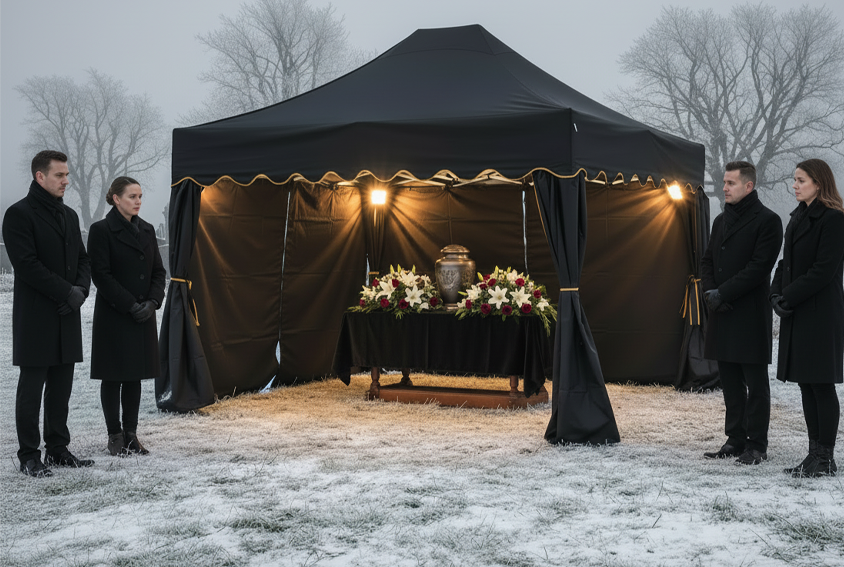
In the case of halogen lighting, which usually consists of individual lamps of more point-like character, planning several light points distributed around the grave is crucial. The typical solution is placing lamps in tent corners, directed slightly toward the center, so that light cones intersect approximately above the grave and in the ceremony's central zone. Such arrangement ensures that the most important area – the burial site, the stand with the deceased's portrait, the space where the celebrant stands – is well illuminated, while light spreads to the sides, also reaching the zone where ceremony participants stand.
It's also worth considering functional aspects of ceremonial space. If the priest or celebrant will be reading texts from a book, they should have access to good quality lighting where they will stand. On a winter afternoon, when grayness prevails outside, natural light arriving from under the tent's edge is practically insufficient for reading, so thoughtful illumination of the ceremony location gains particular importance. If a farewell speech is planned at the graveside, it's worth ensuring that the person speaking will have sufficient light to read the prepared speech.
Lighting planning should also consider the safety of ceremony participants' movement in difficult winter conditions. Paths leading to the grave, spaces where people will stand or sit in chairs, the tent entrance – all these places must be adequately illuminated to avoid trips or falls. In cemeteries, terrain can be uneven, and in winter additionally ice patches appear, accumulated snow layers, post-snow mud, which makes good lighting not just a matter of comfort but actual safety. Practice shows that thoughtful lamp placement can significantly reduce the risk of unpleasant incidents during winter ceremonies.
Mounting and Preparing Lighting – Step by Step in Winter Practice
Effective lighting installation under the ceremonial tent requires a methodical approach and preliminary preparation, which is particularly important in winter conditions. Funeral home employees arriving at the cemetery usually have limited time before the ceremony begins, and additionally must work in difficult conditions – in frost, sometimes in falling snow, often on slippery ground. Therefore, efficiency and knowledge of mounting procedures are crucial. The process begins even before departure to the cemetery – one must ensure that all necessary equipment is complete, functional, and ready for use. This means checking the condition of lamps, power cables, power supplies, as well as any extension cords and distributors that may be needed in the field.
After arriving on site, the first step is setting up the ceremonial tent structure, because only after its assembly can one proceed with lighting installation. Some tents have built-in mounting points for lamps or special holders facilitating hanging lighting equipment. When using LED strips, which are light and compact, mounting usually involves hanging them on the tent's upper crossbars using hooks, clamps, or fastening straps. It's important that strips be stably mounted and cannot shift under wind influence or accidental cable pulling, which happens frequently on windy winter days.
When installing halogen lighting, one must ensure solid bases or tripods on which lamps will be placed. Considering that halogen emits heat during operation, lamps cannot be mounted in direct contact with tent fabric or other flammable materials. Tripods should be positioned stably, even if terrain is uneven or covered with snow – if necessary, wedges or supports ensuring balance can be used. In winter, one must also remember to clear snow from the place where the tripod will stand to guarantee a stable base. Directing lamps in the appropriate direction and at the appropriate angle requires several trials and corrections, so it's worth planning this stage in advance, before the ceremony begins and guests gather.
The next step is preparing power supply. If an electrical outlet is available at the cemetery, the task is relatively simple – just connect the power supply or extension cord to the power source and ensure everything works properly. In winter, particular attention should be paid to whether the outlet is frozen or damp. If the cemetery doesn't have access to electrical energy, using a generator is necessary. The generator should be positioned at a safe distance from the ceremony location – far enough that engine noise doesn't disturb the ceremony, but close enough to allow connecting lighting without using very long electrical cables.
Power cables should be routed in a way that minimizes the risk of tripping over them. If possible, it's worth placing cables along the tent structure, securing them with tapes or cable ties, or routing them at the edge of ceremonial space where participant movement is less. In winter, it's particularly important to protect cables from contact with snow and water – wet cables mean increased short-circuit risk. When cables pass through places where people will move, good practice is securing them with cable channels or special covers that prevent accidental catching. It should be remembered that a funeral ceremony is a moment of great emotions when participants can be distracted, so every element that could pose a potential hazard should be appropriately secured.
After mounting the entire system, it's worth conducting an operation test – turn on the lighting, check that all lamps shine, assess whether light placement is satisfactory in existing winter visibility conditions. This is also a good moment for any corrections – repositioning a lamp, changing the lighting angle, adding or removing a light source. The more experience funeral home employees gain in mounting lighting in winter conditions, the more smoothly the entire process will proceed, and the risk of technical problems during the ceremony will be minimal.
Electrical Safety During Winter Ceremony – Rules and Good Practices
Electrical safety constitutes a priority in every lighting installation in field conditions, especially when the ceremony takes place in a location exposed to winter atmospheric factors. Snow, moisture from melted snow, ice, uneven frozen terrain – all these elements increase risks associated with using electrical devices, so applying proven safety procedures is essential. The basic principle is using only functional, professional equipment that has appropriate certificates and was designed for working in difficult conditions.
All electrical cables should be intact, free of insulation damage, without punctures or cuts. Before each use, it's worth conducting a visual inspection of cables, plugs, and sockets to ensure there are no visible signs of damage. In winter, it's particularly important to check that cable insulation hasn't hardened and cracked under the influence of low temperatures. Extension cords used in external installations must be intended for outdoor use – this means appropriate protection class and resistance to weather conditions. Using domestic extension cords that aren't adapted for outdoor work, in damp or wet environments constitutes a serious hazard, especially in winter when snow melts and water forms.
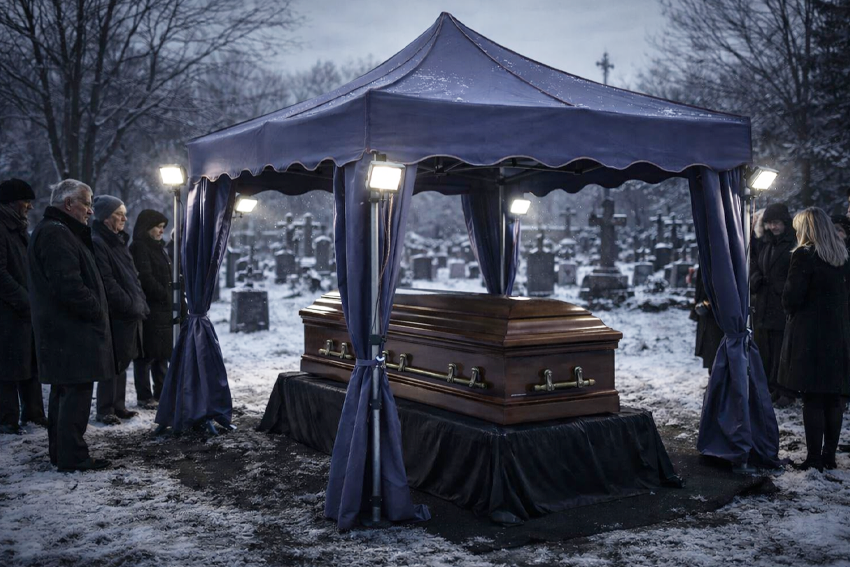
In snowfall conditions, particular attention should be paid to all electrical connection points – sockets, plugs, distributors. If possible, these points should be protected from direct contact with snow and water. In practice, this means placing distributors under the tent tarp or in special protective housings that protect from precipitation. Even brief contact of water from melted snow with electrical elements under voltage can cause a short circuit and in the worst case create danger for people nearby. Particularly dangerous are situations when temperature oscillates around zero and snow alternately melts and freezes.
If the ceremony takes place in conditions of intense snowfall and there's no possibility of completely protecting the installation from moisture, using an installation with residual current protection should be considered. A residual current circuit breaker immediately cuts off power in case of detecting even minimal current leakage, protecting against electrocution. Funeral homes often equip themselves with portable distributors with built-in residual current circuit breaker that increase safety during field work. The cost of such protection is minimal compared to potential consequences of an electrical failure during a ceremony.
The issue of grounding also deserves attention, especially when using a generator. The generator should be properly grounded – driving a metal rod into the ground and connecting the generator's grounding wire to it is a simple but important procedure increasing safety. In winter, when ground is frozen, driving the grounding rod can be more difficult and require using a hammer or other tool. On snowy cemetery ground, one must first clear the snow to reach the soil and ensure effective grounding.
It's also important that people operating lighting be aware of basic electrical safety principles and know how to react in case of problems. One should not touch installation elements with wet or frozen hands, one must not attempt to repair damage without shutting off power, and in case of detecting any irregularities – exposed wires, strange smells, sparking – power should be immediately cut off and the problem eliminated. A funeral ceremony is a moment requiring focus on dignified farewell, not on solving technical problems, so careful preparation and adherence to safety rules constitute the foundation of professional management, especially in demanding winter conditions.
Adapting Lighting to Different Types and Sizes of Ceremonial Tents in Winter
Funeral tents come in different sizes and configurations, from small constructions intended for a few close relatives, to large tents that can accommodate dozens of ceremony participants. Lighting selection and placement must consider the specifics of a given construction to ensure uniform and sufficient lighting adapted to the scale of the ceremony and winter low-visibility conditions. A small tent, often used for intimate ceremonies, requires thoughtful lighting – even a single LED strip or one halogen lamp may prove sufficient to illuminate the entire space on a gloomy December day when the sky is covered with dense clouds.
In larger tents, such as constructions that can accommodate dozens of people, using several light sources strategically placed around the grave is necessary. A system consisting of two LED strips works perfectly in such situations because it allows covering a longer space with light and ensures uniform brightness over the entire surface. In the case of very large tents, used for example during funerals with participation of authorities, clergy, or public figures, it may be necessary to use additional light sources or higher-powered lamps to ensure an appropriate lighting level in conditions when natural light of the winter day is practically absent.
The tent's shape also affects lighting strategy. Rectangular tents allow simple solutions with lamps placed along longer sides or in corners. Tents of atypical shapes, for example hexagonal or round, may require more thoughtful lighting arrangement to avoid creating dark zones. In such cases, using a larger number of weaker light sources distributed evenly around the construction's perimeter may be helpful, instead of several powerful lamps concentrated at selected points.
The tent's height also matters for lighting character. Lower constructions, where the ceiling is relatively close to participants' heads, allow effective lighting even using lower-powered lamps, because light doesn't have to travel large distances. In higher tents, where space above heads is greater, it may be necessary to use more powerful light sources or place them at greater height for light to effectively reach ceremonial space. It should be remembered that the higher lamps are suspended, the wider the area they illuminate, but simultaneously light intensity at specific points may be lower, which in winter low-visibility conditions requires particular attention.
The specifics of a given ceremony should also influence lighting selection. Ceremonies with a large number of participants, where there are rows of chairs, require lighting not only of the central zone around the grave but also passages and seating areas. On the other hand, an intimate farewell in the circle of closest family can focus on more concentrated, intimate lighting of only the key area. Flexibility in approach to each ceremony and the ability to adapt technical solutions to concrete circumstances constitutes the hallmark of a professional funeral home, especially in demanding winter conditions.
Logistics of Transporting and Storing Lighting Equipment in Winter Period
Professional lighting equipment is an investment that requires appropriate care to serve long and reliably. Transporting equipment to the cemetery and back to the funeral home headquarters should occur in a way ensuring protection from mechanical damage. Lamps, power supplies, cables – all these elements can be damaged during uncontrolled transport, so it's worth investing in appropriate packaging or transport cases. Bags with protective foam, transport cases, boxes with compartments – each of these solutions helps protect equipment from shocks and impacts during travel. In winter, equipment must additionally be protected from sudden temperature changes – transferring lamps from a warm car to a frozen cemetery and back can cause moisture condensation inside devices.
Particular attention should be paid to storing electrical cables. Proper cable winding, without sharp bends and crushing, prevents premature insulation wear and reduces the risk of internal damage. In winter, cable insulation can become less elastic at low temperatures, so cables should be wound carefully. Some funeral homes use special cable reels or cable holders that allow organized storage and quick unwinding in the field. It's also worth preparing a set of spare cables and extension cords that can save the situation when during preparations it turns out that one of the elements is faulty or too short.
Storing equipment at the funeral home headquarters should occur in a dry, heated room, protected from moisture and extreme temperatures. LED lighting is relatively resistant to storage conditions, but even the best diodes can degrade if exposed to freezing and thawing cycles or high humidity for an extended period. Halogen lighting, due to its more traditional construction, also requires protection from moisture that can cause corrosion of metal elements and damage to electrical circuits. Storing equipment in an unheated warehouse in winter can lead to moisture condensation problems.
Regular maintenance of lighting equipment extends its lifespan and ensures operational reliability. Cleaning lamps of dust, snow, and dirt after each use, checking electrical connections, replacing damaged plugs or sockets – these are simple operations that nevertheless matter for work safety and efficiency. After each winter use, it's worth allowing equipment to warm to room temperature before storing, which prevents condensation formation inside devices. In case of detecting any irregularities, it's better to deal with them immediately than discover the problem just before the next ceremony when there's no longer time for repair or replacement of the damaged element.
Documenting equipment condition can also prove useful, especially in larger funeral homes where several lighting sets are used by different teams. Maintaining a simple register – when equipment was used, in what conditions, whether any problems occurred – allows for ongoing tracking of equipment status and planning maintenance or replacements. Such an approach prevents unpleasant situations when at a crucial moment of the winter season it turns out that an indispensable element is faulty.
Energy Savings and Operational Efficiency in Long-Term Perspective
The choice of lighting type has not only direct consequences for ceremony quality but also affects the funeral home's operational costs in longer perspective, especially in the winter season when lighting is used much more frequently. LED lighting, though often involving a higher initial purchase cost, offers significant savings in operation thanks to low energy consumption. In practice, this means that with regular equipment use – and most funeral homes use ceremonial lighting multiple times during winter – LEDs pay for themselves relatively quickly through reduced electricity bills and less frequent light source replacement.
Calculation of return on investment in modern lighting should consider not only electricity cost but also service and element replacement costs. LED diodes have a lifespan counting tens of thousands of hours, which in practice means that a system installed once can serve for years without needing light source replacement. Halogen, though cheaper to purchase, requires more frequent bulb replacement, which have significantly shorter lifespan. For a funeral home that in the winter period manages dozens of ceremonies requiring lighting, the difference in operational costs can be marked.
Energy efficiency also matters in the context of using a generator. If the ceremony takes place at a cemetery without access to electrical energy, the generator must provide sufficient power to supply all devices. LED lighting, thanks to low power consumption, allows use of a smaller, lighter, and quieter generator, which translates to greater work comfort – easier transport, lower fuel consumption, less noise disturbing the ceremony. Halogen, requiring greater power, may need a more efficient generator, which increases costs of both equipment purchase and its operation. In winter, when fuel in the generator can freeze at very low temperatures, energy efficiency gains additional importance.
It's also worth considering the ecological aspect, which though not directly affecting the facility's financial balance, may have image and ethical significance. Lower energy consumption means a smaller carbon footprint, which in times of growing ecological awareness can be an argument worth attention. Some clients appreciate when a funeral home demonstrates environmental responsibility, and investment in energy-efficient solutions constitutes one of the manifestations of such an approach.
Communication with the Deceased's Family Regarding Winter Ceremony Conditions
Although ceremony lighting may seem a purely technical matter, in some situations it's worth addressing this topic in conversation with the deceased's family. This particularly concerns situations when the ceremony is planned in the winter period and difficult weather conditions are likely. The family, focused on emotional and spiritual aspects of farewell, doesn't always realize the technical challenges associated with organizing a ceremony in difficult winter conditions – and this is where the professionalism of the funeral home manifests, discretely ensuring that all aspects will be taken care of.
Sometimes the family may have their own preferences regarding lighting character – some prefer warm, traditional light, others prefer bright, clear lighting ensuring good visibility on gloomy winter days. If the facility has different types of equipment, it's worth mentioning this possibility and allowing the family to express their opinion. Such consultation, though concerning a technical detail, shows that the facility treats the ceremony as a whole and cares about every element that can affect how the family will experience the farewell.
In situations when the ceremony is to take place in particularly difficult winter conditions – for example during a predicted snowstorm, on a frigid day with temperature well below zero, or in other extreme circumstances – it's worth talking openly with the family about logistical challenges and ensuring that the facility will take all necessary steps for the ceremony to proceed with dignity despite difficulties. Such advance notice to the family, combined with assurance of professional preparation, builds trust and allows avoiding unpleasant surprises during the ceremony.
Questions and Answers Regarding Winter Funeral Ceremony Lighting
Is LED lighting bright enough for a funeral ceremony taking place on a gloomy winter day?
Yes, modern LED lighting for funeral tents provides sufficient brightness even during ceremonies taking place on the gloomiest winter days when the sky is completely covered by dense clouds. Two LED strips distributed along the ceremonial tent produce uniform, diffused light that effectively compensates for the lack of natural lighting characteristic of December or January afternoons. The key is appropriate strip placement and ensuring that light reaches all key areas – the grave, the place where the celebrant stands, and the space occupied by ceremony participants. LED technology allows obtaining high brightness with relatively low energy consumption, making it a practical solution for ceremonies in winter low-visibility conditions. It's worth remembering that LED diodes don't require a warm-up period and shine at full power immediately after turning on, which can be important when lighting is activated at the moment when weather conditions suddenly worsen.
How to protect lighting during ceremony in snowfall conditions?
Lighting during ceremonies in snowy conditions requires particular precautions. First of all, all electrical connection points – plugs, sockets, distributors – should be protected from direct contact with snow and water resulting from melted snow. It's best to place them under tent cover or in special waterproof housings. Cables leading to lamps should be arranged to minimize snow accumulation – preferably slightly elevated from the ground or routed along the tent structure. It's also worth using extension cords and cables intended for outdoor use that have appropriate moisture protection class and are resistant to low temperatures. The lamps themselves, both LED and halogen available in professional industry offers, usually have some degree of weather resistance, but shouldn't be exposed to being directly covered by wet snow. If conditions are very snowy, additional protection is provided by a portable distributor with built-in residual current circuit breaker that in case of detecting current leakage immediately cuts off power. Particularly dangerous are situations when temperature oscillates around zero and snow melts, creating water that can enter electrical connections.
What are the practical differences between using LED and halogen lighting during a ceremony on a gloomy winter day?
LED and halogen lighting differ in several significant aspects that matter during ceremonies in winter low-visibility conditions. The most important difference is heat emission – halogen lamps during operation produce significant amounts of heat, which on one hand can be pleasant in winter in limited space under the tent, but on the other hand requires caution in handling. LEDs practically don't emit heat, which eliminates burn risk and allows mounting lamps closer to fabrics and other materials, and is also safer to handle in frost when hands may be frozen and less dexterous. In terms of energy consumption, LED lighting is decidedly more economical, which matters when powering from a generator – lower current consumption means lower fuel consumption, which is significant in winter. Regarding light quality, halogen lighting produces intense, warm light with very good color rendering, which may be preferred during solemn ceremonies on gloomy winter days. LEDs offer choice of color temperature and very long lifespan, which in practice means years of operation without light source replacement. The choice between these solutions depends on facility preferences, ceremony specifics, and conditions prevailing at the cemetery on that winter day.
How long does standard lighting installation under the ceremonial tent take in winter?
Installation time depends on employee experience and type of equipment used, though winter conditions may slightly extend this process. An experienced funeral home team should be able to mount a basic LED lighting system in fifteen to twenty minutes from the moment of tent structure erection, considering time needed for working in gloves and with frozen hands. The process includes hanging LED strips on the tent frame, routing cables to the power point, possibly clearing snow from the cable location, and checking the entire system's operation. In case of halogen lighting, installation may take a bit more time because it requires positioning tripods on potentially slippery or snowy ground, directing lamps at the appropriate angle, and testing light placement. The key to efficient installation is preliminary preparation – checking equipment before departure, preparing all necessary cables and extension cords, thinking through the installation layout before starting work. In winter, it's also worth planning a few extra minutes for clearing terrain of snow and protecting electrical points from moisture. First installations may take more time, but with gained experience the process becomes routine and fast even in difficult winter conditions.
Are there situations when ceremony lighting isn't necessary despite a gloomy winter day?
Although gloomy winter days are always characterized by reduced visibility, not every ceremony absolutely requires artificial lighting. Much depends on time of day and cloud intensity. Ceremonies taking place mid-day, between ten and one o'clock, even with completely cloudy sky, sometimes have sufficient diffused natural light to consider forgoing additional lighting, especially if the tent isn't too large and has a light-colored covering. However, the boundary between sufficient and insufficient light can be fluid and also depends on participants' personal comfort – elderly people may need more light to see well, especially on cloudy, gray winter days. In practice, most funeral homes prefer to be cautious and prepare lighting even in situations where theoretically they could do without it. Prepared lighting can be turned on at any moment if it proves necessary – for example when the winter sky suddenly clouds over even more or when heavy snow starts falling – and its absence in a situation when it suddenly becomes even darker can disturb the ceremony's progress. The principle of anticipation and preparation for different scenarios works better than ad hoc action at the last moment, especially in unpredictable winter weather conditions.
Summary
Lighting a funeral ceremony in winter low-visibility conditions is one of many elements of professional management that remains unnoticed when functioning properly, but whose absence would be immediately noticeable. For funeral homes, investment in appropriate lighting equipment and staff training in its operation constitutes not just a technical matter but a manifestation of care for the dignity of every farewell, regardless of conditions in which it takes place. Families saying final goodbyes to loved ones deserve a ceremony conducted with the utmost attention to details – and appropriate lighting, though it may seem a detail, actually belongs to the foundations of such care, especially in the demanding winter months.