Table of Contents
- The first journey nobody talks about
- A word that carries weight
- From litter to palanquin – when being carried meant power
- A revolution on the battlefield
- Stretchers in the mountains – the ethos of those who carry
- How different traditions carry their dead
- The ambulance stretcher – where two worlds meet
- The 3KB ambulance stretcher – a modern form of an old duty
- Dignity in the details – the etiquette of carrying out
- Frequently asked questions
- Conclusion – those who carry
Some objects stand at the centre of a funeral – the coffin, the catafalque, the wreath – and some appear earlier, before anyone lights a candle or says the first prayer. The stretcher belongs to the second group. It appears in the doorway of a flat, in a hospital corridor, on the staircase of an old tenement house, sometimes on a mountainside or at the side of a road. It is the stretcher that takes the first step of a person's final journey. Few people think about it, and yet every family that has lived through the death of a loved one at home remembers that moment forever – the moment the body leaves the place where the person lived.
In this article we look at the customs, traditions and history that have always accompanied the carrying of the sick, the wounded and the dead. We go back to Roman litters and Eastern palanquins, to the battlefields of the Napoleonic era, to the birth of the Red Cross and the first rescue societies in Poland, to the mountain rescuers of the Tatras and to old village customs connected with carrying the deceased out of the house. At the end of this road stands a modern object that ties all these threads together – the 3KB ambulance stretcher, a design rooted in emergency rescue and now also serving funeral homes.
The first journey nobody talks about
When we think of a funeral, we usually picture the procession – mourners walking behind the coffin from the church or chapel to the cemetery. That journey has its own liturgy, its own hymns, its own place in history and art. We wrote about carrying the coffin on the shoulders, and about the confraternities and parish bearers who performed this duty for centuries, in Carried by the Parish: Biers, Coffin Roads and the Long History of Bearing the Dead. But there is an earlier and far more intimate journey – the one from the bed to the door.
In the past it took place only on the day of the funeral, after two or three nights of vigil beside the deceased. Today it usually happens within a few hours of death, when funeral home staff arrive to collect the body. The pace has changed, and so have the circumstances, but one thing has not – it is still a moment of passage, the moment when the home stops being the home of the one who has died.
The threshold as a border between two worlds
In Slavic culture the threshold of a house had an almost sacred meaning. In many regions people believed that the spirits of ancestors lived beneath it, so one should not sit on the threshold, greet anyone across it or hand anything over it. The threshold separated the familiar, protected space of the home from the outside world, full of dangers. It is no surprise, then, that one of the best-known Polish funeral rites took place exactly there – knocking the coffin against the threshold three times.
Ethnographers describe this gesture in different versions. In some interpretations it was the deceased's farewell to the home; in others, a sign that the soul was leaving for good and should not return. Sometimes people said that in this way the dead person "bowed" to the household one last time. The three knocks were also linked with the Holy Trinity, which shows how Polish folk culture blended Christianity with older, pre-Christian beliefs. Whatever the interpretation, the threshold was the place where the object used for carrying – the coffin, the bier or the stretcher – became part of the rite rather than a mere tool.
Why feet first
The expression "to be carried out feet first" is known in English as well as in Polish as a euphemism for death, but its source is a very concrete practice. The deceased was always carried out of the house with the feet towards the door. People explained this in several ways. Most often they said that someone who does not "see" the road by which he was carried out will not find his way back – and the return of the dead, as a restless spirit, was one of the greatest fears of the old village. Another explanation was simpler and more poetic – a living person leaves the house walking forwards, so the dead person also "walks out" as if on his own feet, for the last time.
Interestingly, the rule has survived in professional practice to this day, though for entirely different reasons. Funeral home staff and paramedics pay attention to the orientation of the body for ergonomic and technical reasons – when going down stairs, when loading the stretcher into a vehicle, when turning corners in narrow corridors. The old custom and the modern procedure meet here in an unexpected way.
An open window and a stopped clock
In a traditional home the moment of carrying out was prepared with care. Right after death a window was opened so the soul could leave freely. The clock was stopped, the mirrors were covered, and sometimes the water was poured out of every vessel in the house. After the body had been carried out, the room was swept towards the door, and the benches or stools on which the coffin had rested were turned upside down. All these gestures had one purpose – to mark a clear line between the time of life and the time after death, and to help the deceased, and the living, cross that border without disturbance.
Families today rarely know these customs in detail, but many of them intuitively repeat their meaning. Someone asks for a moment of silence before the stretcher is carried out. Someone else wants to straighten the blanket once more or place a rosary on the chest of the deceased. Experienced funeral home staff know that these few minutes can matter more to the family than the entire later ceremony. They also know that the way the stretcher is brought into the flat, placed by the bed and carried out will stay in the family's memory for years.
A word that carries weight
The Polish word for stretcher, "nosze", is as transparent as a word can be – it comes from the verb "nosić", to carry, and simply means the thing on which something is carried. In old Polish the words "nosze", "nosidła" and "mary" existed side by side. The last of these was eventually reserved for the bier on which the dead were carried or laid out, hence expressions such as "to lie on the bier". Church Latin used the word "feretrum", from the verb "ferre" – to carry. Many European words for carrying equipment come from the same root, and so do words connected with fertility and abundance, which shows how fundamental the act of "carrying" has always been to human experience. The English "stretcher", by contrast, refers to the construction itself – a piece of canvas stretched between two poles.
The history of the word "ambulance" is just as interesting. It comes from the French "hôpital ambulant", a mobile hospital that followed the army, and ultimately from the Latin "ambulare" – to walk, to stroll. Originally, then, an ambulance was not a vehicle but an entire medical unit moving together with the troops. Only later did the name pass to the wagon and then to the motor vehicle. The Polish word for an ambulance, "karetka", leads somewhere else again – it is a diminutive of "kareta", an elegant carriage. An object which in everyday language is associated with sudden accidents and the sound of a siren carries in its name a trace of old courtly refinement.
From litter to palanquin – when being carried meant power
Before the stretcher became a symbol of care for the sick and the dead, for thousands of years it was above all a symbol of status. In ancient Egypt pharaohs and the highest dignitaries were carried in litters, whose images survive on reliefs and tomb paintings. In Rome the litter, or "lectica", was a sign of wealth – carried by slaves called "lecticarii", it allowed senators and wealthy matrons to move through crowded streets without touching the city mud. Julius Caesar even tried to restrict the use of litters in the city, regarding them as a sign of excessive luxury.
The Romans also used the "lectus funebris" – a funeral couch on which the body was displayed and then carried in procession. For wealthy families this was a public event, with actors wearing ancestral masks, musicians and hired mourners. Already then the double nature of the thing we carry on becomes visible – practical on one hand, ceremonial on the other. What someone is carried on says something about who is being carried.
In Asia the same role was played by palanquins. In Edo-period Japan the shape and decoration of the "kago" or "norimono" corresponded precisely to the traveller's social rank. In China the number of bearers carrying an official's sedan chair was strictly regulated according to his rank. In India richly decorated palanquins took part in wedding and religious processions. Early modern Europe had its own version in the town sedan chair – in the seventeenth and eighteenth centuries London, Paris and Vienna even had organised groups of chairmen, hired much like taxis today.
In the Polish-Lithuanian Commonwealth the litter also appeared in the retinues of magnates, but the real stage for display was the "pompa funebris" – the Baroque aristocratic funeral with its castrum doloris, coffin portrait and days-long ceremonies. In this theatre of death every object carried in procession was a work of art. The paradox is that the stretcher used to move the body from the deathbed to the coffin remained completely out of the picture – a plain, anonymous piece of equipment that no chronicler ever thought worth mentioning.
A revolution on the battlefield
For most of history a wounded soldier who could not walk was left to fate. If he was taken from the battlefield at all, it was only after the fighting had ended – often many hours or even days later. This changed thanks to a man whose name every historian of medicine knows today.
Larrey's flying ambulances
Dominique-Jean Larrey, a surgeon of the French army, created in the 1790s a system he called "ambulances volantes" – flying ambulances. These were light, sprung horse-drawn wagons that entered the battlefield while the fighting was still going on, picked up the wounded and took them to dressing stations. Teams of stretcher-bearers worked alongside them. Larrey also introduced a principle that remains the foundation of emergency medicine – the order of treatment depends on the condition of the wounded, not on rank or nationality. Wounded enemy soldiers received help too.
Napoleon held Larrey in high esteem and reportedly called him the most virtuous man he had ever known. From our point of view, however, the most important thing is that the stretcher stopped being an improvised object. It became part of a system – designed, standardised and matched to the vehicle in which it was to be carried. This was the birth of the idea behind the term "ambulance stretcher".
Solferino and the birth of the Red Cross
In June 1859 one of the bloodiest battles of the nineteenth century was fought at Solferino in northern Italy. Henry Dunant, a Swiss businessman who happened to be nearby, saw thousands of wounded men left without any help. He organised local women to dress the wounds of soldiers from both armies, and a few years later described the experience in his book "A Memory of Solferino". His appeal led in 1863 to the creation of the International Committee for Relief to the Wounded, from which the Red Cross grew, and in 1864 to the adoption of the first Geneva Convention.
Among other things, the Convention protected medical personnel and medical equipment. The stretcher-bearer with a red cross armband became one of the most recognisable figures of nineteenth- and twentieth-century wars – a man who walks into fire not to fight but to carry. It was an important moment in the history of rescue. An object which for centuries had signified the privilege of the one being carried now came to signify the sacrifice of the one carrying.
From the army to the city
Wartime experience quickly passed into civilian life. During the American Civil War, the physician Jonathan Letterman organised an ambulance corps whose principles – rapid evacuation, triage of the wounded and permanent teams of stretcher-bearers – influenced later rescue systems in many countries. At the end of the nineteenth century, rescue societies began to appear in European cities.
In the Polish lands the pioneer was Kraków, where the Kraków Volunteer Rescue Society was founded in 1891. A few years later, in 1897, the Warsaw Emergency Aid Society began its work. The first ambulances were horse-drawn and their equipment was, by today's standards, extremely modest. The most important item remained the stretcher, which had to fit inside the carriage, be carried up the narrow stairs of a tenement house and give the patient at least a minimum of stability on cobbled streets. The same three requirements – fit with the vehicle, manoeuvrability inside buildings and stability for the person carried – still face the designers of every modern stretcher today.
Stretchers in the mountains – the ethos of those who carry
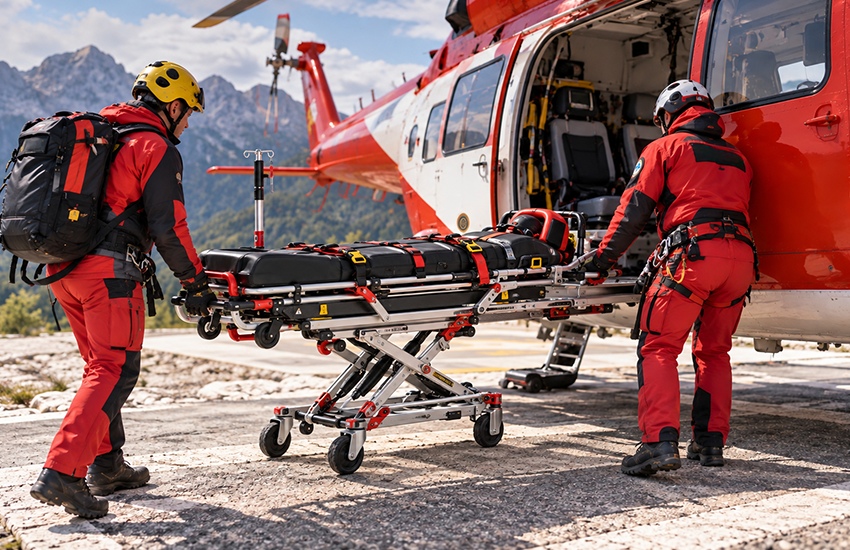
There is one place in Polish culture where the stretcher took on an almost legendary dimension – the Tatra Mountains. In 1909, on the initiative of Mariusz Zaruski, the Tatra Volunteer Rescue Service (TOPR) was founded, one of the oldest mountain rescue organisations in Europe. A year later the famous mountain guide Klimek Bachleda was killed during a rescue operation – for generations of rescuers his death became a symbol of the ultimate sacrifice made for another human being.
Moving an injured person in the mountains is a completely different world from a city street. For decades rescuers used stretchers improvised from poles and sheets, special stretchers on runners, baskets and lowering systems that allowed a casualty to be brought down a rock face. The principle, however, stayed the same – the person being carried must be safe, stable and protected from sliding off. Tatra tradition also preserves a sad truth that rescuers speak of reluctantly: not every operation ends with a life saved. Sometimes the stretcher brings a body down into the valley, and the rescuers become the last people to accompany the deceased on the way back to the family. At this point the world of rescue and the world of funerals meet with no border at all.
How different traditions carry their dead
The way we move the body of the deceased says a great deal about how we understand death and human dignity. Even though procedures today are broadly similar regardless of faith, it is worth knowing different traditions – funeral homes increasingly serve families of varied backgrounds and sensibilities.
Jewish tradition – never leave the dead alone
In Judaism the body of the deceased is surrounded with special care from the moment of death until burial. Members of the burial society, the chevra kadisha, prepare the deceased for ritual washing, and a watcher – the shomer – stays with the body reciting psalms. The dead should not be left alone. Burial takes place as quickly as possible, usually within a day. Moving the body is therefore performed with great seriousness and discretion, and the equipment used must allow gentle, stable movement without unnecessary contact or haste.
Islam – haste as a form of respect
Muslim tradition also calls for prompt burial, and carrying the deceased to the grave is regarded as a meritorious act. The body, wrapped in a simple white shroud, is carried on a stretcher or bier, and participants in the procession often take turns carrying it so that everyone can share in this duty, even briefly. Speed does not mean a lack of respect here – on the contrary, it is an expression of it. The dead should not be delayed on the way to their resting place.
India – the last journey to the river
In Hindu tradition the body is carried on a simple bamboo stretcher decorated with flowers, usually on the shoulders of the male members of the family. The procession heads to the cremation ground, and the bearers repeat the name of God as they walk. In this tradition the stretcher is deliberately simple and temporary – it serves a single journey and is then left behind or burned. It is a striking contrast with the European tradition of durable, carved biers kept by parishes for centuries.
The Polish village – neighbours at the stretcher
In the old Polish village carrying out the dead was a matter for the whole community. Men from the neighbourhood came of their own accord, without being asked – refusing to help would have been a disgrace. They carried the deceased from the bed to the bench, from the bench to the coffin, from the house to the cart or straight to the church. In many regions women were not allowed to carry the coffin; in others young girls did so when the deceased was an unmarried woman. This shared responsibility for carrying survives in memory as something modern families sometimes badly miss. That is why it matters so much that the people who do this professionally – funeral home staff – do it with the same sense that they are carrying someone, not something.
The ambulance stretcher – where two worlds meet
The name "ambulance stretcher" tells a story of its own. It describes an object designed to work with a vehicle – to be loaded onto guide rails, secured in the transport compartment and safely unloaded on arrival. This type of design was born in emergency medicine, where every second counts and a single paramedic often has to manage a weight that only a few decades ago required four people.
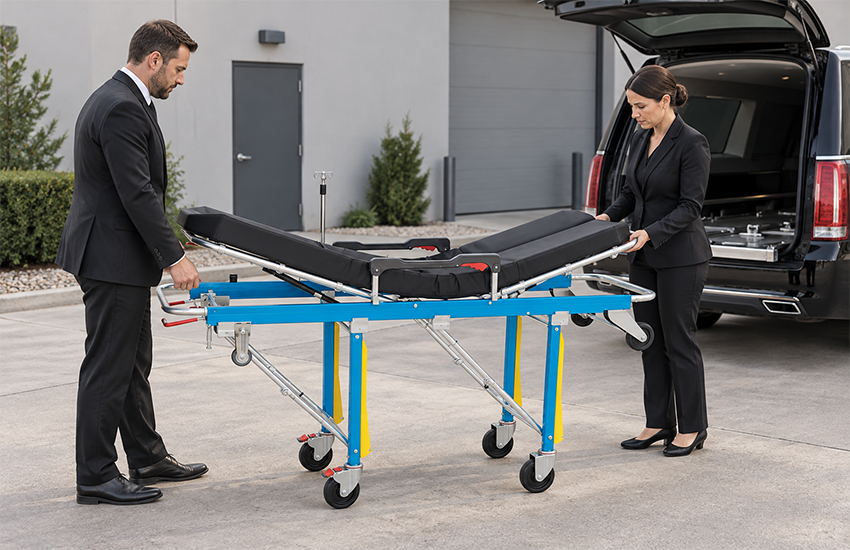
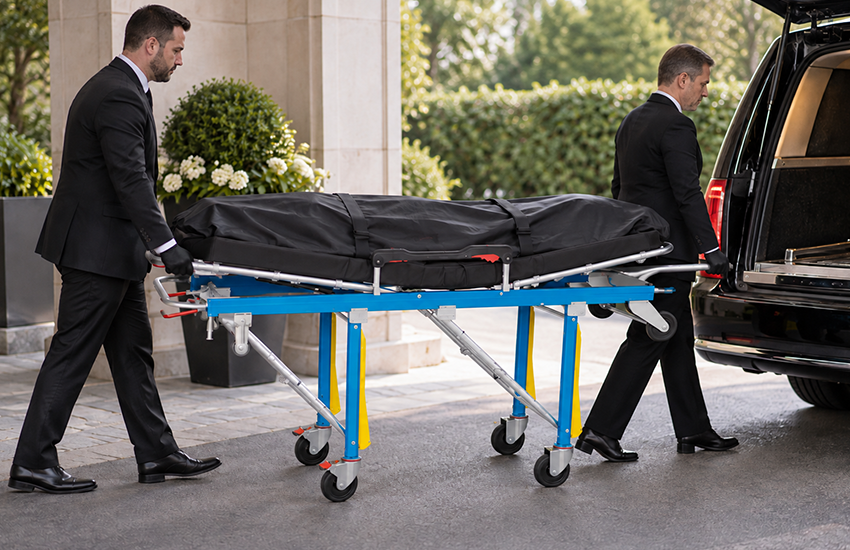
The funeral profession adopted this design for a very simple reason – the challenges are almost identical. The body has to be collected from a third-floor flat without a lift, from a hospital, from a care home, sometimes from the scene of an accident. Staff must pass through narrow doors, turn the corner of a staircase, load the stretcher into the hearse – and do all of this in a way that respects the dignity of the deceased and the feelings of the family watching from the doorway. The difference is that the paramedic fights for a life, while the funeral director protects a memory. Both need the same thing – the certainty that the stretcher will not let them down.
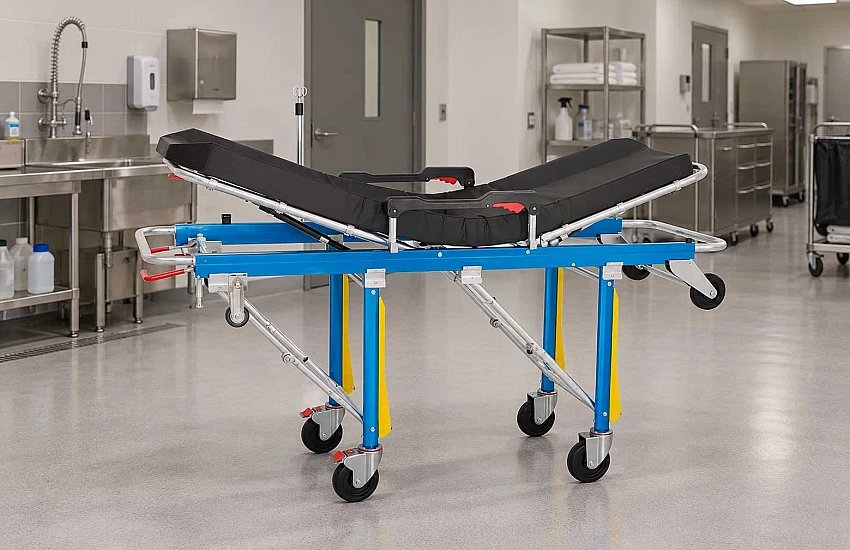
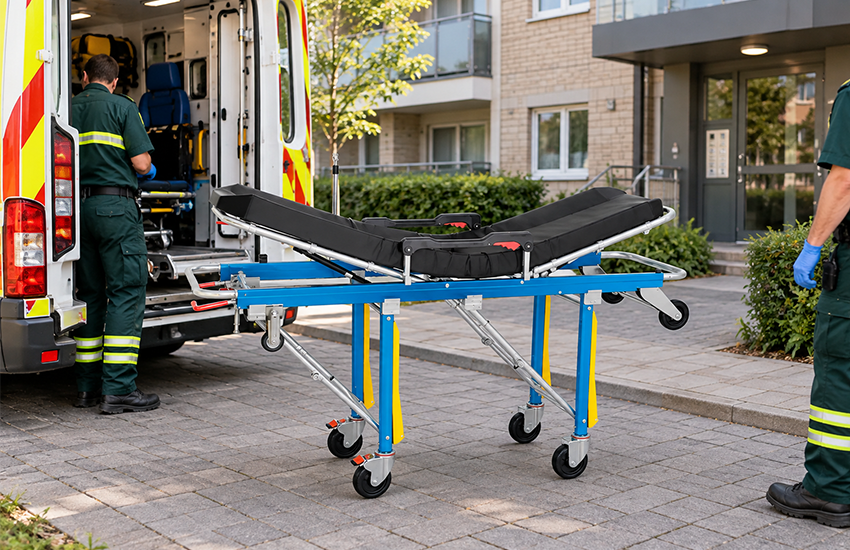
This is well illustrated by the range of ambulance stretchers in the funeral stretchers category at funeraryaccessories.com. It includes, among others, the compact ambulance stretcher model 3F, the 3B ambulance stretcher with an adjustable backrest, the 3E ambulance stretcher that folds into a chair and is useful in very tight stairwells, and the reinforced ambulance stretcher model 3K. The most fully equipped model in this family is the 3KB.
The 3KB ambulance stretcher – a modern form of an old duty
The 3KB ambulance stretcher is a design in which the whole history described above can be seen – from Larrey's idea that the stretcher and the vehicle should form one system, through the mountain rule that the person carried must never slide off, to the age-old need for the last journey to take place in peace and with dignity.
Aluminium and cast joints
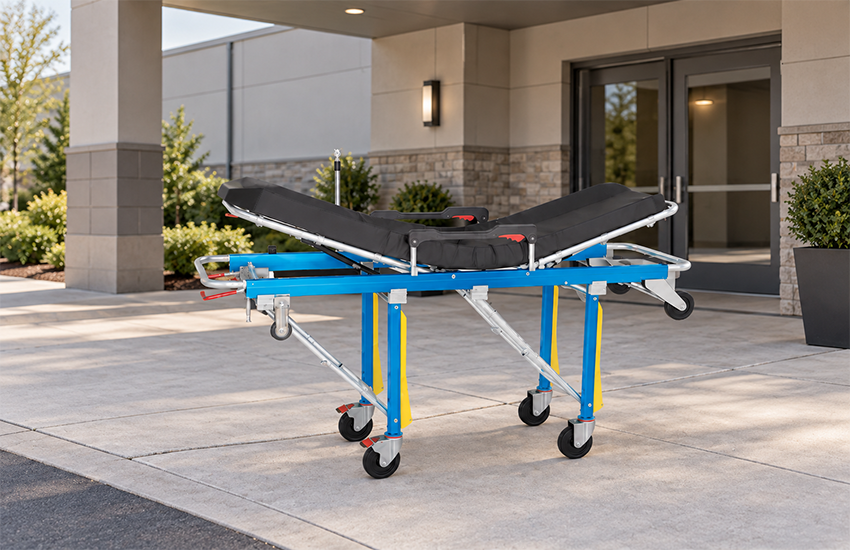
The frame is made of aluminium, and the connecting elements are cast from the same alloy. This matters more than it might seem. The weakest point of any load-bearing structure is its joints – the places where tubes, hinges and mechanisms meet. A uniform material throughout the structure supports its durability and stability under intensive daily use. Aluminium is also resistant to corrosion, which counts when work goes on in all weathers – in rain, in frost, on wet grass outside a country house.
A mattress with raised sides
The distinguishing feature of the 3KB is its contoured mattress with raised sides. In practice it works like a gentle cradle that stabilises the body and limits sideways movement on stairs, around corners and over uneven ground. It is supported by folding side rails and two stabilising straps, which are included in the set. It is a modern answer to the problem faced by Larrey's stretcher-bearers and by the Tatra rescuers – how to keep a person carried in difficult conditions safe.
This also has a dimension that is hard to capture in a technical specification. A family watching a loved one leave home sees the body lying calmly and steadily, not shifting with every step. That image stays in memory. For a funeral home it is a matter not only of safety but also of respect and trust, which are built in exactly such moments.
The leg mechanism and one-person operation
The legs fold by means of a mechanism operated with side handles. This allows the stretcher to be loaded into a hearse by one person – the stretcher is rested on the edge of the loading area, and the legs fold as the frame slides inside. It is exactly the kind of solution that transformed the work of paramedics and now makes the work of funeral homes easier too, especially when only a small team is on site. The 3KB also has an adjustable backrest.
A 200 kg load capacity
The maximum load of the stretcher is 200 kg. This is one of the highest values in this product group and provides a safety margin when transporting people with a high body weight. Modern societies face this challenge more and more often, and funeral home staff and paramedics know well that equipment with insufficient capacity is a real risk – both for the deceased and for those carrying them. The dignity of the last journey must not depend on whether the stretcher holds.
Hygiene and a waterproof mattress
The mattress is made of waterproof PVC, which is easy to clean and disinfect after every use. In funeral work this is fundamental – the equipment must be ready for the next call within a short time and meet sanitary requirements. We write more about keeping equipment clean in our hygiene and safety guide for funeral homes.
Dimensions and storage
Unfolded, the stretcher measures 190 x 55 x 92 cm; folded, 190 x 55 x 25 cm. The frame weighs 45 kg. When folded, the stretcher takes up little space in the hearse or in the funeral home's storeroom. The set includes:
- the stretcher frame,
- a waterproof, contoured mattress,
- two stabilising straps.
Beyond the funeral profession
The design of the ambulance stretcher comes from emergency rescue, and that heritage is clearly visible in the 3KB. Stretchers of this type can be useful wherever a lying person has to be moved safely from a building to a vehicle – in care homes, hospices, transfers between facilities, at large public events or in workplaces that want evacuation equipment on hand. Institutions planning to use the stretcher for transporting living patients should, however, always check the formal requirements for medical equipment that apply to them and consult the store's customer service. For funeral homes, on the other hand, the 3KB is a natural choice – it inherits from rescue work what is most valuable, a reliable structure, and adds what care for the dead requires: calm, stable positioning of the body.
Dignity in the details – the etiquette of carrying out
Equipment is only half the story. The other half is how it is used. Over the years experienced funeral home staff have developed what might be called a modern etiquette of carrying out – a set of unwritten rules that in many ways echo the meaning of the old rites.
The first rule concerns time. It is worth asking the family whether they would like a little more time with the deceased before the stretcher is brought into the room. That moment is the modern equivalent of the old vigil – shorter, but no less important.
The second concerns covering. The body on the stretcher should be covered – with a blanket, a sheet or a dedicated cover – so that the family and chance witnesses on the staircase are not exposed to a sight that could hurt them. In many cultures the face of the deceased is covered only at the last moment, and in many families a relative wants to do it personally. It is worth giving them that chance.
The third concerns quiet and calm movement. Haste, loud instructions, knocks against the door frame – the family remembers all of it. A stretcher that folds smoothly and holds the body steadily lets the staff focus on people rather than on equipment. In this sense good stretcher design is a matter not only of ergonomics but also of tact.
The fourth rule concerns the threshold. Nobody knocks the stretcher against the threshold three times any more, but it is worth remembering that for the family this is still a special moment. Sometimes it is enough to pause for a second, let someone touch the cover with a hand, nod. Such gestures cost little and stay in memory forever.
Finally – direction. Carrying the deceased out feet first is a custom known to almost everyone, even to those who cannot explain its origin. Many families see it as natural and right. It is worth funeral home staff keeping it in mind wherever conditions allow, because for the family it is a sign that their loved one is being treated in line with the tradition in which they grew up.
Frequently asked questions
Where does the custom of carrying the dead out feet first come from?
The custom has its roots in old folk beliefs. People believed that a deceased person carried out with the feet towards the door would not "see" the way out of the house and would not be able to return along it as a restless spirit. Another interpretation says that the dead leave the house the way the living do – walking forwards. The custom survives today and many families still attach importance to it.
How does an ambulance stretcher differ from an ordinary transport stretcher?
An ambulance stretcher is designed to work with a vehicle. It has folding legs that allow it to be loaded into the compartment of an ambulance or hearse, often by one person. An ordinary transport stretcher may be a simpler folding design, with or without wheels, intended mainly for carrying a body over short distances.
Why does a mattress with raised sides matter when transporting the deceased?
The raised sides stabilise the body and limit its movement on stairs, around corners and over uneven ground. On the 3KB they work together with the side rails and stabilising straps. This increases safety and at the same time ensures that the body of the deceased looks calm and dignified in the eyes of the family.
How much does the 3KB ambulance stretcher weigh and what are its dimensions?
The stretcher weighs 45 kg. Unfolded it measures 190 x 55 x 92 cm, and folded 190 x 55 x 25 cm. The maximum load is 200 kg.
Can the 3KB stretcher be operated by one person?
Yes. The folding leg mechanism, operated with side handles, allows one person to load the stretcher into a hearse. In practice, however, at least two people are recommended when carrying a body down stairs or over difficult ground, both for safety and out of respect for the deceased.
Who introduced the first modern system for carrying the wounded on stretchers?
The founder of the modern system is considered to be Dominique-Jean Larrey, a surgeon of the French army, who in the 1790s created the so-called flying ambulances – light horse-drawn wagons supported by teams of stretcher-bearers, which took the wounded from the battlefield while the fighting was still going on. He also introduced the principle of treating the wounded according to their condition rather than their rank.
Can ambulance stretchers be used outside funeral homes?
The design of the ambulance stretcher comes from emergency rescue, so stretchers of this type can be useful wherever a lying person has to be moved safely into a vehicle – in care homes, hospices or at public events. Institutions planning to transport living patients should, however, check the requirements for medical equipment that apply to them and consult the store's customer service before choosing.
Conclusion – those who carry
The history of the stretcher is the history of people who chose to carry others. The Roman litter-bearers, Larrey's stretcher-bearers running across the battlefield, the women near Solferino dressing the wounded, the Tatra rescuers coming down from the Zamarła Turnia, the village neighbours who came unasked to carry the dead out of the house. Today this duty is performed by paramedics and funeral home staff. Materials, mechanisms and procedures have changed, but its meaning has not.
The stretcher is an object nobody photographs and few people talk about. And yet it accompanies a person at the moment they cross the most important threshold – the one between home and the world, between life and memory. That is why it should be solid, stable and worthy of the role. The 3KB ambulance stretcher available at funeraryaccessories.com is a modern answer to a very old need – that the last journey, even the shortest one from the bed to the door, should take place in peace.