Table of Contents
- Why every farewell needs a backdrop
- From the parlour to the parish church – how mourning was staged
- Architecture that vanishes – curiosities of temporary scenery
- The backdrop of farewell in other cultures
- When the funeral home becomes the backdrop
- The POP UP Curved Wall – a modern form of an ancient backdrop
- A backdrop that does not overshadow – conclusion
- Frequently asked questions
When we remember the funeral of someone we loved, memory rarely keeps the details. We do not recall how many wreaths there were, what colour the ribbons were or which hymn was sung first. What we keep is an image – a single frame that stays with us for years. The coffin, the candlelight, the faces of the family and something that usually escapes conscious attention, yet holds the whole picture together. The backdrop.
The backdrop of a ceremony is one of the oldest and least discussed elements of funeral culture. Over the centuries it has taken the form of a white sheet pinned up in a cottage parlour, black cloth hung from the walls of a church, heraldic hatchments fixed above the front door, towering baroque structures known as castrum doloris, and – in other parts of the world – walls of flowers, icon screens and large printed posters. Its purpose has always been the same: to set apart a space in which something extraordinary is happening, and to tell everyone present where to look.
In this article we look at the history of that quiet but fundamental piece of scenery. We explore English and European mourning customs, curiosities from around the world and the way the same need – the need for a dignified, legible background – shows itself in the work of funeral directors today. At the end we introduce a product that is a modern, portable heir to that tradition: the POP UP Curved Wall 3x3, designed with the funeral profession in mind.
Why every farewell needs a backdrop
The psychology of perception has long pointed to a simple principle – the human eye needs a boundary. An object placed in an empty, disordered space looks smaller, more accidental and less important. The same object set against a plain, continuous surface gains weight, clarity and gravity. Portrait painters knew this, theatre designers knew it, and long before them so did the people who prepared the dead for their last farewell.
The eye looks for an edge
Every funeral ceremony has a centre around which the attention of the mourners is organised. Usually it is the coffin or the urn, sometimes a photograph, sometimes a cross. For that centre to do its work, it has to be separated from the everyday surroundings – from windows, doors, furniture, stray colours and signs. The backdrop is that separation. It closes the field of vision, puts it in order and keeps the eye from wandering.
It is no accident that English speaks of the dead "lying in state". The phrase assumes a stage – a place that is set apart, prepared and given a fitting frame. When that frame is missing, the ceremony loses part of its power. Mourners sense that something is not quite right, even if they could not say what.
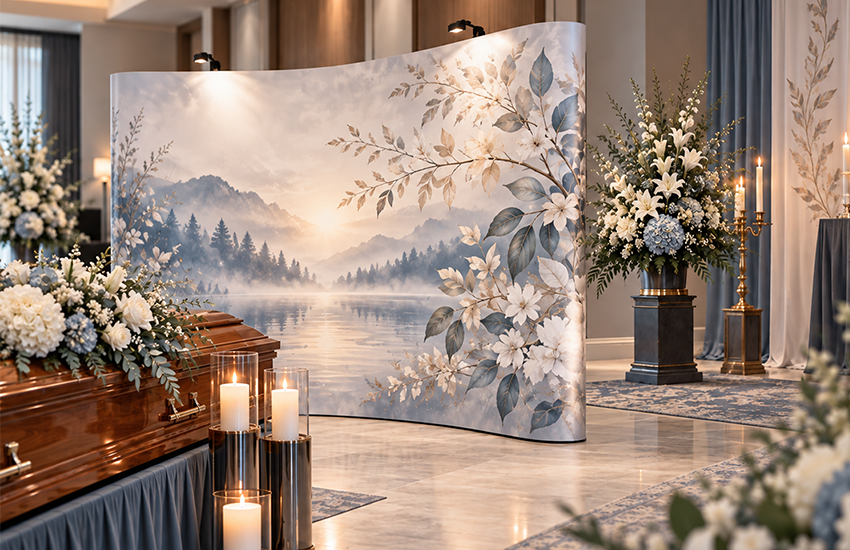
The backdrop as a form of silence
A backdrop has another, subtler function. It is a form of silence. At a time when everyone present is living through emotions that are hard to put into words, a plain surface behind the coffin works like a rest in music – it gives room to breathe. That is why the mourning culture of the past reached so readily for single-coloured textiles: black, white, purple, grey. The aim was not decoration in the everyday sense, but a calm field against which grief could be expressed without distraction.
From the parlour to the parish church – how mourning was staged
English funeral culture is particularly rich in this respect. It combines domestic customs, the liturgy of the church and an elaborate heraldic tradition that reached its height in the funerals of the aristocracy. Each of these strands developed its own way of building a background for the dead.
The front parlour and the white sheet
For centuries, and in many places well into the twentieth century, the body remained at home until it was carried to the church or the cemetery. The room in which it lay – often the front parlour – was transformed. Clocks were stopped at the hour of death, mirrors were covered and curtains were drawn. In many households the wall behind the coffin was hung with a white sheet, against which a crucifix, a candle or a family picture would be placed. An ordinary domestic room became a sacred one, and fabric was the tool of that transformation.
White carried a double meaning in folk tradition. It was the colour of purity and innocence, but also of shrouds and of passing from one world to the next. A white sheet behind the deceased worked as a symbolic boundary between the world of the living and whatever lay beyond. Neighbours who called to pay their respects saw the dead set against a surface that separated them from everyday life. Even this modest gesture shows how deeply rooted the need to set apart the place of farewell really is.
Black-hung rooms and the upholsterer-undertaker
In wealthier households and in churches, black took the leading role. For a funeral of any standing, rooms, staircases and even the interior of the parish church were hung with black cloth. Pillars, pulpit and galleries disappeared beneath it. A church that normally glowed with stone, glass and gilding suddenly became dark and inward. Everyone understood the sign: a farewell was taking place here, mourning had begun.
This is where an intriguing piece of trade history comes in. Many of England's first professional undertakers, in the late seventeenth and eighteenth centuries, came from the upholstery and drapery trades. A large part of their business was precisely the supply and hanging of black cloth – the furnishing of the mourning room, the draping of the hearse and the dressing of the church. In other words, the funeral profession in England was born partly as a profession of backdrops. Those who arranged the dead were, first of all, those who knew how to build a dignified setting around them. The same tradition lives on today in black and coloured funeral cart drapes and trolley covers.
The hatchment – a coat of arms on the front of the house
One of the most distinctive English and Dutch mourning customs was the hatchment. It was a large, diamond-shaped board, framed in black, bearing the coat of arms of the deceased. After a death in an armigerous family, the hatchment was fixed to the front of the house, usually above the main door, where it remained for months. Its background carried a coded message: the half of the shield behind the arms of the deceased was painted black, while the half belonging to a surviving spouse was left white. Passers-by who understood the language could read at a glance who had died – a husband, a wife, a widow or a bachelor.
When the period of mourning ended, the hatchment was usually taken down and hung in the parish church, where many still survive today. The hatchment is the first example in English culture of a backdrop that does not merely mark out a space but actually speaks – presenting the person, their family and their place in the world. The modern memorial photograph displayed on an easel beside the coffin is its direct descendant. As before, image and background work together: one draws the eye, the other gives it gravity. A well-chosen funeral photo stand continues that role in today's chapels.
Lying in state and the great heraldic funeral
At the highest level of society, the setting of the farewell became architecture. Royal and state funerals were organised with the help of the heralds of the College of Arms, who set out the order of the procession and the display of banners, shields and achievements. Bodies of monarchs and great public figures were laid in state on a raised catafalque, surrounded by candles, guards and heraldic hangings. In the twentieth and twenty-first centuries, the medieval timber roof and stone walls of Westminster Hall became one of the most recognisable backdrops of national mourning in the world – a frame so powerful that it needs almost no addition.
Architecture that vanishes – curiosities of temporary scenery
On the European continent the same instinct produced some of the most spectacular funeral decorations ever made. Across baroque Europe, the funerals of rulers, prelates and distinguished citizens involved the building of ephemeral structures designed to amaze, to move and to remind people of the passing of all things – and then to disappear.
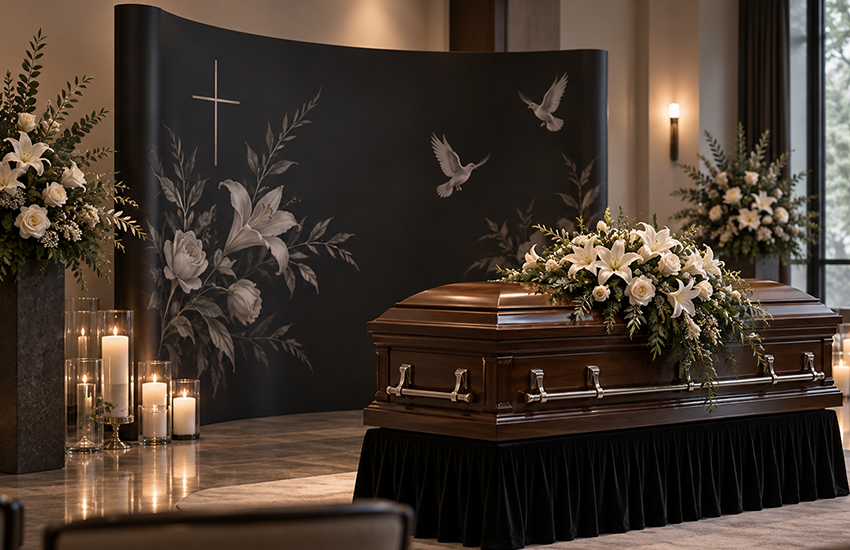
Castrum doloris – a theatre dismantled after the service
The most extraordinary of these was the castrum doloris – a Latin term meaning "castle of grief". It was a structure built around the catafalque: at first a simple wooden frame with a fabric canopy, later something far more elaborate. In the seventeenth and eighteenth centuries a castrum doloris could take the form of a multi-storey architectural composition with columns, obelisks, pyramids, domes and allegorical sculpture, lit by hundreds of candles and hung with coats of arms, epitaphs and painted emblems. It was especially popular in Poland-Lithuania, where one of the first rulers to receive one was King Sigismund II Augustus in the 1570s.
The key point about the castrum doloris is that it was temporary architecture. It was built for a single ceremony, sometimes in just a few weeks, and dismantled after the service. Wooden frames, canvas painted to imitate marble, plaster ornaments and draped fabric created the illusion of a permanent monument, although in reality the whole thing was light, collapsible and made to come down again. That idea – imposing yet portable scenery – turns out to be surprisingly modern, as we shall see.
Polish-Lithuanian funerals added another striking element: the coffin portrait. Painted on a sheet of metal shaped as a hexagon or octagon, it was fixed to the head of the coffin so that mourners could see the face of the deceased throughout the service. After the funeral many of these portraits were hung on church walls, where they remain to this day – a close continental cousin of the English hatchment.
Italian apparati effimeri and painted canvas
In Italy, such decorations were known as apparati effimeri – "ephemeral apparatus". They were often designed by the leading artists of the age, and their appearance was recorded in richly illustrated commemorative prints. Thanks to these engravings we know what structures looked like that have not physically existed for hundreds of years. One curiosity: some of these decorations matched the façade of a church in scale, yet were made entirely of timber, canvas and paint – light, rolled up after use and sometimes reused. Baroque designers were solving exactly the problem today's display designers face: a monumental effect that stays mobile.
Victorian mourning warehouses
In the nineteenth century, Britain developed an entire culture of mourning, covering dress, jewellery, stationery and the furnishing of the home. In London and other large cities, specialised mourning warehouses – the best known of them on Regent Street – arranged their windows and showrooms so that their very appearance inspired trust and seriousness. Dark fabrics, carefully composed displays and discreet lettering created a background that said to the customer: here, they will understand your situation.
This was a turning point in the history of funeral scenery. For the first time, the backdrop began to represent not only the deceased but also whoever was arranging the farewell. The look of the place where a family first meets the funeral business became part of the ceremony – its prologue.
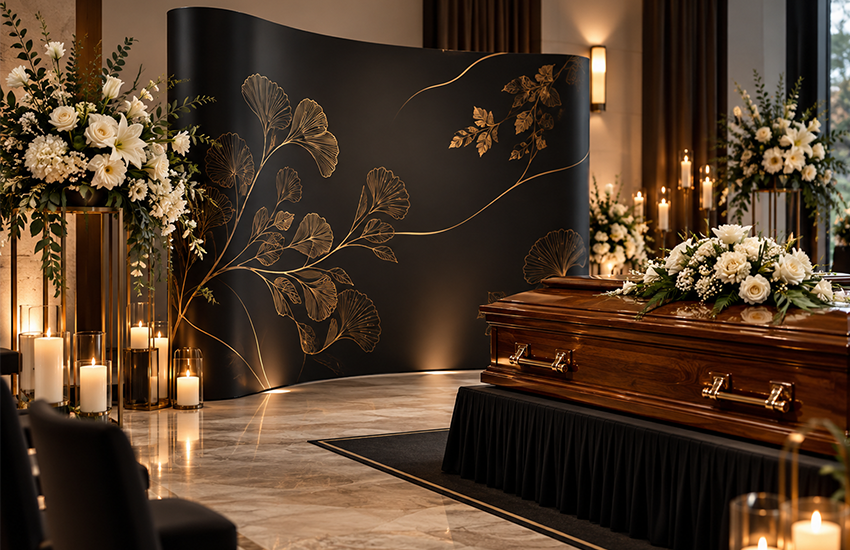
The backdrop of farewell in other cultures
The need to set apart the space of farewell is universal, but its forms are remarkably varied. Looking at them helps us see how many meanings can be carried by what stands behind the coffin.
The Japanese saidan – a wall of flowers
At the heart of a Japanese funeral stands the saidan – an altar on or behind which are placed a portrait of the deceased, a tablet bearing their posthumous name and offerings. Today the saidan very often takes the form of a vast, multi-level wall of flowers, usually white chrysanthemums and lilies, arranged in gentle waves or landscapes. A living backdrop rises behind the coffin – carefully designed, symmetrical and serene.
The saidan shows that a backdrop can be a work of art in its own right without stealing attention from the deceased. The key is restraint in colour and care with proportion. The portrait always stays at the centre, and the flowers form a frame around it – exactly as in the old castrum doloris.
The iconostasis – a wall between worlds
In the Orthodox tradition, the funeral service takes place in a church whose most characteristic feature is the iconostasis – a screen covered in icons that separates the nave from the sanctuary. The coffin stands in the nave, facing the iconostasis. Yet this wall is not an ordinary partition. In Eastern theology the iconostasis is more a window than a wall – the place where the visible world meets the invisible.
Ghanaian funeral posters
Ghana offers an entirely different form. Funerals there are announced on large, colourful posters and billboards showing a photograph of the deceased, their name, dates and a heading such as "Called to Glory" or "Celebration of Life". The posters hang along roads, on walls and fences, and on the day of the ceremony similar graphics often stand behind the place where the coffin is displayed – proof that large-format print and the ancient need for a dignified background need not be in conflict.
The simplicity of Jewish and Muslim tradition
At the opposite end of the spectrum are traditions that deliberately renounce elaborate scenery. Jewish custom emphasises the equality of all in the face of death – a plain coffin, no ornament, no flowers and modest surroundings. Muslim burial is likewise swift and free of display. Yet even here the space of prayer and farewell is clearly set apart, and its ordering, however simple, still matters.
This diversity teaches one thing: a funeral home serving families of different faiths and beliefs should have a neutral, flexible backdrop – one that can be adapted to the character of the ceremony rather than imposing a single style on it.
When the funeral home becomes the backdrop
Let us return to the Victorian mourning warehouses. We noticed that at a certain point the backdrop began to represent the organiser of the farewell as well. In the funeral profession this shift has a deep meaning. A family that has lost someone must, in a very short time, entrust the body, the memory and the ceremony of that person to people they often did not know before. First impressions – the look of an office, a stand, printed materials – become a question of trust rather than mere aesthetics.
From guild banners to exhibition stands
The crafts connected with death – coffin making, stonemasonry, the weaving of mourning cloth – have used marks of identity for centuries. Guild signs, workshop emblems and the banners of burial societies were the old form of what we now call visual identity. Burial clubs and friendly societies, which in Victorian Britain helped working families pay for a decent funeral, marched in processions under their own banners, and their image built the trust of a whole community.
Trade fairs and professional gatherings
Professional gatherings are another place where a company's backdrop plays a major role. In Britain, the profession meets at the biennial National Funeral Exhibition at Stoneleigh Park in Warwickshire; in the United States, at the annual NFDA International Convention and Expo. In Central Europe, the leading event is NECROEXPO in Kielce, Poland, whose eleventh edition took place from 29 to 31 May 2026. At all of them, coffin and urn makers, hearse builders, clothing suppliers and equipment manufacturers exhibit side by side – and every stand has a split second to tell visitors who the exhibitor is and what values it stands for. A stand backdrop does exactly what black-hung walls once did – but today it has to be light, quick to assemble and ready to travel.
The POP UP Curved Wall – a modern form of an ancient backdrop
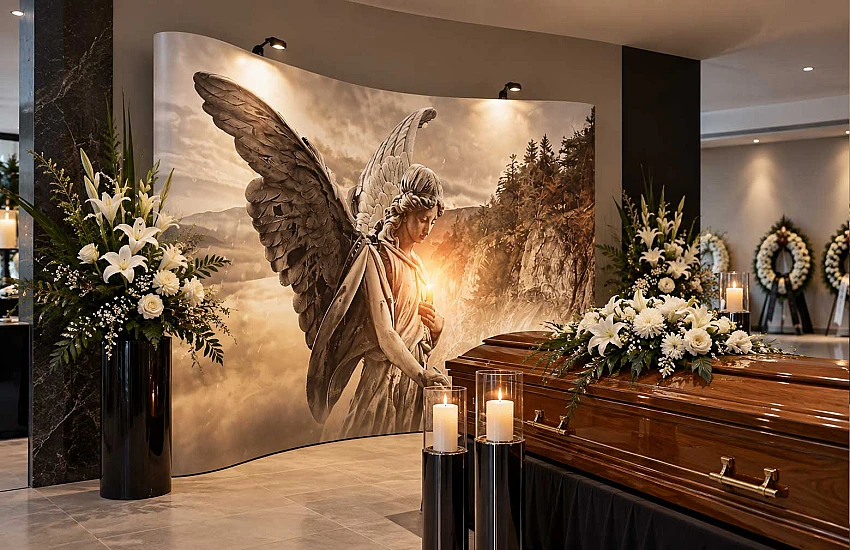
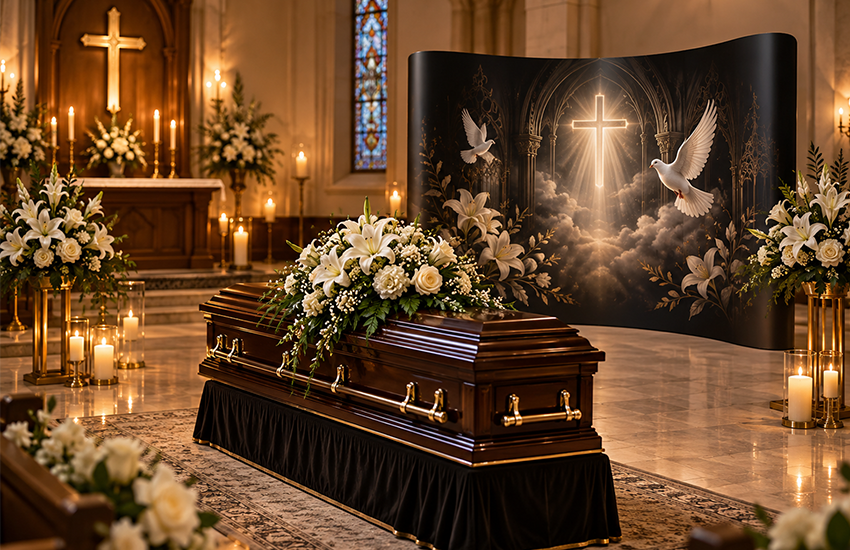
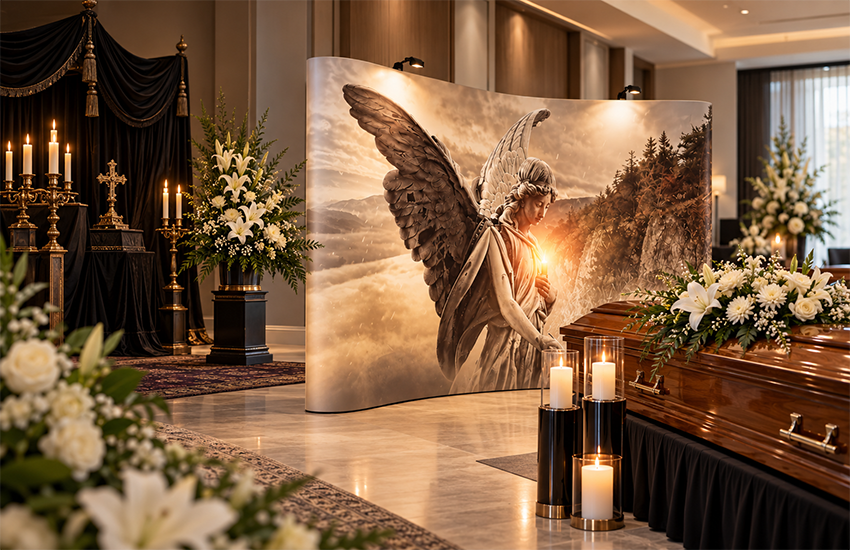
The POP UP Curved Wall 3x3 is a curved display wall designed for funeral homes and companies serving the funeral profession. Its task is to create an elegant, continuous background – at trade fairs, conferences, in the arrangement office and at events where a funeral business appears before a wider audience. If the castrum doloris was a "castle of grief" taken down after the service, the POP UP wall is its modest modern relative: light architecture that creates a space of dignity in minutes and then fits into the boot of a car.
A curve that calms – form and dimensions
The wall's most distinctive feature is its curved shape. This is no accident. For centuries the curve has been associated with sacred architecture – the apse, the niche, the vault – and it has a calming effect on the viewer. A flat wall closes a space; a curve embraces it. Someone standing in front of a curved wall feels that they are in a place apart and sheltered, not in front of an ordinary partition. In a profession that accompanies people through their hardest moments, that difference is real.
The structure is 270 cm wide and 230 cm high. The "3x3" designation refers to the layout of the collapsible frame – three modules across and three high – which produces a large, uninterrupted graphic surface. Its height, taller than an adult, means the wall forms a complete background for the people standing in front of it, and its width is enough to enclose a small stand or a quiet conversation area.
Aluminium, UV laminate and twenty kilograms
The frame is made of corrosion-resistant anodised aluminium combined with durable plastic components. Anodising strengthens the surface of the aluminium and protects it from oxidation, so the structure keeps its appearance despite repeated folding, transport and set-up. That matters in a profession where equipment works in all conditions and must always be ready.
The graphic panels are printed in photographic quality and finished with a UV laminate. The laminate protects the print from fading and scratching, so colours stay deep even after long use. For a funeral home this means that a rich black, a noble grey or a delicate gold will not fade after a few seasons – and, as the history of mourning drapery shows, these are the very colours that carry the most meaning in our culture.
The complete set weighs around 20 kg. Assembly requires no tools: the frame unfolds like a concertina and the panels are then hung on it. Setting up and taking down the wall takes just a few minutes, so one or two people can prepare a presentation space without involving the whole team. Baroque designers spent weeks building their ephemeral structures – modern technology shortens that to a quarter of an hour.
Graphics as a language – a design suited to the profession
The set includes a professional graphic design tailored to the funeral profession, with a choice of many graphic options. This is of real value, because for a funeral business the design of a display wall cannot be left to chance. The graphics play the same role that hatchments and the inscriptions around a coffin portrait once did – they speak of identity, of values and of the tradition from which the business has grown.
A well-designed wall for a funeral home rests on a few simple principles that already worked in the mourning scenery of the past. The first is restraint in colour – one dominant tone, usually dark or muted, complemented by a noble accent such as silver or gold. The second is space – large, calm surfaces on which the company name and emblem can breathe without crowding. The third is symbolism chosen with sensitivity: a sprig of foliage, light, a subtle botanical motif or a landscape carry more dignity than a pile of slogans. The fourth is legibility – typography that is elegant yet clear from several metres away. Graphics that resemble a quiet landscape more than a loud banner help visitors feel safe – the legacy of the white sheet in the cottage parlour.
Where the POP UP wall works best
The manufacturer names three main uses: trade fairs and exhibitions, client meetings and service presentations, and the customer service area of the funeral home. At a trade fair, the wall creates an enclosed, recognisable stand against which conversations take place and products are shown. At conferences, training days and professional meetings it serves as a background for talks and photographs. In the arrangement office it brings order to the space, separates the area where families are met from the administrative part and builds a calm atmosphere.
The portability of the structure opens up further possibilities. Funeral homes are increasingly involved in the life of their communities – holding open days, information evenings, services of remembrance and events devoted to bereavement support. In each of these situations a curved wall with well-chosen graphics makes it possible to create a dignified, coherent background quickly in a place that normally serves a quite different purpose – a church hall, a community centre or a marquee. Just as black cloth once turned a parish church into a place of mourning, today a thoughtful design can turn an ordinary room into a place of reflection.
The wall works well alongside other equipment. Placed behind a table with a book of condolence, next to a photo stand or a funeral podium, it creates a coherent composition. The space in front of it can be discreetly defined, for example with a retractable belt barrier in gold with a black belt, a modern echo of the rails and rope barriers that once surrounded a body lying in state.
What the wall means for the image of the funeral profession
Today the same logic applies to the businesses that arrange farewells. A funeral home that looks after its image in an elegant, coherent and restrained way tells families something very important: that it will take the same care over the ceremony for the person they have lost. The POP UP Curved Wall is a tool for that kind of communication – light, durable and designed with the funeral profession in mind.
A backdrop that does not overshadow – conclusion
The history of the funeral backdrop is the history of a human need for order at the moment when the world seems to fall apart. The white sheet in the parlour, the black cloth in the church, the hatchment above the door, the gold and candlelight of the castrum doloris, the flower walls of Japanese ceremonies, the Orthodox iconostasis and the vivid posters of Ghana – all these forms answered the same question: how to give a farewell a frame that allows it to be fully felt.
Today's funeral profession answers that question in many ways – with drapes, tents, canopies, stands and podiums. Among those answers is the POP UP Curved Wall 3x3: curved, portable and designed to create a dignified background for the businesses that every day create the background for final farewells. There is a certain symmetry in that. Those who have looked after the scenery of mourning for generations also need a place that says about them what words alone cannot – that memory, respect and care are values to them, not slogans.
Frequently asked questions
What is a POP UP curved wall and how is it used by a funeral home?
A POP UP curved wall is a collapsible display structure with printed graphic panels that creates a large, continuous background. Funeral homes use it mainly at trade fairs, conferences and service presentations, and in the arrangement office. Its curved shape and restrained graphics build an atmosphere of seriousness and trust, while its portability means it can also be used at open days and community events.
What are the dimensions of the POP UP Curved Wall 3x3?
The structure is 270 cm wide and 230 cm high, and the complete set weighs around 20 kg. The "3x3" designation refers to the layout of the frame – three modules across and three high. This surface provides a full background for people standing in front of the wall and can enclose a small stand or conversation area.
Does assembling the wall require tools or special skills?
No. The anodised aluminium frame unfolds without tools, and the printed panels are then hung on it. Setting up and taking down the wall takes a few minutes and can easily be done by one or two people. The lightweight structure also makes it easy to transport in an ordinary car.
What graphics work best on a display wall for a funeral business?
Restrained designs work best – one dark or muted dominant tone, a noble accent of silver or gold, plenty of open space and elegant, legible typography. Calm symbolism, such as botanical motifs, light or a landscape, is a good choice. The set includes a professional graphic design tailored to the funeral profession, with many graphic options to choose from.
Can the POP UP wall be used at memorial services or remembrance events?
Yes – its portability means it can be used wherever a dignified background is needed quickly in a space that normally serves another purpose, such as a church hall, a community centre or an information evening ahead of a remembrance service. The condition is well-chosen, restrained graphics that support the character of the event rather than drawing attention away from it.
What was a mourning hatchment?
A hatchment was a large, diamond-shaped board bearing the coat of arms of the deceased, fixed above the front door of the house after a death and later moved to the parish church. The black and white areas of its background showed who had died – a husband, a wife or an unmarried person. Hatchments were common in England and the Netherlands from the seventeenth to the nineteenth century, and many still hang in English churches today.
How should the wall be cared for so the print keeps its colours?
The printed panels are finished with a UV laminate that protects them from fading and scratches. To keep them looking their best, store the wall in a dry place, transport the panels rolled as instructed, avoid creasing the graphics and clean the surface with a soft, slightly damp cloth. The anodised aluminium frame is corrosion-resistant and needs no special maintenance.