Table of Contents
- Why the Space of a Farewell Is Never Accidental
- From Procession to Farewell Hall – A Short History of Ceremonial Order
- Invisible Boundaries – How Culture Divides the Space of Mourning
- Funeral Etiquette – What Mourners Expect of a Well-Organised Ceremony
- Modern Tools for Ordering Space – the Discreet Role of the Barrier Post
- Barrier Posts in Practice – Chapel, Farewell Hall and Cemetery
- Outdoor Ceremonies and Farewells with Large Attendance
- Curiosities – How Other Cultures Order the Space of Mourning
- The Psychology of Order – What Happens in the Mourner's Mind
- Caring for Ceremonial Equipment – Habits That Pay Off
- Frequently Asked Questions (FAQ)
- Conclusion – Order as a Form of Respect
There are elements of a funeral ceremony that every mourner notices at once – the coffin, the flowers, the candlelight, the words of the celebrant. And there are elements that no one notices at all, until the moment they are missing. The order of the space belongs firmly to the second category. When the family of the deceased has its own place, when the procession forms without confusion, when no one wanders by accident into an area where staff are working, the ceremony flows with a calm, dignified rhythm and those present can give their attention to what truly matters. When that order is absent, even the most moving farewell can dissolve into a series of small, painful jolts.
In this article we look at a subject the funeral profession rarely discusses openly, though it has shaped its work for centuries – the cultural rules that govern the space of mourning. We trace how ceremonial order evolved, from the funeral processions of earlier ages to the modern farewell hall; we map the invisible boundaries that tradition and etiquette draw around the deceased; and we consider how today's funeral directors translate these long-established principles into daily practice – not least with the help of tools as discreet as an elegant barrier post.
Why the Space of a Farewell Is Never Accidental
Anthropologists have long observed that the funeral is one of the most profoundly "spatial" rituals known to humankind. Unlike most other ceremonies, a funeral is a journey – literally and symbolically. The deceased moves from the home or chapel of rest, through the church, crematorium or farewell hall, and on to the place of committal. Each stage of that journey has its own setting, its own order and its own rules, and mourners sense intuitively where they may stand and where a space begins that is reserved for someone else.
That instinct did not appear from nowhere. For centuries, the order of a funeral mirrored the order of society itself – places in the procession and in the church were allotted according to kinship, rank and standing. Today the hierarchy has softened considerably, yet its echo remains remarkably strong. No one imagines a stranger taking the front pew while the widow or the children of the deceased look for a seat at the side. We still expect the closest family to stand nearest the coffin, and everyone else to keep a respectful distance.
The difficulty is that modern ceremonies take place in spaces that rarely organise themselves. The parish church or the front parlour of a family home imposed its own layout almost naturally – everyone knew where the place of honour was and where the neighbours stood. A modern crematorium chapel, a farewell hall or the broad avenue of a large municipal cemetery is a neutral, multi-purpose space with no obvious points of orientation. It falls to the funeral director to give it, within an hour or less, the structure that tradition has been whispering to mourners for generations.
From Procession to Farewell Hall – A Short History of Ceremonial Order
The Funeral Procession as the First "Map" of Mourning
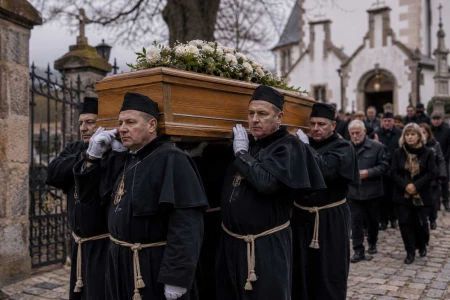
The oldest and most legible form of organising the space of mourning is the procession. Across Europe its composition was strictly codified – the cross or the officiant at the head, then the coffin, immediately behind it the closest family, and beyond them, in an order determined by kinship and standing, the remaining mourners. The procession was, in effect, a moving map of social relationships: one glance at who walked in which row was enough to read who the deceased had been and whom they had left behind.
Remarkably, the order of the procession was protected not only by custom but, at times, by what amounted to a ceremonial guard. In the grand funerals of the aristocracy and the merchant classes, this duty fell to funeral marshals and, later, to the famous mutes of the Victorian undertaker – solemn figures bearing draped staves and wands who walked before the coffin and quite literally marked out the boundaries of the cortège, ensuring that no one uninvited pressed between the family and the bier. Their crepe-covered staves were the direct ancestors of every later tool for ordering ceremonial space – from velvet ropes and drapes to today's belt barrier posts. The idea has never changed: dignity requires boundaries, and boundaries require clear, graceful signs.
The Hierarchy of Mourners in Tradition
Funeral custom long specified with great precision who was entitled to a place closest to the deceased. First the widow or widower and the children, then parents and siblings, then the wider family, close friends, neighbours and finally the whole community. In church this was mirrored by the pews – the front rows belonged by custom to the chief mourners, and to breach that order was a serious social misstep. The very phrase "chief mourner", still used by celebrants and funeral directors across the English-speaking world, is a living remnant of that codified hierarchy.
This unwritten geography of grief has survived into the present in astonishingly intact form. Observers of contemporary ceremonies note that even at entirely secular farewells, mourners spontaneously reproduce the old arrangement – family beside the coffin or urn, close friends in a second circle, acquaintances and official delegations further back. The role of the ceremony's organiser is therefore not to impose an order but to enable one: to prepare the space in such a way that every mourner finds, without asking and without embarrassment, the place that custom has assigned them for centuries.
State Funerals and Lyings in State – Ceremonial Refined to Perfection
The most sophisticated school of ceremonial space management is the state funeral. The baroque castrum doloris – the towering catafalque of royal obsequies, surrounded by candles, banners and emblems of office – was set apart from the rest of the church by balustrades and drapery, and access to each zone was regulated by a master of ceremonies. Mourners could pay their respects, but only in a prescribed order and along a prescribed route.
Modern state occasions continue this tradition with near-mathematical precision, and nothing illustrated it more vividly than the lying in state of Queen Elizabeth II in 2022, when hundreds of thousands of people filed past the catafalque in Westminster Hall along a route marked out, mile after mile, by barriers and stanchions – a queue that itself became a moment of collective mourning, orderly and profoundly dignified at once. It is worth noticing that at ceremonies of the highest rank, the posts and ropes almost invariably appear in tones of gold or brass paired with black or deep purple – the palette that European culture has associated with majesty and solemnity for centuries. A funeral home that adopts the same aesthetic in its everyday work is drawing, consciously or not, on the very same ceremonial code.
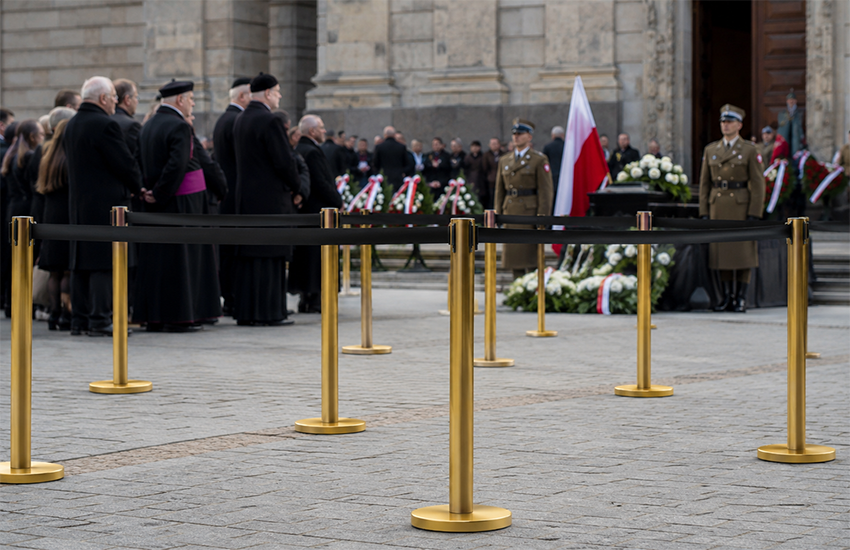
Invisible Boundaries – How Culture Divides the Space of Mourning
Look closely at any well-organised funeral and you will find several zones whose existence most mourners never consciously register – precisely because they are so well marked. It is worth naming them, for understanding this invisible geography is the first step towards professional space management.
The Zone of the Immediate Family
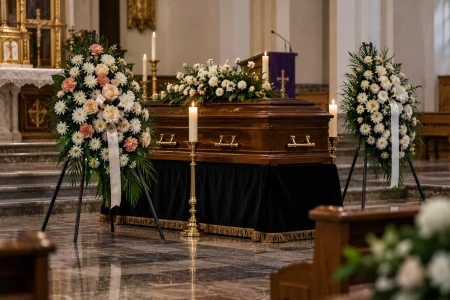
The heart of every ceremony. This is the space directly beside the coffin or urn – the front rows of chairs in the farewell hall, the front pews of the church or chapel, the immediate surroundings of the grave at the committal. Tradition demands that it be unambiguously reserved, and yet – herein lies the whole difficulty – that the reservation carry nothing of an official prohibition. No one wants to see a "no entry" sign at a funeral. The culture of mourning expects subtle signals: a discreet demarcation that says "this place is for the family" without uttering a single word. It is precisely in this role that elegant posts joined by a belt or rope have served for generations – a sign clear enough that no one is left in doubt, and graceful enough not to intrude upon the solemnity of the moment.
The Space of the Community – Wider Family, Friends, Delegations
The second circle of the ceremony belongs to the remaining mourners. Here order takes a different form – the point is not reservation but flow. Attendees need to know which way to enter, where to stand, how to form up for condolences and where to join the cortège. In practice, this is where most confusion arises: the queue for the book of condolence crosses the path along which wreaths are carried in, delegations with standards search for their positions, latecomers thread their way through the middle of the gathering. Experienced celebrants and conductors know that discreetly marking out the lines of movement – the entrance, the exit, the route to the place where flowers are laid – prevents nearly all of these situations before they can occur.
Behind the Scenes – the Staff Zone
The third zone is invisible by design: the working space of the funeral team. The spot where the coffin trolley waits, the sound desk, the route along which the coffin will shortly be carried and which mourners should therefore leave clear, and – at the cemetery – the immediate surroundings of the open grave, where simple safety requires a respectful distance. Cordoning off these areas is not a flourish but an elementary mark of professionalism. Nothing undermines confidence in a funeral home so quickly as a mourner who has strayed backstage and seen what was never meant to be seen.
Funeral Etiquette – What Mourners Expect of a Well-Organised Ceremony
Funeral etiquette is usually described from the guest's point of view: what to wear, what to say to the family, how to behave in the chapel. Far less is said about the other side of the same contract – what mourners are entitled to expect of the organisers. Yet those expectations are very concrete, even if they are rarely spoken aloud.
First – clarity. A mourner is in an emotionally difficult state, and the last thing they need is uncertainty: may I sit here, may I approach the coffin, which way should I go? A well-organised space answers those questions before they are asked. Second – discretion. Every organisational sign should be noticeable but never loud; a funeral is not a public event and does not tolerate the aesthetics of the office or the building site. Third – coherence. If the chapel is arranged with gravity and taste while the space is marked out with random, brightly coloured plastic, the dissonance is instant and it lingers in memory long after the ceremony itself has faded.
These three expectations – clarity, discretion and coherence – together form the criterion by which every piece of space-management equipment deserves to be judged. And they explain why the funeral trade has developed its own distinct aesthetic standard for objects as seemingly prosaic as barrier posts.
Modern Tools for Ordering Space – the Discreet Role of the Barrier Post
To most people, a retractable belt post brings to mind an airport, a bank or a queue at the post office. In the funeral profession, however, the very same object performs a far subtler duty – it is the modern heir of the funeral marshal's staff, of the balustrade around the castrum doloris and of the velvet rope before the catafalque. It draws the boundaries that the culture of mourning requires, and that no one wishes to draw with words.
The difference between an "office" post and a post worthy of a funeral ceremony comes down to three qualities: colour, workmanship and stability. Fluorescent warning tapes and chromed stanchions straight from a shopping centre bring into the space of mourning an aesthetic that is utterly foreign to it. The funeral trade needs solutions designed in its own language – and those are the solutions worth choosing deliberately.
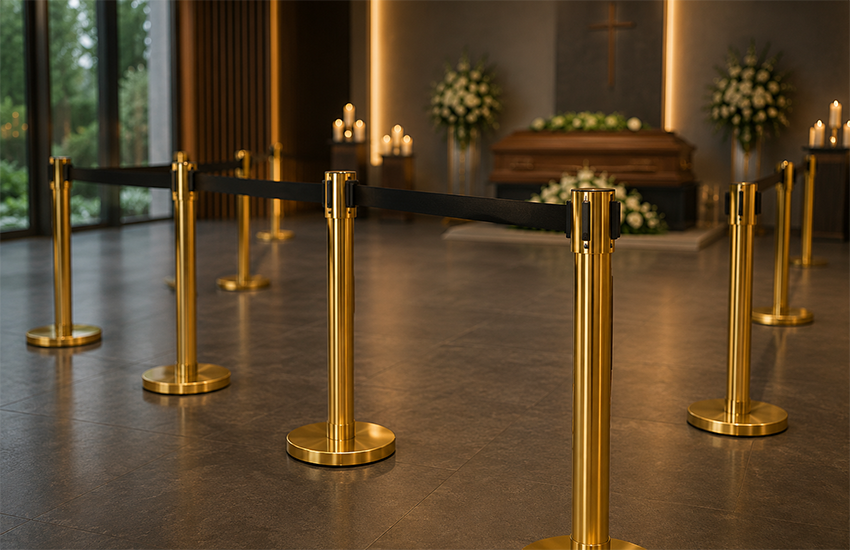
Retractable Belt Barrier – Gold with a Black Belt
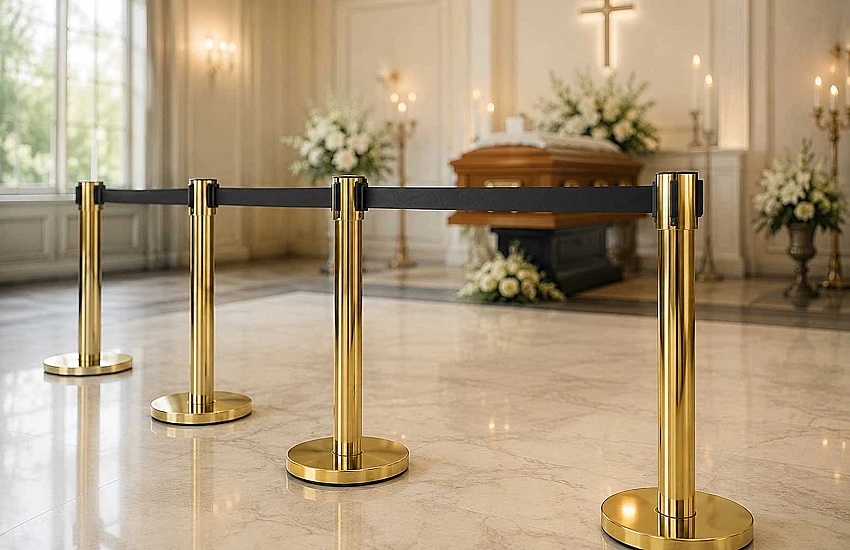
A fine example of a product designed around the specific needs of funeral ceremonies is the retractable belt barrier in gold with a black belt, available from funeraryaccessories.com. The pairing of colours is anything but accidental – the gold post and black belt reproduce the classic palette of funeral ceremonial, familiar from the most solemn farewells. The post is made of stainless steel, which makes it resistant to damage, easy to keep clean and able to preserve its elegant appearance through years of intensive use – no small matter in the daily life of a funeral home, where equipment travels constantly between chapel, hearse and cemetery.
The construction has been thought through with the realities of ceremonies in mind. At 90 cm tall, the post makes the demarcation perfectly visible without ever feeling like a wall – it orders the space, it does not divide the people in it. The retractable belt, 200 cm long and 4.8 cm wide, allows posts to be linked into lines of any shape within seconds, adapting the layout to a particular chapel, farewell hall or cemetery path. Special attention is due to the base, 32 cm in diameter – it is the base that gives the whole structure its stability, including on the uneven ground of a churchyard, on paving stones or on grass. In a space where elderly, grieving and often distracted people are moving about, a post that stands firm is quite simply a matter of safety.
The retracting mechanism matters too. Ceremonies follow one another at a pace that leaves no room for lengthy rearrangements – the same farewell hall may be prepared several times in a single day, each time for a different family and often in a different configuration. Posts with a retractable belt allow the entire geography of a space to be changed in literally a few minutes, without noise, without tools and without extra hands. After the ceremony they disappear just as quickly, taking up minimal room in the store cupboard or the vehicle.
Gold and Black – Colours That Speak the Language of Ceremonial
It is worth pausing over the palette itself, for a fascinating cultural history lies behind it. Black established itself as the colour of mourning in Europe in the late Middle Ages and the early modern period, displacing an older white that remains the colour of grief in many Asian cultures to this day. Gold, by contrast, has never been a colour of sorrow – it has always been the colour of dignity, of the sacred and of whatever is most precious. In funerary art, gilding adorned catafalques, candlesticks, coffin furniture and the braiding of mourning drapery precisely to declare that the person being mourned deserved the noblest of materials.
The union of gold and black is therefore the essence of the ceremonial code: solemnity paired with dignity, grief with honour. A post finished in this palette does not pretend to be invisible – it takes part in the staging of the farewell, just as the candlesticks, the catafalque and the floral tributes do. That is the essential difference between it and neutral or utilitarian alternatives, which at best remain foreign to the aesthetics of the ceremony and at worst openly clash with them.
Specifications That Matter in Daily Work
From a funeral director's point of view, one more thing counts: predictability. Stainless steel does not corrode despite working in damp conditions – and graveside ceremonies take place in rain, snow and fog just as often as in sunshine. The smooth surface wipes down and disinfects quickly, which in premises serving several families a day is a hygienic standard, not a luxury. The black belt, nearly five centimetres wide, remains clearly visible even in the subdued light of a chapel, while reflecting no glare into photographs or video – a genuine consideration in an age when many families record the ceremony or stream it to relatives who could not attend in person.
Barrier Posts in Practice – Chapel, Farewell Hall and Cemetery
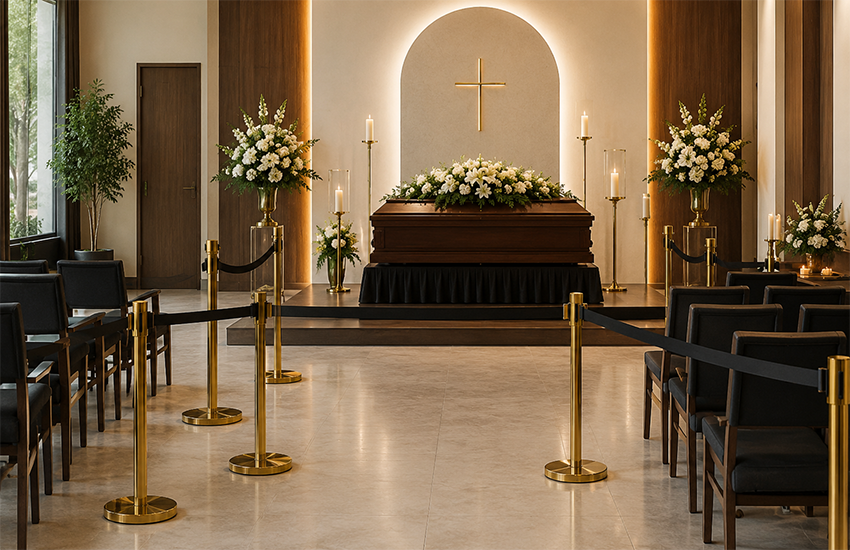
What does the daily work of these unassuming tools actually look like? In the chapel and the farewell hall they most often mark the family zone – a line of belt run along the front rows of chairs communicates the reservation more clearly, and more graciously, than any printed sign could. The second classic use is ordering the condolences: two or three posts are enough to form a natural queue of people approaching the family or the book of condolence, sparing everyone the awkward crowding at the most emotional moment of the day.
At crematoria and funeral homes with their own chapels, posts bring order to what is often the trickiest moment of all – the junction between two consecutive services. A discreetly marked waiting area for the next family prevents two groups of mourners from meeting in the doorway, a scene that is simply painful for both. At the cemetery, meanwhile, posts play a double role, aesthetic and protective: cordoning the immediate surroundings of the grave, marking positions for standard bearers, guiding the cortège along the intended path at large funerals – all tasks that in practice decide whether a ceremony flows or falters.
A separate scenario is the calendar of remembrance. Around All Souls' Day in Catholic Europe, on Remembrance Sunday, and in the days before Christmas, cemeteries receive crowds unlike any other time of year. Cemetery managers and municipal services have long relied on portable barrier systems on such days – to direct pedestrian flow, to protect sections under repair, to mark assembly points for services of remembrance. Equipment in a restrained, ceremonial palette serves that purpose incomparably better than red-and-white construction tape, which – effective though it is – jars in the setting of a cemetery like almost nothing else.
Outdoor Ceremonies and Farewells with Large Attendance
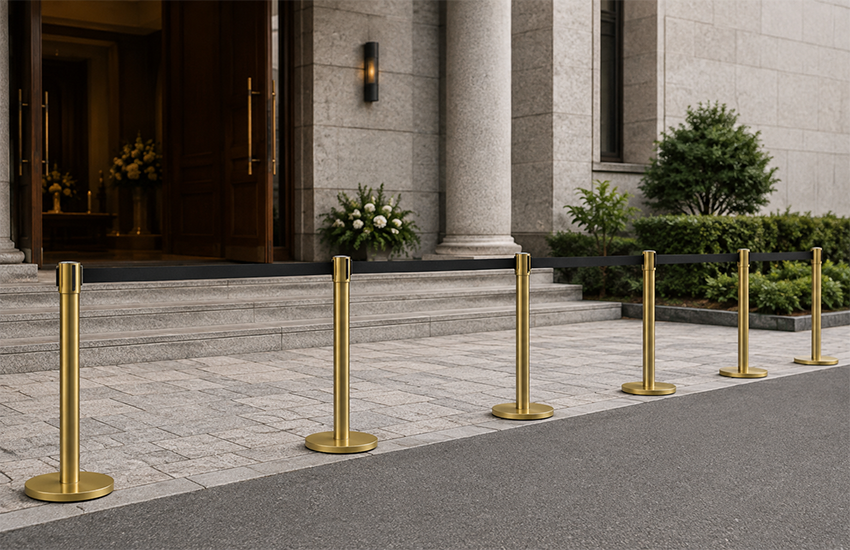
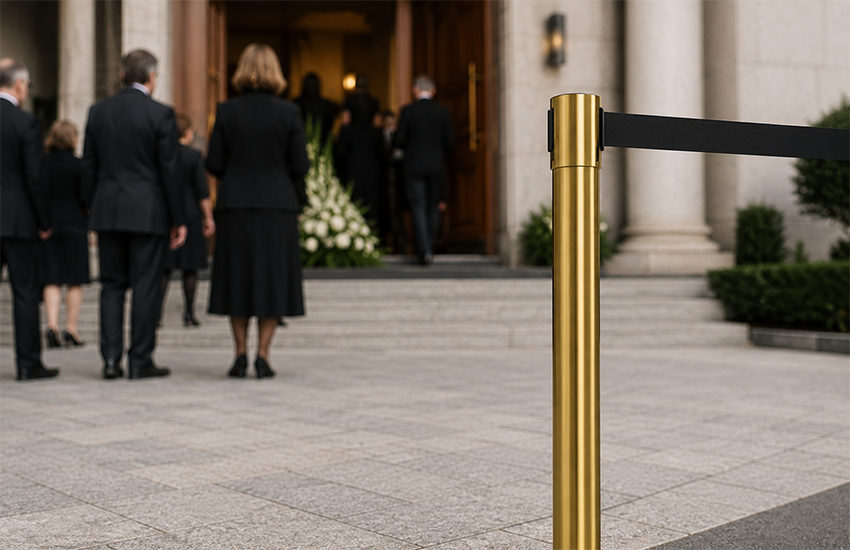
A particular organisational challenge is posed by funerals attended by hundreds, sometimes thousands, of mourners – the farewells of public figures, respected clergy, firefighters, teachers, to which an entire community turns out. Paradoxically, it is precisely when emotions run highest and the crowd is densest that discreet infrastructure becomes the condition of a dignified occasion. A sector for the family, places for delegations and standard bearers, a clear passage for the cortège, an area for the press – all of it comes into being through lines of posts, set out long before the first mourners arrive. Woodland burial grounds and natural cemeteries, increasingly popular across the English-speaking world, present the same need in a different key: paths must be suggested rather than imposed, and a line of elegant posts does exactly that without disturbing the landscape that families have chosen for its peace.
The experience of large ceremonies yields lessons that apply to even the most intimate service. The first rule: boundaries drawn in advance hurt no one, boundaries enforced in words hurt everyone. A request spoken to a mourner – to move aside, to keep out of a particular area – always carries the risk of offence; a belt stretched between two elegant posts communicates the same thing impersonally and painlessly. The second rule: a well-ordered space feels larger. The same forecourt before a chapel, structured by clear lines, accommodates mourners more smoothly and more comfortably than a space left to chance.
Curiosities – How Other Cultures Order the Space of Mourning
The need to draw boundaries around the deceased is universal, though every culture answers it in its own way. In Japanese tradition, the ceremonial space is often defined by folding screens and curtains in black and white or black and silver, hung around the funeral altar – their arrangement determines precisely where the family sits and where the other guests, who approach in turn to offer incense. In the cultures of the Mediterranean, the boundary was for centuries the threshold of the house of mourning, marked with black cloth or a wreath – a sign legible to the whole community, and one that survives in the mourning crepe once hung on front doors across Britain and America. In Jewish tradition, particular care surrounds the route of the procession and the order in which mourners pass before the bereaved to speak the words of consolation. In Ireland, the wake preserved into modern times a precise domestic geography – the room of the deceased, the room of the family, the room of the visitors – that every guest read without a word of instruction.
Against this background, the European ceremonial post with its golden shaft and dark belt appears as the newest link in a very long chain. From the marshal's staff and the Victorian mute's draped wand, through the balustrade of the castrum doloris and the velvet ropes of the nineteenth-century funeral parlour, to today's retractable belt systems – the technology has changed, the function has not. A person bidding farewell to someone they love needs an ordered space, because outward order helps to compose what is happening within. That, perhaps, is the deepest meaning of the work the funeral trade performs each day when, before the ceremony begins, it quietly sets out a few unassuming posts.
The Psychology of Order – What Happens in the Mourner's Mind
It is worth asking, finally, why an ordered space acts on mourners so powerfully and yet so imperceptibly. The psychology of grief offers several clues. A person in the first days after a loss functions in a state researchers describe as narrowed attention – a mind occupied with grieving has very limited capacity left for processing new surroundings, making decisions and finding its bearings. Every question a mourner must answer alone – where to sit, which way to walk, whether it is permitted to come closer – is, in that state, a genuine burden. A clearly organised space lifts dozens of such micro-decisions from every person present and lets them remain with the reason they came.
The second clue lies in the nature of ritual itself. Rites of passage – and the funeral is their most vivid example – draw their consoling power precisely from predictability and structure. At the moment when the mourner's inner world seems to be coming apart, the outer world of the ceremony must hold its shape: everything happens in the proper order, in the proper place, in the proper way. The structure of the space is the physical, tangible carrier of that shape. It is no accident that people who attend badly organised funerals later reach for words such as "chaos" and "shambles" – nor that those memories go on hurting long after the details of the service itself have blurred.
And there is a third, most practical clue: an ordered space relieves not only the mourners but the family. The bereaved very often feel like hosts at the ceremony – responsible for everything "going as it should", for no one feeling overlooked, for the occasion proceeding with dignity. When the funeral home takes the organisation of the space upon itself, the family is released from that role. They can simply be present – grieving, remembering, receiving condolences – instead of directing. It is hard to imagine a more valuable gift on such a day, or a better testimony to a funeral home's professionalism.
Caring for Ceremonial Equipment – Habits That Pay Off
If barrier posts help to stage the ceremony, they deserve the same care as every other piece of ceremonial equipment. Good practice is simple and quickly becomes habit. After every outdoor service, the posts should be wiped free of moisture and soil – stainless steel forgives a great deal, but regular care keeps the depth of the gold finish for years. The belt is best retracted slowly and fully, guided by hand; the mechanism then runs smoothly and is never strained. In transit between locations, posts travel best upright or secured against knocking together – the 32 cm base keeps them steady in the vehicle, and a moment's attention during loading protects the finish from scratches.
It is also worth developing standard layouts for the venues served most often. Experienced teams prepare simple plans: an arrangement for their own farewell hall, arrangements for the chapels and churchyards they visit most frequently, a variant for large outdoor services. Preparing the space then ceases to be improvisation and becomes a repeatable, refined procedure – one that can be entrusted to any member of the team in the certainty that the result will always be the same. In a profession that never gets a second attempt, repeatability is among the most precious of currencies.
Frequently Asked Questions (FAQ)
How does a barrier post for the funeral trade differ from an ordinary office stanchion?
Above all in aesthetics and purpose. Office and retail stanchions are designed for commercial spaces – hence the chrome, the bright belts and, not infrequently, the printed advertising. A post intended for funeral ceremonies, such as the gold post with a black belt, is finished in a ceremonial palette that harmonises with the furnishing of chapels and farewell halls. Equally important is a heavy, stable base that allows the post to stand securely even on the uneven ground of a churchyard or cemetery.
How many posts does an average funeral home need?
It depends on the scale of the business and the character of the ceremonies served. In practice, a minimum set is four to six posts – enough to mark out the family zone in a chapel or to form a condolence queue. Funeral homes handling large services, operating their own farewell hall or working alongside a crematorium usually keep sets of eight to a dozen or more, which allows several zones to be organised at once – the entrance, the family area and the working zone behind the scenes.
Are retractable belt posts suitable for outdoor use at the cemetery?
Yes, provided they are properly made. The key is the material's resistance to moisture – stainless steel posts can be set out at the graveside in wet weather without concern. A wide, stable base matters just as much; a model with a 32 cm base stands firmly on paving, flagstones and mown grass alike. After the ceremony it is enough to wipe the posts dry before storage, which preserves their appearance for years.
How can seats be reserved for the family discreetly, without offending other mourners?
Impersonal communication works best – a boundary set in place before mourners enter the chapel or hall. A belt run along the front rows of chairs is a sign everyone understands and it requires no words at all; just before the service begins, a member of staff retracts it with a single movement and shows the family to their places. This approach is universally read as care for the closest relatives of the deceased, not as a restriction on anyone else.
Why does funeral ceremonial so often pair gold with black?
It is the inheritance of centuries of European funerary tradition. Black has symbolised mourning and solemnity since the late Middle Ages, while gold has always stood for dignity, the sacred and the highest honour paid to the person being mourned. The pairing appeared on catafalques, candlesticks, coffin furniture and the braid of mourning drapery, and it returns today in the furnishing of chapels and farewell halls. Equipment finished in this palette joins the staging of the ceremony naturally instead of competing with it.
Can barrier posts be used outside funeral ceremonies as well?
Yes – and this is one of the arguments for the investment. Cemetery managers use posts to direct visitor flow on days of remembrance, to protect sections during works and to mark processional routes. Funeral homes also use them at memorial services, anniversary gatherings and commemorative events. The restrained palette means the equipment suits every one of these occasions.
What should a funeral home look for when choosing a barrier post?
Four things: material, stability, the belt mechanism and the palette. Stainless steel guarantees durability and easy cleaning. A wide base ensures a secure stance in all conditions. A smooth retracting mechanism with a belt long enough to link posts into lines – 200 cm in the model described here – determines the speed of the work. The palette, finally, should answer the solemnity of the occasion; a gold post with a black belt is the choice closest to classic funeral ceremonial.
Conclusion – Order as a Form of Respect
The culture of farewells teaches that the dignity of a ceremony does not spring from grand gestures alone – it is born of an accumulation of details, each of which seems minor on its own. An ordered space is one of those details: invisible when it works, painfully felt when it is missing. From the marshal's staff and the mute's draped wand to the modern farewell hall, the principle has never changed – boundaries drawn with tact protect what is most precious in a farewell: the peace of the family and the composure of everyone who has come to pay their respects.
For a funeral home, this means that the tools of space management deserve the same attention as any other piece of equipment. The retractable belt barrier in gold with a black belt unites everything the role demands – a ceremonial aesthetic, solid stainless steel construction, stability and speed of use. It is a small piece of equipment that performs work of great significance every single day: it makes sure that, in the hardest of moments, everything is in its place.