Table of Contents
- Shelter as the oldest gesture of honour
- The canopy in Christian and English tradition
- The hearse, the pall and the heraldic funeral
- Victorian mourning and the shelter that never came
- The canopy beyond Europe
- Why a canopy organises a ceremony
- The modern form of an ancient gesture – Funeral Tent 3×4.5 m Premium PRO
- Composing the ceremonial space
- Details that mourners never notice
- Frequently asked questions
- The same gesture, different tools
There is a gesture so old that nobody remembers when it began, and yet we repeat it at every funeral held under open sky. The gesture consists of stretching a piece of cloth above people's heads. Above the deceased, above the family, above the officiant. Not above the whole cemetery, not above the cortege, but precisely above the place that matters at that particular moment.
It can be explained in entirely practical terms – it rains, the sun is harsh, the wind gets up. The explanation is true but incomplete. Canopies were raised on mild days under cloudless skies as well. They were raised over sovereigns, over relics, over the sacrament, over brides, over the coffins of bishops. For thousands of years, cloth stretched above someone's head has meant one thing: what lies beneath requires separating from the rest of the world.
This article traces that gesture – its roots in the Mediterranean world, its distinctly English expressions in the lych-gate, the heraldic funeral and the candlelit hearse, its counterparts in Jewish and nomadic tradition, and finally what remains of it in the daily work of a modern funeral director. Because the funeral tent, for all its anodised aluminium and technical fabric, is a direct descendant of the baldachin, the pall and the ceremonial hearse. The material has changed. The meaning has not.
Shelter as the oldest gesture of honour
A sky that had to be repeated
In most ancient cosmologies the sky was a vault – a structure, a dome, a tent pitched above the earth. Language preserved this. Hebrew poetry described the heavens as spread out like the curtain of a tent, and across the steppe and the desert the metaphor was simply obvious: the world is a great tent, and its roof is held up by masts we cannot see.
From this follows a logic that seems strange today and was once entirely natural. If the sky is the roof of the world, then raising your own roof over a chosen place creates a world in miniature at that spot – ordered, set apart, sacred. The canopy did not protect against the sky. It quoted the sky.
You can see it in the oldest depictions of power. Assyrian kings on palace reliefs travel beneath a parasol carried by no ordinary servant but by a dignitary, and the parasol itself belongs to the regalia. The same holds in Egypt, Persia, India and Byzantium. These were not sunshades for people who could not afford shade. They were signs that this person had a separate sky of their own.
The tent as the first sacred architecture
Before there were temples of stone there were temples of cloth. The portable sanctuaries of nomadic peoples were tents – timber frames with layered coverings, pitched at each halt and struck again before moving on. This matters for the funeral profession, because it shows that impermanence was never the opposite of dignity. The tent was not a lesser sanctuary. It was the sanctuary that could come to wherever the people happened to be.
That is precisely the role of the modern funeral tent. A cemetery does not have walls around every plot, covered walkways or a chapel beside every grave. The service takes place where the grave is, not where an architect once decided a ceremony ought to happen. A funeral director who erects a tent is therefore doing exactly what the builders of portable sanctuaries did – bringing sacred space to the point where it is needed.
The canopy in Christian and English tradition
From the Roman velum to the ciborium
The Romans knew the velarium – vast awnings drawn over the seating of amphitheatres, worked by sailors, because only sailors could handle rigging on that scale. They also knew the velum in its narrower sense, as cloth marking out a place of significance, and portable canopies carried above persons of rank.
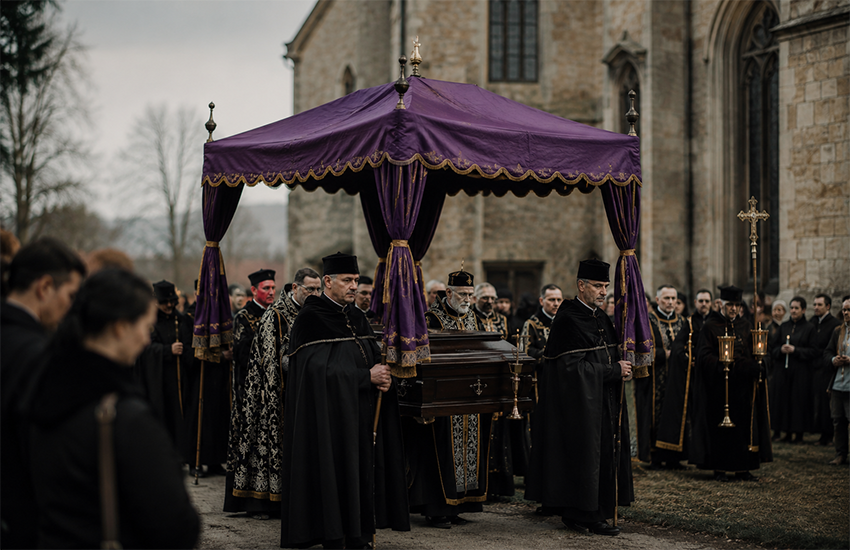
Christianity adopted this vocabulary at once. Above the altar stood the ciborium, a stone or timber canopy on four columns – literally a tent translated into permanent architecture. In England the same idea produced the stone tester and the carved canopy above tomb effigies in cathedrals from Canterbury to York, and above the medieval shrines that drew pilgrims. Even the Coronation Chair in Westminster Abbey stands within a tradition in which the crucial moment of anointing is screened by a canopy held over the sovereign by four Knights of the Garter.
It is worth pausing on the word valance, because it returns later in this article. The lower edge of a canopy, that scalloped band running around the roof, is not an ornament added out of idleness. It is the edge that defines where the separated space ends. A valance is a line of demarcation drawn in the air at eye level.
The lych-gate, England's covered threshold
English churchyards preserve one of the finest surviving examples of funerary shelter anywhere in Europe, and most visitors walk through it without a second thought. The lych-gate – from the Old English word for corpse – is the roofed gateway at the entrance to a churchyard, and it exists for one purpose: to shelter the body and the bearers while they wait for the priest.
Under the older rubrics, part of the burial service was read at the entrance to the churchyard before the procession moved to the grave. The bearers, who had often carried the body a considerable distance on foot, needed somewhere to set down their burden out of the rain. Many lych-gates therefore have a stone slab or timber bench built into them, and a number of surviving examples in Kent, Sussex, Hampshire and the West Country retain this feature.
The lych-gate is a permanent structure doing exactly what a funeral tent does temporarily. It marks a threshold, it shelters the moment of transfer, and it gives the mourners a defined place to stand while something formal is spoken. When a modern funeral director pitches a tent at the graveside, they are extending the logic of the lych-gate to the one point in the churchyard that never received a roof.
The hearse, the pall and the heraldic funeral
When a hearse was a canopy of candles
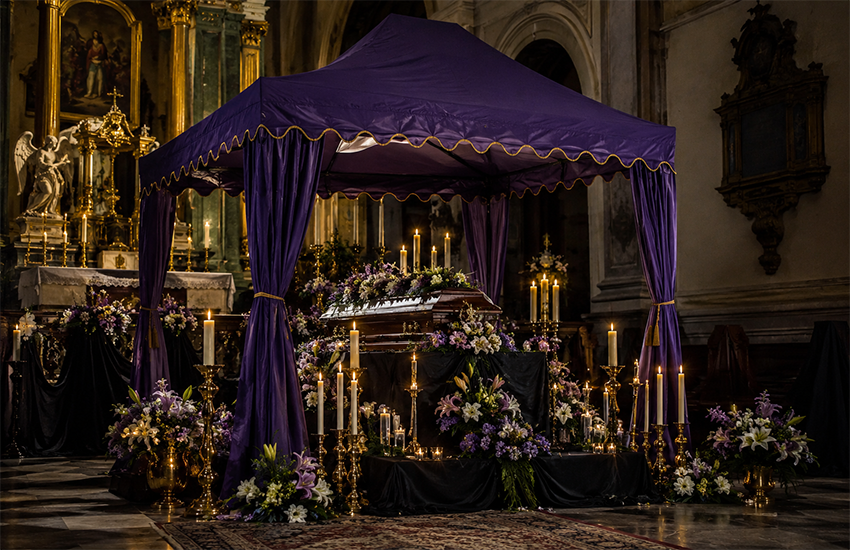
Few words in the funeral vocabulary have travelled as far from their origin as hearse. Today it means a vehicle. In medieval and Tudor England it meant something quite different: an elaborate framework of timber and iron erected above the coffin inside the church, bristling with candles, hung with black cloth and armorial banners.
The word descends through Old French from a Latin term for a harrow, the toothed farming implement – because the earliest versions were spiked frames holding tapers, resembling a harrow turned upside down. From these developed structures of extraordinary ambition. The hearses built for royal and noble funerals could rise many feet above the coffin, carrying hundreds of candles, panels of painted verse, escutcheons and a canopied roof surmounted by a crown or coronet according to the rank of the deceased.
Like everything of its kind, the hearse was demountable. After the obsequies it was taken down, and the black cloth was frequently distributed to the poor or reused. Enormous effort went into a structure that everyone knew in advance would disappear within days. Impermanence did not diminish the solemnity. It constituted part of it, because it marked the funeral as a single irreversible event rather than a permanent condition.
Heraldry, funeral achievements and the printed valance
To the hearse and its drapery were fixed the signs of identity. Escutcheons bearing the arms of the deceased, banners, and inscribed panels reciting offices and lineage. From the fifteenth century onward the College of Arms in London regulated these funerals in detail, prescribing what rank was entitled to what display – how many mourners, what length of black gown, what form of hearse, which officers of arms attended.
Afterwards the hatchment, a lozenge-shaped board painted with the arms of the deceased, hung over the door of the house during the mourning period and was then removed to the parish church. Hundreds still hang in English churches today, high on the nave walls, mostly unread. Alongside them, in many churches, hang the funeral achievements themselves – helm, crest, gauntlets and spurs carried in the procession and left behind as a permanent record.
The modern printed valance on a funeral tent is the direct, if far more modest, descendant of this practice. The name of the funeral home along the lower edge of the roof functions exactly as the escutcheon on the drapery once did – as a statement of who is answerable for the conduct of this particular farewell.
Victorian mourning and the shelter that never came
The nineteenth century turned English funerals into a full industry. The great garden cemeteries built to relieve the appalling overcrowding of urban churchyards – Kensal Green, Highgate, Nunhead, Abney Park, Brompton, West Norwood, together known as the Magnificent Seven – gave London a new landscape of mourning, with chapels, colonnades, catacombs and carefully composed vistas.
Victorian mourning culture developed an elaborate grammar of textiles: crape for the first stage of widow's mourning, jet jewellery, black-edged stationery, mutes standing at the door with draped wands, plumes of black ostrich feathers on the horses. Every surface that could carry an indication of grief was made to carry one.
What that century did not solve, however, is the same problem that remains unsolved today. All this refinement stopped at the chapel door. Once the procession moved out to the grave, the mourners stood in the open with nothing above them, and English weather being what it is, a great many nineteenth-century funerals ended in a scramble of umbrellas at the graveside. Photographs and engravings of the period show it repeatedly.
The graveside was, in effect, the last unroofed moment in an otherwise thoroughly staged sequence. It is worth recognising that the modern funeral tent is not an addition to tradition but the completion of something the tradition had left undone for centuries.
The canopy beyond Europe
Ohel and sukkah, impermanence as theology
In Jewish tradition the word ohel means tent, and it also names a type of funerary architecture – a small structure raised over the grave of a particularly revered figure. The building is masonry or timber, but the name remained a tent, which says a great deal about the durability of the metaphor.
The same tradition produced a festival whose essence is dwelling for a week in a provisional structure roofed with branches, through which the stars must remain visible. The sukkah is required to be impermanent. Its roof may not be sealed. The theology speaks of the fragility of human dwelling and of trust in what exceeds us, and it is hard to think of anything closer to the situation at a graveside.
In the same tradition the canopy also appears at weddings. The chuppah is four poles and a cloth, under which a couple enters a new state. The same shape opens married life and closes earthly life. The canopy turns out to be a universal sign of threshold.
Steppe, desert and hospitality under cloth
Nomadic cultures developed the tent to a level that permanent architecture took far longer to reach. The yurt of Central Asia has a lattice frame, a collapsible skeleton, a precisely calculated roof curvature and a smoke opening functioning as a zenith. The Bedouin tent of woven goat hair changes behaviour with humidity – the fibres swell and seal the weave in rain while remaining breathable in heat.
In both cultures the tent was also a social institution. To come beneath another's roof meant to come under the host's protection, even if the guest arrived from a hostile tribe. The law of hospitality held for as long as the host's cloth was above the guest's head. That is a very concrete, material version of the same idea a funeral director enacts by pitching a tent over a family – for as long as these people stand under this roof, someone is answerable for them.
Why a canopy organises a ceremony
Boundary, threshold and focal point
A graveside service in an open cemetery has one structural problem: there are no walls. Nobody can tell where the ceremony begins and the ordinary path ends. Mourners do not know how close to come, where to stand, at what point they are properly inside. The result is often a ragged half-circle that spills across neighbouring plots and forms no legible shape at all.
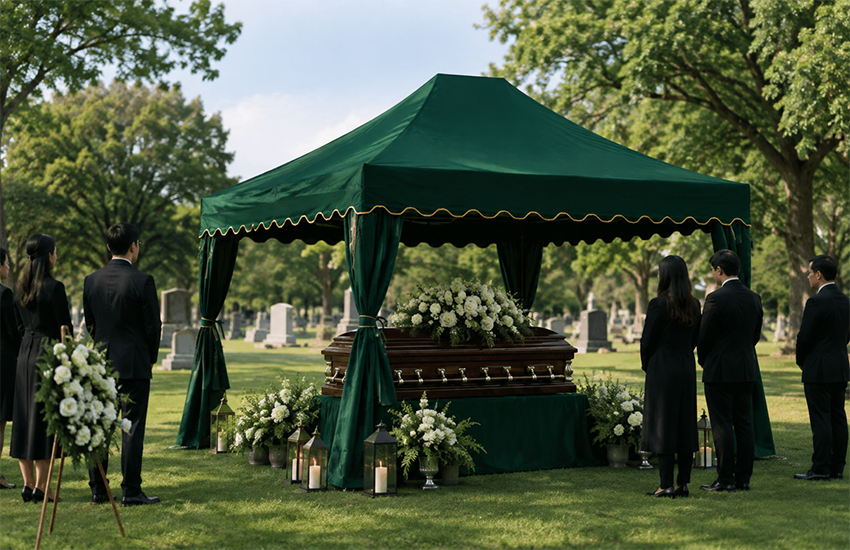
A canopy solves this without erecting a single wall. It need only cast a shadow with a clear edge and hang a valance at eye level. People immediately read where the centre is, where the boundary lies and which way they should face. The space is organised without anyone issuing instructions, and that is worth a great deal in a situation where nobody wants to be told where to stand at the grave of someone they loved.
Anthropology describes this through the idea of threshold. A rite of passage requires a set-apart zone in which a change of status can occur. The deceased passes from the company of the living to the company of the ancestors; the family passes from caring for the ill to mourning. The passage needs a place belonging fully to neither order. A tent is such a place, because it stands where a few hours earlier there was nothing, and it will be gone before dusk.
Sound, light and silence under the roof
There is a purely sensory dimension too, rarely written about and perfectly familiar to anyone who has conducted a service outdoors. Open space swallows the voice. A eulogy delivered with no reflecting surface anywhere disperses into the air, and the speaker must raise their voice, which strips the words of intimacy. A canopy stretched overhead acts as a modest reflecting plane and returns part of the sound downward. The effect is subtle but real – under a tent one can speak more quietly and be heard better.
The same applies to light. Harsh midday sun makes people squint and turn their faces away, which disrupts the composition of the whole gathering. Diffused light passing through the canopy evens out contrast, softens shadows on faces and makes any photographs the family may wish for far calmer in tone.
Then there is the most obvious point of all, and the most consistently underrated. Rain drumming on umbrellas is a sound that reliably destroys every spoken word. Thirty mourners with thirty umbrellas means thirty independent surfaces blocking one another's view and clashing at the edges. One roof instead of thirty delivers quiet and order at the same time.
The modern form of an ancient gesture – Funeral Tent 3×4.5 m Premium PRO
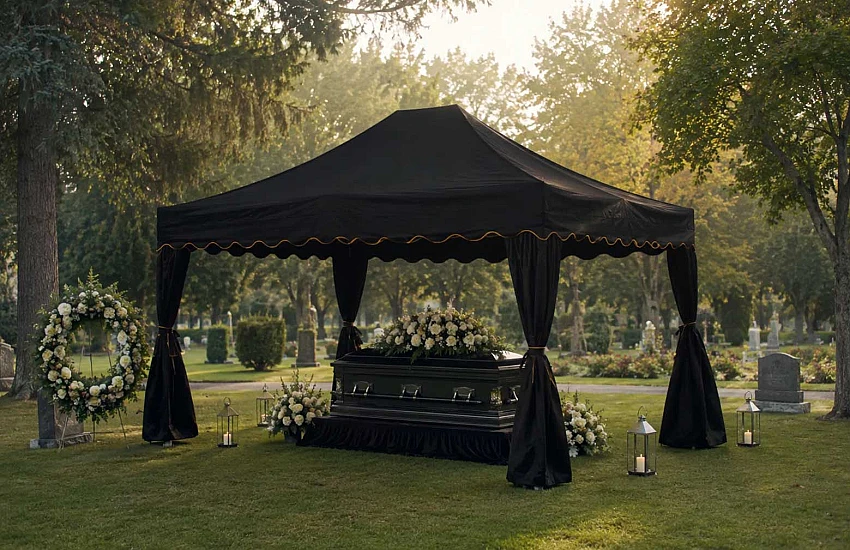
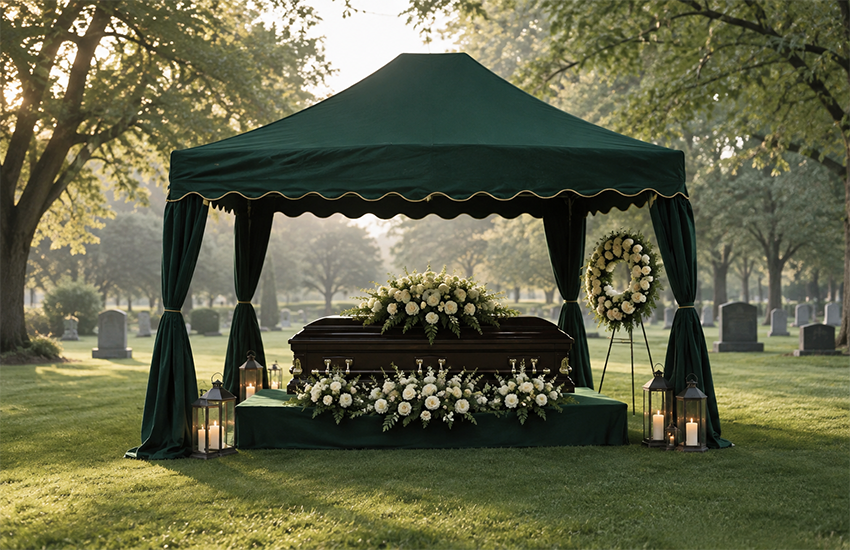
All of this tradition has a concrete technical continuation today. The Funeral Tent 3×4.5 m Premium PRO available from funeraryaccessories.com is designed for precisely what has been described above – creating a set-apart, dignified space where no architecture exists, and doing so quickly, repeatably and without risk.
The octagonal 54 mm profile, or why geometry matters
The frame is made from anodised aluminium with an octagonal leg profile of 54 mm. Choosing an octagon over a square or a round tube is not an aesthetic decision. A polygonal profile distributes stress more evenly than a square section, which concentrates it at the corners, while resisting torsion better than a round tube of comparable mass. In practice this means a frame that does not flex or work under lateral wind load.
The manufacturer states the tent may be used in wind gusts of up to 100 km/h provided additional anchoring is employed, and gives a five-year warranty on the structure itself. The braces measure 18×35 mm and the height is adjustable in five steps, which allows the tent to be levelled on uneven ground – and uneven ground is the norm in British churchyards, where plots sit on slopes, paths fall away and the soil after rain is soft on one side and firm on the other.
Set this against the history. A Tudor hearse took carpenters days to build and its stability depended on their judgement. A processional canopy holds up because four people are paying attention. The modern funeral tent transfers that responsibility to material and geometry – and only that makes it possible to erect the structure once, then several hundred times more, in every kind of weather, at the same standard of safety.
Canopy, valances and leg covers
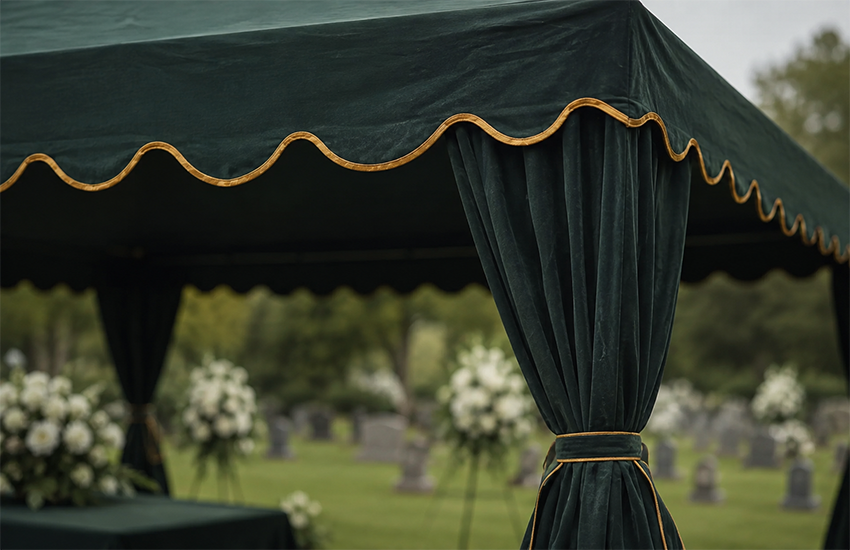
The roof covering is made of waterproof fabric protecting attendees from rain and moisture. The roof carries decorative printed valances, while the remaining sections are supplied in factory colour. Four leg covers finished with decorative trim, available in gold or silver, conceal the frame.
Those leg covers deserve particular attention, because few people realise how completely they change the reading of the whole object. An exposed aluminium leg reads as equipment – something from a building site or a village fete. The same leg in a fabric cover with trim reads as a column. The difference lies entirely in the finish, yet the register shifts from structure to ceremonial architecture. It is exactly the operation applied to Tudor hearses when raw timber posts were covered in black cloth.
The complete working unit weighs 33 kg including roof, covers and frame, and the folded frame packs into transport dimensions of 25×33×160 cm. Tent height is 320 cm and entrance height is 190 cm, both measured with the leg covers fitted. The second figure matters more than it appears, because bearers pass beneath the canopy carrying a coffin at shoulder height and need clearance overhead.
Personalisation as modern heraldry
The tent can be personalised with a printed logo, company name or other graphic element on the valances, and a graphic visualisation of the design is included, so the finished appearance can be reviewed before production. A wide range of colour variants is available, allowing the tent to be matched either to the firm's visual identity or to the character of the service.
Printed sidewalls can be ordered as an option. Their role is twofold. They increase privacy for the family, which matters at the funerals of publicly known figures and in densely occupied sections of a cemetery. They also close the volume, turning a canopy into a room – at which point the analogy with the portable sanctuary becomes literal.
Returning to the heraldic thread: a firm's name on a valance is not advertising in the ordinary sense. It is a signature on completed work, in the same way a founder's mark appears on a church bell. Families who have witnessed a well-conducted service remember that name, because they associate it with order on a day when very little else was orderly.
Assembly, transport and the rhythm of the working day
The set comprises the Premium PRO aluminium frame with its five-year warranty, the roof cover with printed valances and remaining sections in factory colour, four leg covers with decorative trim, an anchoring kit of four tension straps with carabiners and four ground stakes, and a protective storage cover. Assembly is designed to be rapid, and the tent remains stable on soft ground and hard surfaces alike.
That last point is routinely underweighted at the moment of purchase and decides everything in practice. A funeral director conducting two services on the same day must strike the tent, transport it and pitch it again elsewhere within a tight schedule. Thirty-three kilograms and a 160 cm bag mean it fits in the boot of a typical service vehicle and does not require three people to handle.
That repeatability is, in fact, the only thing that separates modern practice from the heraldic funeral in any fundamental way. Elaborate provision was once the privilege of a few, because preparing it took weeks. Today the same degree of separation and gravity can be offered to every family, on any day of the week, in any weather. That is a real and quiet democratisation of ceremony – and it happened by way of a folding frame.
Composing the ceremonial space
Size and the character of the service
Two principal formats are available. The Funeral Tent 3×3 Premium PRO suits cremated remains interments and small services, where the covering needs to reach the place of burial together with the officiant and the immediate family. The 3×4.5 m format adds a further metre and a half along the long axis – and that axis is decisive at a full burial, because the coffin, the lowering device and the bearers must all line up in a single run.
Firms wanting the same footprint with the standard frame can consider the Funeral Tent 3×4.5 m PRO, or the smaller Funeral Tent 3×3 m. Choosing between the PRO and Premium PRO lines comes down in practice to the conditions a firm most often works in – the more exposed and wind-swept the cemeteries, the stronger the argument for the heavier octagonal profile. The full range sits in the funeral tents category.
Ballast, lighting and the boundary at ground level
On hard standing, on paved cemetery paths or on frozen winter ground, stakes cannot be driven and ballast becomes the only option. Cast iron weights of 15 kg give the most compact mass per leg, 15 kg sand weights offer a lighter alternative to store, and water weights travel empty and are filled on site, which is often the deciding factor when the vehicle is already loaded.
Winter services in northern latitudes raise a further point that has no medieval equivalent, because medieval funerals did not take place at four in the afternoon in December. A LED lighting set for funeral tents or a halogen light with handle keeps the readings legible and the ground visible when the light goes early.
Experienced conductors also close the composition at ground level. Barrier posts with retractable tape separate the ceremonial zone from the path and regulate the movement of anyone passing through. The canopy draws the boundary in the air; the posts draw it on the ground. Together they form the same figure that the altar rail and the ciborium once formed inside a church. The wider range is set out in the full catalogue of funeral accessories.
Details that mourners never notice
A few small matters connected with ceremonial shelter go entirely unconsidered by those attending, and yet they shape the impression the day leaves behind.
The first is the colour of the covering. White and ivory read in Britain today as neutral and formal, though a century ago many would have found pale cloth over a grave improper. In East Asian cultures white remains the colour of mourning, whereas in Europe black took that role only in the later Middle Ages, displacing an earlier preference for violet and the natural shade of undyed wool. The availability of several colour variants makes it possible to respect these differences where they matter, and Britain's genuinely multi-faith burial grounds mean they matter more often than they used to.
The second is the sound of the fabric. A taut covering under wind produces a low, regular note that mourners register as background rather than interruption, unlike loose cloth, which cracks and distracts. A properly tensioned and anchored roof not only holds better; it sounds calmer.
The third is the shadow. On a bright day the edge of the shadow cast by a tent is more sharply legible than the frame itself, and it is the shadow that actually arranges where people stand. Worth remembering at morning and late-afternoon services, when it travels several metres within the hour.
The fourth is that a well-pitched tent disappears. If the frame is stable, the covering taut and the legs covered, mourners stop seeing it within the first half-minute. That is the best possible review. Elements of ceremonial provision are working when they draw no attention to themselves and direct it instead to where it belongs.
Frequently asked questions
Where does the tradition of raising a canopy over a ceremony come from?
It grows out of a very ancient association between the sky and a vault or a tent pitched over the world. Stretching cloth above a chosen place meant creating a space there that was set apart, ordered and under protection. Hence the canopies over rulers in Assyria, Persia and Byzantium, the ciborium above the Christian altar, the processional canopy, the chuppah over a married couple, and finally funerary shelters such as the medieval hearse. The modern funeral tent continues that line directly.
What was a lych-gate for?
A lych-gate is the roofed gateway at the entrance to an English churchyard, its name derived from the Old English word for corpse. It sheltered the body and the bearers while they waited for the priest, since part of the burial service was formerly read at the churchyard entrance before the procession moved to the grave. Many surviving examples retain a stone slab or bench on which the bier could be rested. It performs permanently what a funeral tent performs temporarily – marking a threshold and sheltering the moment of transfer.
Why does a funeral tent have valances along the roof edge?
The valance serves a function far older than decoration. The lower edge of a canopy marks the boundary of the set-apart space, drawing it in the air at the eye level of those attending, so that mourners read the extent of the ceremonial zone without being told. Historically the valance is also where signs of identity were placed – once arms and inscriptions, today the name and logo of the funeral home. On the Premium PRO 3×4.5 m it is precisely the valances that carry the print option.
What is the construction of the Funeral Tent 3×4.5 m Premium PRO?
The frame is anodised aluminium with an octagonal leg profile of 54 mm, braces measuring 18×35 mm and five-step height adjustment. Tent height is 320 cm, entrance height 190 cm, and the weight of roof, covers and frame together is 33 kg. The manufacturer gives a five-year warranty on the structure and states it may be used in wind gusts of up to 100 km/h provided additional anchoring is employed.
What is included in the set?
The set comprises the Premium PRO aluminium frame with a five-year warranty, the roof cover with printed valances and remaining sections in factory colour, four leg covers with decorative trim, an anchoring kit consisting of four tension straps with carabiners and four ground stakes, and a protective storage cover. The folded frame packs to transport dimensions of 25×33×160 cm.
When should you choose 3×4.5 m rather than 3×3 m?
The 3×3 m format suits interments of cremated remains and small services, where the covering needs to reach the place of burial along with the officiant and immediate family. The 3×4.5 m format adds a further metre and a half along the long axis, which matters at full burials because the coffin, the lowering device and the bearers must line up in a single run. Many firms hold both sizes and select according to the character of each service.
How do you secure a tent where stakes cannot be driven?
On paved cemetery paths, hard standing or frozen winter ground, ballast replaces stakes. Cast iron weights of 15 kg give the greatest mass in the smallest volume, sand weights of the same rating are lighter to store, and water weights travel empty and are filled on site, which is frequently decisive when the vehicle is already fully loaded. Ballast should be applied to every leg rather than only to the windward pair, and it remains necessary in combination with the anchoring kit whenever conditions are exposed.
The same gesture, different tools
From the cloth sanctuaries of nomadic peoples, through the Roman velum and the ciborium, to the candlelit hearses raised in English parish churches and the lych-gates still standing at churchyard entrances – the idea has not moved. A person being taken leave of by a community deserves a sky of their own, even if it lasts an hour and packs into a bag a hundred and sixty centimetres long.
A funeral director who pitches a tent over a grave is not adding a modern element to the ceremony. They are performing one of the oldest gestures our culture ever devised in the face of death, using anodised aluminium instead of oak beams. Mourners do not need to know this. It is enough that they feel what the first person to stretch cloth over a body intended them to feel – that they are standing in a place where somebody has taken care of everything.