Table of Contents
- Why urn transport demands careful attention
- Urn carriers – what they are and how they work
- Types of urns and what they require from a carrier
- Urn carrier models available from funeraryaccessories.com
- Sets with bases – a complete presentation for urn services
- Choosing the right urn carrier for the service type
- Safe urn transport step by step – practical guidance
- Cremation in context – industry trends and what they mean for equipment
- Why invest in a professional urn carrier
- FAQ – Frequently asked questions
- Summary
Cremation has become one of the most widely chosen forms of final disposition across the English-speaking world. In the United Kingdom, cremation accounts for more than three quarters of all funerals, and the trend is similarly strong in Australia, Canada, and parts of the United States, where cremation rates have been climbing steadily year on year. As a result, the practical and ceremonial demands placed on funeral homes have shifted significantly. The coffin is no longer the sole focal point of the service – increasingly, it is the urn that holds centre stage.
With that shift comes a set of operational challenges that are easy to underestimate. The moment of carrying the urn – from the hearse to the chapel, from the chapel to the catafalque, from the catafalque into the hands of the family, and finally to the place of interment or scattering – determines much of how the entire service is experienced. Improvised solutions expose the urn to the risk of slipping, shifting, or being damaged. None of that should happen during a service that is, by definition, meant to be dignified and respectful.
The answer is a professional urn carrier: a purpose-built accessory designed to ensure the urn is transported safely, stably, and with the visual composure that a funeral service demands. An urn carrier is a product that bridges engineering and aesthetics – it must be robust enough to secure a heavy, often polished urn, and understated enough not to distract from the solemnity of the occasion.
Why urn transport demands careful attention
The urn as the ceremonial centrepiece
In funeral ritual, every object carries symbolic weight. The coffin communicates rest and accompaniment. The urn – smaller, more concentrated, almost intimate – holds the entire presence of the person who has died. Every action taken around it, including the simple act of carrying it, therefore carries ceremonial significance that goes well beyond logistics. An urn is not a package to be moved from A to B. It is a physical symbol of memory, the last tangible trace of a person's life.
Seen in this light, any hurried, clumsy, or ergonomically poor handling of the urn is not merely a technical mistake – it is an intrusion into a space governed by a different set of rules: those of respect, stillness, and composure. Bereaved families watch that moment with extraordinary attentiveness. How the funeral director's staff holds the urn, places it, lifts it – all of it shapes the family's experience of the entire service.
The risks and responsibilities of urn transport
Urns are made from a wide variety of materials: stone, wood, metal, ceramic, biodegradable composites. Each has different characteristics in terms of weight, surface texture, and vulnerability. Stone and marble urns can weigh several kilograms and feature smooth, polished surfaces that are particularly susceptible to scratches. Ceramic urns are often delicate and do not tolerate impacts well. Wooden urns, while typically lighter, may have irregular profiles with carvings or decorative elements that make stable placement on a flat surface difficult. Metal urns tend to be the heaviest and most robust, but their polished surfaces are just as prone to scratching as stone.
The funeral home bears responsibility for the entire service proceeding without incident. An urn carrier is one of those pieces of equipment that can appear invisible when present – but whose absence or poor quality is felt immediately. It is precisely for this reason that professional funeral homes are increasingly turning to purpose-built equipment rather than improvised solutions such as trays, draped cloths, or ordinary boxes.
Urn carriers – what they are and how they work
Structure and operating principle
An urn carrier is a specialist funeral accessory designed to allow the safe, dignified transport of an urn by a funeral home staff member or – in some family traditions – by a close relative. It typically consists of a base, a system that prevents the urn from shifting during transport, and handles that make carrying comfortable and secure.
Depending on the model, the urn is secured in different ways: through adjustable arches that embrace the urn from the sides, through containment rings, through a central insert with a shaped aperture that stabilises the base of the urn, or through a combination of these elements. Critical to all designs are rubber rings or bumpers, which serve a dual purpose: protecting the urn from scratches and providing friction to prevent the urn from sliding even if the carrier is slightly tilted.
Materials and build quality
Urn carriers fall into two broad material categories: steel and upholstered fabric. Metal models are constructed from stainless steel or powder-coated steel, offering corrosion resistance, longevity, and ease of cleaning. Upholstered models use fabric coverings – velvet, satin, or cotton-polyester blends – that give the carrier a softer visual presence and allow for a wide range of colour choices to match chapel décor or family preferences.
Stainless steel, used in the metal urn carrier models, is a material trusted in demanding industrial and medical environments – resistant to moisture, cleaning chemicals, and the variable outdoor conditions that cemetery services can present. Powder coating, used on the black steel variant, involves electrostatically applying dry powder to the steel and curing it in an oven at over 180°C. The result is a finish substantially tougher than conventional paint: resistant to chipping, scratching, and UV fading.
Build quality reveals itself in the details: the precision of welds in metal models, the quality of upholstery in fabric ones, and above all the accuracy of any adjustable components such as sliding arches or expanding rings. A poorly made carrier will look tired after only a few services and, in extreme cases, will cease to function as a protective device altogether. When selecting an urn carrier, it is worth paying close attention to who manufactures it and what level of specialist experience they bring.

Types of urns and what they require from a carrier
The urn market today is highly diverse. Alongside traditional metal urns, there are wooden urns in a range of timber species, stone and marble urns, hand-painted ceramic urns, artistic glass urns, and biodegradable urns designed for earth burial or water interment. Each material behaves differently in terms of weight, surface finish, and susceptibility to damage.
A stone or marble urn can weigh several kilos and has a smooth, polished surface that scratches easily. A ceramic urn may be fragile and unlikely to survive a drop or sharp knock. A wooden urn, though lighter, can have irregular profiles with carvings or embellishments that make stable seating on a flat surface unreliable. A metal urn is generally the heaviest and most durable, but its polished surface is no more forgiving of scratches than stone.
This diversity is precisely what makes an adjustable urn carrier with rubber protective elements so valuable. The rubber rings on the arches conform to the urn's shape and do not harden with extended use, providing consistent protection regardless of which urn model is in use that day. A carrier with adjustable width allows a funeral home to handle several different urns in the course of a single week without changing equipment or resorting to ad hoc padding.
Urn carrier models available from funeraryaccessories.com
The funeraryaccessories.com shop, operated by Prima-Tech S.C., offers several urn carrier models produced in Poland to a consistent standard. Each takes a slightly different approach to material, form, and adjustability – giving funeral homes a range of options suited to different service styles and aesthetic preferences. Below is a detailed description of each model.
Mirror urn carrier – polished stainless steel
The most distinctive model in the range is the mirror urn carrier, constructed from stainless steel with a mirror-polished finish. The bright, reflective surface gives this carrier an exceptional visual quality – the steel mirror reflects its surroundings in a subtle, refined way that harmonises naturally with the atmosphere of a funeral service.
Technically, the carrier features three adjustable arches that allow it to be fitted to urns of varying sizes. Each arch has rubber rings to protect the urn from scratches, and the edges of the base are fitted with rubber bumpers serving the same protective function. Profiled, ergonomic handles provide a secure and comfortable grip for extended carrying. The base dimensions are 52 × 46 cm with a height of 20 cm, making it compatible with the vast majority of standard cremation urns. This model is available from stock; custom dimensions or individual project specifications can be accommodated on request from the manufacturer.
Black urn carrier – matte powder-coated finish
The alternative to the mirror finish is the black urn carrier, built from the same steel but finished with black powder coating. The technique, widely used in automotive and architectural applications, produces an exceptionally durable matte surface that neither reflects light nor chips, and is fully resistant to corrosion and mechanical damage.
The black finish gives this model a discreet, minimalist quality – a carrier that draws no unnecessary attention, providing instead an elegant, receding backdrop for the urn. The construction is identical to the mirror version: three adjustable arches, rubber rings, rubber bumpers, ergonomic handles, base 52 × 46 cm and height 20 cm. Available from stock; other colour finishes can be produced to order.
Urn carrier no. 1 – upholstered with central insert
A fundamentally different approach to both aesthetics and function is taken by urn carrier no. 1, an upholstered model in the classic ceremonial tradition. The load-bearing surface is covered with fabric available in multiple colour options, allowing it to be matched precisely to the décor of the chapel or the family's preferences.
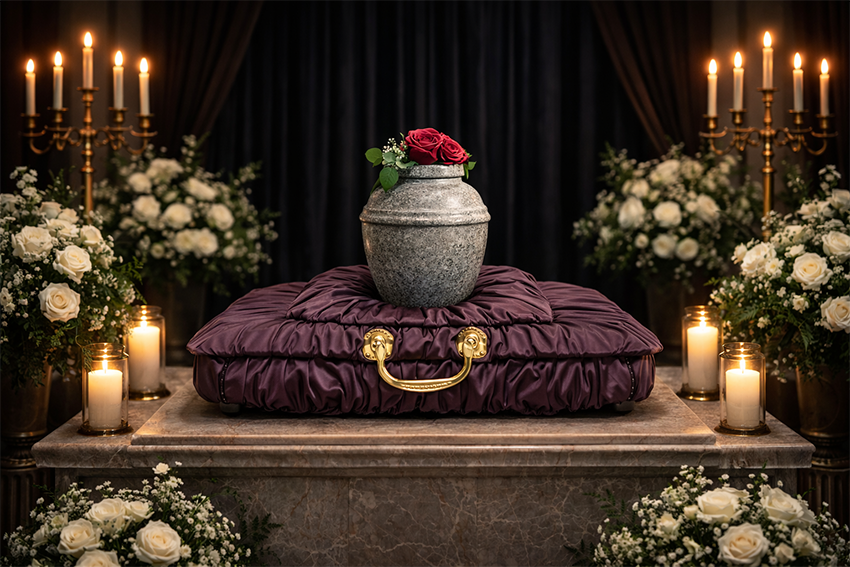
The central technical feature is a removable insert with a circular aperture in which the base of the urn is stabilised. This design ensures the urn remains centred and cannot shift accidentally during transport. Comfortable handles on either side allow for safe one- or two-person carrying. The compact base dimensions are 50 × 45 cm. The carrier is available to order with a production lead time of a few working days. A dedicated base can be purchased as an accompaniment, creating a coordinated presentation set for the service.
Urn carrier no. 2 – upholstered with arch system
The most fully specified upholstered model in the range is urn carrier no. 2, distinguished by its system of four arches with rubber bumpers. The arches surround the urn on four sides, forming a protective cage that prevents both scratching and displacement during transport.
The carrier has an adjustable span: one side opens to allow fitting to urns of different widths. The overall dimensions are 31 × 58 cm and fabric is available in multiple colours, as with model no. 1. Side handles provide comfortable carrying. This model is consistently praised by funeral home staff for its ease of use and reliability. Available to order with a short lead time.
Sets with bases – a complete presentation for urn services
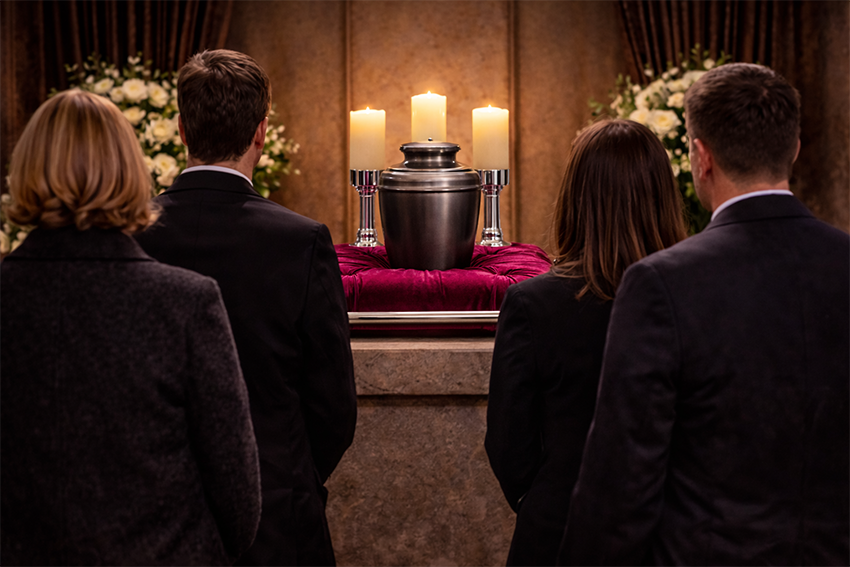
The carrier alone is one link in the ceremonial chain. For the urn to be presented during a memorial service or funeral with appropriate solemnity, a dedicated base is required – the element on which the carrier and urn are placed at the focal point of the chapel. Prima-Tech has developed several coordinated sets combining carrier and base to create coherent urn service presentation systems.
Set: Base + Urn carrier no. 1
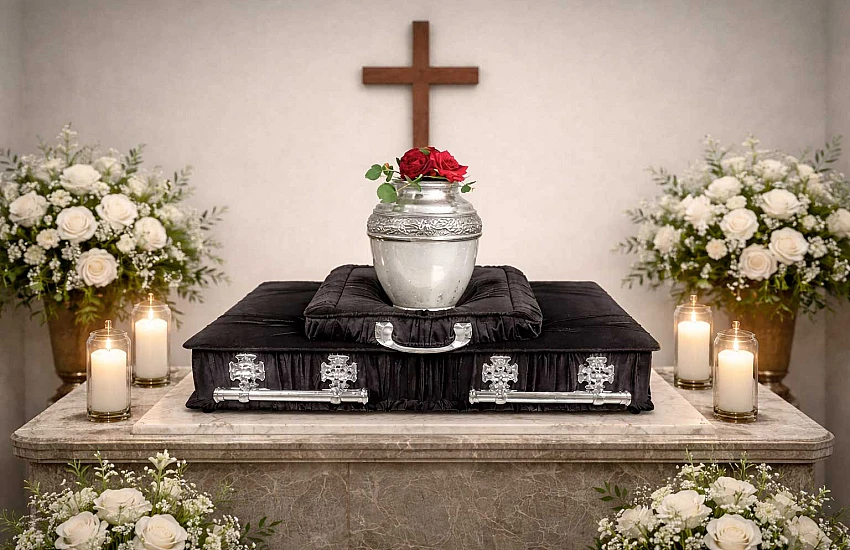
The most straightforward and elegant solution is the Set: Base + Urn carrier no. 1. The set pairs the upholstered carrier no. 1 with a colour- and dimension-matched base that provides stable, elevated presentation of the urn. Dark tones and velvet finishing give the set a classic, professional appearance suited to chapel, church, or funeral home settings. Available from stock.
Three base options for urn carrier no. 2
Three separate bases have been developed for use with urn carrier no. 2, each suited to a slightly different ceremonial atmosphere. The base for urn carrier no. 2 with candles enhances the drama of the service – directed lighting around the urn creates an atmosphere of focus and intimacy even in a large space. The base for urn carrier no. 2 without candles is the more austere choice, underscoring the gravity of the occasion through simplicity of form. The metal base for urn carrier no. 2 in a marble-effect finish combines the durability of steel with the elegance of a stone-like surface, working well in contemporary funeral home interiors. Each base can be purchased separately or as the complete urn carrier and candle base set, ensuring full visual coherence across the presentation.
Choosing the right urn carrier for the service type
Chapel and church services
Indoor services in chapels, churches, or funeral home reception rooms tend to have a consistent visual grammar: catafalque or dedicated base at the centre, surrounded by flowers and tributes. In this context, the aesthetic coherence of the carrier with the rest of the setting matters most. Classic dark fabrics in black, navy, or burgundy integrate naturally with traditional interiors, making the upholstered carriers no. 1 and no. 2 the most intuitive choices.
It is worth noting, though, that chapel lighting is often subdued or candle-based. In that atmosphere a mirror-finish metal carrier can be particularly striking – candlelight reflecting from polished steel creates a subtle, luminous quality around the urn without being theatrical. The matte black version, by contrast, recedes almost entirely into darker interiors, allowing the urn itself to command attention. In contemporary cremation chapels and modern funeral home spaces where steel, glass, and clean lines dominate, either metal model is a natural fit.
Graveside and outdoor services
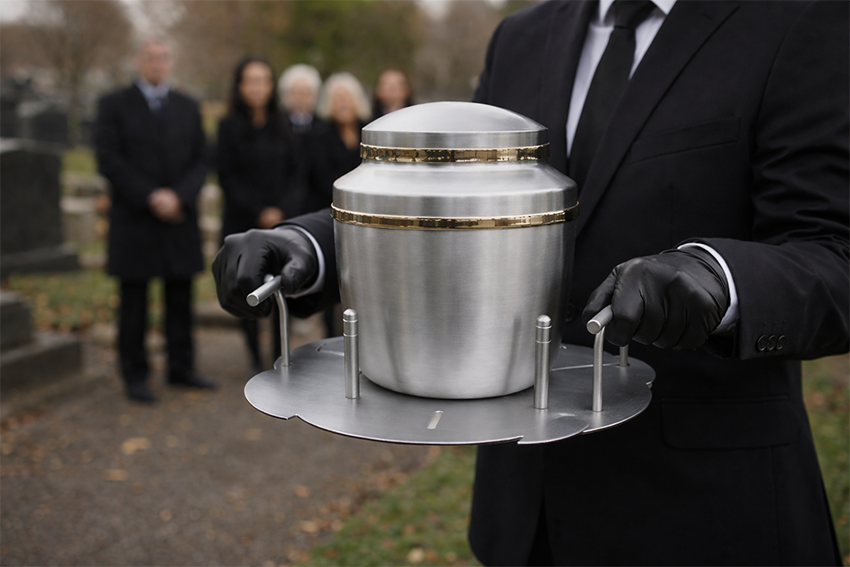
Carrying an urn outdoors introduces a different set of challenges: uneven ground, variable light, weather conditions, and the need to navigate cemetery paths that may be narrow, wet, or in poor repair. Under these conditions, what matters most is stability in the hands and confidence in the grip. The metal carriers – both mirror and black – were designed with exactly this use in mind: secure handling in any conditions, a compact footprint that does not impede movement.
Winter conditions present a particular challenge: icy paths, wet surfaces, and low temperatures that make ungloved handling of metal uncomfortable. The profiling of the handles – their shape, surface texture, and diameter – therefore has considerable practical significance. Well-designed handles maintain a secure grip even through thick gloves, a detail that proves its value repeatedly during the winter months when outdoor graveside services demand additional care from every member of staff.
Matching the carrier to your funeral home's visual identity
Funeral homes that take their visual identity seriously increasingly equip themselves with sets of accessories that coordinate in colour and style. The option to order carrier fabric in a chosen colour – available for both models no. 1 and no. 2 – allows the equipment to be aligned precisely with the chapel's colour palette, the drape on the trolley, or the overall interior scheme. Well-matched accessories create a visually coherent ceremony environment that communicates professionalism and attentiveness to the families in your care.
It is also worth thinking about urn carriers as part of a modular urn service system rather than as a standalone purchase. A funeral home that equips itself with carrier, base, and – where appropriate – a catafalque compatible with its scissor trolleys, has a coordinated set usable in multiple configurations: carrier alone for transport, carrier with base for chapel presentation. This modularity is one of Prima-Tech's key design principles and allows funeral homes to build out their urn service equipment gradually as cremation volumes increase.
Safe urn transport step by step – practical guidance
Before the service – equipment checks
Every service should be preceded by a brief technical check of the urn carrier. Verify that adjustable arches or rings move freely, that rubber protective elements are in place and show no signs of wear, and that the handles are clean and dry. Metal carriers should be wiped down with a soft dry cloth to remove any dust or fingerprints from previous use. Upholstered carriers require a quick visual inspection of the fabric – clean, unworn, and free of creasing.
Equally important is a fit check: the urn should be placed in the carrier before leaving the preparation room, not during the service. Adjusting arches or rings in advance, away from the family's line of sight, eliminates unnecessary anxiety and ensures the urn is properly secured. The moment when the urn is placed in the carrier for the first time without a prior fit check is one of the most common sources of small but distressing incidents during services. A brief rehearsal in the preparation room is good professional practice.
During the service – carrying the urn correctly
When carrying a loaded urn carrier, the essential rule is to use both hands with full support from beneath. The carrier should never be transported by a single handle or gripped from above with one hand, as both positions compromise balance and increase the risk of tilting. Walking pace should be measured and unhurried, without sudden movements or sharp changes of direction.
Particular care is needed when stepping onto or down from raised surfaces – for example, when placing the urn on an elevated catafalque or carrying it to a lectern. These are the moments of highest risk to stability. The staff member should have clear space to manoeuvre, and movement around them should pause momentarily. On stairs or uneven terrain, two-person carrying is advisable, with one person leading and the other providing balance support from behind. If the service involves handing the urn to a family member, a brief, calm explanation of the correct grip beforehand is always worthwhile.
Transport in the hearse and at the graveside
The urn carrier is designed for pedestrian transport, not motorised transit. In the hearse, the urn is secured separately – typically on a dedicated urn catafalque or in a purpose-built housing that prevents movement during the journey. The carrier is loaded into the vehicle alongside the urn and positioned to minimise the risk of shifting. Prima-Tech manufactures urn catafalques compatible with its scissor trolley range, creating an integrated system for transport and chapel presentation.
At the cemetery – after leaving the hearse and proceeding to the place of interment or scattering – the carrier returns to its primary role. Cemetery ground can be uneven, paths may be narrow or slick after rain. It is precisely in these conditions that the value of metal carriers with profiled handles becomes most apparent: reliable grip in difficult conditions, without the need to continuously adjust the urn's position mid-procession.
Cremation in context – industry trends and what they mean for equipment
The rise in cremation rates across the UK, the US, Australia, and Europe is not a short-term fluctuation – it reflects deep and lasting changes in how contemporary society approaches death, memorialisation, and the economics of funeral services. In the UK, where the cremation rate now exceeds 78 per cent, many funeral homes have been rethinking their facilities and equipment to reflect the reality that the urn, not the coffin, is now the more common ceremonial object.
For funeral professionals, this shift means that the urn carrier is no longer a marginal piece of specialist equipment. It has become a standard item of operational kit, in the same category as coffin trolleys, catafalques, or chapel tents. Funeral homes that invest in complete urn service equipment now will build a durable competitive and reputational advantage. Families who choose cremation are often more engaged with the aesthetic details of the service than those who have made the same choice by default – they tend to have opinions about how the urn is presented and carried, and they notice when those details are handled with care.
Health and safety considerations also apply. Handling heavy urns repeatedly, particularly in the course of a busy working day, places demands on staff that well-designed ergonomic equipment can meaningfully reduce. An urn carrier with properly profiled handles distributes load more evenly, reduces grip fatigue, and minimises the micro-adjustments that accumulate over the course of multiple services.
Why invest in a professional urn carrier
Choosing a professional urn carrier is a decision about the quality of service a funeral home provides to families at one of the most difficult moments of their lives. Improvised solutions – trays, cloths, boxes – may appear adequate at first glance, but they satisfy none of the criteria that actually matter: they do not protect the urn, they do not provide ergonomic support, and they do not belong in the visual language of a dignified service.
The urn carriers produced by Prima-Tech combine considered functionality with aesthetics appropriate to the gravity of the occasion. Rubber protection elements safeguard even delicate ceramic or polished urns. Adjustable mechanisms allow a single carrier to accommodate a range of urn sizes without the need for multiple units. Fabric colour selection enables coordination with the broader presentation of the service. Polish manufacture guarantees the ability to communicate directly with the producer and arrange custom specifications.
The long-term perspective is also relevant. A funeral home conducting several dozen cremation services per year will use a carrier hundreds of times over a few years. A product made from durable materials – stainless steel, powder-coated plate, or high-specification upholstery fabric – will maintain its appearance for many years with routine care. A funeral home equipped with a complete, coordinated set of urn service accessories gives families the confidence that every detail of the farewell has been given the attention it deserves. And that confidence is one of the most valuable things a funeral professional can offer.
FAQ – Frequently asked questions
Will the urn carrier fit any urn?
Most urn carriers available from funeraryaccessories.com include adjustment mechanisms that allow them to accommodate urns of different sizes. The mirror and black metal carriers both feature three adjustable arches that can be set to match the width of the urn. Urn carrier no. 2 has opening arches on one side, making it easy to fit around non-standard dimensions. Urn carrier no. 1, with its central insert, has a fixed aperture – for very large or very small urns it is worth confirming dimensions with the manufacturer, who can produce a custom solution if required.
What is the key difference between an upholstered and a metal urn carrier?
Upholstered carriers offer a soft, textile aesthetic associated with traditional funeral service. They are lighter and available in a wide colour palette, allowing precise matching to chapel décor or family preferences. Metal carriers – mirror and black – have a more contemporary character, are easier to clean between services, and are more resistant to the wear of heavy use over many years. The choice between the two groups depends primarily on the style of service, the funeral home's visual identity, and individual preference.
Can the carrier be purchased without a base?
Yes – all carriers available from funeraryaccessories.com can be purchased individually, without a dedicated base. Bases are sold as complementary products or in sets. A funeral home that already has a stand or catafalque of appropriate dimensions can limit its purchase to the carrier alone. It is worth noting, however, that coordinated sets – such as the Set: Base + Urn carrier no. 1, or the complete urn carrier and candle base set – provide a level of visual cohesion that is difficult to achieve by mixing components from different series.
How should an urn carrier be maintained to keep it looking its best?
Metal carriers – both mirror and black – should be wiped down with a soft, dry cloth after every service. Abrasive or acidic cleaning agents must be avoided, as they will scratch the mirror surface or damage the powder coating. Upholstered carriers benefit from regular fabric brushing and occasional treatment with a specialist velvet or ceremonial fabric cleaner. Rubber components – rings and bumpers – should be inspected periodically for signs of wear and replaced as needed by contacting the manufacturer directly.
Is it possible to order a carrier in a non-standard colour or size?
Yes – as the manufacturer, Prima-Tech S.C. offers the ability to produce urn carriers in custom dimensions or in fabric colours chosen by the client. Metal carriers can be finished in alternative colours on request. For upholstered models, a wide range of fabrics is available to choose from. Custom orders are processed following direct contact with the company's sales team, where lead times, specifications, and personalisation options can be discussed in full.

Summary
Safe urn transport during a funeral service is a question that brings together the practical and the symbolic. A well-chosen urn carrier protects the urn from damage, supports funeral home staff ergonomically, and lends the act of carrying the urn the composed, ceremonial quality it deserves. None of that is achievable without the right equipment – improvisation delivers neither the protection nor the aesthetic coherence that a professional service requires.
The continued growth of cremation across the English-speaking world means that urn carriers are no longer niche equipment for a small number of specialist operators. They are becoming standard kit, in the same category as coffin trolleys, chapel catafalques, and funeral tents. Funeral homes that invest in a complete, coordinated urn service setup now will be well positioned for the years ahead.
The range available at funeraryaccessories.com covers metal models – mirror and black – and upholstered models, with or without matching bases, all manufactured in Poland by Prima-Tech S.C. Adjustable securing systems, rubber protective components, and ergonomic handles together make up a product designed for demanding day-to-day professional use. A funeral home that equips itself with a complete, matched set of urn service accessories does more than protect the urns in its care – it gives bereaved families the assurance that the farewell to their loved one is being conducted with the attention and respect it deserves. And that assurance is the truest measure of professional excellence.