Table of Contents
- From a Repeated Rite to an Individual Farewell
- Secularisation and New Forms of Farewell
- Cremation - the Quiet Revolution of the Century
- Farewells Beneath the Open Sky
- Technology in the Service of Memory
- Ecology and Green Farewells
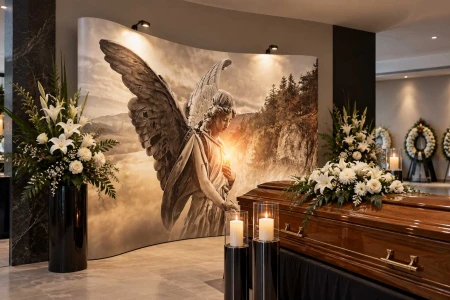
- Aesthetics and the Organisation of Ceremonial Space
- The New Role of the Funeral Home
- The Future of Funeral Ceremonies
- Frequently Asked Questions
Bidding farewell to the deceased is among the oldest and most universal of human rituals, and yet its form has never been as fluid as it is today. Only two generations ago, a funeral followed an almost unchanging script - the same order of events, the same gestures, the same setting repeated over decades. The first quarter of the 21st century, however, has brought a change deeper than any before it. The funeral ceremony has ceased to be merely an obligatory rite and has become a space in which families seek personal meaning, their own language, and an individual rhythm of farewell.
For funeral homes, this represents far more than a passing fashion. It is a lasting shift in expectations that is redefining the role of the entire funeral profession - from the way conversations with bereaved families are conducted to the equipment required to organise a dignified ceremony. Understanding these changes has become a condition of running a funeral business effectively and with empathy. Below we examine the most important directions in which the modern farewell is heading, along with the practical consequences of these shifts for the daily work of a funeral home.
From a Repeated Rite to an Individual Farewell
For most of the 20th century, the funeral was a collective ritual in the fullest sense of the word. Its shape was determined by the community - the parish, the neighbourhood, local tradition - while the family acted as a participant rather than a co-author. The pattern was clear and not open to negotiation, which in an era of lower mobility and stronger social ties offered a sense of security and belonging.
The turn of the century coincided with profound demographic and cultural change. Societies became more diverse in their worldviews, families smaller and more geographically dispersed, and the relationship between the individual and tradition far more selective. As a result, it was increasingly the relatives of the deceased who began to ask a question that had rarely been posed before: how do we wish to say goodbye. The funeral stopped being a script imposed from above and began to be designed - consciously, with care to reflect the personality, values, and life story of a particular person.
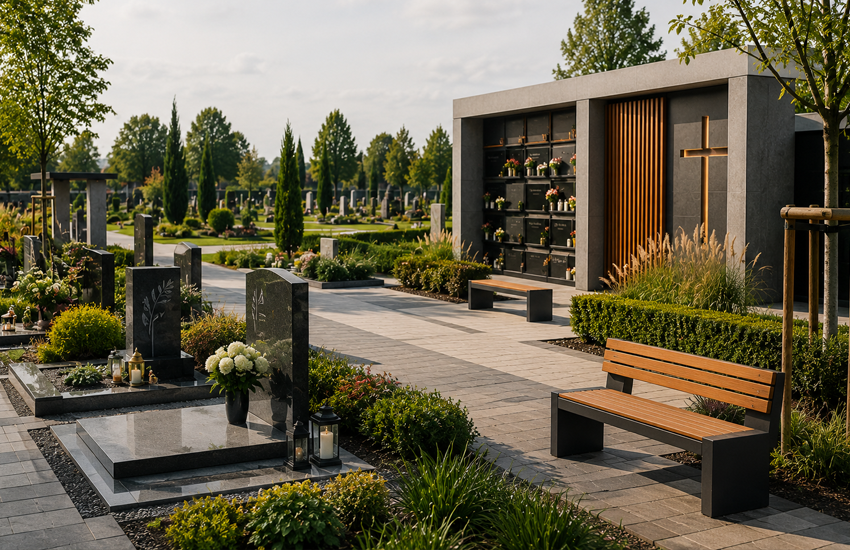
This change does not mean a rejection of tradition. Many families still choose a classic religious setting, yet even then they expect elements that will make the ceremony unique - the deceased's favourite music, a personal recollection read by a grandchild, a photograph accompanying the service. Personalisation has become the new norm, and funeral homes capable of handling it with sensitivity build an advantage that cannot be reduced to the price of the service alone.
Secularisation and New Forms of Farewell
One of the strongest drivers of change is advancing secularisation. A growing group of families - including in countries where religious tradition remains strong - chooses secular ceremonies or combines religious and secular elements in ways previously unseen. This is not merely a question of declared faith, but also of the rising number of multi-faith and multicultural families, and of those in which the deceased clearly stated their own preferences for the farewell before death.
Secular and Humanist Ceremonies
A secular funeral, led by a master of ceremonies or a humanist celebrant, focuses on the life of the deceased, their achievements and relationships, rather than on an eschatological perspective. This form demands greater flexibility from the organiser - the ceremony tends to be longer, includes tributes from loved ones, individually chosen music, and sometimes symbolic gestures such as the lighting of candles or the placing of mementoes. Within this arrangement, the funeral home becomes a partner in staging the ceremony rather than merely an executor of a fixed order of service.
Personalisation as Standard, Not an Extra
Personalisation has permeated every layer of the modern farewell. Families request colour schemes that echo the passions of the deceased, floral arrangements that depart from the classic palette, and presentations of photographs and recordings. Themed farewells appear - referencing a profession, an interest, or a beloved place - which not long ago might have seemed inappropriate but today are often received as the most authentic tribute. For a funeral home, this means the need to hold equipment versatile and tasteful enough to serve as a neutral, dignified backdrop for very different scenarios.
Cremation - the Quiet Revolution of the Century
No other factor has changed the logistics and aesthetics of the funeral as profoundly as the rising popularity of cremation. In many European countries it has become the dominant form, and its share continues to grow steadily, particularly in large urban areas. Cremation is not merely an alternative method of disposition - it is, above all, an entirely different rhythm and setting for the ceremony, requiring funeral homes to rethink their approach to space and equipment.
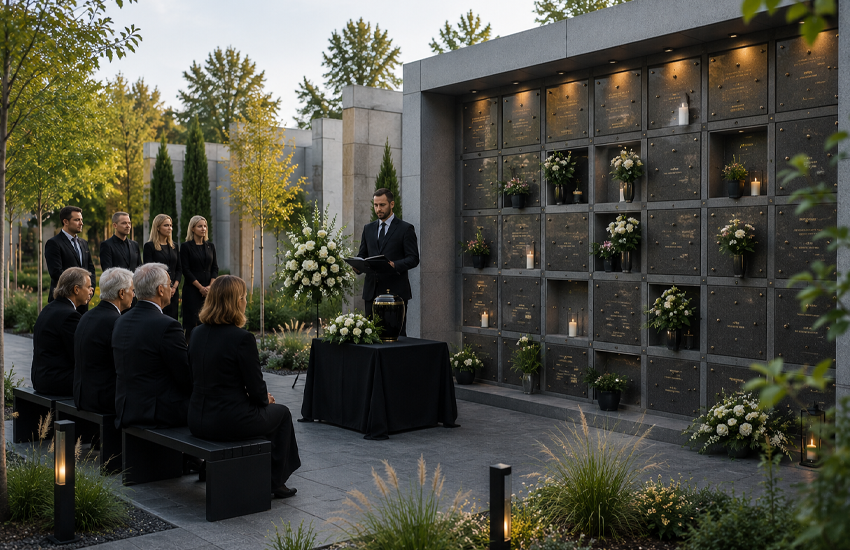
An urn ceremony follows different rules from a traditional coffin funeral. The urn is small, easy to transport and to present, and the farewell itself is often spread out in time - cremation may precede the actual ceremony by days or weeks, giving the family freedom in choosing the date and place. The scale of the setting changes too. Where an elaborate catafalque and a large space were once required, an intimate but carefully arranged area focused around the urn now suffices.
A Dignified Setting for the Urn Ceremony
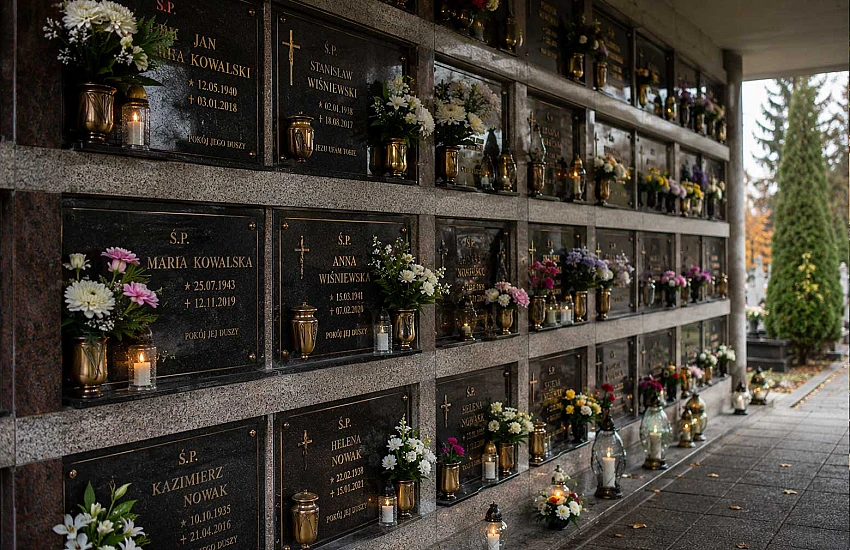
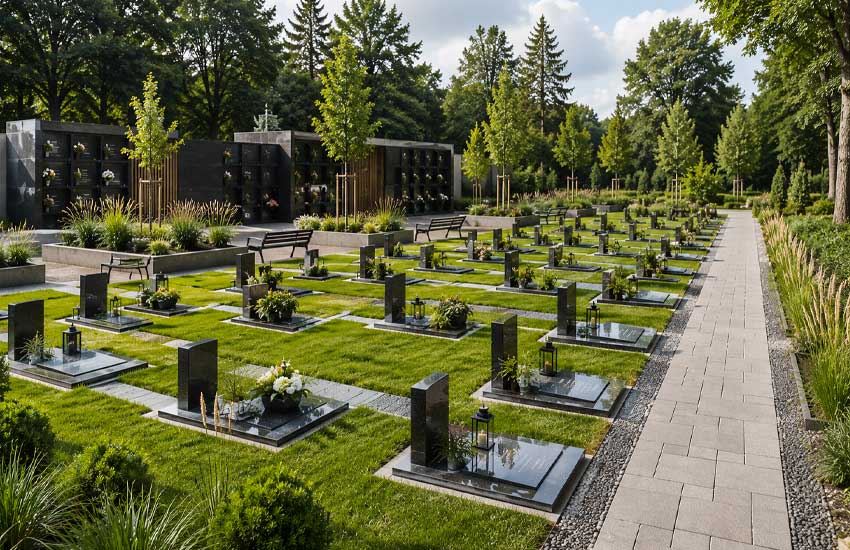
The intimate character of an urn farewell does not mean it can be treated as a simplified version. On the contrary - the smaller scale makes every detail more visible, and aesthetic expectations rise accordingly. Urn ceremonies are increasingly held outdoors, at the urn grave or in a specially designated part of the cemetery, which presents funeral homes with concrete challenges relating to the weather and the appearance of the surroundings.
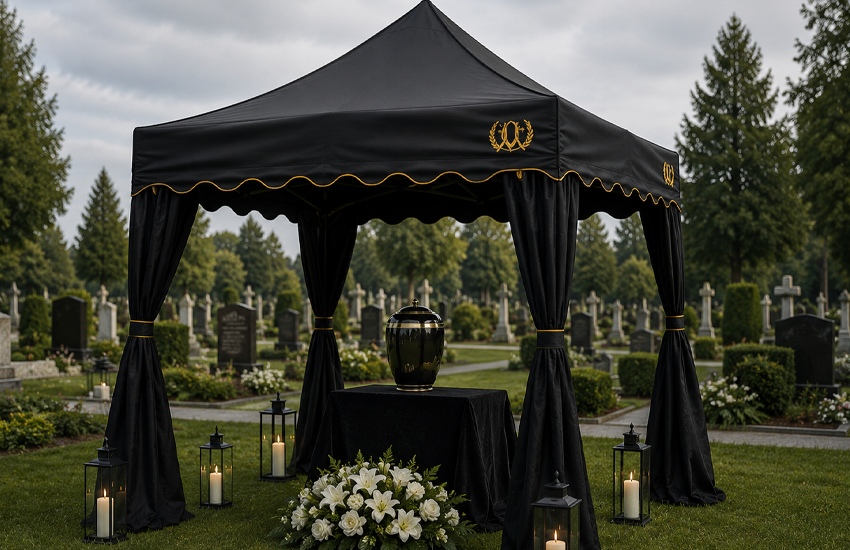
The answer to these needs is dedicated equipment designed with the scale of an urn farewell in mind. A compact, small-format funeral canopy provides a dignified and elegant shelter for the urn and the closest mourners, regardless of the weather, and can be set up in minutes at almost any point in the cemetery. Built on a hexagonal aluminium PRO profile, such structures remain stable in wind and rain while staying light enough for easy transport between locations. Waterproof roof fabric, an anchoring set, and the option of logo printing make them tools that combine practicality with care for the funeral home's image - exactly what today's smaller, more personal ceremonies require. You can explore the available sizes and configurations in our dedicated funeral tents range.
Farewells Beneath the Open Sky
The second clear trend of the 21st century is the move of ceremonies outdoors. Services held at cemeteries, in gardens of remembrance, and sometimes in places of particular significance to the deceased, respond to a desire for a farewell in a less formal setting, closer to nature and more personal. The weather then ceases to be a secondary detail and becomes a factor that can determine the course and dignity of the entire occasion.
A professional funeral home must be prepared equally for rain, heat, and wind, because no family should have to choose a farewell while fearing that the weather might disrupt it. Here a solid canopy structure plays a key role, protecting attendees while creating an elegant frame for the ceremony. The Funeral tent 3×3m was designed precisely with such requirements in mind. Its aluminium frame with a hexagonal profile offers resistance to loads and corrosion, while the 3×3 m footprint provides ample space for participants and essential equipment. At a weight of around 27 kg and a height of 320 cm, the tent remains easy to transport, and the complete set - with a protective cover, leg covers, an anchoring set, and a three-year warranty on the frame - means it is ready to work within the demanding daily rhythm of a funeral home.
The value of such a solution is not limited to protection from the elements. An aesthetic, colour-matched tent with the option of custom printing becomes part of a cohesive corporate image, visible at every open-air ceremony. At a time when families choose their funeral home ever more deliberately, this attention to the setting translates into trust and recommendations.
Technology in the Service of Memory
Digitalisation, which has transformed almost every area of life, has not spared the sphere of farewell. Technology entered the funeral ceremony not to dehumanise it, but to remove barriers - above all the barrier of distance, which in an age of global migration separates families across different continents.
Live Streaming and Hybrid Funerals
Live streaming of a ceremony, until recently regarded as an emergency measure, has become a permanent part of many funeral homes' offerings. It allows those who cannot attend in person - because of distance, ill health, or other commitments - to take part in the farewell. The hybrid funeral, combining physical presence with remote participation, requires new technical skills from the funeral home and a discreet but well-considered organisation of space, so that recording equipment does not disturb the solemnity of the moment while still enabling a dignified broadcast.
Digital Places of Remembrance
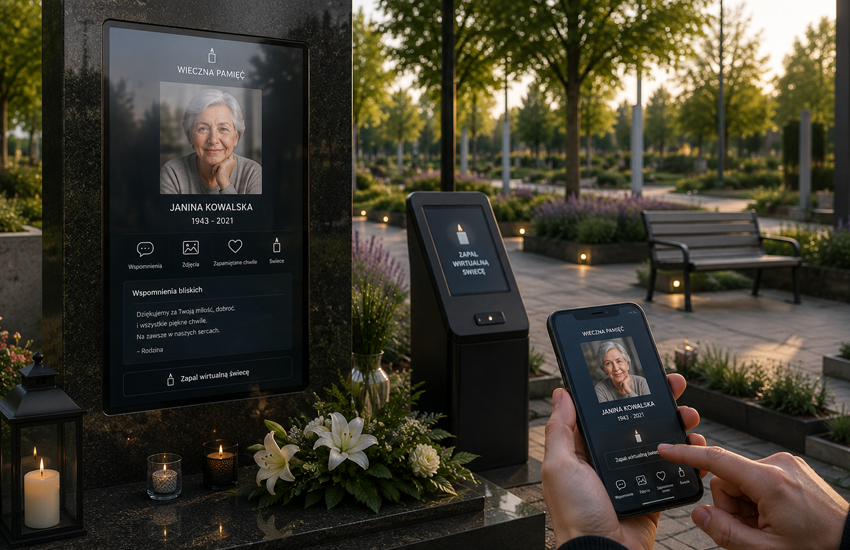
Beyond the ceremony itself, technology is permanently changing the way we preserve the memory of the deceased. Online books of condolence, virtual memorial spaces, QR codes placed on headstones and linking to biographies or photo galleries - all of this creates a new, digital layer of mourning and commemoration. For a funeral home, this means the chance to expand its offering with services that did not exist a decade ago and that are now increasingly expected by younger generations of families.
Ecology and Green Farewells
Growing environmental awareness has also been reflected in the way we think about death and burial. The green funeral - with its emphasis on biodegradable urns, natural materials, a reduced environmental footprint, and burials in natural settings - has ceased to be a niche and is gradually entering the mainstream. Some families treat care for the environment as a natural extension of the values their loved one lived by, and expect the funeral home to propose solutions consistent with that philosophy.
This trend also reaches into expectations of equipment and the organisation of ceremonies. Durable, reusable equipment - structures made of corrosion-resistant materials that serve for many years - fits the logic of responsible resource management better than single-use alternatives. A funeral home that can speak the language of environmental values and back it with concrete practices responds to a real and growing market need.
Aesthetics and the Organisation of Ceremonial Space
The rising importance of an individual farewell, often recorded and broadcast, has given the organisation of ceremonial space a significance it did not previously hold. Order, a clear division of zones, and discreet management of attendee movement have stopped being a matter of convenience and have become an element of the ceremony's dignity and the funeral home's image. Wherever a larger group of mourners gathers, where technical staff work and recording equipment appears, a lack of organisation quickly translates into chaos that strips the moment of its solemnity.
The answer to this need lies in elegant, mobile solutions for marking out space. The Retractable belt barrier in gold with a black belt makes it simple and elegant to separate areas reserved for the immediate family, to mark walkways, or to secure technical zones. Made of stainless steel with a stable, weighted base, it combines stability with a restrained, formal appearance that harmonises with the character of a funeral ceremony. It works equally well in a chapel and farewell hall as at the cemetery, while its compact dimensions ease transport between locations - a consideration for funeral homes serving many different venues.
A seemingly minor piece of equipment such as a barrier post in practice determines whether a ceremony runs smoothly and with due gravity. It is precisely the sum of such details - the tent, the setting for the urn, the orderly space - that builds the impression of professionalism families remember for years.
The New Role of the Funeral Home
All the changes described above add up to a fundamental shift in the role played by the modern funeral home. From an executor of a fixed, repeated script, it becomes an adviser, organiser, and partner to the family in designing a unique farewell. This requires not only equipment and facilities, but above all soft skills - the ability to listen, to read a situation, and to hold a conversation at one of the most difficult moments in human life.
Professionalism today is expressed in the readiness to realise very different visions - from a classic religious ceremony to a secular, intimate urn farewell held outdoors with a live stream for a dispersed family. A funeral home equipped with versatile, aesthetic, and reliable equipment can approach each of these scenarios with composure and confidence that the setting will not let it down. It is precisely this readiness, rather than the catalogue of services itself, that has become the most valuable asset of a funeral business.
It is also worth noting that changing family expectations translate into the way they choose a provider. The decision is ever less often made solely on the basis of tradition or proximity, and ever more often on reputation, approach to the client, and visible care for the quality of the setting. In this context, investment in equipment is not merely an operating cost but an element of brand-building that returns in the form of trust and referrals.
The Future of Funeral Ceremonies
The direction of change appears lasting, and the coming years will most likely deepen the tendencies already observed today. Personalisation, a greater role for family choice, the further rise of cremation and open-air farewells, and an ever-deeper integration of digital tools will probably define the funeral ceremony in the decade ahead as well. In parallel, environmental sensitivity will grow, alongside the expectation of a cohesive, aesthetic experience from the first contact with the funeral home right through to the ceremony itself.
For the funeral profession, this means a need for constant adaptation - not by abandoning tradition, but by skilfully combining it with new needs. Funeral homes that treat these changes as an opportunity rather than a threat, and that invest in both the skills of their teams and the quality of their equipment, will be better prepared to serve families in the way they now expect. The evolution of funeral ceremonies in the 21st century is, ultimately, a story about one thing - an ever-deeper respect for the uniqueness of every human life, and a farewell capable of expressing that respect.
Frequently Asked Questions
Why have funeral ceremonies changed so much in the 21st century?
Several parallel factors are responsible - secularisation, demographic change, greater family mobility, and a growing desire to express the memory of the deceased in an individual way. The farewell has ceased to be merely a repeated rite and has become a space that families consciously shape so that it reflects the personality and values of a particular person.
How does an urn ceremony differ from a traditional coffin funeral?
An urn ceremony usually has a more intimate character and a different rhythm - cremation may precede the actual farewell by days or weeks, giving the family freedom in choosing the date and place. The smaller scale of the occasion, however, makes every detail of the setting more visible, which is why it is worth investing in aesthetic, appropriately scaled equipment such as a compact funeral canopy.
How should an open-air funeral ceremony be prepared?
The key lies in protection against the weather and in creating an aesthetic, orderly space. A solid funeral tent shields attendees from rain, wind, and sun while forming a dignified frame for the occasion. It is also worth planning the division of zones and walkways in advance, using barrier posts for example, so that the ceremony proceeds smoothly.
Are live-streamed funerals a lasting trend?
Every indication suggests they are. Streaming and hybrid funerals meet a genuine need among geographically dispersed families and people who, because of health or distance, cannot attend in person. More and more funeral homes are including such services in their standard offering, treating them as part of a modern, empathetic approach to mourning.
What is a green funeral?
A green funeral is a form of farewell that reduces environmental impact - through biodegradable urns, natural materials, and burials in natural settings. The trend also extends to expectations of equipment, which should be durable and reusable, in keeping with the logic of responsible resource management.
How has the role of the funeral home changed?
The modern funeral home has moved from being an executor of a fixed script to an adviser and partner to the family in designing an individual farewell. This calls for both soft skills - sensitivity and the ability to listen - and versatile, reliable equipment that makes it possible to meet very different visions for a ceremony.
What equipment is worth having to meet new family expectations?
The foundation is versatile, aesthetic, and durable equipment suited to a range of scenarios - from intimate urn farewells to open-air ceremonies. A compact funeral canopy, a larger funeral tent, and elegant barrier posts for organising space together form a set that allows a funeral home to conduct almost any contemporary ceremony with confidence and dignity.