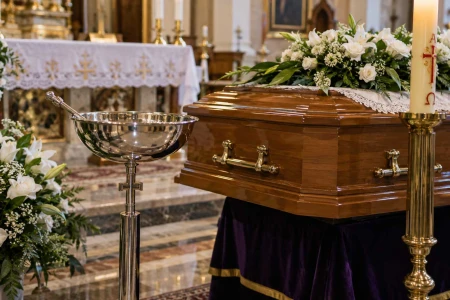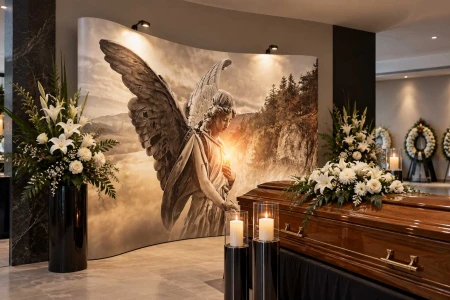
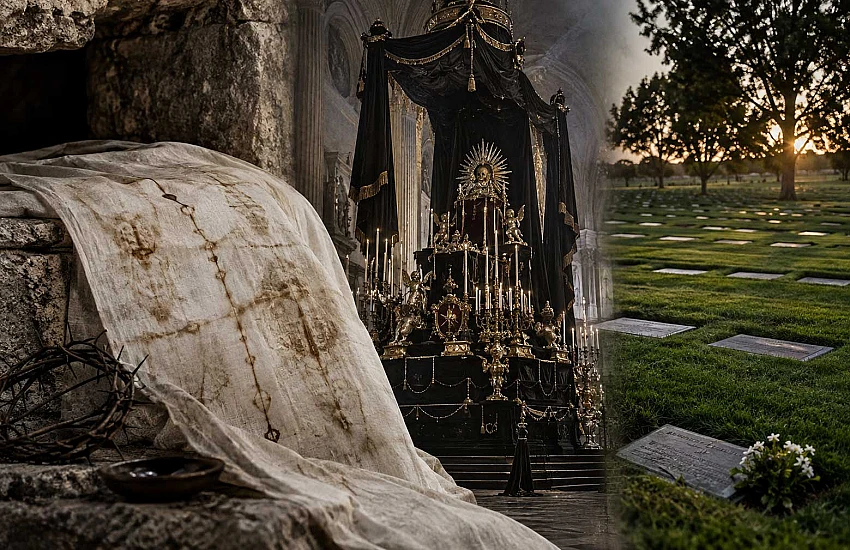
Table of Contents
- The Open Grave in the Cultural Imagination
- The Veil in the European and Victorian Tradition
- The American Revolution in Cemetery Design
- The American Grave in European Cemeteries
- The Cover Plate – Anatomy of an Object
- The Drape That Completes the Form
- The Detail as a Professional Language
- Curiosities from the Border of Culture and Craft
- Frequently Asked Questions
- In Closing
There are things at a funeral that everyone sees and no one mentions, and things that no one sees and everyone feels. The open grave belongs firmly to the second category. A rectangle of darkness, freshly turned clay in a colour we never encounter in ordinary life, the raw edge of an excavation – this is the most literal image of death that any mourner is likely to witness. And it is precisely for that reason that cultures across the world have spent thousands of years working out how to soften it, frame it, cover it and make it bearable. Not conceal it in the sense of pretending, but veil it in the sense in which sacred things are veiled: not because they are shameful, but because they are too bare to be looked at directly.
This article follows a single gesture through history – the gesture of covering. It begins with the archaic idea of the grave pit as a threshold between worlds, moves through the extraordinary textile culture of European and Victorian mourning, crosses the Atlantic into the rural cemetery and memorial park movements that reshaped what a burial ground was allowed to look like, and arrives at an object that today sits on lawn sections in cemeteries across Europe: the cover plate for American grave and the fitted drape that completes it. It is a story in which a piece of powder-coated steel turns out to be the descendant of a very old idea.
The Open Grave in the Cultural Imagination
A pit, a threshold, a boundary
Across most European traditions, the grave cut was never treated as a simple hole in the ground. It was a threshold. Anthropologists describing rites of passage have long observed that a funeral has the same structure as an initiation or a wedding: there is separation from the community of the living, there is a liminal phase, and there is incorporation into a new order. The open grave is the purest spatial expression of that middle stage. The deceased has left the living but has not yet been received by the earth. Everything that happens above the cut – the prayers, the eulogy, the music, the handful of soil – takes place in suspended time.
Liminal phases are considered dangerous in every culture, which is why they attract such elaborate protective machinery: the wake, the covering of mirrors, the stopping of clocks, carrying the coffin feet first, the ritual closing of the house door. The open grave falls under the same logic. British and Irish folklore collected in the nineteenth century warned against leaving a grave open overnight, against allowing an animal near it, against letting a child look into it. None of this was about hygiene. It was about the conviction that an opening works in both directions.
Earth as both mother and dread
In agricultural societies, earth carries a fundamentally double meaning. It is the mother, the provider, the source of harvest – and it is the thing that swallows. English preserves both layers in its idioms: we speak of hallowed ground, and we speak of the ground opening up beneath us. Casting a handful of soil onto the coffin is an act of tenderness and an act of final separation performed in one movement. That doubleness gives freshly excavated earth an emotional charge at a funeral entirely out of proportion to its physical presence.
Every experienced funeral director will confirm a detail worth stating plainly: mourners who have held their composure through the whole service very often break at the moment they see the spoil heap and hear soil strike the lid. This is not a matter of taste or decoration. It is a matter of sensory literalness that no other element of the ceremony achieves. The entire later history of graveside equipment – mats, surrounds, frames, covers and fabrics – is in essence a history of attempts to soften that single second.
Why covering is not concealment
It is tempting to read the covering of graves as evidence of a culture in flight from death, a culture that would rather pretend nothing has happened. The history of the rite says otherwise. The most unflinchingly mortal funeral cultures Europe has produced – the Spanish penitential brotherhoods, the Neapolitan confraternities, the great heraldic funerals of Tudor and Stuart England – used cloth and drapery in quantities far beyond anything we would contemplate today. The veil does not abolish death. It formalises it. It provides a frame within which death can be borne, and borne together.
Covering therefore functions as a ritual bracket. It separates what belongs to the technical order – the cut, the spoil, the frame, the sexton's tools – from what belongs to the ceremonial order. While the bracket holds, the mourner sees a ceremony. When the bracket fails and a raw structural element shows through the fabric, the mourner suddenly sees a construction site. That distinction is the whole craft of funeral service, and it explains why an apparently minor accessory can decide how an entire ceremony is remembered.
The Veil in the European and Victorian Tradition
Shroud, pall, cloth – the family of mourning textiles
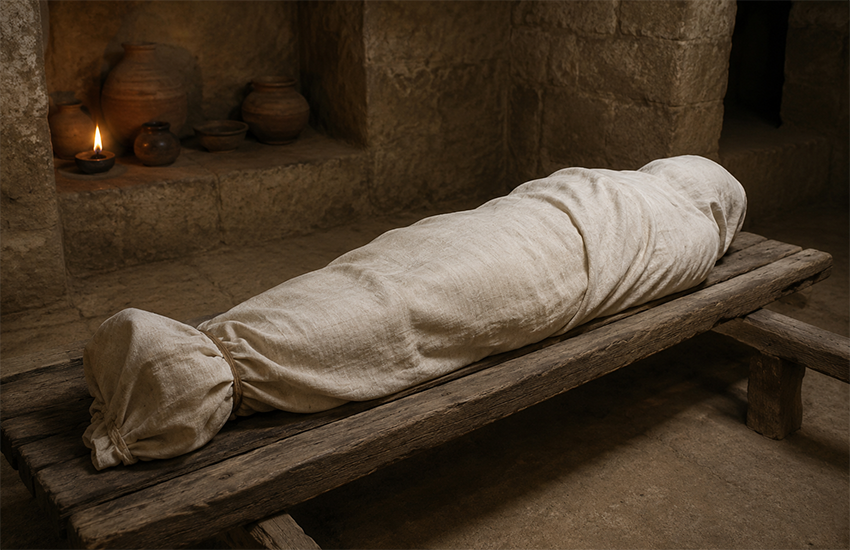
Cloth has accompanied the dead for longer than the coffin has. Before burial in a wooden box became standard, bodies were wrapped in linen, and that wrapping was the only thing separating the deceased from the soil. In England the practice was even legislated: the Burial in Woollen Acts of the seventeenth century required the dead to be buried in wool, and parish registers were obliged to record affidavits confirming it. Textile was not incidental to the funeral. It was the funeral's primary material.
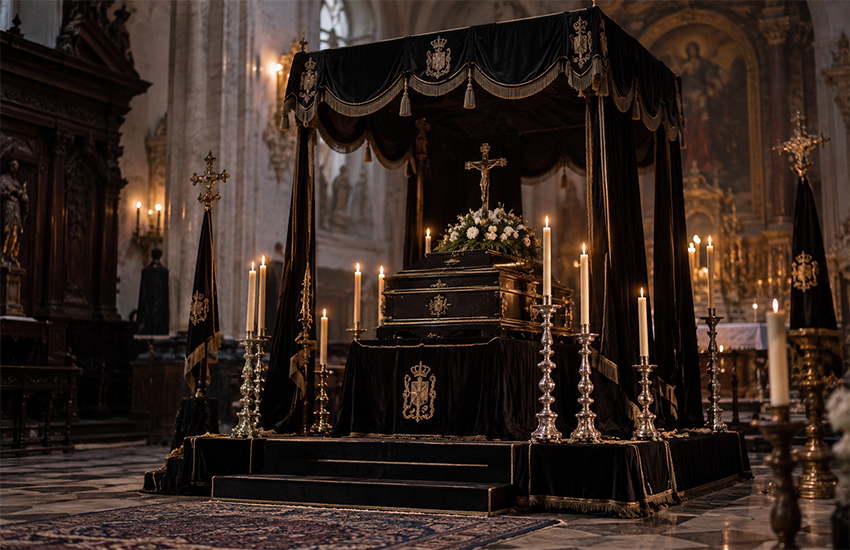
From the shroud descends an entire family of funerary textiles: the coffin lining, the pall laid over the coffin, the black cloth hung in the church, the mourning hatchment displayed on the front of the house, and eventually the fitted drape. The common denominator never changes – fabric marks the boundary between sacred space and ordinary space. For a heraldic funeral, an English parish church might be hung in black baize from the chancel arch to the porch. The building did not change; the cloth changed what it meant.
The Victorian high point
Nineteenth-century Britain took this logic to a scale that is difficult to imagine now. Mourning was a fully articulated visual system with its own materials, its own suppliers and its own rules. Crape – a crimped, matt silk that deliberately refused to shine – became the defining fabric of bereavement, produced on an industrial scale at Courtaulds. The undertaker's trade supplied palls, hangings, plumes, mutes and mourning coaches. The house of the deceased was marked from the street by drawn blinds and a black door knocker.
What matters here is not the ostentation but the underlying principle, which survived the Victorian excess and remains in force today. The Victorians understood something that the modern industry rediscovers constantly: mourners cannot process an abstraction. They need the loss to be given a visible form. Cloth was the medium through which that form was delivered, because cloth can be draped over anything – a coffin, a carriage, a church pew, a frame at the graveside – and instantly transfer it from the practical world to the ceremonial one.
The graveside cloth
By the later nineteenth century, British and American undertakers were routinely equipping the graveside itself. Parish and trade inventories of the period list palls, graveside carpets, kneelers for the family, and cloth described simply as covering for the grave – laid over the edges of the cut so that soil would not spill onto the coffin and, just as importantly, so that mourners would not stare into raw clay. Here we have the direct ancestor of the contemporary solution. The materials have changed and the structure has changed, but the function has not moved an inch: between the mourner's eye and the excavation there must be something that belongs to the ceremony rather than to the earthworks.
The American Revolution in Cemetery Design
From churchyard to rural cemetery
The story that leads to the object known today as an American grave cover begins in the United States in the first half of the nineteenth century. American cities were struggling with overcrowded churchyards and looking for a new model. The answer was the rural cemetery movement, launched with the founding of Mount Auburn near Boston in 1831 – an expansive landscaped ground with ponds, carriage drives and mature planting, in which graves were absorbed into scenery. Green-Wood in Brooklyn followed in 1838, Laurel Hill in Philadelphia the same decade, and in Britain the garden cemeteries of Kensal Green and Highgate answered the same problem in the same idiom. The cemetery ceased to be a place people avoided and became a place they visited on Sundays.
The next step was more radical still. Towards the end of the nineteenth century the lawn cemetery emerged, in which upright monuments were abandoned in favour of markers set flush with the turf. The original motive was practical – uninterrupted mowing and simpler grounds maintenance – but the consequence was cultural. The cemetery began to look like a park rather than a forest of stone. Carried to its logical extreme in the Californian memorial parks of the early twentieth century, most famously Forest Lawn in Glendale under Hubert Eaton, this aesthetic produced an entirely new set of demands on the graveside ceremony.
When the landscape must remain unbroken
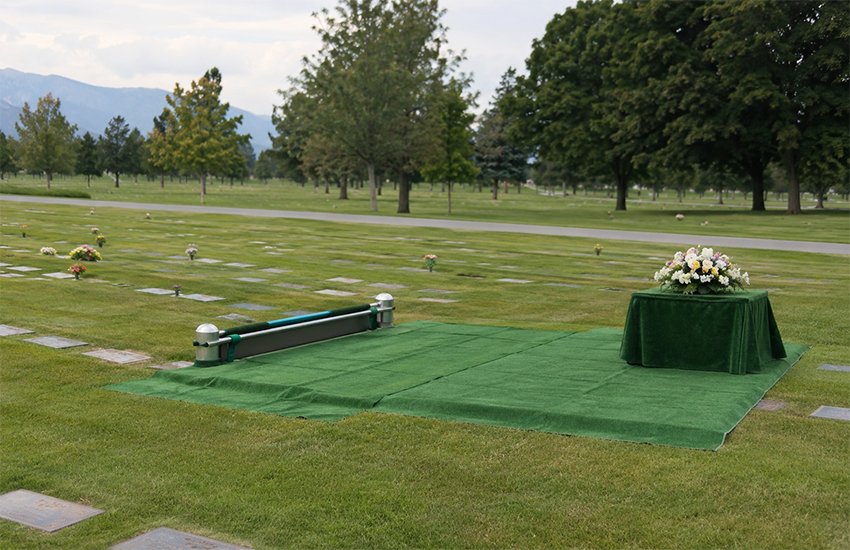
On a lawn section, the open grave is a wound in a perfectly level surface. It cannot be disguised with planting, kerbs or a surround, because the regulations governing such sections almost always prohibit permanent additions around the marker. At the same time, the entire philosophy of the layout depends on the impression of continuous green. A new requirement therefore appeared, one that earlier cemetery models had never generated: complete, temporary covering of the burial site for the duration of the ceremony, leaving no trace afterwards.
The American funeral trade answered with an elaborate kit developed across the twentieth century – artificial turf mats laid over the spoil heap, frames edging the cut, mechanical lowering devices, folding canopies, and drapes and skirting to conceal the structure. The purpose of the whole assembly was singular: the mourner should see neither a clod of excavated soil nor any working component. What remained visible was to be the casket or urn, the flowers, and cloth.
An aesthetic of continuity
It is worth noting that the American model invented nothing fundamentally new. It simply carried to its conclusion a principle Europe had been pursuing for centuries with baize and drapery. The difference lies in the shift of emphasis from church to graveside, and from permanent construction to demountable equipment. A Tudor heraldic funeral required weeks of preparation by joiners and painters. Modern graveside equipment is assembled in minutes and struck just as fast, because the ceremony is now shorter and a funeral home may conduct several in a single day.
That change of tempo is one of the most significant and least discussed developments in funerary culture of the last century. The rite has not lost its structure, but it has compressed. What once unfolded over days must now fit into an hour. This is why objects such as a demountable grave cover acquired an importance they could never have held before – they became carriers of form under conditions in which there is no longer time to build form.
The American Grave in European Cemeteries
Where the name comes from
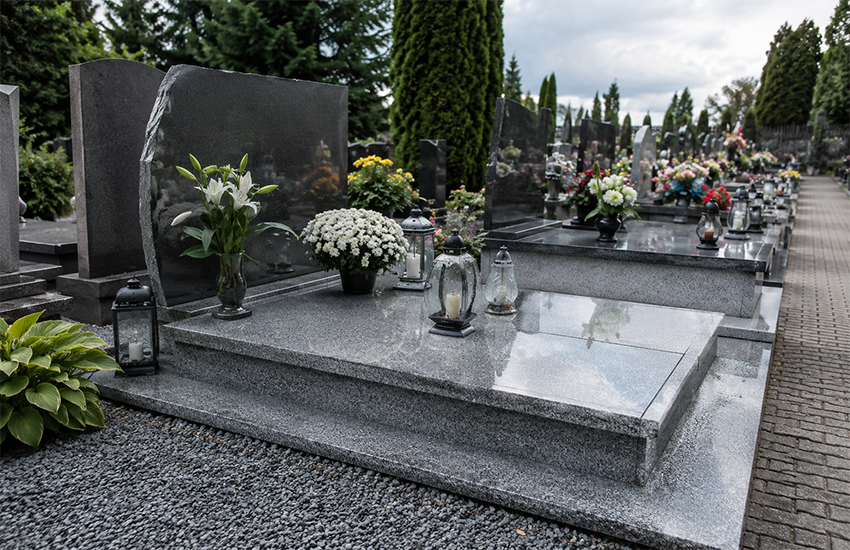
Across continental Europe the term American grave circulates as trade shorthand and is a frequent source of confusion. It does not denote a grave built to any American legal specification. It describes a burial plot laid out in the style associated with North American lawn cemeteries: open turf, a marker set flush or low, no kerbs, no benches, no surrounds and no elaborate planting. Sections of this kind arrived comparatively late in many European municipal cemeteries and gained ground quickly, particularly for cremated remains.
The name stuck because the traditional European cemetery looks nothing like this. It is dense, vertical, highly individualised, filled with granite surrounds, benches, lamps and planting. A lawn section stands out sharply against that background and reads, to a European eye, as imported. It is a nice irony that in Britain and Australia the identical arrangement is usually called simply a lawn grave, with no reference to America at all – a reminder of how strongly a name reflects the route by which a practice reached a given market rather than the practice itself.
Cremation and a new scale of ceremony
The spread of lawn sections coincided with the rise of cremation and urn burial, and the coincidence is not accidental. An urn grave has different dimensions from a full burial, fits a smaller module, and sits far more comfortably within the repeating, orderly grid of a lawn section. The scale of the graveside ceremony changed with it: a smaller cut, a smaller object committed to the earth, and a different choreography of mourners gathered more tightly around the site.
That tighter choreography has a consequence worth stating directly. At a full-size grave, mourners stand at a certain remove from the edge, a distance dictated by the size of the coffin and the working space required by cemetery staff. At an urn grave they stand much closer and look for much longer. Every detail is within arm's reach of the eye – the edge of the cut, the texture of the soil, the way the fabric falls. Expectations of the graveside setting rose, in other words, at precisely the moment the graveside itself became smaller.
The Cover Plate – Anatomy of an Object
Structure and geometry
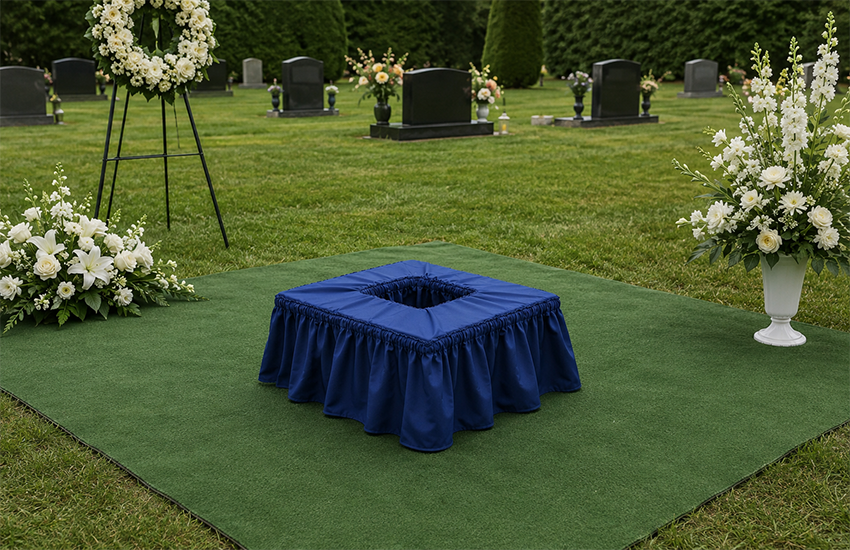
The answer to that requirement is an apparently simple object. The cover plate for an American grave is built around a steel frame that forms a regular geometric volume over the burial site, measuring 80 x 80 x 40 centimetres. Those three figures are not arbitrary – they correspond to the most common urn grave modules found on lawn sections, so that the cover encloses the cut together with its immediate surroundings and produces a single, ordered form.
The purpose of that geometry is at once practical and visual. A rectangular volume with clearly drawn edges organises the space around the burial site and establishes a boundary that mourners instinctively do not cross. What emerges is something close to a miniature catafalque standing directly on the turf – a surface on which the urn, flowers, a photograph or a candle can be placed, and around which a circle of mourners naturally composes itself. It is the same mechanism that church structures performed for centuries, transferred outdoors and reduced to a form that can be assembled in minutes.
Steel, powder coating and outdoor service
The choice of material follows directly from the conditions in which the object works. A committal takes place in the open air year-round, in rain, frost, wind and on softened ground. A steel frame provides the rigidity and stability required when the surface underfoot is uneven or waterlogged – a routine situation on lawn sections, which by design have no hard standing next to the graves themselves.
Powder coating serves a far more serious function here than mere finish. A powder-applied coating is substantially more resistant to mechanical damage and corrosion than conventional wet paint, and that translates directly into how the object looks after several hundred ceremonies. Equipment used in the field is dragged past grave edges, loaded into vehicles, rested against stone. A frame that starts showing rust after two seasons has left the ceremonial order and rejoined the technical one – and that is exactly the line that must never be crossed.
Assembly as part of the choreography
In day-to-day practice, setting up and striking equipment is part of the staging of the day. The cover is placed before the cortège arrives, so that mourners find the site already prepared rather than watching it being prepared. Simplicity of construction carries a value here that no specification sheet records: the fewer operations assembly requires, the less of the staff's attention is absorbed by equipment and the more remains available for the family.
Experienced funeral conductors point to a second consideration – predictability. Equipment that behaves identically every time allows a repeatable order of service to be built around it. Improvisation at the graveside is always visible, even when it concerns a trifle. A stable, familiar structure is in that sense an instrument of calm: the team knows how long it takes to set up and exactly how it will look, and that knowledge flows into the composure of the whole ceremony.
Non-standard sizes
European cemeteries are not uniform. Lawn sections laid out in different decades and by different authorities use different modules, and many funeral homes serve municipal, parochial and private grounds with divergent regulations simultaneously. The option of having both the cover and its fitted drape produced in non-standard dimensions, agreed individually, therefore matters a great deal. For a firm serving a particular cemetery with an unusual module, it means the ceremony no longer has to be adapted to the equipment – the equipment can be adapted to the ceremony.
The Drape That Completes the Form
Why the frame alone is not enough
A cover plate without its drape is exactly what it appears to be: a steel frame. Only fabric turns it into an element of the rite. That distinction carries the thousand-year history described above – structure belongs to the technical order, cloth to the ceremonial one. The curtaine for American grave is the component that closes the form, concealing the frame, evening out the volume and creating a single soft surface on which the urn and flowers can rest.
The pairing of these two products is an excellent illustration of how the whole trade works. Almost no item of funeral equipment functions on its own. A trolley needs its cover, a catafalque its cloth, a frame its drape. Hard skeleton and soft skin is a pattern that repeats at every level of this craft – and one that ultimately reproduces the oldest funerary arrangement we know: body and shroud.
Fabric that has to survive a cemetery
Ceremonial textiles work in conditions their appearance gives no hint of. A graveside drape is brushed against soil and stone, meets damp, wind, candle wax and pollen. It is folded in haste and carried in a vehicle between two services on the same day. Three material properties therefore decide everything: durability, stain resistance and resistance to creasing.
The last of these deserves a sentence of its own, because it is routinely underestimated. A drape that requires no ironing solves a problem that is entirely real in daily practice – fabric taken out of storage has to look immaculate immediately, with no preparation stage, no board and no iron in the back of the chapel. A crease on graveside cloth is visible from every angle and instantly undoes the impression of careful preparation. A material that returns to shape by itself is therefore not a convenience but a condition of repeatable quality.
Manufacture matters too. These drapes are produced in-house by Prima-Tech, which allows control over material selection and finishing, and reinforcement in artificial leather at the points most exposed to abrasion extends the working life of the fabric precisely where it wears fastest. It is a workshop detail, but in practice it determines how many seasons a drape remains fit to appear at a ceremony.
Fitting and colour
Fitting the drape is simple to describe and demanding to execute: the fabric is drawn over the assembled frame so that it lies evenly and the edges of the volume stay legible. A well-fitted drape neither sags nor ripples – it emphasises the geometry of the structure rather than blurring it. Dimensional agreement between fabric and frame is a precondition, which is exactly why the cover and its drape are designed as a set rather than as two independent products that happen to fit.
Drapes are available in a range of colours, and bespoke colourways and decorative details such as fringing can be produced to order. For a funeral home maintaining a consistent visual identity – matching trolley covers, catafalque cloths, canopies and graveside drapes – this is a practical instrument for building a recognisable house style. Maintenance is undemanding: in most cases wiping with a damp cloth is sufficient, with no laundering and no pressing.
The Detail as a Professional Language
What mourners notice without being able to name it
Families leaving a cemetery rarely comment on equipment. They say the funeral was dignified, or that something was not quite right without being able to identify what. That inability to name is highly instructive, because it reveals what the work of a funeral director actually consists of. The components of the setting operate below the threshold of conscious attention. Nobody appraises a grave cover or a drape – they receive the whole as ordered or disordered, prepared or improvised.
This is why funeral service is a profession of detail. There are no secondary elements, because any detail that falls out of the pattern immediately becomes the protagonist of the memory. Crooked fabric, a protruding section of frame, a visible spoil heap – these are the things a family will remember for years without ever articulating them. The reverse holds just as firmly: when everything is in place, the ceremony is remembered as calm, and that calm is credited to people rather than to objects.
Where the cover sits in a firm's equipment
Within a set of ceremonial equipment, the cover and its drape occupy a particular position, because they serve the final and most emotionally exposed part of the service. The chapel, the cortège, the eulogy all happen earlier. The grave is the end of the road and its image is the one that stays. A firm that has invested attention in the earlier stages and left the finale without a setting forfeits a substantial part of the effect of its own work.
The object also belongs to a broader shift in the European market, in which urn burial has ceased to be regarded as a simplified option and has become a full ceremonial form with its own repertoire of objects and gestures. Appropriate equipment is the condition of that shift. Without it, an urn committal on a lawn section genuinely does look plainer than a traditional burial – not because it means less, but because it lacks the instruments with which form is built.
Curiosities from the Border of Culture and Craft
In many English parishes it was the sexton's recognised duty to board over or otherwise cover a grave between digging it and the arrival of the cortège. Failure to do so was regarded as a serious discourtesy to the family. The modern grave cover is a direct equipment-based continuation of the same obligation.
The pall – the cloth spread over a coffin – gave English the phrase a pall descended, meaning a mood of gloom settling over a gathering. The metaphor runs in the opposite direction to the object's real function: the pall was never intended to darken the room, but to dignify what lay beneath it. Language remembered the colour and forgot the purpose.
The canopy, now associated chiefly with religious processions, accompanied the funerals of the great for centuries. The principle is identical to that of the grave cover: over what matters a roof is built, and around what matters a boundary is drawn. The modern ceremonial canopy and the grave cover are two halves of the same very old gesture, one working from above and one from below.
The dimension of 80 x 80 centimetres, today read as a technical module, has a distant ancestor in monumental masonry. Workshops worked for centuries to repeating modules dictated by the size of block that could be carted and lifted without machinery. Standards in funerary culture almost always originate in the constraints of material and transport, and only later come to be read as form. The lawn section repeats the pattern exactly: its regular grid began as a groundskeeping convenience and was subsequently reinterpreted as a deliberate aesthetic of order and repose.
Uniform lawn sections are sometimes criticised for stripping graves of individuality. It is worth remembering that the original justification for the arrangement was the idea of equality before death, an idea equally present in the European monastic tradition, where monks have for centuries been buried beneath identical, minimally marked crosses. The lawn section thus meets, quite unexpectedly, one of the oldest ideas in Christian funerary culture.
Frequently Asked Questions
What exactly is a cover plate for an American grave and what does it do during a ceremony?
It is a structure placed over the burial site for the duration of the service, built on a steel frame and forming a regular volume of 80 x 80 x 40 centimetres. Its role is to cover the cut and its immediate surroundings and to create an ordered surface on which the urn, flowers or a photograph of the deceased can be placed. It therefore serves simultaneously as a screen and as a ceremonial element, defining the boundary of the ritual space around the grave.
Why are these plots called American graves in Europe?
The term is colloquial and refers to the aesthetic of lawn cemeteries widespread in the United States since the turn of the twentieth century – open turf, markers set flush with the ground, no kerbs and no surrounds. Against the dense, vertical European cemetery, a section of this kind looks distinctly imported, hence the name. In Britain and Australia the identical arrangement is usually called simply a lawn grave.
Is the cover suitable for year-round use in poor weather?
Yes. The steel frame provides stability on uneven and softened ground, while powder coating protects the structure against corrosion and the mechanical damage to which field equipment is constantly exposed. It is designed for continuous outdoor service across changing conditions throughout the year.
Can the cover be made in a size other than standard?
Yes. Lawn sections in European cemeteries are laid out to varying modules, so both the cover and its fitted drape can be produced in non-standard dimensions agreed individually. The details of such an order are arranged directly with the manufacturer.
Is the drape essential, or purely decorative?
From the standpoint of the rite, the fabric is what closes the form. The frame on its own remains a technical structure; only the drape conceals it and creates a single soft surface belonging to the ceremonial order. In funerary tradition, cloth has always marked the boundary between sacred and ordinary space, which is why the drape is treated as the completion of the cover rather than as an ornament added to it.
How is the drape cared for, and does it need ironing?
The materials used are durable, stain-resistant and require no ironing, which matters considerably when several ceremonies fall on a single day. In most cases wiping with a damp cloth is enough to remove marks. Artificial leather reinforcement at the points most exposed to abrasion extends the working life of the fabric.
Can the drape be matched to the rest of a firm's equipment?
Yes. Drapes are available in a range of colours, and bespoke colourways and decorative details such as fringing can be produced on request. For firms maintaining a consistent visual identity across trolley covers, catafalque cloths, canopies and graveside drapes, this is a practical way to build a recognisable and coherent style of service.
In Closing
The history of covering the open grave is, in the end, the history of a culture attempting to reconcile two things that resist reconciliation: the obligation to look death in the face, and the need to do so in a way the living can survive. The shroud, the pall, the black-hung church, the graveside cloth, the turf mat over the spoil heap, the cover plate and its drape are successive answers to the same problem, formulated in different centuries with whatever technical means were to hand.
The object standing today on a lawn section, looking like a straightforward piece of equipment, is therefore rather more than equipment. It is a link in a very long chain of gestures in which people have for millennia repeated the same act: over what departs, a cloth is spread. And the task of the funeral professional – yesterday as today – is to make sure that cloth lies straight.