Table of Contents
- The moment of lowering – why it is the hardest part of the ceremony
- The traditional method – webbing straps and boards over the grave
- Safety with heavy coffins – what ergonomics and regulations say
- The modern funeral lowering device – how mechanised and remote-controlled lowering works
- Comparison – traditional method versus a lowering device
- When to choose a powered device, and when a simpler solution will do
- Putting a lowering device into daily practice – practical tips
- Frequently asked questions
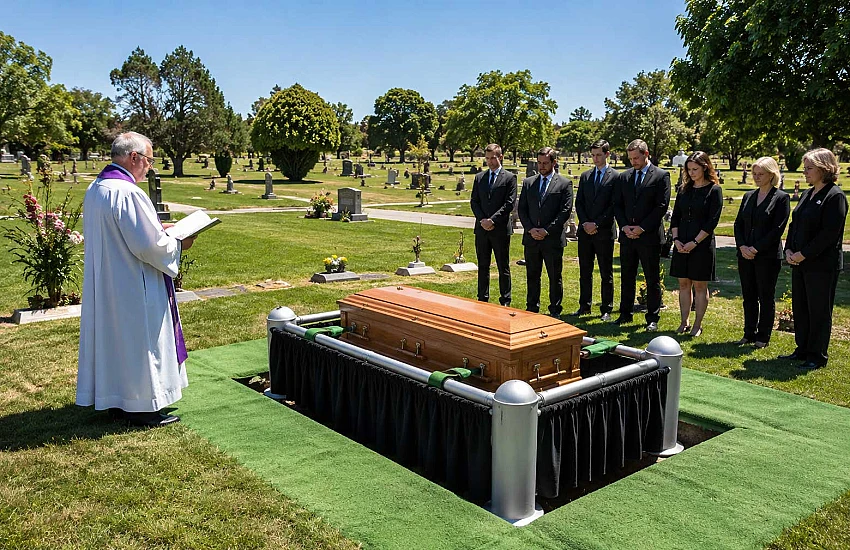
There is one moment in every funeral when conversation falls silent and every gaze turns to the same place. It is the moment the coffin leaves ground level and descends slowly into the grave. For the family it is the symbolic, final farewell. For the funeral home it is the most visible – and most demanding – part of the entire service.
How the lowering of the coffin unfolds shapes, to a large extent, how mourners will remember the whole burial. A smooth, calm descent builds a sense of solemnity and respect. Any jolt, any wobble, any nervous correction of position can break the atmosphere of concentration in an instant and stay in people's memory for years. So the question of whether to lower the coffin in the traditional way – on webbing straps and boards – or to reach for a modern funeral lowering device is not purely technical. It is a decision that touches the safety of staff, the quality of the service and the dignity of the ceremony itself, all at once.
This article compares both routes without idealising either. It shows what manual coffin lowering really looks like, where its limits lie, how a mechanised and remote-controlled lowering device works, and in which situations each solution performs best. We focus on the three things that matter most to a funeral home and to a grieving family: the smoothness of the ceremony, safety when handling heavy coffins, and the impression the whole process leaves on those saying goodbye.
The moment of lowering – why it is the hardest part of the ceremony
Most of a funeral home's work happens away from the family's eyes. Preparing the deceased, transport, arranging documents, setting up the place of burial – all of this takes place earlier and in calm. The lowering of the coffin is different. It happens in public, in front of dozens and sometimes hundreds of people, in complete silence, at the point of greatest emotional tension. It is the only moment in which technical work and the family's experience fall exactly on top of one another.
The difficulty is that there is no room for a second attempt. A coffin cannot be discreetly pulled back up and lowered again. What happens at the graveside happens once and is remembered as it was. This is why experienced funeral directors know that this brief stretch of the ceremony carries more weight than hours of earlier preparation.
What the family sees, and what stays behind the scenes
The family sees a slow, even descent and people who control that movement with a calm that can be felt. What it does not see is the effort behind it. It does not see the tensed muscles, the straps straining under load, or the signals the bearers exchange with a glance. And that is precisely the point – the whole technique should remain invisible, with the mourners' attention resting on the farewell, not on the way it is carried out.
The trouble begins when the "behind the scenes" starts to show. When the coffin tilts to one side, when someone has to steady it with a knee, when a strap begins to slip along the edge. These moments pull the family out of its concentration and direct attention exactly where it should not go – onto the mechanics of the process. Good coffin lowering is therefore the kind that nobody notices as "lowering". It simply happens.
The cost of a mistake at the most important moment
The consequences of a slip at this moment are out of all proportion to its length. From the family's perspective, every wobble is taken very personally – as a lack of respect, as carelessness, or in the worst reading as something that "went wrong" during the farewell to a loved one. From the funeral home's perspective it is a reputational risk that cannot be undone with a discount or an apology. In an industry where recommendations pass from person to person, one difficult funeral can weigh on a reputation more heavily than dozens of services delivered flawlessly.
To this is added a purely practical dimension. The coffin is heavy, the grave has limited dimensions, and the ground around it is often uneven, wet or soft. In these conditions the margin for error during manual lowering is genuinely narrow. That is why the market has long sought solutions that widen this margin – and it is exactly this search that led to the spread of mechanical and electric funeral lowering devices.
The traditional method – webbing straps and boards over the grave
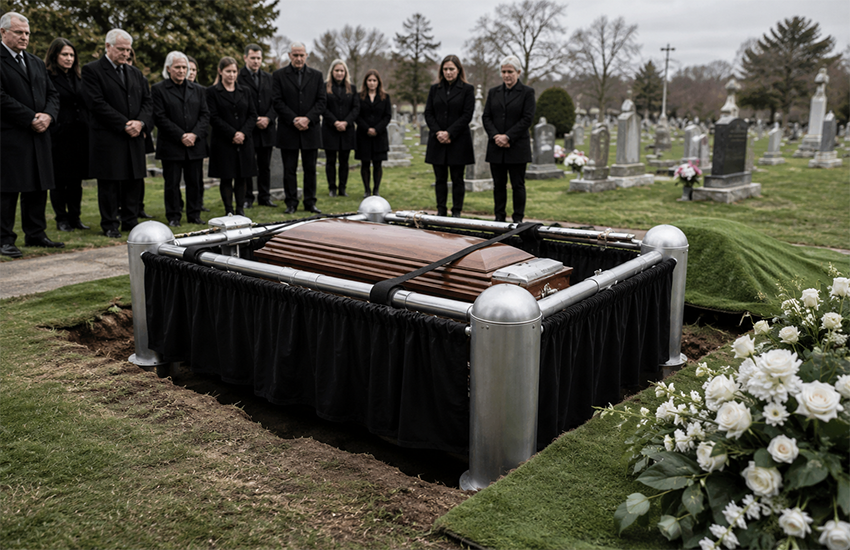
The oldest and still most widespread way of lowering a coffin rests on two simple elements: boards or beams laid across the grave, and webbing straps passed beneath the coffin. It is a method known for generations, requiring no power, easy to transport and intuitive for any team. Its strength lies in its simplicity, and its weakness in the fact that the whole load and the whole of the control rest on people.
How manual coffin lowering works, step by step
In the classic version, two strong boards or metal beams are laid across the open grave, and the coffin rests on them before lowering. Underneath, perpendicular to the coffin, the straps are passed through – usually two, sometimes three – held on both sides by the bearers. On a signal the team raises the coffin slightly, an assistant removes the boards from beneath it, and then everyone pays out the straps evenly, lowering the coffin to the bottom. Once it reaches the base, the straps are withdrawn with a single smooth pull.
It sounds simple, but each of these stages demands precision and synchronisation. The lift must be even on both sides. The boards must be removed at the right instant and without a sudden movement. The straps must be released at the same pace by everyone at once – otherwise the coffin tilts lengthwise or across. For a dozen or more seconds the entire weight rests solely on the arms and spines of the staff, and they have no mechanism to take over even part of that load.
A professional development of this method is a frame in which the straps are attached to an adjustable structure. The store's range of casket lowering devices grows out of exactly this idea, bringing order and a more dignified appearance to a process that, in its purely manual form, depends entirely on the strength and timing of the team.
The strengths of the traditional method
It would be unfair to reduce the traditional method to its limitations alone. It has real advantages that explain its endurance. First, it is independent of any power source – there is no battery to run flat and no electronics to fail. Second, the equipment is light and compact, easy to carry even to hard-to-reach parts of a cemetery. Third, for many families the very act of carrying and lowering the coffin by human hands has a symbolic dimension – a gesture of closeness and personal involvement that no device can replace.
In smaller communities, at cemeteries with difficult access, and at burials where the family itself wishes to carry and lay the coffin, the strap method remains a natural choice. There its simplicity is an asset, not a flaw. The question, then, is not "whether the traditional method is good", but "in what conditions it stops being enough".
Limits and risks – weight, coordination, weather
The limits of the traditional method reveal themselves fastest with heavy coffins. A solid oak coffin with full fittings, together with the deceased, can weigh anywhere from well over a hundred to more than two hundred kilograms. Distributing that load across several people who must simultaneously keep a perfectly even pace as they pay out the straps is a task demanding both strength and rehearsed coordination. It takes only one person releasing a strap a fraction faster for the coffin to lose its balance.
The second factor is weather and the lie of the land. Wet straps become slippery, muddy ground robs the bearers of a sure footing, and frost stiffens both hands and material. The narrow space around a freshly dug grave leaves no room to position one's feet freely. In such conditions even an experienced team works at the edge of comfort, and the risk of an uncontrolled movement rises.
A third, often underestimated problem is the availability of hands. The traditional method requires a coordinated team of several people present at the precise moment of lowering. In the staffing reality of many funeral homes, assembling such a team for every ceremony can be an organisational challenge – especially on days with a higher number of funerals.
Safety with heavy coffins – what ergonomics and regulations say
Lowering a coffin is not only a question of how the ceremony looks, but also a genuine matter of occupational safety. Manual handling of heavy loads is among the most common causes of musculoskeletal injury across many industries, and funeral work combines a heavy load with an awkward posture, time pressure and the strain of the moment. That combination is especially conducive to overexertion.
How much a coffin really weighs, and why it matters
Standard coffins are roughly 190 to 210 centimetres long and 60 to 75 centimetres wide, and their mass depends on the material, the thickness of the timber and the fittings. A light pine coffin is one thing, but a solid oak construction with metal elements and a fully fitted interior weighs considerably more. Once the mass of the body is added, the total weight that a team must control over an open grave regularly exceeds the figures considered safe for one person to lift by hand.
From an ergonomic standpoint, what matters is not only how much the coffin weighs, but the posture in which that weight is carried. Lowering takes place in a stooped position, with the arms extended and often with a twist of the trunk – precisely the arrangement that loads the lumbar spine most severely. Every kilogram acts here with greater force than when lifting close to the body in an upright stance.
The most common things that go wrong during manual lowering
In practice, a handful of typical scenarios recur. The most common is uneven release of the straps, which tilts the coffin and forces a sudden correction. The second is a strap slipping when it is wet or poorly positioned beneath the coffin. The third is the loss of a stable footing by one of the staff on soft or uneven ground. The fourth, and most worrying, is the overloading of a single person who, fearing the coffin will drop, takes on an excessive share of the weight and exposes themselves to injury.
Each of these situations is at once a safety hazard and a risk of disrupting the ceremony. What is a moment of overexertion for a worker is, for the family, a visible wobble of the coffin. Solutions that reduce the share of human strength in this stage therefore improve two things at the same time – they protect the team and they raise the quality of the occasion.
Ergonomics and the funeral team
The health of staff is a form of capital that a funeral home can easily overlook until a problem appears. Repeated loading of the spine accumulates over years, and its results are sick leave, staff turnover and a drop in performance. Investing in equipment that takes over part of the physical work is therefore also an investment in the stability of the team and the continuity of the business.
Across the anglophone world, occupational frameworks point in the same direction. In the United Kingdom the Manual Handling Operations Regulations 1992 require employers to avoid hazardous manual handling so far as is reasonably practicable, and to assess and reduce the risk where it cannot be avoided; the broader European duty under Council Directive 90/269/EEC follows the same logic. The modern approach to safety is to eliminate risk at its source rather than merely train people to endure it. In the context of coffin lowering, that means transferring the weight and the control from muscles to a mechanism – and this is exactly the role of a modern funeral lowering device.
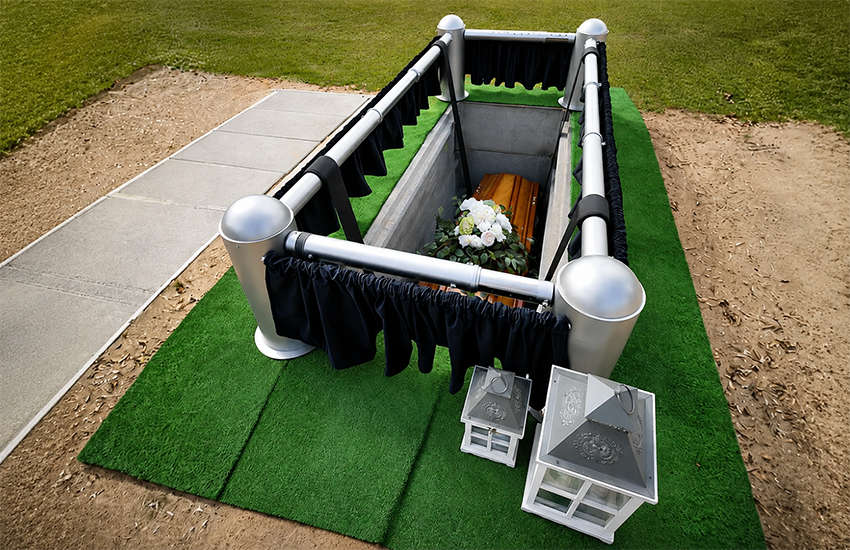
The modern funeral lowering device – how mechanised and remote-controlled lowering works
A modern funeral lowering device takes upon itself both the weight of the coffin and the control over the pace of its descent. Instead of relying on the strength of several people paying out straps, the operator manages a smooth, even movement while the device holds the load and the speed in check. Within the store's range of casket lowering devices, this idea is offered at two levels of sophistication, and the choice between them depends on the profile of the funeral home and the ceremonies it serves.
From a manual brake to a wireless remote – two tiers of control
The first tier is a mechanical lowering device that controls the descent through a braking system rather than an electric drive. The store's funeral lowering device lowers the coffin into the grave or tomb on straps, with adjustable length and width to suit different graves. Its unique braking system ensures a constant, even lowering speed, while ball bearings give smooth and quiet operation. With a maximum load capacity of 450 kg, it carries even the heaviest coffins with a comfortable margin, and because it needs no power at all, it is unaffected by battery state or electrical faults. Its working footprint, at roughly 239 centimetres in length, is built around full-size coffins.
The second tier is an electric, remote-controlled lowering device – the powered evolution of the same category, and the solution increasingly chosen by funeral homes that want the highest standard of repeatability. Here a wireless remote allows the operator to control the descent from a comfortable, dignified distance, without holding any levers or ropes. A battery-powered electric drive ensures a smooth, controlled movement without jerking, which means that once the device is set up, one person can conduct the entire procedure. In the traditional manual method, between two and six staff were typically engaged in lowering the coffin, with the attendant risk of an uneven descent; the electric device removes that problem entirely – something smaller funeral homes with limited staff value particularly highly. The current range of remote-controlled and mechanised models is presented together in the casket lowering device section.
Constant, even lowering speed and full operator control
At the heart of the modern device's advantage is a controlled, even descent that does not depend on the changing form of the team. With the mechanical model, the braking system holds the speed steady from start to finish; with the electric model, the speed can be regulated and the movement stops the instant the control is released. In both cases the coffin can be held at any point of its descent – for a moment of prayer, a final word or a family's gesture – and the movement resumed exactly when it is right.
This control is something that manual release of the straps cannot offer to the same degree. With straps, holding the coffin halfway down means several people sustaining the full weight in stillness, which is tiring and risky. With a powered device the same pause is effortless and stable, and the pace of descent remains even from beginning to end, regardless of the team's condition.
Adjustable construction and work at the graveside
Work at the graveside means constant contact with moisture, earth, mud and changeable weather. Modern lowering devices are therefore built from materials chosen to withstand outdoor use and to make cleaning easy – stainless steel models in particular hold up well to a rainy burial and keep their appearance over years of intensive use. The adjustable length and width allow the device to be matched to different grave dimensions and to the conditions of a particular cemetery. Before work begins, it is essential to make sure that all the adjustment elements are properly secured – a basic part of the preparation routine that translates directly into reliable operation.
What dignified equipment looks like to the family
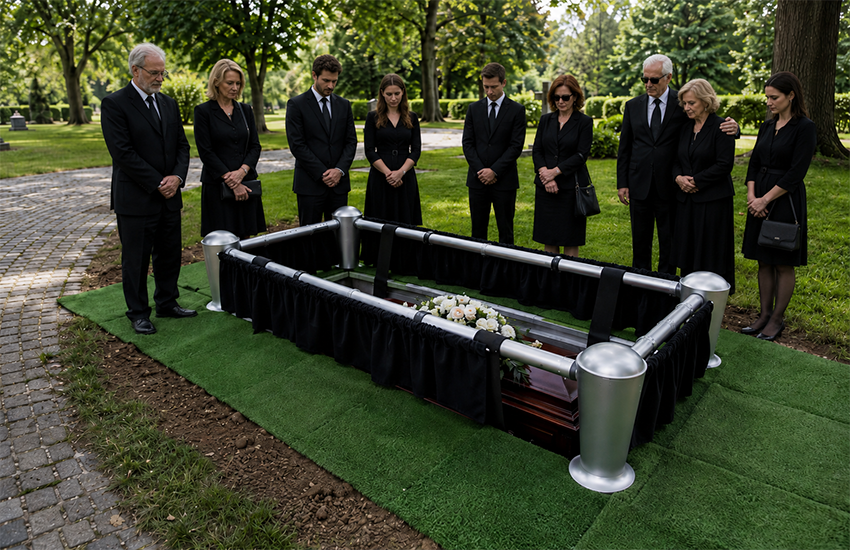
A device only earns its place at the graveside if it blends into the dignity of the occasion rather than standing out from it. Covers and side drapes conceal the working elements, so that what the family sees is a calm, even descent rather than a piece of machinery. The aim is for the equipment to do its work quietly and unobtrusively, leaving the family's attention where it belongs – on the farewell.
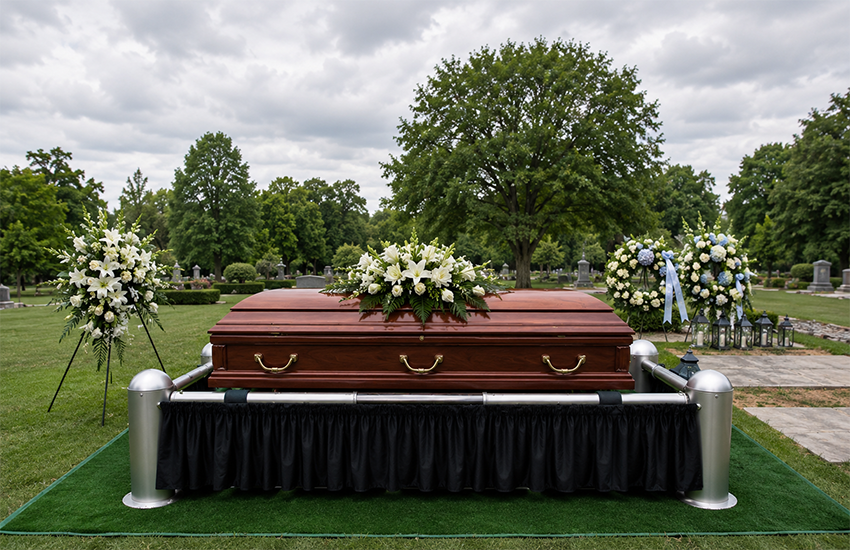
Comparison – traditional method versus a lowering device
With both approaches in view, they can now be set side by side along the three dimensions that matter most to a funeral home and to a family. This is not a comparison of "better versus worse" in the abstract – it is a map of trade-offs that helps in choosing the right tool for particular conditions.
Smoothness and solemnity of the ceremony
With the traditional method, the smoothness of the descent depends entirely on the condition and coordination of the team on the day. With a well-rehearsed crew the movement can be beautiful and calm; with a tired or hastily assembled one it can be uneven and tense. The pace varies, and holding the coffin halfway down takes an effort that is easy to notice. The solemnity of the moment is therefore only as good as the team that happens to be available.
A lowering device separates the quality of the ceremony from the momentary form of the people involved. The movement is even and controlled every time, whether it is the first or the fifth funeral of the day. The operator can slow, pause and resume the descent smoothly, matching it to the rhythm of prayer and the gestures of the family. The quiet operation and the repeatability of the movement keep the mourners' attention on the farewell rather than on the technique. This is the greatest advantage of a powered solution in terms of how the ceremony is experienced.
Worker safety and protecting the coffin
In the strap method the whole load rests on people, and safety depends on their strength, coordination and the ground beneath their feet. The risk of a back injury, a slipped strap or a lost footing is real and grows with the weight of the coffin and the worsening of the weather. Every emergency threatens both the worker and the dignity of the burial at once.
A lowering device transfers the weight and the control from muscles to a mechanism rated for far more than a coffin will ever weigh – the mechanical model carries up to 450 kg. The coffin is held steadily by the device rather than by straining arms, which removes the most common causes of injury and uncontrolled movement. With the powered model, one person takes over operation after setup, so there is no need to engage a large team at the most demanding moment. In terms of safety the difference between the two methods is at its clearest – here technology delivers an advantage that is hard to dispute.
The family's impression and the funeral home's reputation
Families rarely judge equipment directly. They judge the impression – the sense that the farewell proceeded with proper calm and respect. A smooth, quiet, assured descent of the coffin builds that impression by itself, without a word. A funeral home that can guarantee it regardless of the weather, the weight of the coffin and the staffing of the day earns a reputation for being professional and trustworthy.
From the point of view of reputation, a modern lowering device therefore works in two ways. Directly – through the quality of the very moment the family sees. And indirectly – as a signal that the funeral home invests in modern, considered equipment and takes every detail of the ceremony seriously. In an industry where trust translates straight into recommendations, that signal has real value. The traditional method can match it under ideal conditions and with an excellent team, but it does not offer the same repeatability in every situation.
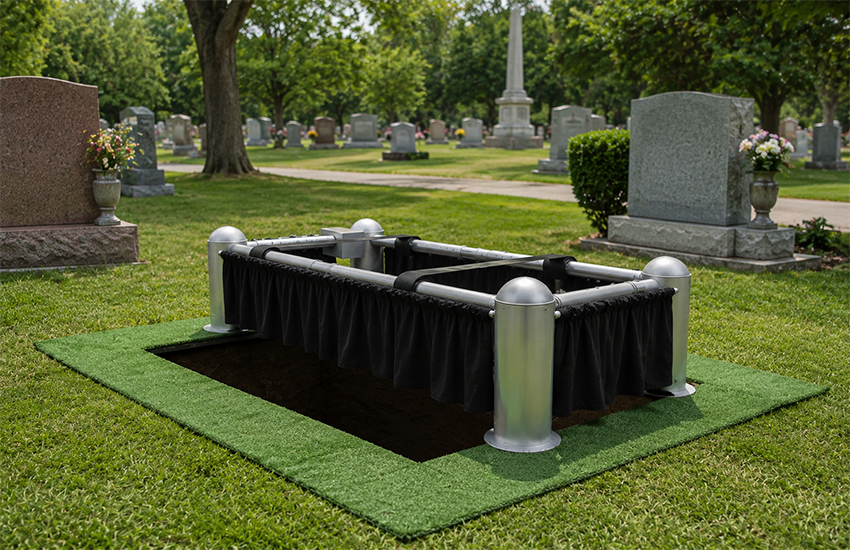
When to choose a powered device, and when a simpler solution will do
An honest comparison does not end with the claim that newer always means better. The choice of equipment should follow from the profile of the funeral home, the character of the cemeteries it serves and the number of ceremonies. For some businesses a powered lowering device will be an investment that pays for itself every day; for others, simpler or mechanical solutions will prove entirely sufficient.
The funeral home profile that gains the most
A powered lowering device delivers the greatest value where the number of funerals is high and the load on the team is heavy. If a funeral home handles many ceremonies a week, if heavy oak coffins are a regular occurrence, if the staff is small and a several-person team is hard to assemble for every lowering – the device solves all of these problems at once. It is equally well suited to businesses that build their position on the highest standard of service and want to guarantee a repeatable quality regardless of conditions.
The health of the team over the longer term is an argument in its own right. Where the same staff lower coffins day after day for years, transferring the weight to a mechanism is concrete protection against accumulating injuries and turnover. Seen this way, a lowering device is not so much an expense as an element of the operational stability of the business.
Complementary solutions across the range
Between the purely manual method and a powered device there is room for mechanical solutions. The store's mechanical funeral lowering device, controlled by a braking system and operating quietly on ball bearings without any need for power, is a natural middle ground for homes that want a steady, even descent without the cost of an electric drive – the full picture of available models sits in the casket lowering device category. For urn burials, the lighter and smaller scale of the task is better matched by dedicated urn carriers and the corresponding handling equipment.
It is worth remembering, too, that lowering the coffin is only one stage of graveside work, and that the smooth running of the ceremony also depends on the logistics of transport. On difficult, uneven cemetery ground the off-road coffin cart – reinforced steel, a 300 kg capacity, large all-terrain wheels and braked swivel casters – carries even the heaviest coffins with control, while the wider selection of coffin trolleys covers everything from compact folding scissor models to platform carts. A well-chosen set of equipment means the entire journey of the coffin – from the hearse to the bottom of the grave – proceeds smoothly and with dignity at every stage.
Putting a lowering device into daily practice – practical tips
Buying the equipment is the beginning of the road, not its end. Whether a lowering device genuinely raises the standard of service depends on how it is introduced and maintained. A few simple principles allow its potential to be used in full and help avoid the typical problems.
Preparation and setup at the graveside
Setting up and preparing the device for work should be carried out by at least two people. This is the moment to set the length and width adjustment for the particular grave and to check that all the fixings are properly secured. Good practice is to do this in advance, before the cortège arrives, so that in the presence of the family the device is already prepared and operation comes down solely to a smooth, invisible descent. Once the device is correctly set up, the lowering itself – with the powered model – can be handled by a single operator.
Before each use it is also worth checking the technical condition of the straps and the correctness of their attachment. It is a short task that eliminates the most basic faults. Covers and drapes should be fitted so that they neatly conceal the working elements – their role is to make the device blend into the setting of the ceremony.
Maintenance, charging and inspections
For the electric model the most important operating principle is simple: the device should not be used while its battery is charging. Charging should therefore be planned outside ceremony hours, ideally to a fixed rhythm – for example at the end of the working day – so that the device always sets out with a charged battery. During operation the powered model runs solely on its battery, which is why charging discipline translates directly into reliability. The mechanical lowering device, by contrast, needs no charging at all and is always ready, with its braking system providing controlled descent independent of any power.
Stainless steel makes cleaning easier, but after work in mud or rain it is worth cleaning and drying the device so that it serves without fault. Regular contact with the manufacturer over inspections, and access to spare parts, close the subject of upkeep. Equipment treated with this kind of routine works for years, and a piece of equipment that can be quickly serviced and for which parts are available serves far longer than one without any service backing.
Ultimately, the choice between manual lowering and a powered device comes down to the question of how much uncertainty a funeral home is willing to leave in the most visible moment of a burial. The traditional method offers simplicity and independence, but it places the weight and the risk on people. A modern funeral lowering device places them on a mechanism, giving the operator full, repeatable control over the smoothness, the safety and the impression the family takes away. For a growing number of professional funeral homes it is exactly this certainty that settles the choice.
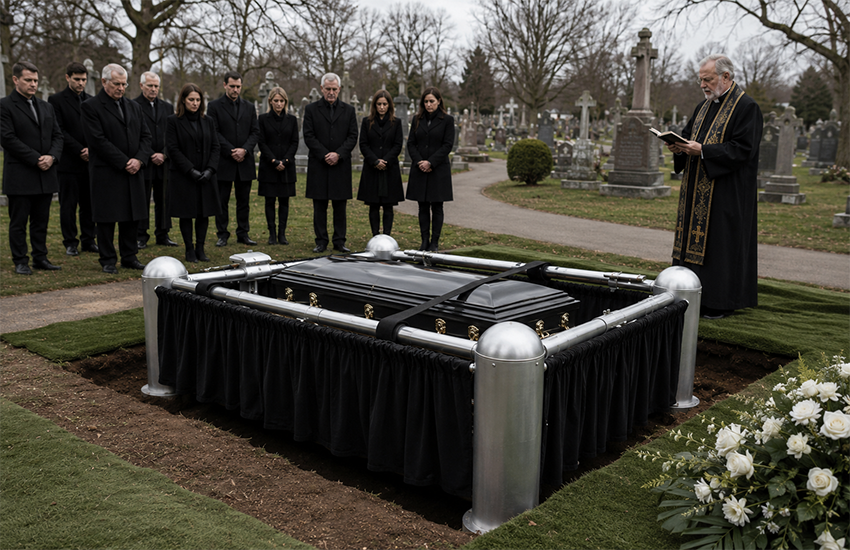
Frequently asked questions
Can one person operate a funeral lowering device?
With the electric, remote-controlled model, yes – once the device is set up, the lowering and raising of the coffin can be handled by a single operator, with a wireless remote allowing control from a dignified distance. The setup and preparation of the device itself should be carried out by at least two people. This is a significant difference from the traditional method, which at the moment of lowering requires a coordinated team of several people paying out the straps.
What is the maximum load capacity, and is it enough for heavy coffins?
The store's mechanical funeral lowering device offers a maximum load capacity of 450 kg. That comfortably covers even heavy oak coffins with full fittings together with the deceased, whose combined weight usually falls between well over a hundred and around two hundred kilograms. The weight is held by the mechanism rather than by the staff, which removes the most common causes of strain during manual lowering.
What happens if the battery runs out during the ceremony?
The electric, remote-controlled model is battery-powered, so disciplined charging outside ceremony hours keeps it ready for work. The mechanical lowering device, by contrast, needs no power at all – it relies on a controlled braking system for a constant, even descent, and is therefore entirely unaffected by battery state. For homes that want freedom from charging routines altogether, the mechanical model removes the question entirely.
Is a lowering device quiet enough not to disturb the solemnity?
Yes. The mechanical model's braking system delivers a constant, even lowering speed, while ball bearings ensure smooth and quiet operation; the electric model lowers smoothly without jerking and stops the moment the control is released. The descent stays calm and controlled, and covers or drapes conceal the working elements, so the device fits into the dignified setting of the farewell rather than standing out from it.
Can the device be adjusted to different grave sizes?
Yes. The lowering device has adjustable length and width, allowing it to be matched to different coffin sizes and grave conditions across a particular cemetery. Before work begins, it is important to make sure that all the adjustment elements are properly secured, so that the device operates reliably throughout the descent.
How does a lowering device differ from the manual straps-and-boards method?
The strap method relies entirely on the strength and coordination of a team that pays out the straps by hand. A mechanical lowering device uses a steel frame and a braking system to control the descent without any power. An electric, remote-controlled device goes a step further – it takes the weight on a battery-powered drive and gives the operator smooth, repeatable control of the pace through a wireless remote. The full range of mechanical and remote-controlled models can be compared in the casket lowering device category.
Does buying from the manufacturer include service and spare parts?
Yes. The equipment comes directly from the manufacturer, Prima-Tech S.C., which provides technical support, service and access to spare parts. For equipment used in the daily work of a funeral home, the availability of service and parts matters no less than the technical specification itself, because it determines how long and how reliably the device will serve.