Table of Contents
- International Repatriation – The New Reality in the Funeral Profession
- The Legal Framework: What Governs Cross-Border Transport of Human Remains?
- The Transport Capsule – The Central Element of International Transfer
- Body Bags – The Foundation of Safe and Hygienic Transfer
- Stretchers and Coffin Trolleys in International Operations
- Embalming and Body Preparation for Long-Distance Transfer
- Documentation – The Paper Trail That Crosses Every Border
- Transport Mode: Air, Road, or Rail?
- Building International Partner Networks
- Building Internal Procedures for International Repatriation
- Frequently Asked Questions
- Conclusion
Death does not respect borders. Every year, thousands of people die abroad – during holidays, while living as expatriates, or on long-term business assignments. At the same time, foreign nationals die in countries far from home, and their families need their loved ones returned for burial. For a funeral home, handling these cases goes far beyond logistics – it is fundamentally about preserving dignity and demonstrating professionalism at every stage of the process. Funeral homes that are ready to manage international repatriation gain a genuine competitive advantage and build a reputation as a trustworthy, comprehensive partner for families during their hardest hours.
International Repatriation – The New Reality in the Funeral Profession
For a long time, transporting human remains internationally was considered a rare event – the kind of case that came up perhaps once a year at most. Today, the picture looks entirely different. According to EU Commission estimates, over 17 million EU citizens live and work outside their home country. Add to that millions of tourists, students, and seasonal workers travelling abroad at any given time, and it becomes clear that requests to repatriate remains from Germany, the United Kingdom, the Netherlands, Norway, or the United States are no longer exceptional – they are a regular part of what a well-prepared funeral home handles.
Proper preparation for this type of assignment requires simultaneous investment in three distinct areas: technical equipment and facilities, procedural and legal knowledge, and a reliable network of international partners. The absence of any one of these pillars can lead to delays, legal complications, and in the worst cases, serious sanitary problems. A grieving family waiting for their loved one to come home cannot afford any of these outcomes.
It is also worth noting that international repatriation is not only about bringing remains home. Funeral homes increasingly face the reverse scenario – a foreign national dies locally, and the family abroad needs the body returned to their country. This demands familiarity with export regulations and the ability to coordinate with foreign consulates and overseas funeral partners who may operate under very different systems and cultural expectations.
The Legal Framework: What Governs Cross-Border Transport of Human Remains?
The transport of human remains within Europe is governed primarily by the 1937 Berlin Agreement, updated by the 1973 Strasbourg Agreement – the foundational treaty ratified by most European countries, which sets out the requirements that coffins and transport containers must meet when crossing international borders. Any funeral home engaged in this type of work must understand these requirements, as they directly affect which containers are acceptable and what documentation must accompany a shipment.
Beyond the multilateral framework, every individual assignment requires several key documents. The foundation is a death certificate issued by the competent authorities of the country where death occurred, translated into the language of the destination country or into English. A permit to transport human remains is equally essential; in most jurisdictions, this is issued by the relevant public health authority. When transport is to be carried by air, the airline may impose its own additional requirements regarding containment, embalming certification, and cargo documentation.
A funeral home preparing to offer international repatriation services should build a reference document listing the requirements for the most commonly handled destinations. In practical terms, this means having country-specific checklists for Germany, the United Kingdom, the United States, the Gulf states, and wherever else your community's diaspora is likely to be. The requirements can differ substantially from one jurisdiction to the next. Designating at least one staff member responsible for cross-border documentation – and investing in their ongoing training – is not optional; it is a basic operational necessity.
The Transport Capsule – The Central Element of International Transfer
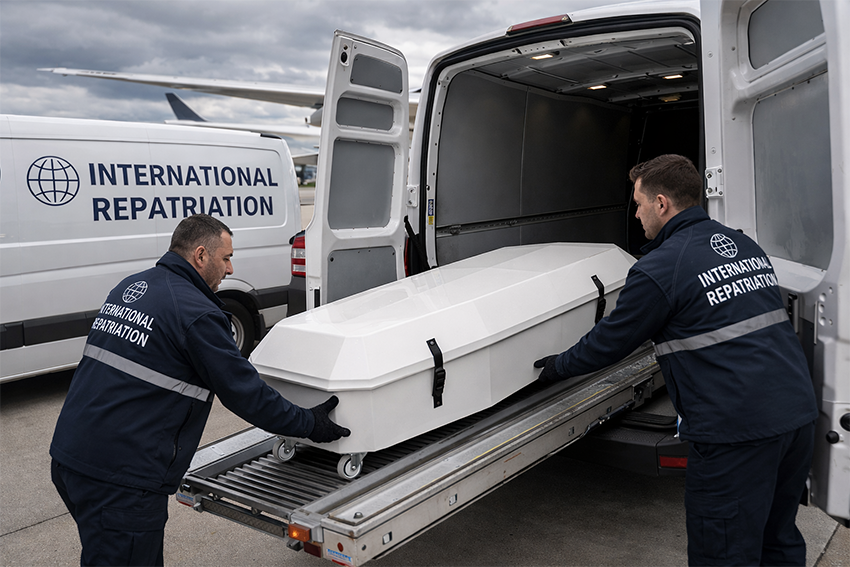
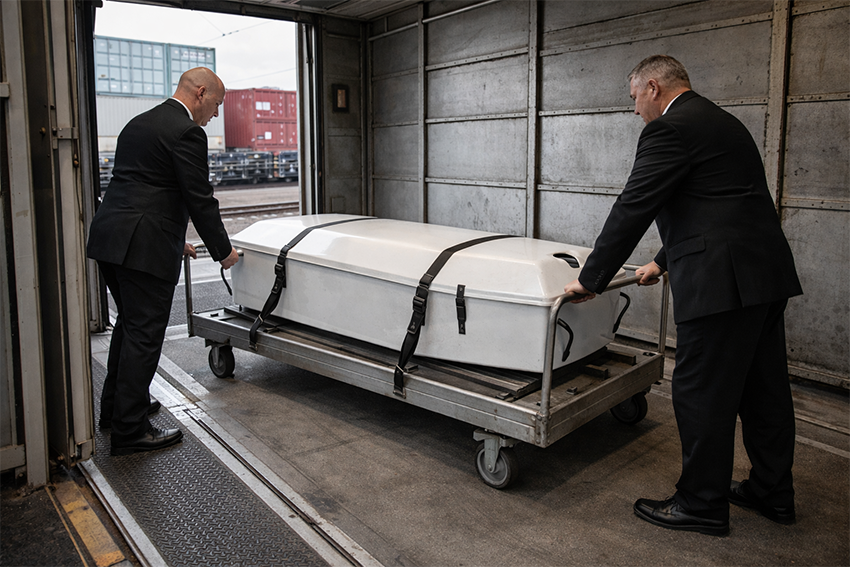
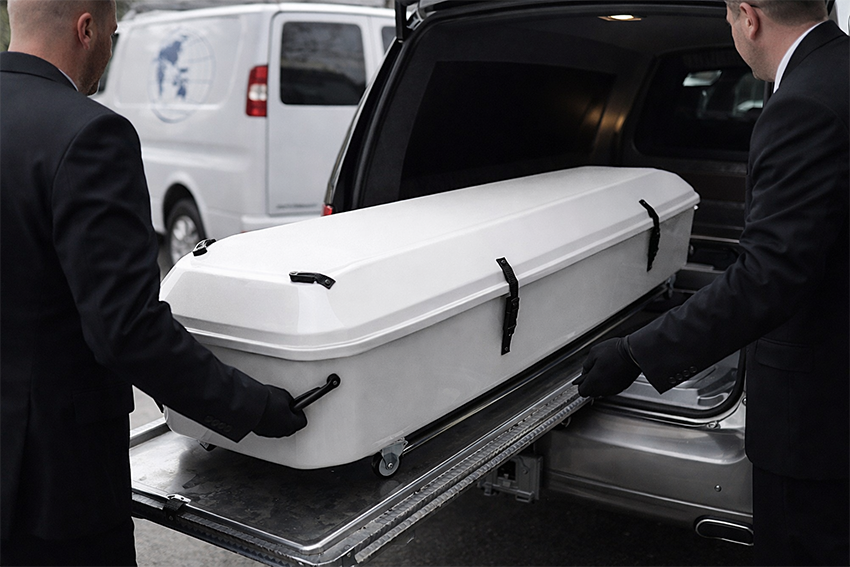
When it comes to international repatriation, no single piece of equipment is more closely tied to sanitary and legal compliance than the transport capsule. This is a rigid, sealed container whose sole purpose is to provide an airtight enclosure for human remains throughout the entire journey – from the moment the funeral home takes custody through to the final destination. Unlike a ceremonial coffin, the transport capsule has no representational function; its role is entirely technical and hygienic. Yet its presence is a mandatory requirement for most forms of air and rail transport internationally.
Construction and Technical Specifications
The transport capsule available from funeraryaccessories.com is manufactured from fibreglass-reinforced polyester laminate – a material that combines low weight with exceptional resistance to mechanical damage. The capsule measures 207 cm in length, 77 cm in width, and 41 cm in height, dimensions that align with the industry standard and ensure compatibility with the loading systems used by commercial airlines and specialist freight operators.
The most operationally significant feature of this capsule is its sealing system, which prevents the escape of fluids and odours – a requirement that is non-negotiable for air cargo and international rail transport. Both the interior and exterior surfaces can be cleaned and disinfected efficiently, which matters both for maintaining sanitary standards and for the practical reality of reusing the container across multiple assignments. Two transport wheels are fitted at the rear, along with an ergonomic handle, making it significantly easier to manoeuvre the loaded capsule in the confined spaces common to cargo terminals, mortuary bays, and vehicle holds.
The capsule is manufactured to order by Prima-Tech S.C., a Polish company specialising in funeral equipment, which means that technical support and after-sales service are readily accessible. Ordering to specification also means the container can be adapted to particular operational requirements if needed.
When Is a Transport Capsule Mandatory?
Not every repatriation requires a transport capsule. For domestic transfers where the deceased is placed directly into a ceremonial coffin and transported by hearse, the capsule is not needed. For international air transport, however, it is effectively a universal requirement. Airlines will only accept human remains as cargo in sealed containers that meet defined technical standards – and the fibreglass-reinforced polyester laminate capsule satisfies those standards in full.
The capsule is also indispensable when transport takes place in high ambient temperatures or when the overall transit time exceeds 24 to 48 hours. Even where the body has been embalmed, the sealed container provides an additional layer of protection against external contamination and eliminates any risk of complications during border inspections or customs clearance. It is, in every sense, the product around which an effective international repatriation operation is built.
Body Bags – The Foundation of Safe and Hygienic Transfer
The transport capsule provides the outer containment, but equally critical is the correct preparation of the body within it. Body bags serve as the primary layer of isolation and must meet exacting standards of strength, leak-resistance, and hygiene. A funeral home engaged in international transfers should carry several types of body bag, matched to different operational situations and the specific requirements of different transport routes.
Type C Body Bags with Round Zipper – The Professional Transport Standard
Type C body bags are the most widely used model in funeral homes handling long-distance transfers. Their defining characteristic is a round zipper that travels the full perimeter of the bag, providing rapid, airtight closure that holds securely under demanding working conditions. They are available in both black and white, allowing each facility to select the variant that best matches its operational protocol or the expectations of specific clients.
The Body Bag Type C BLACK – Round Zipper is manufactured from heavy-gauge 0.18 mm polyethylene film, which delivers high resistance to tearing and leakage. At 220 × 90 cm with a load capacity of up to 180 kg, it is sized appropriately for standard adult transport procedures. The reinforced carrying handles are positioned to allow safe and comfortable transfer by two or four operatives. Each bag is individually packaged with a pair of disposable gloves, ensuring the product is ready for immediate use with no additional preparation.
The Body Bag White, Type C – Round Zipper offers the same technical specification in white. White is the preferred option in some hospital settings and among funeral homes serving communities where white is the traditional colour of mourning. Both variants are supplied in packs of ten, which simplifies stock management and ordering.
Type P Body Bags with Straight Zipper – A Versatile Choice for Everyday Operations
Type P body bags, fitted with a linear (straight) zipper running the length of the bag, perform well in situations that do not require the same level of perimeter sealing as air freight, but still demand reliable hygienic containment. They are available in black and white, and are standard equipment for ambulance services, hospital mortuaries, emergency response teams, and funeral homes handling shorter domestic transfers or the initial stage of a longer repatriation chain.
The straight zipper runs the full length of the bag, making it easy to position the deceased and achieve a reliable seal without complex manipulation. The straightforward construction translates directly into reliability under the pressure of rapid response – a characteristic that matters when a repatriation begins with the handover of remains from a foreign hospital or emergency service and time is of the essence. For international transfers, Type P bags are frequently used as the first line of containment immediately after the funeral home takes custody, before the body is formally prepared and placed in the transport capsule for onward shipping.
Exhumation Bags – A Specialist Solution for Skeletal Remains
A distinct category is the Exhumation Bag (for Coffin) – Zippered, designed for the transport of human remains during exhumation or in cases where the body must be moved some time after death. Made from 0.12 mm polyethylene film in an exceptionally large 150 × 350 cm format, the bag provides ample working space even in demanding outdoor or confined conditions.
In the context of international transport, the ability to apply a customs seal to this bag is particularly significant. Many countries and border agencies require sealed containers for the transport of exhumed remains, and the exhumation bag's design accommodates standard security seals, ensuring full chain-of-custody control throughout transit. The full-length sleeping-bag-style zipper provides a secure, airtight closure with easy access when required. Individual packaging eliminates cross-contamination risk between uses.
Stretchers and Coffin Trolleys in International Operations
The transport capsule and body bags address the containment side of the operation, but equally important is the equipment used to move remains within the funeral home and onto transport vehicles. Professional funeral stretchers used in an international repatriation context should be resistant to moisture, easy to decontaminate, and equipped with a reliable folding mechanism that allows efficient movement through the narrow corridors common in cargo terminals, hospital loading bays, and vehicle decks.
Funeral homes that regularly handle air cargo transfers will particularly appreciate stretchers with waterproof coverings, which protect both staff and the surrounding environment in the event of any breach in containment. The choice of coffin trolley also matters more than it might seem: height-adjustable models with wheels suited to both hard flooring and outdoor surfaces give staff the flexibility to work efficiently across very different environments – from polished airport terminal floors to the uneven surfaces of a freight apron.
Stair wheel attachments for stretchers are worth a separate mention. For any operation involving buildings without lifts – older hospital wings, heritage properties used as chapels of rest, or residential addresses – stair-rated wheels transform what would otherwise be a two-person struggle into a manageable task with appropriate equipment. These are the details that separate a funeral home that has genuinely thought through its repatriation workflow from one that is merely attempting to improvise.
Embalming and Body Preparation for Long-Distance Transfer
Every cross-border transfer, and particularly any that involves air transport, requires that the body be properly prepared from a sanitary standpoint. Most countries and almost all commercial airlines require embalming as a condition of accepting human remains as cargo. The embalming performed for transport purposes differs from cosmetic preparation – its primary aim is preservation and sanitary containment, not presentation. Airlines and regulatory authorities care about preventing any biological hazard during transit, not about how the deceased will look at the service.
A funeral home positioning itself to handle international transfers should be equipped with a properly specified embalming table, the appropriate fluids, and – critically – a documented procedure that demonstrates compliance with sanitary requirements. Many overseas partners and carriers require a written embalming certificate signed by a qualified practitioner or physician, which means that documentation of this stage is as important as the procedure itself.
It is worth being aware that in some Muslim-majority countries, embalming is not permitted on religious grounds. In these cases, the body must be exceptionally well contained within the transport capsule and held at a low temperature in a mortuary refrigerator until departure. A funeral home offering a professional service must have alternative protocols prepared for such situations, ideally developed in consultation with a legal adviser or specialist consultant familiar with the requirements of the relevant jurisdictions.
This brings the mortuary refrigerator into focus as a non-negotiable element of any repatriation-capable facility. The paperwork alone for an international transfer typically takes between five and fourteen working days to compile and approve. Without refrigeration capacity sufficient to hold remains in appropriate conditions throughout that period, the funeral home simply cannot offer this service responsibly.
Documentation – The Paper Trail That Crosses Every Border
In international repatriation, documentation is every bit as important as the physical equipment. A single missing document can result in the shipment being held at the border, with the attendant distress for the waiting family. Every member of staff involved in handling international assignments must know exactly which documents are required for each destination, where to obtain them, and how long each takes to process.
The standard documentation set for exporting human remains typically includes a death certificate with apostille or a certified translation, an export permit from the competent national health authority, a medical certificate of cause of death (especially important where death was sudden or where infectious disease is a factor), an embalming certificate, and – for air transport – the appropriate airway bill and cargo declaration compliant with IATA regulations. Transfers to countries outside the European Union frequently require additional certification from the receiving country's consulate.
For the reverse scenario – receiving remains from abroad – the receiving funeral home must manage its side of the documentation chain, which typically includes registering the death locally if it has not already been entered into the national records, and liaising with the family regarding the documentation that accompanied the body from the country of origin. Preparing template communications and checklists in English, and in the languages most relevant to your local diaspora communities, dramatically reduces the time spent managing the administrative process under pressure.
Transport Mode: Air, Road, or Rail?
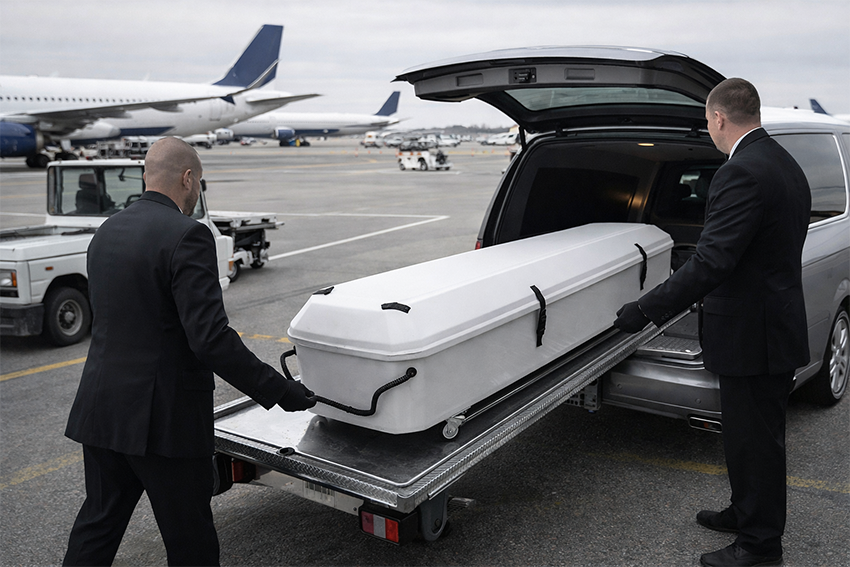
The choice of transport mode depends on distance, the condition of the body, the wishes of the family, and the availability of connections. For transfers within a few hundred kilometres inside Europe, a specialist refrigerated hearse or mortuary vehicle is usually the most practical option – faster to arrange, more flexible, and generally less expensive than air freight. Road transport also requires less documentation than air and gives the funeral home direct control over the conditions throughout the journey.
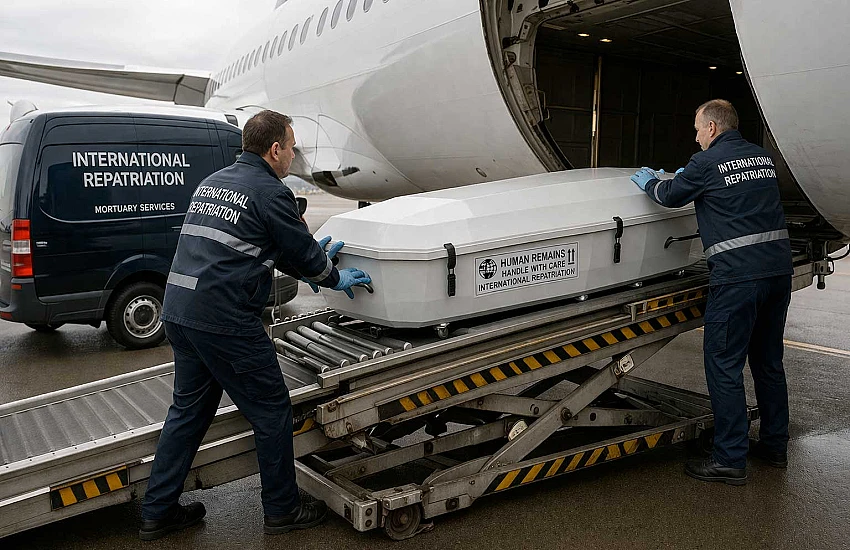
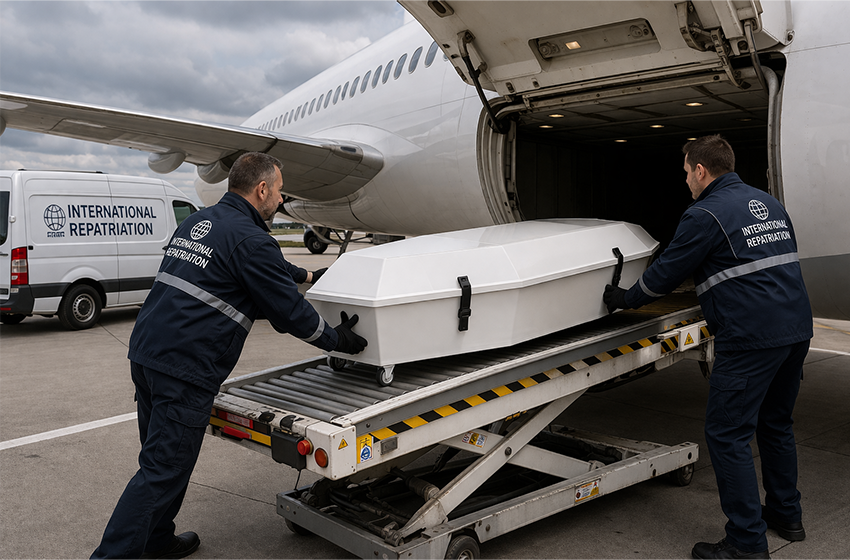
Air transport is the standard choice for distances that would take many hours by road, or for transfers to other continents. Commercial airlines accept human remains exclusively as cargo – never in the passenger cabin – and they each have their own detailed requirements regarding packaging, labelling, and documentation. The transport capsule must be labelled in accordance with IATA regulations, and all documents must be physically attached to the shipment in a way that prevents accidental separation during handling. Establishing a working relationship with a freight forwarder who has experience with human remains is strongly advisable; they will know the specific requirements of each carrier and can manage the cargo booking on the funeral home's behalf.
Rail transport is used for certain Central European routes – between Germany, Austria, and neighbouring countries – and combines some of the advantages of both road and air: it is relatively economical, maintains consistent temperature conditions, and requires less documentation than an air shipment. Regardless of the mode chosen, the funeral home must document every stage of the custody chain and retain copies of all permits, in case of inspection at any point along the route.
Building International Partner Networks
No funeral home can manage the full repatriation chain in isolation. Effective international transfers depend on partnerships with overseas funeral homes, customs brokers, document translators, consular offices, and specialist freight operators who understand the particular requirements of human remains transport. Building these relationships takes time, but the investment pays dividends with every subsequent assignment.
In Europe, professional associations such as Funeral Service International facilitate introductions to accredited overseas partners. Developing a register of trusted partners, with contact details, notes on their language capabilities, and a record of previous assignments handled together, gives the funeral home a significant operational advantage when a family calls in distress and needs immediate action. Equally, reaching out to the consular offices of the countries most relevant to your community – particularly those representing significant diaspora populations – creates a channel through which referrals flow naturally, as consulates regularly need to identify reliable local funeral homes for their nationals who die abroad.
A strong overseas partner is one who understands what the receiving country needs, knows the local regulations, and can efficiently compile a complete documentation set. On your side, providing a clear written protocol for inbound transfers – covering your documentation requirements, preferred transport specifications, and contact procedures – transforms every new partnership into a repeatable, efficient process rather than a bespoke improvisation each time.
Building Internal Procedures for International Repatriation
A funeral home that takes international repatriation seriously cannot rely on institutional knowledge that lives in a single person's head. Procedures must be written down, staff must be trained against them, and all necessary equipment must be maintained in a state of readiness. An internal repatriation protocol should cover at minimum four areas: initial information gathering (country of death, transport mode, religion and family wishes), documentation management, technical body preparation and equipment checks, and external partner coordination.
A stage-by-stage checklist – from the first family contact through to physical handover or receipt of the body – is an essential operational tool. That checklist should include confirmation that appropriate body bags are in stock and have been selected for the assignment, that the transport capsule has been inspected and is serviceable, that all documentation is in progress, and that the relevant overseas partner has been briefed. The more detailed the checklist, the less room there is for improvisation under pressure.
Staff training must cover the practical skills as well as the procedural knowledge. Operatives need to know how to correctly size and close a body bag, how to apply a security seal to an exhumation bag, and how to load a capsule safely onto a vehicle or pallet. Errors at this stage – even small ones – can have serious consequences at a customs checkpoint or sanitary inspection. Regular refresher training keeps skills sharp and ensures that new team members are brought up to standard.
Routine stock checks, periodic inspection of the transport capsule, and calibration of refrigeration units should all be assigned to a named individual on a defined schedule. International repatriation enquiries do not arrive at convenient moments – a family may call on a Friday evening with a departure scheduled for Monday morning. The funeral home that is ready at all times is the one that earns a reputation for reliability.
Frequently Asked Questions
What documents are absolutely required to transport human remains internationally?
The core documentation set includes a death certificate with apostille or certified translation, a permit to transport human remains issued by the competent sanitary authority (or its equivalent in the country of death), a medical certificate of cause of death, and an embalming certificate. For air transport, IATA-compliant cargo documentation is also required. Transfers to countries outside the European Union frequently require additional consular authorisation from the receiving country. Requirements vary significantly by destination, so it is always advisable to verify the current requirements with the relevant consulate or with your overseas funeral partner before the shipment is confirmed.
Does a transport capsule replace the coffin for air transport?
A transport capsule is not a substitute for a ceremonial coffin – it serves an entirely technical and sanitary function. In air transport, the capsule is typically used either as the primary cargo container, which is then replaced by a ceremonial coffin at the destination, or it is placed inside an outer shipping crate for added protection during handling. The funeral ceremony itself always takes place with the deceased in a coffin. In some cases, where the family has chosen direct cremation on arrival, the transport capsule may be the only container used throughout the entire process.
How long does it take to prepare remains for international transfer?
Preparation time varies depending on several factors, but five to fourteen working days is a realistic expectation for most international transfers. This period encompasses waiting for a complete documentation set to be compiled and approved, embalming and any required certification, arranging transport (airline booking or vehicle scheduling), and customs clearance. Families should be informed of a realistic timeline at the earliest possible stage so that they can make corresponding arrangements for the reception and service at the destination.
What is the difference between a Type C and a Type P body bag?
The primary difference is the zipper configuration. Type C body bags feature a round zipper that travels the full perimeter of the bag, providing a higher level of containment and faster access from any side – making them the preferred choice for funeral homes and for longer-distance transfers. Type P body bags use a straight linear zipper running along the length of the bag; they are simpler to operate and entirely adequate for shorter transfers and for the initial containment of remains in hospital or emergency settings. Both types are available in black and white, and share equivalent load capacity and PE film quality.
Does a funeral home need a special licence to handle international repatriation?
The licensing requirements vary by country. In most jurisdictions, there is no specific "international repatriation licence" distinct from the standard funeral home authorisation; however, every individual transfer requires a separate transport permit from the relevant sanitary authority. The funeral home's vehicle must also meet any applicable requirements for the transport of human remains. In practice, funeral homes that handle regular international transfers develop an ongoing working relationship with their local health authority, which streamlines the permit process considerably and reduces turnaround times.
Conclusion
Handling international repatriation demands considerably more of a funeral home than standard domestic services. It requires the ability to act under time pressure, with complete documentation, appropriate equipment, and a clear understanding of the procedures that apply on both sides of the border. Investing in a professional transport capsule, a well-stocked selection of body bags, trained staff, and documented protocols is the foundation without which this service cannot be delivered safely or with the dignity that every family deserves.
Funeral homes that are genuinely prepared for this category of assignment do not simply gain a commercial advantage. They gain the capacity to accompany families through one of the most acutely painful situations a person can face – when someone they love has died far from home, and needs to be brought back. That is a responsibility worth taking on with full commitment.