Table of Contents
- Why heatwaves have become a permanent challenge for the funeral industry
- What happens to the human body in high temperatures
- The cold chain as the foundation of work in the heat
- Transporting the deceased during a heatwave
- Protecting the body – body bags and hygiene procedures
- Organising ceremonies and serving families during heatwaves
- A readiness review before the heatwave season
- Frequently asked questions
- Summary
Summer months across Europe increasingly bring not isolated hot days but long, multi-day heatwaves, during which the temperature in the shade stays above thirty degrees and the nights bring no real relief. For most industries this means discomfort and higher air-conditioning bills. For funeral homes, mortuaries and chapels it is something far more serious – a direct threat to the quality of work, to compliance with sanitary regulations, and, most importantly, to the dignity of the deceased and the peace of mind of their families.
High ambient temperature dramatically accelerates the natural processes that occur in a body after death, shortens the window in which all organisational tasks can safely be completed, and puts the entire technical infrastructure of the business to the test. A funeral home that performs flawlessly for nine months of the year may, on a July weekend, face a situation in which there is no space left in the cold storage, the cooling unit cannot keep up, and a transport from a distant town takes several hours too long.
The good news is that a heatwave can and should be prepared for in advance. The right equipment, well-considered procedures and a seasonal technical inspection make it possible to get through the hottest weeks of the year without losing control of the situation. Below you will find a practical guide to what happens to a body in the heat, how to organise the cold chain, transport and protection of remains, and how to run ceremonies so that the heat does not undermine their dignity.
Why heatwaves have become a permanent challenge for the funeral industry
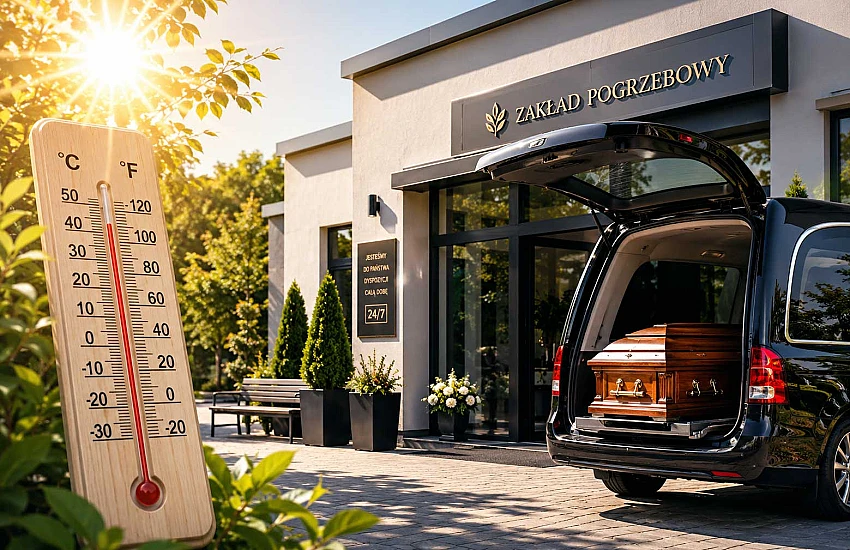
Two decades ago, truly oppressive heat was treated across much of Europe as the exception – a few days a year to be waited out. Today the situation looks different. Periods of extreme heat appear regularly, last longer and cover an ever-larger area, including regions that once enjoyed a milder climate. For a funeral home this means that readiness for heat must be treated as a permanent element of planning rather than an ad-hoc reaction to the weather forecast.
Climate change and the seasonality of a funeral home's work
The growing frequency of heatwaves is changing the rhythm of work for funeral businesses. The season in which demands on the cold chain are highest is becoming longer and harder to predict. It is increasingly difficult to assume that hot days will fall solely in July and August – intense heatwaves now occur as early as May and can return well into September. Planning equipment purchases, servicing and staff leave schedules must account for this variability, because a cold-storage failure in the middle of a heatwave is a scenario that simply leaves no time for an emergency response.
Rising mortality and pressure on resources
Heatwaves are not only a technical problem – they are also periods of increased mortality, especially among the elderly, the chronically ill and those living alone. In practice this means that precisely when working conditions are at their most difficult, more deceased arrive at the funeral home than usual. This accumulation is particularly dangerous because it strikes two resources at once: the capacity of the cold storage and the availability of staff, which over the holidays is often reduced by leave. A funeral home that plans a reserve of refrigeration capacity and staffing with such peaks in mind will get through the hardest days far more easily.

What happens to the human body in high temperatures
Understanding why heat is so dangerous for a funeral home's work begins with the basics of post-mortem biology. Ambient temperature is one of the most important factors influencing the rate of change occurring in a body after death, and the difference between a cool and a hot room can mean an entirely different course for the whole process and an entirely different time frame in which the funeral home can operate.
The rate of post-mortem change and ambient temperature
Decomposition processes are driven by enzymatic activity and the multiplication of microorganisms, and both phenomena accelerate as temperature rises. In a cool environment the changes progress slowly and predictably, giving the funeral home a comfortable time margin to complete formalities, contact the family and prepare the ceremony. In the heat, the same scope of change may take place in a fraction of that time. Cooling the body as quickly as possible from the moment of collection therefore becomes not a matter of convenience but an absolute priority that determines every subsequent organisational decision.
It is worth remembering that it is not only high temperature itself that has an adverse effect, but also humidity and restricted air flow. A technical room exposed to the sun for much of the day, without effective ventilation, can heat up to values significantly higher than the temperature outside. That is why, when planning readiness for heat, one must look not only at the refrigeration equipment but also at the conditions prevailing in the back-of-house rooms themselves.
Sanitary and hygiene risks during a heatwave
Accelerated post-mortem change brings a real sanitary risk. Higher microbiological activity means a greater burden on staff, more intense odours, the faster appearance of leakage and a greater risk associated with insects, which are exceptionally active in the heat. All of this translates into the need to rigorously follow hygiene procedures, more frequently disinfect work surfaces and transport equipment, and use personal protective equipment without exception. On hot days the margin for error in matters of hygiene is simply smaller, and the consequences of negligence appear more quickly.
The cold chain as the foundation of work in the heat
If there is one piece of equipment that determines the efficiency of the entire funeral home during a heatwave, it is a reliable and properly sized cold chain. All summer planning should be organised around it, because no procedure or goodwill on the part of the staff can replace a stable, low storage temperature.
The mortuary fridge as the heart of the back-of-house
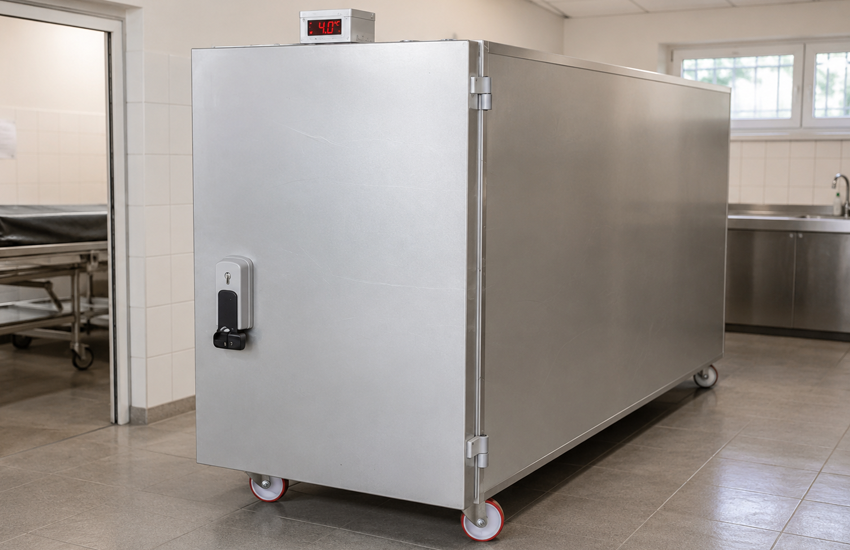
A professional mortuary refrigerator is the absolute foundation of a funeral home's readiness for heat. A good example of a solution matched to the realities of a medium-sized funeral business is the mortuary fridge for 2 bodies available from funeraryaccessories.com. Its walls are made of insulated panels, covered on the inside with stainless steel and on the outside with lacquered galvanised sheet, combining ease of hygiene maintenance with durability of construction. A built-in air cooler and a cooling unit powered at 230 V maintain a stable temperature that can be brought down to zero degrees as standard, and optionally, for an additional fee, even to minus three or minus five degrees – which during particularly intense heatwaves provides a valuable additional safety margin.
In everyday work, the design details also matter enormously. The fridge is fitted with solid wheels with brakes, so it can be positioned stably in a chosen spot or moved when needed, as well as primary and auxiliary trolleys that make loading the body easier. The doors close with a latch lock and key, with an emergency release from the inside, and the whole unit is operated via an intuitive control panel. The manufacturer covers the fridge with a twenty-four-month warranty and the cooling system with a twelve-month warranty, which at this class of equipment is a meaningful argument for an investment made with years of intensive use in mind.
When choosing a fridge for the heatwave season, it is crucial to think about capacity with a reserve. If in a typical week the funeral home handles a certain number of deceased, during a heatwave – overlapping with increased mortality and with holidays at neighbouring firms that redirect their overflow to others – that demand can rise sharply. A fridge sized strictly to average occupancy will serve well for most of the year, but at the peak of the season it may turn out to be a bottleneck. For larger firms it is worth considering higher-capacity models or combining several units, in order to avoid a situation in which space runs out precisely when it is needed most.
The functionality of the fridge can be further increased with the right accompanying equipment. Stainless steel trays make hygienic handling of bodies and keeping the interior clean easier, and the hydraulic trolley with a foot pump significantly streamlines loading and unloading, reducing the physical effort required of staff – which in the heat, when every additional exertion is more taxing, has considerable importance for safety at work.
The refrigerated catafalque and storage during the viewing
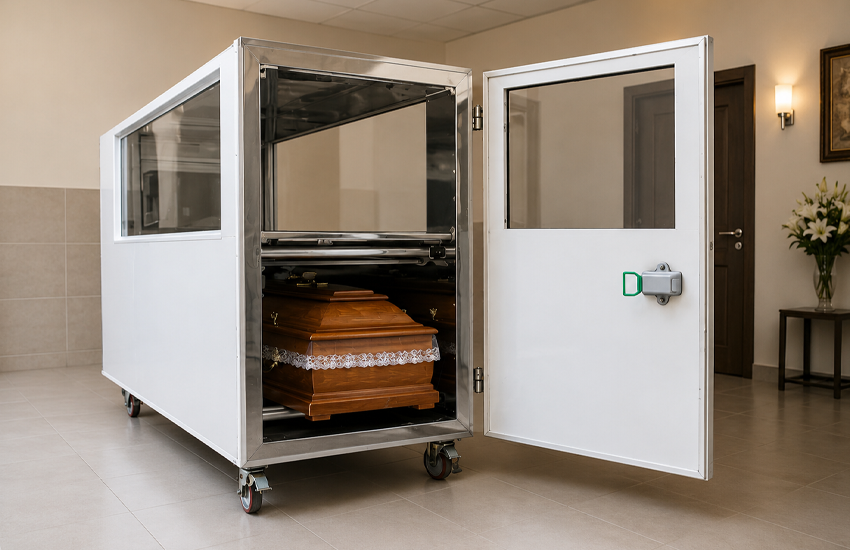
Heat complicates not only the storage of remains in the back-of-house but also the very organisation of the farewell, especially when the family wishes for a traditional viewing with an open coffin. In a hot chapel, keeping the body looking dignified for several hours becomes difficult, and at times outright impossible without active cooling. A solution that combines a technical function with the aesthetics of the ceremony is the refrigerated catafalque. It allows the coffin to be displayed in a manner befitting the solemnity of the moment, while keeping the body at a suitably low temperature during the lying-in-state. For funeral homes offering services at the highest level, such equipment can be the difference between a farewell conducted with full dignity and the need to shorten the ceremony because of the weather.
Redundancy, backup power and technical inspections
Heatwaves are periods in which power grids operate under enormous strain, partly because of the widespread use of air conditioning. The risk of power outages rises precisely when the continuous operation of the cold storage is most important. That is why serious planning for heat readiness should include backup power, for example in the form of a generator with output matched to the needs of the back-of-house, along with a clear procedure for what to do in the event of a failure. Redundancy is equally important – where possible, it is better to have more refrigeration spaces than current needs dictate, so that the failure of one unit does not mean the paralysis of the entire funeral home.
A seasonal technical inspection of the cooling systems should be carried out before the heat arrives, not during it. Among the things requiring a check are the tightness of doors and seals, the level of refrigerant, the cleanliness of the condensers and the accuracy of the control panel readings. A cooling unit clogged with dust or working in a heated, unventilated room loses efficiency exactly when it must work hardest. A short, planned inspection in spring is incomparably cheaper and less stressful than an emergency service call on a July weekend.
Transporting the deceased during a heatwave
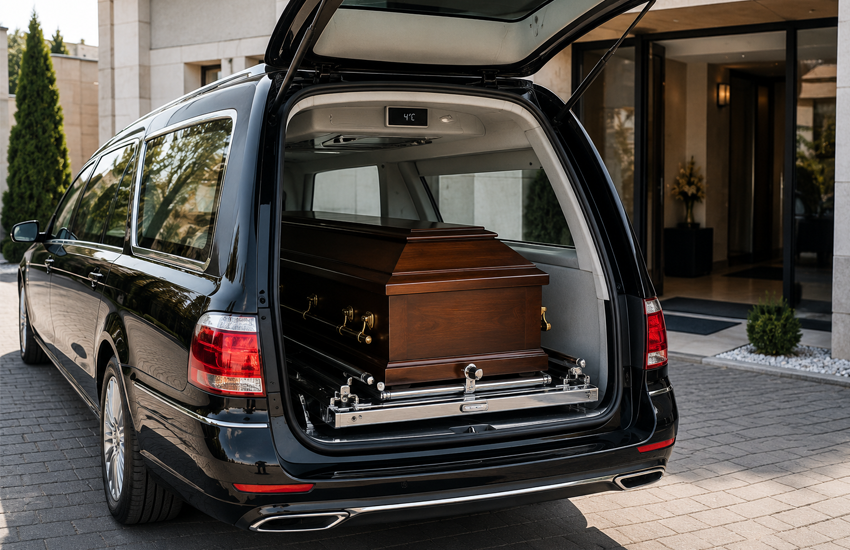
The second link that is put to a particular test in the heat is transport. It is during transport that the body is most often exposed to high temperature – in a heated vehicle, while waiting, on a long route, or in a situation where collection takes place from a location without any cooling whatsoever.
The challenges of short and long routes
Even a short journey on a hot day can be demanding, because the interior of the vehicle heats up rapidly and the temperature in the load space can considerably exceed that outside. In the case of long-distance transport – for example, repatriating a deceased person to their home town from the other end of the country – the problem multiplies, because the body remains outside controlled conditions for many hours. In such situations the key is to combine appropriate transport equipment with the shortest possible completion time and, where feasible, with cooling of the vehicle.
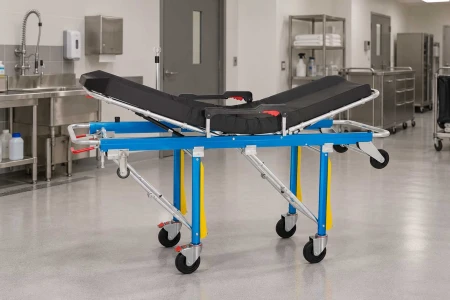
A proven solution that raises the safety and dignity of transport is the transport capsule from funeraryaccessories.com. Made of durable materials such as stainless steel and resilient plastics, it provides protection against the elements and mechanical damage, while its sealed construction limits the sanitary risk during transport. The capsule performs well both on short local routes and in transport over greater distances, and its intuitive handling makes loading and unloading easier even in difficult conditions. It is equipment that, combined with well-planned logistics, significantly reduces the impact of heat on the transport stage.
Planning logistics and shortening response times
During heatwaves, transport logistics take on new significance. The shorter the time between the call and collection, and between collection and placing the body in cold storage, the lower the risk of adverse change. In practice this means the need for an efficient on-call system, a clear division of tasks, and readiness of vehicles and equipment even before the heatwave begins. It is also worth planning routes so as to limit time spent stationary in full sun and, where possible, to carry out transports during the cooler parts of the day. Every hour saved is a real benefit for the quality of work and the peace of mind of the family.
Protecting the body – body bags and hygiene procedures
The third pillar of readiness for heat is the proper protection of the body and rigorous hygiene procedures. This is an area in which seemingly minor accessories have an enormous impact on staff safety, the cleanliness of the back-of-house and the dignity of the deceased.
Matching the bag to conditions and type of incident
A body bag is the basic element of protecting the body from the moment of collection, and in the heat its role grows further. A sealed, durable covering limits the spread of odours, protects against leakage and makes maintaining hygiene easier during both transport and storage. In the body bags offer at funeraryaccessories.com there are various variants matched to specific needs – from type C models with a round zip, through type P models with a straight zip, available in white and black versions, to a specialist exhumation bag for a coffin. Choosing the right type depends on the circumstances of the incident, the anticipated storage time and the requirements of a given procedure, and in heat conditions it is worth opting for solutions of the highest tightness and durability.
Bags made of durable materials, resistant to mechanical damage, are especially valuable when a body has to be moved repeatedly or transported over a greater distance. A stock of bags of various types, prepared before the season, is one of the simplest and least expensive elements of readiness, and at the same time it delivers a measurable improvement in safety at work.
Disinfection procedures and staff protection
In the heat, hygiene procedures cannot be treated as a formality. More frequent and more thorough disinfection of work surfaces, transport equipment and the interior of the cold storage reduces the sanitary risk, which builds up faster in warm conditions. Staff should have constant access to personal protective equipment and to disinfectants, and the procedures for handling a body in conditions of elevated temperature should be clearly described and known to all employees. The protection of the workers themselves against the effects of heat is no less significant – access to water, the chance to recover in a cooler room, and a sensible organisation of physical work during the hottest hours of the day translate directly into the safety and quality of the tasks performed.
Organising ceremonies and serving families during heatwaves
Technical readiness is one thing, but heatwaves also affect the course of the ceremonies themselves and the comfort of those taking part in them. A professional funeral home takes both of these dimensions into account, because a ceremony conducted in difficult weather conditions calls for particular sensitivity and organisation.
Shortening the time between death and burial
On hot days it is reasonable, in agreement with the family and with respect for its expectations and the formal requirements, to aim for the smoothest possible completion of the whole process. The shorter the time from death to burial or cremation, the lower the dependence on the capacity of the cold chain and the lower the risk of adverse change. This is not about haste at the expense of dignity, but about thoughtful organisation that eliminates unnecessary delays and allows the family to bid farewell to their loved one in dignified conditions.
Comfort and safety of ceremony participants
Heat poses a real threat to the health of mourners, among whom there are often elderly and infirm people, particularly susceptible to overheating and dehydration. When organising a farewell on a hot day, it is worth ensuring shaded spaces, access to water and, where possible, holding the most important parts of the ceremony during cooler hours. Funeral tents providing shade over the burial site, chairs for those who cannot stand for long, and a thoughtful shortening of the most demanding parts of the ceremony are elements of care that families appreciate and remember. The safety of participants is just as important here as the technical protection of the body.
Preparing staff for extreme conditions
Getting through a heatwave smoothly ultimately depends on people. Staff should know how to act in conditions of elevated temperature, be familiar with the emergency procedures in case of cold-storage overload or a power outage, and understand why shortening response times matters so much in this period. It is worth running a short briefing on the rules before the heat arrives, making sure everyone knows the location and operation of the emergency equipment, and ensuring a sensible schedule that accounts for the burden of physical work on hot days. A well-prepared team works calmly and effectively even when conditions are demanding.
A readiness review before the heatwave season
The best time to prepare a funeral home for extreme heat is early spring, when there is still time for purchases, servicing and any filling of gaps. It is then worth looking holistically at the three pillars of readiness. First, the cold chain – whether the capacity of the units is sufficient with a reserve, whether the devices have passed their technical inspection and whether there is a plan in case of a failure or power loss. Second, transport – whether the vehicles and transport capsules are operational and ready, and whether the on-call system allows for a quick response. Third, protection and hygiene – whether the stock of body bags, disinfectants and personal protective equipment is adequate, and whether the procedures are known to the entire team.
Such an orderly approach means that the arrival of a heatwave is not a source of chaos but a predictable situation for which the funeral home is simply prepared. Investment in solid equipment and well-considered procedures pays off not only in peace of mind during the hottest weeks but also in the trust of families, who in the most difficult moments can count on professional, dignified service regardless of the weather.

Frequently asked questions
How quickly should a body be cooled during a heatwave?
Cooling should take place as quickly as possible from the moment of collection, because in high temperatures post-mortem change progresses far faster than in a cool environment. The shorter the time between collection and placing the body in a mortuary fridge, the better the quality of the subsequent work is safeguarded. In practice, during a heatwave, cooling is treated as an absolute priority to which the logistics of collection and transport are subordinated.
What mortuary fridge temperature is appropriate during a heatwave?
As standard, mortuary refrigerators for storing remains maintain a temperature close to zero degrees, which under typical conditions is fully sufficient. Some units, such as the mortuary fridge for 2 bodies from funeraryaccessories.com, allow the temperature to be optionally lowered to minus three or minus five degrees, which during particularly intense heatwaves or longer storage provides an additional safety margin. The choice of a specific temperature depends on the situation and the anticipated storage time.
Will an existing cold storage unit be enough at the peak of summer?
That depends on the ratio of its capacity to actual occupancy on the most difficult days. Heatwaves often coincide with increased mortality and the holiday period, which can sharply raise demand for refrigeration spaces. If the fridge is sized strictly to average needs, it may prove insufficient at the peak of the season. It is worth planning capacity with a reserve or providing for the possibility of expanding with additional units.
How can long-distance transport of a deceased person be protected in the heat?
The key is to combine appropriate equipment with the shortest possible completion time. A sealed transport capsule made of durable materials protects against the elements and limits the sanitary risk, while planning the route so as to minimise stops in full sun and to use the cooler parts of the day further improves the safety of transport. Where possible, long-distance transport is worth carrying out in a vehicle with a cooled load space.
What should be done in the event of a power or cold-storage failure during a heatwave?
The best answer is preparation in advance. Backup power in the form of a generator with appropriately matched output makes it possible to keep the cold storage running even during a power outage, which is more likely in the heat because of grid overload. Equally important are redundancy of refrigeration spaces and a clear procedure for what to do in the event of a failure, so that the team knows exactly how to respond before the situation becomes critical.
Which body bags perform best in high temperatures?
In heat conditions, sealed bags made of durable materials resistant to mechanical damage perform best, limiting the spread of odours and the risk of leakage. The funeraryaccessories.com offer includes various types of bags – with round and straight zips, in white and black versions, as well as specialist exhumation bags. The choice of a specific model depends on the circumstances of the incident and the anticipated time and manner of storing the body.
When is the best time to prepare a funeral home for the heatwave season?
The optimal moment is early spring, when there is still time for a technical inspection of the cooling systems, any equipment purchases, replenishing stocks of accessories and discussing procedures with staff. Preparing equipment and procedures during an ongoing heatwave is considerably more difficult and stressful, which is why it is worth treating heat readiness as an element of year-round planning rather than a reaction to the current forecast.
Summary
Extreme heatwaves are a challenge for the funeral industry that will recur ever more frequently, which is why the best strategy is systematic preparation rather than an ad-hoc response. A reliable cold chain, sized with a reserve, built around a professional mortuary fridge and supported by backup power, forms the foundation of readiness. Well-planned transport using a sealed transport capsule, together with consistent hygiene procedures and the right choice of body bags, complete the picture of a funeral home that copes even in the most difficult conditions. Care for the comfort of ceremony participants and the preparation of staff mean that the heat, though it remains a demanding adversary, does not strip a funeral home's work of its most important quality – dignity towards the deceased and their loved ones.