Table of Contents
- Scissor Trolleys – Elegance and Functionality in Chapels
- Terrain Trolleys – Reliability in All Conditions
- Folding Trolleys – Mobility and Space Saving
- Trolley and Drape Sets – Comprehensive Solution
- Criteria for Selecting Trolley to Establishment Specifics
- Maintenance and Keeping Trolleys in Readiness
- Safety Working with Funeral Trolleys
- Innovations in Contemporary Trolley Construction
- Market Trends and Future of Funeral Trolleys
- Summary of Practical Selection Aspects
- Frequently Asked Questions
Transporting a casket during a funeral ceremony requires not only dignity and respect but also appropriate technical preparation. Choosing the right funeral trolley can determine the comfort of funeral home staff's work and the smooth flow of the ceremony. Modern funeral home equipment offers a wide selection of solutions adapted to various terrain and spatial conditions, so it's worth understanding the specifics of individual models before making a purchase decision.
Funeral trolleys differ not only in construction and aesthetics but primarily in functionality under specific conditions. One model will work well in a spacious chapel with smooth floors, while a completely different one is needed on the uneven terrain of a cemetery located on a hill. Knowledge of these differences allows for conscious investment in funeral equipment that will serve for years without failure and the need for frequent repairs.
Scissor Trolleys – Elegance and Functionality in Chapels
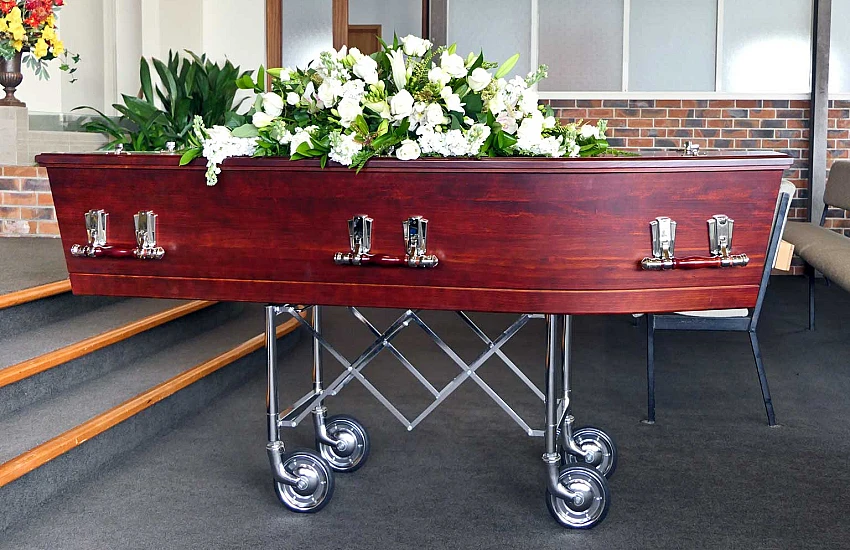
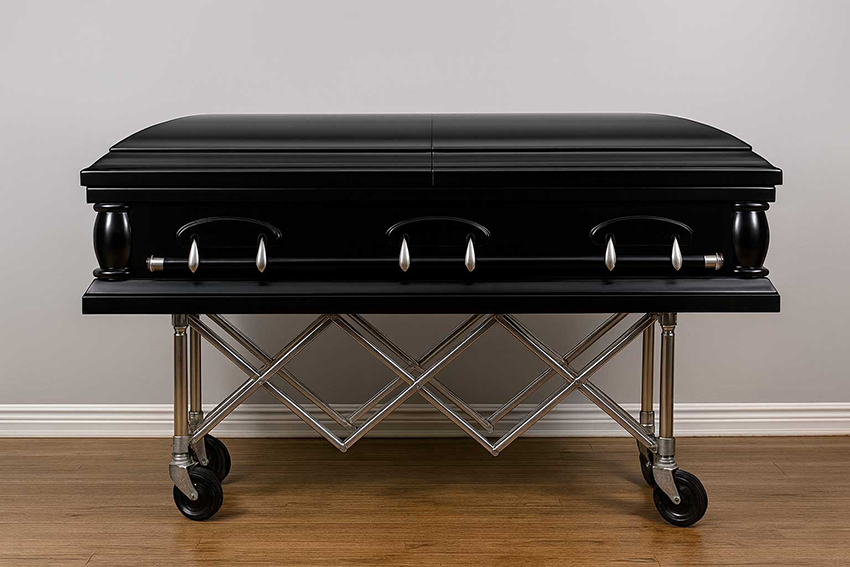
Scissor trolleys form the foundation of every professional funeral home's equipment. Their characteristic construction is based on a scissor mechanism that enables smooth height adjustment of the platform. This solution works perfectly in enclosed spaces where precision and aesthetic appearance of the equipment are required.
The operating mechanism of a scissor trolley is based on a system of arms forming the characteristic X shape. During deployment, these arms gradually straighten, raising the trolley's deck to the appropriate height. This process can occur manually by lifting the platform or using a hydraulic mechanism in more advanced models. Standard working height ranges from approximately sixty centimeters in the folded position to even one hundred centimeters when fully extended, allowing perfect adaptation to various spatial conditions.
The solid construction of scissor trolleys is made from steel or aluminum, which guarantees longevity and stability. Aluminum models are characterized by lower weight, making them easier to maneuver in tight spaces, while steel versions offer even greater load capacity and mechanical durability. The trolley deck is usually covered with non-slip material, which prevents the casket from shifting during transport.
A key aesthetic element of the scissor trolley is the possibility of using a drape, an ornamental fabric covering. The drape not only gives the trolley an elegant appearance but also conceals its technical construction, which is particularly significant during ceremonies in chapels or churches. Contemporary drapes are made from high-quality stain-resistant materials in various colors, most commonly burgundy, black, navy blue, or dark green. Thanks to thoughtful construction with velcro fasteners and grommets, the drape can be quickly put on and removed, facilitating daily staff work.
The application of scissor trolleys finds its place primarily in funeral chapels, funeral homes, and churches. The smooth floors of these facilities ideally complement the wheel construction mounted in scissor trolleys, which are typically smaller and more precise than in terrain models. Standard rubber wheels with a diameter of approximately ten centimeters ensure quiet and smooth trolley guidance through interior spaces.
During chapel ceremonies, the scissor trolley serves as a catafalque on which the casket rests. The ability to adjust height allows positioning the casket according to the room's specifics and the deceased's family preferences. It's also worth noting models with wheel-locking capability, which increases stability when the trolley is set in the ceremony location.
Premium scissor trolley models are equipped with additional aesthetic elements such as gold-plated or silver-plated handle finishes, decorative legs, or more refined folding mechanisms. Some funeral homes also invest in sets consisting of a trolley and dedicated premium drape with fringe, creating a cohesive visual composition during ceremonies.
Terrain Trolleys – Reliability in All Conditions
Casket transport in cemetery areas places completely different requirements on funeral equipment than work in enclosed spaces. Uneven paths, stone walkways, grassy slopes, or hilly terrain require the use of trolleys specially designed for such conditions. Terrain trolleys, also called cemetery trolleys, are the answer to these challenges.
The main distinguishing feature of terrain trolleys is the wheel construction. Significantly larger wheels with diameters often exceeding twenty centimeters, made from durable rubber or foam-filled, allow overcoming terrain obstacles without losing stability. Wider tires increase the contact surface with the ground, preventing the trolley from sinking into soft soil or sand. Many models also use treaded wheels that improve traction on wet surfaces.
The frame construction of terrain trolleys is more massive and reinforced compared to scissor trolleys. Steel profiles with greater wall thickness and additional reinforcements in the most stressed areas guarantee that the trolley will withstand not only the weight of the casket but also stresses resulting from travel over uneven terrain. The load capacity of standard terrain trolleys typically ranges from two hundred to three hundred kilograms, ensuring safe transport of even the heaviest caskets.
An essential element of terrain trolleys is the brake system. Strong foot brakes placed near the rear wheels allow for secure stopping of the trolley even on slopes. In models intended for work on highly varied terrain, brakes acting on all wheels are used, which significantly increases safety during standstill on sloped cemetery paths.
The height of terrain trolleys typically doesn't undergo adjustment to the extent as in scissor models, which results from the priority significance of stability over flexibility. Standard transport platform height is approximately eighty centimeters, representing a compromise between loading convenience and stability during movement. Some models have limited height adjustment capability allowing for adaptation by several centimeters.
Handles in terrain trolleys are typically distributed at the four corners of the construction, enabling the trolley to be guided by more people. This is particularly useful when overcoming difficult route sections, where additional help allows maintaining full control over transport. Ergonomic handles covered with non-slip material ensure a secure grip even in wet conditions.
The application of terrain trolleys extends beyond the cemetery itself. They are often used also during outdoor ceremonies where smooth paths transform into grassy slopes. In winter funeral situations, when cemeteries are covered with snow or ice, terrain trolleys constitute an indispensable solution. Their stable construction and developed wheel system ensure safe transport even in the most difficult atmospheric conditions.
Many funeral homes decide to have both scissor trolleys for chapel work and terrain trolleys for cemetery transport. Such a set guarantees operational versatility and the ability to adapt equipment to a specific situation. However, it's worth remembering that some models combine features of both types, offering a compromise between the elegance of scissor trolleys and terrain functionality.
Folding Trolleys – Mobility and Space Saving
Contemporary funeral homes often operate under conditions of limited storage space, which forces seeking solutions optimizing available space utilization. Folding trolleys are the answer to these needs, combining full functionality with compact storage capability.
The trolley folding mechanism consists of reducing the construction height by folding the scissor mechanism or rolling up the support arms. In the folded state, trolley height typically decreases to approximately thirty centimeters, allowing storage of several units stacked one on another. Such a solution enables saving even seventy percent of storage space compared to traditional non-folding models.
The unfolding and folding process has been designed to be intuitive and quick. In most models, it's sufficient to unlock the safety catch, raise the platform, and snap the mechanism into the working position. The entire operation typically takes less than thirty seconds, which doesn't negatively affect ceremony organization efficiency. Safe locking mechanisms guarantee that the trolley won't accidentally fold during use.
Despite compact construction, folding trolleys don't yield in durability to their non-collapsible counterparts. Materials and reinforcements used in them ensure load capacity at a minimum level of two hundred kilograms, sufficient for safe transport of standard caskets. However, it's worth paying attention to the precision of folding mechanism execution, because frequent use can lead to wear of moving elements if they're not of appropriate quality.
Folding trolleys find application particularly in smaller funeral homes that handle a small number of daily ceremonies and don't have spacious warehouses. They're also a popular choice for companies starting operations, for whom minimizing initial infrastructure costs is significant. The mobility of these trolleys makes them easy to transport between different locations, which can be useful when servicing ceremonies in distant localities.
Some folding trolley models have been designed with versatility of application in mind. Equipped with larger wheels and reinforced constructions, they can fulfill functions of both indoor and terrain trolleys. Although their capabilities in difficult terrain are limited compared to dedicated cemetery trolleys, they constitute a reasonable compromise for establishments seeking one universal solution.

Trolley and Drape Sets – Comprehensive Solution
Purchasing a funeral trolley together with a dedicated drape constitutes an increasingly popular solution among funeral homes caring about visual cohesion of equipment. Sets combining a scissor trolley with high-quality covering offer not only financial savings compared to purchasing separate elements but also guarantee perfect component fitting.
The drape, being a fabric covering of the trolley, plays a key role in giving the ceremony appropriate aesthetic framing. Made from high-grade fabrics, often with addition of satin or velvet, the drape masks the trolley's technical construction, presenting elegant covering in a color matched to the ceremony character. Standard drape dimensions are typically one hundred fifty centimeters length, sixty centimeters width, and fifty-five centimeters height, though custom-sized drapes are also possible.
Contemporary drape construction takes into account practical aspects of daily use. A velcro system placed on corners prevents the material from tangling in wheels during transport, which was a common problem in older solutions. Grommets allow stable attachment of the drape to the trolley construction, eliminating the risk of covering sliding during ceremonies. Gathered finishing with sewn-in elastic automatically adjusts to different trolley lengths, meaning one drape can service a trolley in both maximally extended and shortened positions.
Premium drapes are equipped with additional decorative elements such as fringe in gold or silver color and ornamental central strips emphasizing the entire composition's elegance. Materials used for their execution are characterized by stain-resistant properties, significantly facilitating cleanliness maintenance. In most cases, it's sufficient to wipe the drape with a damp cloth to remove any soiling, and the material doesn't require ironing thanks to appropriate synthetic fabric application.
Trolley and drape sets are offered in various color variants adapted to regional traditions and funeral home preferences. The most popular colors are burgundy, black, dark green, and navy, though ordering drapes in other shades is also possible. Some manufacturers offer drape personalization through embroidering the funeral home's logo or other graphic elements, allowing distinction in the local funeral services market.
When deciding on a set purchase, it's worth paying attention to dimensional compatibility. The drape should be matched to the specific trolley model to ensure perfect fit and aesthetic appearance. Manufacturers typically offer drapes dedicated to their trolley models, guaranteeing optimal fitting of all elements. In the case of having trolleys from different manufacturers, ordering custom-made drapes that will account for the specific model's construction is possible.
Criteria for Selecting Trolley to Establishment Specifics
Choosing an appropriate funeral trolley should take into account a number of factors related to the establishment's operational specifics and conditions under which the equipment will be exploited. The first step is analyzing typical usage scenarios and identifying the most frequently appearing operational challenges.
Funeral homes operating mainly in urban areas, where ceremonies take place in spacious chapels equipped with smooth floors, should focus on scissor trolleys offering wide height adjustment possibilities. Aesthetics plays a particularly important role here, so it's worth considering premium models with elegant finishes and complete sets with drapes. Folding mechanism functionality can be an additional asset if storage space is limited.
In the case of establishments servicing rural and small-town areas, where cemeteries often are characterized by uneven terrain configuration, terrain trolleys become the priority. Here the key significance lies with large wheels with deep tread, solid frame construction, and efficient brakes. It's also worth considering having at least two terrain trolleys to ensure operational continuity in the event of failure or simultaneous servicing of several ceremonies.
Usage frequency directly translates to equipment durability requirements. Establishments conducting several daily ceremonies should invest in trolleys made from highest-quality materials, where every construction element has been designed with intensive exploitation in mind. Adjustment mechanisms, wheels, and bearings should be characterized by increased wear resistance. In such cases, seemingly higher purchase price quickly returns through longer equipment lifespan and lower servicing costs.
The terrain specifics where the establishment operates has fundamental significance for selecting the appropriate model. Mountain and hilly areas require trolleys with increased stability and strong brakes. Seaside areas, where air is characterized by high salt content, should be serviced by trolleys made from corrosion-resistant materials, preferably stainless steel or aluminum with appropriate protective coatings. Cemeteries located in forests or parks, where paths lead through unpaved areas, require terrain trolleys with maximally developed suspension systems.
Ergonomic aspects have a direct impact on staff work comfort and safety. Appropriate handle height, their shape, and non-slip covering prevent hand fatigue during prolonged trolley guidance. The ability to adjust platform height allows adapting working position to individual needs of employees of different heights. Trolleys equipped with swivel wheels enable precise maneuvering in tight spaces without the necessity of lifting one end of the construction.
Maintenance and Keeping Trolleys in Readiness
Professional funeral equipment requires systematic maintenance to retain full functionality through long years of use. Regular technical inspections and appropriate care of individual trolley elements prevent failures at the least expected moments and extend equipment lifespan.
The basic element of maintenance is maintaining cleanliness of all trolley surfaces. After each use, it's worth wiping the frame and platform with a damp cloth to remove dust and any soiling. Particular attention should be paid to hard-to-reach places where dirt can accumulate affecting the operation of moving mechanisms. Application of neutral cleaning agents guarantees that protective coatings or chromed elements won't be damaged.
Folding and height adjustment mechanisms require periodic lubrication to maintain smooth operation. Using dedicated technical greases with non-dusting properties that won't attract contaminants is recommended. Lubrication frequency depends on usage intensity, but as a standard, performing this activity at least once per quarter can be adopted. In the case of daily-used trolleys, this interval should be shorter.
Wheels constitute the element most exposed to wear, so they require special attention. Regular inspection of tire condition, checking pressure in pneumatic wheels, and verifying bearing condition should be part of routine servicing. Any rubber cracks, excessive tread wear, or play in bearings should be repaired immediately to prevent more serious damage. It's also worth periodically checking brake operation, adjusting their pressure according to manufacturer recommendations.
Storing trolleys under appropriate conditions significantly affects their durability. Storage rooms should be dry and protected from extreme temperatures. Humidity promotes corrosion development, particularly in the case of trolleys with steel construction. If the establishment doesn't have an optimal warehouse, considering application of protective covers securing equipment from dust and moisture is worth it.
Drapes and fabric coverings also require regular care. Despite contemporary materials being stain-resistant, systematic cleaning prevents permanent dirt settling. Most drapes can be cleaned through hand washing in lukewarm water with addition of delicate detergent, then they should be left to dry in an extended position. Avoiding high temperatures during drying prevents material deformation and elastic construction element damage.
Documenting performed maintenance activities allows monitoring equipment technical condition and planning replacement of worn components. A simple service log in which inspection dates, performed activities, and observed problems are noted facilitates equipment management and allows quick identification of recurring faults requiring service intervention.

Safety Working with Funeral Trolleys
Casket transport using a funeral trolley involves specific hazards, awareness of which and knowledge of safety procedures are crucial for protecting funeral home workers' health. Proper equipment utilization and adherence to ergonomic principles minimizes injury and accident risk.
The most basic principle is observing the trolley's permissible load capacity. Construction overload not only increases risk of equipment damage but primarily threatens loss of stability and transport control. Before each use, it's worth verifying whether the combined mass of casket together with the deceased's body fits within the given model's capacity parameters. Standard trolleys are designed for approximately two hundred fifty kilogram loads, while reinforced models can safely transport even three hundred kilograms.
Proper weight distribution on the trolley platform has key significance for maintaining balance. The casket should be positioned centrally so that the center of gravity falls on the platform's geometric center. Asymmetric placement can lead to trolley tipping, particularly when overcoming terrain irregularities. In the case of scissor trolleys, proper locking of the height adjustment mechanism before transport commencement is also important.
Trolley guidance requires concentration and environmental awareness. On uneven terrain, utilizing all available handles and guiding the trolley by at least two people is recommended, which ensures better direction control and allows quick reaction in a threat situation. Movement pace should be adapted to terrain conditions – on steep descents or uneven surfaces, slowing is necessary to prevent uncontrolled acceleration.
Special caution should be observed when overcoming thresholds, steps, or curbs. Funeral trolleys are not designed for overcoming larger vertical obstacles, and attempts to drive onto a high threshold can lead to construction tipping or mechanism damage. In such situations, tilting the trolley and carefully driving one wheel axle at a time or, if possible, choosing an alternative route is recommended.
Atmospheric conditions affect transport safety. Wet cemetery paths become slippery, which reduces wheel traction and extends braking distance. In winter, icing is an additional threat that can lead to slipping even during slow trolley guidance. In difficult conditions, considering application of special wheel overlays increasing traction or using anti-slip agents on dangerous route sections is worth it.
Regular staff training in safe funeral trolley use should be standard in every professional establishment. Workers must know not only basic trolley guidance principles but also emergency situation procedures. Simulations of various scenarios, from stability loss to wheel immobilization, allow developing appropriate reflexes and minimize panic risk in an actual crisis situation.
Innovations in Contemporary Trolley Construction
The funeral home equipment industry continually develops, introducing innovative technological solutions aimed at increasing work comfort and transport safety. Contemporary funeral trolleys significantly differ from models from a decade ago, offering functions adapted to modern expectations and standards.
One development direction is electric lifting systems that eliminate the necessity of manually folding and unfolding the scissor mechanism. Compact electric motors powered by batteries allow smooth platform height adjustment using a simple control panel. This solution significantly reduces workers' physical burden, particularly in establishments conducting many daily ceremonies. Contemporary lithium-ion batteries ensure sufficient capacity for conducting several dozen lifting cycles with one charging.
Advanced suspension systems constitute another innovation area. Traditional trolleys relied solely on tire elasticity, which wasn't always sufficient on very uneven terrain. Newer models are equipped with additional shock-absorbing elements placed in platform suspension, which effectively dampen vibrations and impacts during transport. This solution has particular significance for maintaining ceremony dignity, minimizing visible trembling and jerking during trolley guidance for participants.
Composite material development allowed creating trolleys combining low own weight with high mechanical durability. Carbon fiber application in key construction elements reduces trolley mass even by thirty percent compared to traditional steel models, while maintaining or even increasing load capacity. Lighter trolleys are easier to maneuver, which translates to less staff fatigue and greater precision during positioning.
Intelligent safety systems introduced in the newest trolley models include electronic overload sensors, automatic lifting mechanism locks, and systems warning about improper weight distribution. Although these solutions increase initial purchase cost, they significantly raise the safety level and can prevent costly accidents and equipment damage.
Modular construction of some contemporary trolleys allows easy configuration adaptation to changing needs. The ability to exchange standard wheels for terrain ones, add or remove decorative elements, or mount additional accessories makes one trolley model a universal tool useful in various situations. Such an approach is particularly attractive for smaller establishments that prefer having one but versatile solution instead of several specialist models.
Market Trends and Future of Funeral Trolleys
Observing the funeral accessories market development, clear tendencies shaping the future of funeral trolley construction and functionality can be noticed. Growing client expectations toward ceremony quality, changing regulations, and technological progress designate directions of this funeral home equipment segment's evolution.
Ecological approach to production becomes increasingly visible in funeral equipment manufacturers' offerings. Utilizing materials from recycling, applying water-based paint coatings, and designing constructions with later disassembly possibility and component reuse responds to the industry's growing ecological awareness. Some manufacturers already offer old trolley return programs, which after renovation go to resale or are broken down into parts used in new products.
Equipment personalization becomes a standard expected by funeral homes wishing to distinguish themselves in a competitive market. The ability to order trolleys in non-standard colors, with engravings or special finishes allows creating cohesive visual identification of the establishment. Some companies also offer execution of drapes with printed patterns or embroidered logos, contributing to brand recognition building.
Information technology integration with funeral home equipment may seem futuristic, but first solutions already appear in the market. Trolley location tracking systems within extensive cemetery complexes, electronic maintenance protocols saved in the cloud, or mobile applications allowing quick ordering of spare parts are examples of development directions. In the future, we can expect even broader IoT technology implementation in funeral equipment.
Demographic change of societies and extending average life span translates to growing demand for trolleys with increased load capacity. Manufacturers respond to this trend by introducing reinforced models designed for loads exceeding three hundred kilograms, while simultaneously maintaining ergonomics and guidance ease. These solutions become standard particularly in Western markets, where the obesity problem affects an increasingly larger population part.
Standardization of dimensions and connection interfaces between different funeral equipment elements may in the future facilitate composing sets from different manufacturers. Similar to the automotive industry, where specific norms allow part interchangeability, also in the funeral equipment sector initiatives appear aiming at key parameter unification. Such situation development would simplify spare part logistics and increase establishment flexibility in equipment management.
Summary of Practical Selection Aspects
The decision to purchase a funeral trolley should be preceded by thorough analysis of specific establishment needs and conditions under which equipment will be exploited. There doesn't exist one universal solution ideal for all situations, so it's worth devoting time to thoughtful consideration of available options.
The basic selection determinant is the type of terrain where the establishment most frequently conducts ceremonies. Activity concentrated on enclosed spaces and well-paved cemetery paths allows investment in elegant scissor trolleys offering wide adjustment possibilities and aesthetic finishes. On the other hand, servicing hilly, gravel, or ground terrains requires priority treatment of terrain functionality over aesthetics.
Establishment size and number of conducted ceremonies directly affects equipment durability requirements and the need for having backup equipment. Large funeral homes servicing several daily ceremonies should have at least three trolleys of different types, ensuring operational continuity even in case of one's failure. Smaller establishments can efficiently function with one or two trolleys, provided choosing models with proven reliability.
Financial aspects, though important, shouldn't be the sole decision criterion. A funeral trolley is an investment for years, and savings during purchase can lead to higher operational costs related to more frequent repairs or the necessity of earlier replacement. Models from reputable manufacturers, though more expensive to purchase, often prove more economical in longer perspective thanks to higher execution quality and spare part availability.
The ability to test equipment before purchase offered by some suppliers constitutes a valuable opportunity to verify whether a given model truly meets expectations. A short trial period allows ergonomics assessment, functionality checking in real conditions, and identification of possible problems before making a final decision. It's worth taking advantage of such possibility if available.
View the complete funeral trolleys offer and choose the ideal model for your establishment.
Frequently Asked Questions
What is the average durability of a funeral trolley with intensive use?
A properly maintained funeral trolley can serve from ten to fifteen years with daily use. Key significance lies with material execution quality and systematic service maintenance. Trolleys with reinforced steel construction and stainless steel elements show even longer lifespan, often exceeding twenty years. Wheels and bearings wear fastest, which with intensive exploitation may require replacement every three to five years. Folding mechanisms in scissor models also undergo gradual wear, but with proper lubrication maintain functionality throughout the trolley's usage period. It's worth remembering that durability significantly decreases when equipment is overloaded or exploited under conditions exceeding its technical specification.
Can one trolley replace the need for having different models?
Theoretically, universal models exist combining scissor and terrain trolley features, however in practice no single trolley achieves full functionality of specialist solutions. A universal trolley will work as basic equipment for a small funeral home, but larger companies servicing diverse terrains should have at least two equipment types. A scissor trolley with larger wheels can operate on moderately uneven terrain, but on steep cemetery paths or in marshy ground its capabilities will be limited. Similarly, a terrain trolley can function in a chapel, but its massive construction and lack of elegant finishes may contrast with ceremony framing. The optimal solution for most establishments is having at least one scissor trolley for indoor use and one terrain trolley for cemetery work.
How often should technical inspections of trolleys be conducted?
Technical inspection frequency should be adapted to equipment usage intensity. Establishments conducting several daily ceremonies should perform basic visual inspection before each use, checking wheel condition, brake operation, and construction stability. Detailed technical inspection with all mechanism control, lubrication, and adjustment should be conducted at least once per quarter. In the case of lower usage intensity, a semi-annual interval between complete inspections may be sufficient. Regardless of schedule, the trolley requires immediate inspection after every situation that could result in damage, such as overturning, driving through a deep hole, or collision with an obstacle. Professional service specializing in funeral equipment should conduct in-depth technical control at least once yearly, even if the trolley shows no visible wear signs.
Do funeral trolleys require special certificates or homologation?
In most countries, funeral trolleys as professional equipment should meet general requirements concerning safety of products introduced to the market but aren't subject to specific industry certification or homologation. Manufacturers are responsible for their products' compliance with applicable technical norms, including ergonomic and strength requirements. It's worth paying attention to declarations of conformity attached to equipment, which confirm meeting appropriate standards. In an international context, trolleys exported to European Union countries should have CE marking confirming compliance with EU directives. For funeral homes, purchasing equipment from reputable manufacturers who can document their products' quality and provide technical support is crucial. Lack of certification requirements doesn't mean that execution quality is insignificant – on the contrary, a professional establishment should set high standards when selecting equipment.
How should drapes be stored to maintain aesthetic appearance?
Material drapes require proper storage to maintain color intensity and finish cleanliness through years. The best solution is storing drapes in a hanging position on special hangers enabling free material arrangement without creases. If such possibility doesn't exist, drapes can be folded loosely, avoiding strong crushing which could lead to permanent creases. The storage place should be dry, ventilated, and protected from direct sunlight action, which can cause color fading. Periodic, gentle drape cleaning prevents permanent dust and soiling settling. In the case of premium drapes with additional decorations such as fringe or embroidered elements, using protective covers guarding against mechanical damage of delicate details is worth it. Before a longer period of non-use, for example during the vacation season with fewer ceremonies, drapes should be thoroughly cleaned and stored in a way minimizing the risk of mold appearance or unpleasant odors.