Table of Contents
- Transport and Logistics in Difficult Winter Conditions
- Cemetery All-Terrain Trolley as the Foundation of Winter Equipment
- Protection Against Moisture and Frost Effects
- Lighting and Visibility in the Short Winter Day
- Ceremonial Tents and Canopies for Winter Weather
- Tools for Working with Frozen Ground
- Clothing and Protective Equipment for Personnel
- Storage and Organization of Winter Equipment
- Work Safety in Winter Conditions
- Client Communication in the Context of Winter Difficulties
- Cooperation with Cemetery Administrators
- FAQ
Winter months present funeral homes with unique challenges that require thoughtful logistics and proper equipment. Snow, ice, shorter days, and unpredictable weather don't change the fact that funeral ceremonies must proceed as planned, maintaining dignity and safety for all participants. Proper preparation of the warehouse for the winter season is not just a matter of work comfort, but above all a guarantee of smooth service delivery in the most difficult atmospheric conditions.
Funeral homes operating in Poland are well acquainted with the specifics of the winter season. Frost intensifying after dark, slippery cemetery pathways, muddy terrain after thaws, or deep snow hindering access to burial sites – this is the daily reality faced by funeral industry workers from November to March. During this period, not only team professionalism becomes particularly important, but also the quality of equipment that must perform in extreme conditions.
Preparing a funeral home for winter requires thinking through the entire logistics chain – from the moment of collecting the deceased from the place of death, through transport to cold storage and preparation for the ceremony, to final transport to the cemetery and conducting the burial. Each of these stages involves specific challenges that intensify during the winter period. Proper equipment not only maintains operational fluidity but also ensures staff safety and the dignity of the deceased.
Transport and Logistics in Difficult Winter Conditions
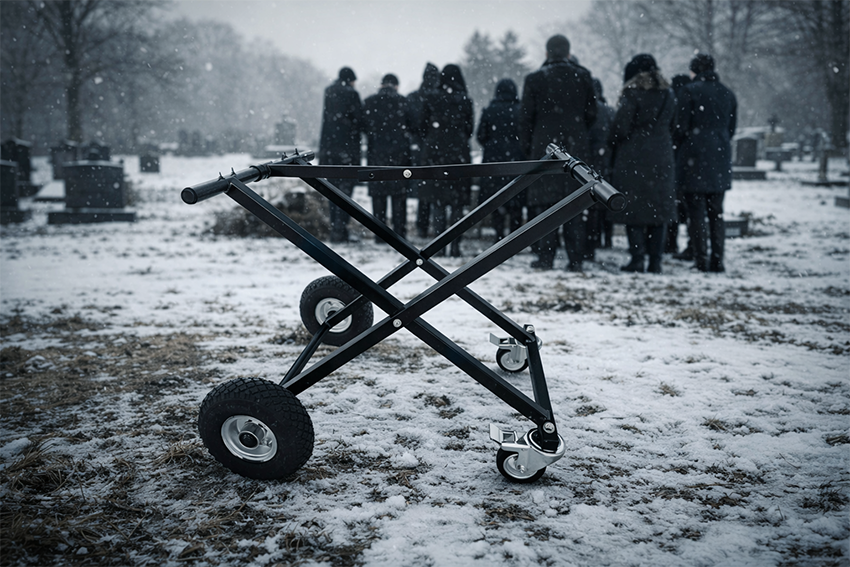
The winter specifics of funeral home operations are most evident in the area of transport and logistics. Classic solutions that work for most of the year may prove insufficient in the face of snow, ice, and mud. Transporting a coffin from the cemetery gate to the burial site on icy, uncleared pathways requires equipment with significantly higher parameters than standard trolleys designed for use on paved surfaces.
Cemetery Specifics in Winter Season
Cemeteries, especially historic ones located on hilly terrain, become true testing grounds for transport equipment in winter. Terrain irregularities that pose only minor obstacles in summer can completely prevent safe transport using standard equipment when covered with snow or ice. Paths running uphill or downhill, eroded by years of rain and snow, require trolleys with special characteristics.
Frozen ground is difficult to level and maintain in proper condition. Many municipal cemeteries lack funds for continuous snow removal from all paths, limiting themselves to main communication routes. This means that funeral homes must manage independently on the last stretch – from the paved pathway to the specific burial site, which may be several dozen meters away, on terrain covered with snow or post-snow mud.
Stability and Maneuverability of Equipment
In such conditions, the stability and maneuverability of transport equipment become crucial. The trolley must ensure not only safe coffin transport but also work comfort for the operators, who often must cover significant distances in uncomfortable conditions. Fatigue and cold staff represent a real risk that directly impacts service quality and ceremony safety.
Winter transport also involves specific requirements for protecting the coffin and decorations. Strong wind, snowfall, or sleet can destroy flower arrangements, soak ribbons, or damage the coffin surface. Proper equipment should consider the possibility of securing the transported cargo against weather conditions while maintaining a dignified and aesthetic overall appearance.
Cemetery All-Terrain Trolley as the Foundation of Winter Equipment
The heart of a funeral home's winter logistics is a solid trolley adapted for work in difficult terrain. This is not equipment that can be replaced with improvised solutions – its construction must meet the specific requirements posed by the winter season at Polish cemeteries. An all-terrain cemetery trolley is an investment that pays for itself during the first winter, eliminating transport problems and dramatically improving working conditions for teams conducting burials.
Pneumatic Wheels and Frame Construction
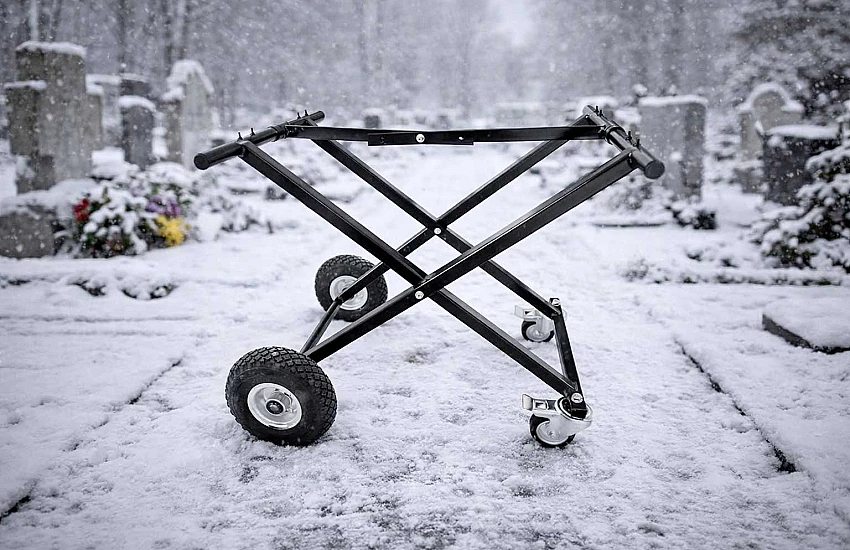
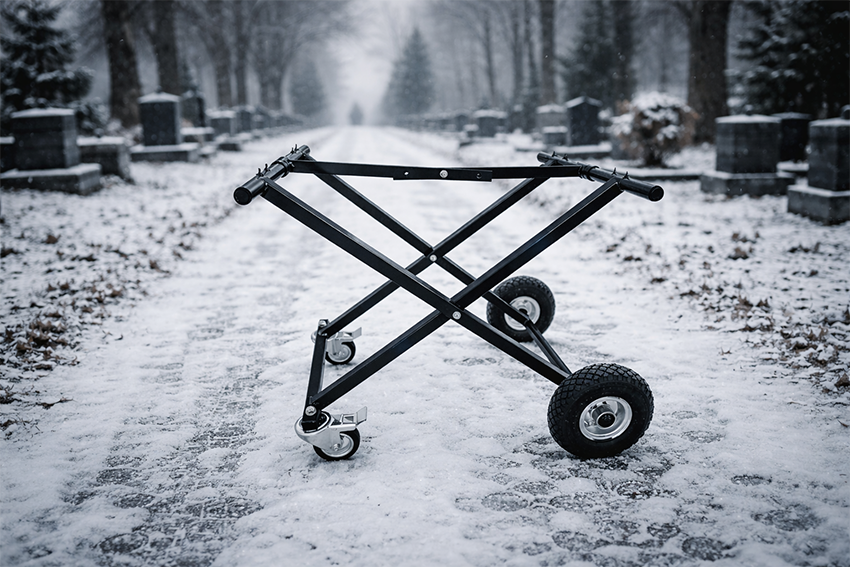
The all-terrain funeral trolley features a construction designed specifically for work on unpaved, slippery, and uneven surfaces. Its key element is pneumatic wheels of appropriate width and tread that ensure stability on muddy or icy surfaces. Unlike standard trolleys with small wheels, the all-terrain model doesn't sink into soft ground or slide on ice, allowing safe transport even in the most difficult conditions.
The frame construction in the all-terrain model accounts for increased loads and stresses occurring during navigation of irregularities. The reinforced steel construction withstands not only the weight of the coffin with the deceased's body but also additional forces arising during travel over uneven terrain, braking on slopes, or maneuvering in mud. Construction solidity translates directly into safety – both for staff operating the trolley and for the dignity of the deceased, whose transport must occur without shocks or risk of tipping.
Brake System and Safety
The brake system in an all-terrain trolley is another critical element for winter operation safety. Standard foot brakes may fail on icy surfaces or at significant terrain slope angles. A professional all-terrain trolley is equipped with a reliable braking system that allows safe stopping even on steep, slippery pathways. This is particularly important at older cemeteries with hilly topography, where level differences can be significant.
Ergonomics and Work Comfort
The ergonomics of operating an all-terrain trolley have been designed with long-term work in difficult conditions in mind. Handles positioned at appropriate height, the ability to guide from front or rear, and smooth rolling despite large wheels – all this translates into less staff fatigue and greater maneuvering precision. In winter conditions, when hands are stiff from cold and terrain is slippery, every ergonomic element matters for safety and work comfort.
The load-bearing surface of the all-terrain trolley should ensure stable and secure coffin placement regardless of its dimensions. Profiled supports or an adjustable mounting system guarantee that the coffin won't shift during transport over uneven terrain. In practice, this means peace of mind for operators and ceremony participants, who don't need to fear unexpected situations during the procession.
Many experienced funeral home owners emphasize that having at least one all-terrain trolley in equipment is the foundation of winter operational readiness. In the winter season, demand for this type of equipment naturally increases – not only due to weather conditions but also because winter months are characterized by statistically higher mortality, especially among the elderly. Having an appropriate trolley allows accepting orders even where other funeral homes decline due to logistical difficulties.
Protection Against Moisture and Frost Effects
Winter moisture represents one of the most insidious challenges for funeral homes. This isn't just about rain or snow, but ubiquitous moisture penetrating materials, destroying decorations, and creating uncomfortable conditions for all ceremony participants. Professional moisture protection is a series of thoughtful solutions that protect both equipment and ceremony setting elements.
Protective Covers for Coffins and Decorations
Protective coffin covers constitute a basic protection element during transport in precipitation conditions. Waterproof material protects the coffin surface from moisture and dirt, maintaining its aesthetic appearance until the ceremony. In practice, reusable covers that can be quickly applied during loading and removed just before the ceremony begins work well. A well-designed cover not only protects against moisture but also allows safe coffin carrying without risk of hands slipping on a wet surface.
Special protective materials for wreaths and flower arrangements gain particular importance during the winter period. Frost and moisture can destroy even the most beautiful floral composition within minutes. Transparent protective films, discreetly applied during transport, help maintain flower freshness and protect delicate petals from freezing. They can be quickly removed just before the ceremony, preserving the natural appearance of decorations.
Maintenance and Equipment Storage
Protection of technical equipment against frost and moisture effects requires a systematic approach. Metal equipment elements such as stands, handles, or trolley arms should be regularly maintained with anti-corrosion agents. Winter moisture combined with road salt, which inevitably reaches cemetery grounds, accelerates corrosion processes. Preventive maintenance performed in autumn helps avoid equipment failures at the least opportune moment.
Equipment storage during the winter period also requires proper organization. Equipment elements that aren't used daily should be located in a dry, secured room. Particular attention should be paid to fabrics – carrying straps, covers, decorative fabrics – which in a moist environment can become moldy or begin to rot. Proper warehouse ventilation and periodic checking of stored material condition are simple activities that help avoid costly losses.
Work footwear for staff is an often overlooked yet extremely important element of winter protection. Appropriate boots with reinforced soles with deep tread, waterproof and insulated, are not a luxury but a necessity. Workers spending hours in the cold, often in stationary positions during ceremonies, must have adequate thermal foot protection. Wet or frozen feet represent not only discomfort but real health risk and increased probability of slip-related accidents.
Lighting and Visibility in the Short Winter Day
Winter months are characterized by significantly shortened daylight, which directly affects funeral ceremony organization. In December, dusk falls around four o'clock in the afternoon, and many ceremonies must take place in conditions of limited visibility or after complete darkness. Proper lighting of the ceremonial space is not only a matter of aesthetics but above all safety for participants moving across potentially dangerous winter terrain.
Portable LED Lighting Systems
Portable LED lighting sets work excellently during ceremonies taking place at dusk. Their advantage is quick setup capability, low energy consumption, and cool light that doesn't pose a fire hazard even in direct contact with fabrics or tree branches. A well-selected lighting set allows creating an appropriate atmosphere while maintaining sufficient visibility for safe movement.
Lighting of the space around the grave gains particular importance during ceremonies taking place in the cemetery depths, far from main pathways. Spotlights mounted on tripods allow directing the light stream exactly where needed, avoiding participant blinding. A battery-powered system eliminates the need for cable routing and ensures independence from external energy sources, which is crucial in cemetery areas often lacking electrical installations.
Work Lighting for Teams
Flashlights and headlamps for workers are basic winter season equipment. Teams working on grave preparation, especially on cloudy, short winter days, need independent light sources allowing precise work. Headlamps leave hands free, which is invaluable during activities requiring tool use. High-power flashlights with hanging capability work well during tasks requiring illumination of a larger area.
Reflective marking of paths and ceremony area helps with spatial orientation at dusk. Discreetly placed reflective elements along the route from the main pathway to the ceremony location allow participants to safely reach their destination even when sunlight fades. This solution is particularly important at large, extensive necropolises where distances can be significant and terrain difficult to navigate.
Ceremonial Tents and Canopies for Winter Weather
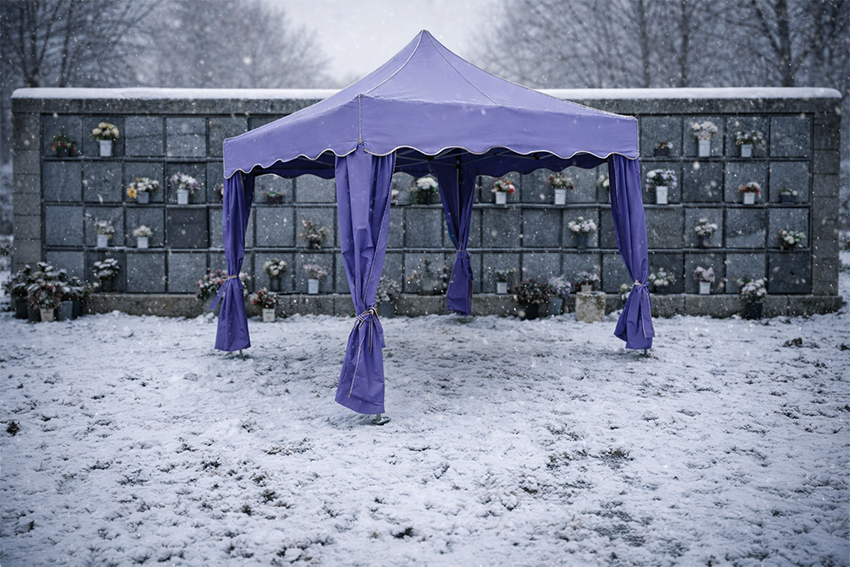
The unpredictability of winter weather makes securing the ceremonial space from precipitation and wind a necessity. Ceremonial tents are not only protection from snow or rain but also an element creating an intimate space of focus, separating participants from cold and blizzards. Professional canopy coverage allows conducting ceremonies with dignity regardless of weather whims.
Tent Construction and Materials
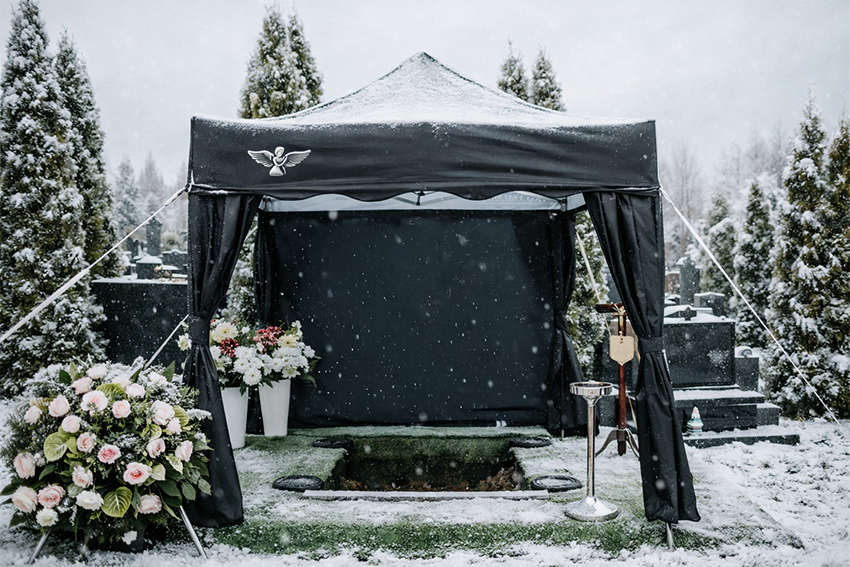
Solid ceremonial tent constructions must withstand winter wind pressure, which can be significant in open cemetery spaces. Reinforced metal frames, proper ground anchoring, and tear-resistant material are basic requirements. In practice, constructions enabling quick assembly and disassembly work well, as changing weather conditions often require quick reactions.
Tent material should be waterproof but simultaneously allow water vapor passage to avoid condensation inside. Specialized fabrics used in ceremonial tents combine these properties, ensuring dry space for participants even during intense precipitation. Darker material coloring, most often in shades of dark navy or black, corresponds to the moment's gravity and harmonizes with winter grayness of surroundings.
Side Walls and Heating Systems
Side walls in ceremonial tents serve an important protective function against lateral wind and snow. Winter gales can be gusty and multidirectional, and an open construction without side shields is of little use in such conditions. Walls are worth equipping with transparent windows that maintain visibility to surroundings while protecting from wind. Some models have liftable walls, allowing adjustment of protection level to current conditions.
Space heating system under the tent is a solution used mainly during long ceremonies on particularly frosty days. Portable gas or electric heaters allow raising temperature by several degrees, which significantly impacts participant comfort, especially elderly people and children. Safe use of such devices requires maintaining appropriate distances from flammable materials and ensuring space ventilation.
Tools for Working with Frozen Ground
Digging graves in winter is one of the greatest operational challenges for funeral homes. Frozen earth reaches hardness close to concrete, and standard tools may prove insufficient. Grave preparation in such conditions requires specialized equipment and much more time than in summer months, which must be considered in ceremony planning.
Mechanical Equipment and Manual Tools
Mechanical excavators equipped with special attachments designed for frozen ground constitute the basic tool when graves need to be prepared in the depth of winter. However, not all cemeteries allow heavy equipment entry, especially in historic necropolis courtyards with narrow pathways and historic tombstones. Then reinforced-construction manual tools become necessary.
Steel crowbars of significant weight and profiled edge allow breaking compact, frozen ground. Work requires not only strength but also proper technique to avoid injuries. A pickaxe with a very sharp, heavy edge first pierces the top frost layer, then the crowbar loosens larger chunks that can be removed with a shovel. This is a time-consuming and exhausting process, which is why winter graves are often prepared with greater advance notice.
Ground Thawing Methods
Gas burners are sometimes used to soften ground before digging. Intensive surface heating for several dozen minutes allows thawing the top layer, facilitating excavation start. However, this method requires caution – excessive heating can damage nearby tombstones, plants, or tree roots. Additionally, gas burners are effective only with moderate frosts and in surface ground layers.
Grave covers against freezing are a preventive solution used by some cemeteries and funeral homes. Special thermal insulation mats spread on a previously prepared grave protect the earth from freezing for several days. This allows preparing a grave in advance, even before severe winter arrives, and securing it until the ceremony. This solution works particularly well for burials planned with greater advance notice.
Clothing and Protective Equipment for Personnel
Work in winter conditions exposes funeral home workers to prolonged cold exposure, often in stationary positions during ceremonies. Appropriate work clothing is not a luxury but necessary equipment ensuring work ability and team health safety. Winter work clothes must combine functionality with professional appearance appropriate to ceremony character.
Outerwear and Work Gloves
Winter work jackets and coats should provide effective thermal insulation while being sufficiently elegant to match funeral ceremony gravity. Black or dark navy outerwear of classic cut, made from breathable materials with waterproof membrane, allow maintaining professional appearance and thermal comfort. The ability to wear a warm layer underneath is important, which requires appropriate, somewhat looser cut.
Winter work gloves are a particularly important element, as hands are most exposed to freezing during precise activities related to ceremony service. Two-layer construction gloves work well – with a thin, grippy inner liner allowing precise object manipulation and a thick, insulated outer layer for wearing during breaks between activities. Black gloves from waterproof material combine functionality with appropriate appearance.
Warming Accessories and Winter Footwear
Warming accessories such as ear covers or thin caps worn under ceremonial top hat or hat help minimize heat loss through the head. Though not always visible, these small elements significantly impact comfort and ability to concentrate during lengthy ceremonies. On particularly frosty days, it's also worth having access to disposable chemical warmers that can be placed in pockets or gloves.
Winter work boots with appropriate thermal insulation, anti-slip sole, and waterproof upper constitute fundamental equipment. Feet, as most distant from the heart, are particularly susceptible to freezing during prolonged standing on frozen ground. High-quality work boots with thermal insulation and moisture-resistant membrane allow maintaining comfort even during several hours of work in the cold.
Storage and Organization of Winter Equipment
Effective funeral home preparation for the winter season requires not only purchasing appropriate equipment but also its proper organization and storage. Winter equipment takes up more space than standard summer equipment, and its quick availability when needed is crucial for operational efficiency. A well-organized warehouse is the foundation of effective response to changing weather conditions.
Warehouse Space Organization
Dedicated warehouse space for winter equipment should be located in an easily accessible place, preferably near the garage exit. Quick access to all-terrain trolleys, tents, or lighting allows shortening preparation time for departure, which is particularly important for orders requiring immediate response. Shelf and rack labeling facilitates finding needed elements even by less experienced workers.
Checklists and Equipment Maintenance
A checklist system for winter equipment helps avoid situations where some crucial element is missing at the ceremony location. Before each departure, it's worth going through a checklist verifying equipment completeness: all-terrain trolley, protective covers, lighting, spare tools, protective clothing for the team. Routine use of checklists eliminates most problems resulting from oversight or haste.
Equipment maintenance after each use in winter conditions is necessary to maintain it in working order. Removing mud, snow, and ice, drying metal elements, checking mechanism operation – these simple activities performed immediately after returning from the cemetery prevent corrosion and failures. For trolleys, particular attention should be paid to wheel bearings and brake mechanisms, which are most exposed to frost and moisture damage.
Rotation of consumable material supplies requires a systematic approach. Protective covers, films, carrying straps, and other consumable materials should be replenished ongoing to avoid shortage situations at season peak. Maintaining simple consumption records allows predicting demand and placing orders with appropriate advance notice, avoiding the necessity of urgent purchases at inflated prices.
Work Safety in Winter Conditions
The winter specifics of work in the funeral industry carry increased risk of accidents and health problems. Hazard awareness and proper team preparation are the foundation of safely conducting ceremonies in difficult atmospheric conditions. Regular training and adherence to safety procedures are not formalities but real tools for protecting staff health and life.
Risk of Slips and Falls
Risk of slipping on icy surfaces constitutes the most common hazard during winter ceremonies. Particularly dangerous are moments of coffin carrying, when four pallbearers must move synchronously across slippery surfaces. Appropriate footwear is the foundation, but equally important is training the team in safe carrying techniques and step placement on slippery ground. In extreme cases, it's worth considering sprinkling the walking route with sand or salt before the ceremony.
Hypothermia and Health Hazards
Hypothermia and frostbite are real threats to workers spending many hours in the cold. Initial hypothermia symptoms – shivering, movement slowing, concentration problems – may be trivialized as normal cold reaction. Meanwhile, improperly treated hypothermia can lead to serious health consequences. Regular breaks in a warm room, hot beverages, and the ability to change into dry clothes after getting wet are basic preventive measures.
Overload and musculoskeletal system injuries intensify in winter due to muscle stiffness and more time needed to reach the ceremony location through difficult terrain. Carrying a coffin over uneven, slippery terrain requires greater effort than on a level, dry pathway. The team should be aware of increased risk and use appropriate lifting techniques, and if necessary, use support from additional people or mechanical transport aids.
Hazards associated with using heating equipment require particular caution. Gas heaters, burners used for ground thawing, or other devices producing high temperature can be sources of burns or fire. Following manufacturer's instructions, maintaining appropriate distances from flammable materials, and never leaving turned-on devices unattended are basic safety rules.
Client Communication in the Context of Winter Difficulties
Winter atmospheric conditions affect not only technical aspects of ceremony organization but also communication with deceased persons' families. Transparent information about possible delays, additional requirements, or weather-related limitations builds trust and helps avoid misunderstandings. Professional approach to communication in difficult conditions is a sign of funeral home maturity.
Informing About Potential Difficulties
Early informing about potential difficulties related to winter weather should become standard in the period from November to March. During first conversations with the family, it's worth mentioning the possibility of weather-related delays, necessity of additional preparations, or potential difficulties in accessing certain cemetery parts. Such advance notice, though it may seem unpleasant, allows the family to psychologically prepare for possible complications.
Flexibility in Ceremony Planning
Flexibility in planning ceremony times gains particular importance in winter. The shortened day means that late afternoon ceremonies will take place practically after dark. It's worth proposing alternative times to families, considering lighting conditions and safe participant movement ability. Some families may not be aware how early dusk falls in December, and will appreciate professional advice in this regard.
Preparing the family for cemetery conditions is also part of professional service. Discreet information that pathways may be slippery, terrain muddy or covered with snow, allows participants to appropriately select footwear and clothing. Suggesting bringing additional warm items for elderly people, umbrellas, or portable chairs for people with limited standing ability is appreciated and demonstrates the funeral home's concern for participant comfort.
Photographic documentation of preparations and ceremony progress in difficult winter conditions can be a valuable communication tool with future clients. Photos presenting professionally conducted ceremonies despite blizzards or frost, showing specialized equipment use and attention to every detail, build the funeral home's image as a reliable partner regardless of conditions. Of course, publishing such materials requires family consent and appropriate presentation context.

Cooperation with Cemetery Administrators
Effective organization of winter funerals requires close cooperation between funeral homes and cemetery administration. Mutual understanding of work specifics and parties' capabilities allows better ceremony preparation and avoiding operational problems. Building good relationships with necropolis managers is an investment that pays off especially in difficult winter conditions.
Planning and Grave Preparation
Early arrangements regarding grave preparation in the winter period are crucial for ceremony organization fluidity. Cemetery administrators should be informed with appropriate advance notice about planned burials so they can organize earthworks considering difficulties related to frozen ground. In some cases, it may be necessary to postpone the ceremony date due to inability to prepare the grave at the designated time.
Accessibility Information and Logistics
Information about pathway conditions and accessibility of individual cemetery parts should be communicated to funeral homes ongoing. An uncleared pathway leading to the old necropolis section may prevent access by standard vehicle or trolley. Knowledge of such limitations in advance allows the funeral home to prepare appropriate all-terrain equipment or propose to the family an alternative grave location in a more accessible cemetery part.
Logistics issues such as the possibility of temporarily parking a technical vehicle near the ceremony location or access to an electrical power source require coordination with administration. In winter, when the walk from cemetery gate to burial location may be significantly hindered, the ability to transport equipment closer to the destination significantly facilitates work. Not all cemeteries allow this, but it's worth asking and seeking compromise solutions.
Joint problem-solving related to extreme weather conditions builds partnership relationships. When after a night blizzard the entire cemetery is covered with snow, the funeral home can propose help with clearing the path to the ceremony location, and administration in return will provide equipment or materials. Such cooperation based on mutual support benefits both parties and translates into better family service quality.
FAQ
When is the Best Time to Prepare the Funeral Home for Winter Season?
Preparations for the winter season should begin in September or early October, before the first frosts arrive. This is the moment for inspection and maintenance of all equipment that will be intensively used in coming months. Trolleys, tools, lighting, and tents should be checked for technical efficiency, shortages supplemented, and any defects from the previous season repaired. New equipment purchases are worth planning for this period when there isn't yet increased demand and suppliers have full product ranges.
October is the time for team training on winter equipment operation and safety procedures. New personnel need to be shown the specifics of work in difficult conditions, reminded of rules for safe movement on slippery surfaces and all-terrain equipment operation. It's also worth organizing practical exercises with quick tent assembly or all-terrain trolley transport before real orders appear. The better the team preparation, the more smoothly the first winter ceremonies will proceed.
November is the last moment to replenish the warehouse with consumable materials that will be intensively used in the winter season. Protective covers, films, carrying straps, maintenance agents – everything should be available in appropriate quantities. It's also worth checking work clothing condition for workers and supplementing shortages in gloves, headwear, or winter boots. The December season peak is not a good time to search for equipment shortages.
Does an All-Terrain Trolley Really Make a Difference Compared to Standard?
The difference between a standard trolley and all-terrain in winter conditions is fundamental and concerns not only work comfort but above all safety. A standard trolley with small wheels designed for paved pathways won't cope with slippery, uneven surfaces covered with snow or mud. Small wheels sink into soft ground, the trolley loses stability and becomes practically impossible to guide in a straight line. Workers must put enormous effort into maintaining travel direction, and the risk of tipping everything is real.
An all-terrain trolley with large pneumatic wheels behaves completely differently. Wider wheels distribute weight over a larger surface, preventing sinking into soft ground. Tread ensures grip on slippery surfaces, and larger wheel diameter allows easier navigation of terrain irregularities. The difference is particularly visible on slopes – while a standard trolley may be difficult to stop on an icy path running uphill, the all-terrain thanks to effective brakes and better grip gives full control over travel pace.
The safety issue of the deceased is crucial here. Transporting a coffin on an unstable trolley that slides and tilts at every irregularity is not only stress for workers but real risk of coffin falling. Such a situation would be traumatic for ceremony participants and tragic for the funeral home's reputation. An all-terrain trolley practically eliminates this risk thanks to stable construction and driving characteristics adapted to difficult terrain.
Finally, the issue of worker fatigue – operating a standard trolley over slippery, uneven terrain is an exhausting struggle with equipment that affects the team's physical condition. The all-terrain trolley, though it may be somewhat heavier, rolls smoothly and requires significantly less effort to operate. This translates into less team fatigue and greater precision in performing duties during the ceremony.
What Are the Most Common Mistakes in Winter Preparation?
The most common mistake is postponing preparations until the last moment, meaning waiting until snow actually falls and frosts arrive. In such a situation, the funeral home enters the winter season unprepared, and the necessity of urgent equipment purchases involves limited choice and often higher prices. Worse still, the first winter orders become a test for an unprepared team, which can lead to operational problems and customer dissatisfaction.
The second popular mistake is economizing on crucial equipment. Some funeral homes try to "survive" winter with standard equipment, counting on favorable weather or somehow managing through improvisation. In practice, this means declining orders at more difficult locations, prolonged worker hardship with improper equipment, or – in the worst case – risky situations during ceremonies. Savings on proper equipment can cost significantly more in the form of reputation loss or worker health problems.
Neglecting maintenance of existing equipment is another typical problem. Trolleys, tools, and other equipment elements after a summer-autumn season of work need inspection and maintenance before winter usage intensification. Skipping this stage leads to equipment failures at the least opportune moment – in the middle of a ceremony or during transport to the cemetery. Emergency equipment repair is more expensive and troublesome than preventive maintenance.
Lack of team training on winter equipment operation and safety procedures can lead to ineffective use of available equipment. Workers who don't know how to properly use an all-terrain trolley, assemble a tent, or secure ceremonial space won't fully utilize available equipment capabilities. Moreover, the risk of accidents related to improper equipment use increases.
Does Every Funeral Home Need Full Winter Equipment?
The scope of necessary winter equipment depends on several factors specific to a given funeral home. First, geographic region and local climate conditions matter. A funeral home operating in mountains or Masuria, where winters are long and snowy, needs fuller equipment than a company from southwestern Poland, where winters tend to be milder. Intensity and duration of difficult winter conditions directly translates into specialized equipment demand.
The second issue is the profile of serviced cemeteries. A funeral home cooperating mainly with modern urban necropolises with well-maintained asphalt pathways can manage without an all-terrain trolley, though certain winter equipment elements remain universal. However, a company servicing old, rural cemeteries with unpaved paths and hilly terrain absolutely must have equipment adapted to difficult conditions.
Business scale also determines the scope of investment in winter equipment. A small funeral home conducting several ceremonies monthly can rent specialized equipment when needed or cooperate with other companies. A large funeral home with broad operational range and dozens of ceremonies monthly must have its own complete equipment, as continuous rental would be inefficient and costly.
However, it's worth emphasizing that certain winter preparation elements are universal for all funeral homes regardless of scale or location. Appropriate clothing for workers, basic protective covers, portable lighting – this is the minimum that every professional funeral home should provide. Differences mainly concern specialized equipment like all-terrain trolleys or ceremonial tents, whose scope can be adapted to individual needs.
How to Assess Whether Purchased Winter Equipment Meets Expectations?
Verification of winter equipment quality and usefulness proceeds best in real work conditions, but certain aspects can be assessed at the purchase stage and first tests. For all-terrain trolleys, stability tests on uneven ground and brake system checking are crucial. It's worth testing the trolley with load corresponding to coffin weight on sloped terrain, checking how it behaves during braking and starting. A trolley that tilts sideways or whose brakes don't work reliably isn't suitable for professional use.
Construction quality can be assessed by examining construction details. Welds should be even and aesthetic, without cracks or inaccuracies. Moving parts must operate smoothly, without play or jamming. Paint material or anti-corrosion coating should be evenly applied, without chips or stains. These seemingly minor details matter for equipment durability in difficult winter conditions.
A tent or ceremonial canopy should be tested for assembly and disassembly ease. A construction requiring over an hour to assemble won't work in conditions when weather changes dynamically. Ideally, two workers can set up the tent within 15-20 minutes. It's also worth checking construction stability – a well-anchored tent shouldn't show tendency to tip over in moderate wind.
Long-term assessment occurs after the first winter season, when actual equipment wear and possible construction problems are visible. A trolley that after three months of intensive work requires bearing repairs or brake adjustments is probably not sufficiently durable. A tent whose fabric begins to leak or whose frame deforms should be replaced with better quality. Winter conditions quickly verify actual equipment quality.