Table of Contents
- The Symbolism of Funeral Flowers in Polish Tradition
- The Meaning of Colours in Funeral Arrangements
- Types of Funeral Floral Arrangements
- Professional Equipment for Wreath Presentation and Transport
- All Saints' Day – Polish Tradition and Cemetery Flowers
- Funeral Flowers in World Traditions
- Practical Tips for Choosing Funeral Flowers
- Frequently Asked Questions
- Summary
Flowers accompany people during the most important moments of life – from birth, through weddings, to the final farewell. In the context of funeral ceremonies, plants play a particularly special role, serving as a universal symbol of remembrance, respect and love that does not end with the passing of a loved one. Funeral flower arrangements are an inseparable element of mourning ceremonies in Poland and around the world, expressing emotions that often cannot be put into words.
Funeral floristry is a field that combines tradition, symbolism and aesthetics in service of a dignified farewell to the deceased. Choosing the right funeral flowers is a decision that requires careful consideration – each species carries specific meaning, and the colours of the arrangement convey particular emotions. In Polish culture, distinct customs related to funeral flowers have developed, which differ from traditions in other European and non-European countries.
This article serves as a comprehensive guide to the world of funeral flowers. We will discuss the most popular plant species used in mourning ceremonies, their symbolism and the meaning of individual colours. We will examine Polish traditions related to cemetery flowers, including the special role of chrysanthemums during All Saints' Day celebrations. We will also compare customs from various European and world cultures, and draw attention to professional funeral home equipment that enables dignified presentation and transport of floral arrangements during ceremonies.
The Symbolism of Funeral Flowers in Polish Tradition
Polish funeral floristry tradition has been shaped over centuries, drawing from Christian values and Slavic rituals associated with ancestor worship. Flowers placed on graves and accompanying funeral ceremonies are not merely decoration – they carry deep symbolic meanings that help families and loved ones express their feelings towards the deceased.
In European culture, individual flower species have acquired specific symbolic connotations that influence their selection during funeral ceremonies. Understanding these meanings allows for conscious selection of floral arrangements that correspond to the character of the ceremony and the relationship connecting us with the deceased.
Chrysanthemums – Queens of Polish Cemeteries
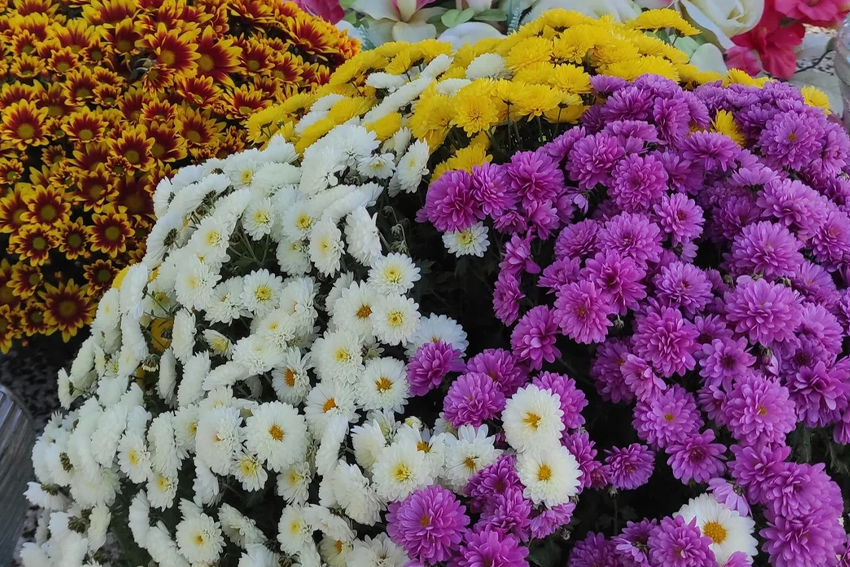
Chrysanthemums hold a special place in Polish funeral tradition and are inseparably associated with All Saints' Day and All Souls' Day. These impressive flowers, available in a wide colour range from golden yellows through deep burgundies to classic whites, symbolise sorrow, grief and mourning for the loss of a loved one. In Poland, the custom of decorating graves with chrysanthemums is so deeply rooted that these flowers are rarely used on other occasions – their presence unequivocally brings to mind the cemetery context.
The history of chrysanthemums as mourning flowers dates back to the 19th century, when the custom of carefully tidying and decorating graves before 1st November became widespread. Chrysanthemums gained popularity not only due to their symbolism but also thanks to their practical properties – these flowers are characterised by exceptional durability and resistance to low temperatures, which is significant in Polish climatic conditions prevailing at the end of October and beginning of November. The golden shades of chrysanthemums harmonise perfectly with the autumn atmosphere and colours of falling leaves, creating a visually cohesive setting for All Souls' celebrations.
Interestingly, the symbolism of chrysanthemums varies significantly depending on the cultural sphere. While in Poland and many continental European countries chrysanthemums are reserved exclusively for the mourning context, in East Asia these flowers can symbolise longevity, rebirth and joy. In Japan, the white chrysanthemum is a symbol of the imperial family and is associated with dignity, although it also appears during funeral ceremonies as a sign of respect for the deceased.
Lilies – Symbol of Purity and Resurrection
Lilies are among the most recognisable funeral flowers in Western culture and hold an honoured place in funeral floristry. White lilies have symbolised purity, innocence and peace of soul for centuries, making them a particularly appropriate choice for farewell ceremonies. In Christian tradition, lilies are associated with the Virgin Mary and symbolise spiritual renewal and faith in eternal life after death.
The elegant, lance-shaped lily flowers add a solemn character to funeral arrangements and are distinguished by a delicate, soothing fragrance. Due to their symbolism, lilies are particularly often chosen for funerals of young people and children, expressing the pain of premature loss and emphasising the innocence of those departing. In Polish tradition, white lilies also constitute a common element of funeral wreaths and arrangements intended for those who led lives marked by spirituality and religiosity.
It should be noted that lilies are delicate flowers, sensitive to low temperatures and mechanical damage, which requires special care during transport and storage. Professional funeral homes are equipped with appropriate transport equipment that allows the freshness and aesthetics of lily arrangements to be maintained throughout the funeral ceremony.

Calla Lilies – Elegance and Nobility
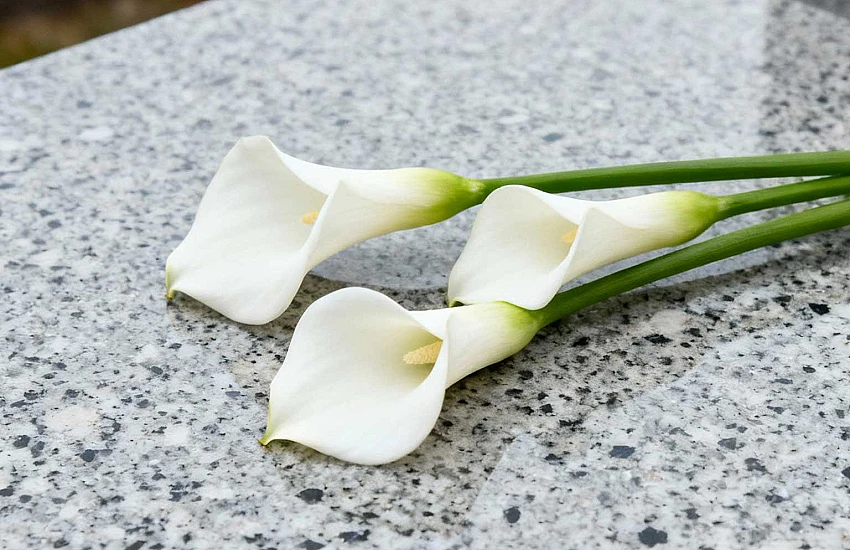
Calla lilies, also known as zantedeschia, are flowers with an exceptionally refined appearance that enjoy great popularity in funeral floristry. Their characteristic chalice shape and smooth, elegant petals give funeral arrangements a dignified character. Calla lilies symbolise purity, innocence and compassion for those in mourning, and their presence in wreaths and arrangements emphasises the respect held for the deceased.
In Poland, calla lilies traditionally hold an honoured place in funeral wreaths and are one of the most popular choices alongside lilies and chrysanthemums. These flowers come in various colours – from classic white through delicate cream and tea shades to purple and yellow variants. Each colour carries slightly different meaning: white calla lilies express purity and peace, while purple ones can symbolise deeper mourning and longing.
Calla lilies are characterised by good durability, making them a practical choice for funeral arrangements that must maintain a fresh appearance through many hours of ceremony and subsequently present themselves worthily on the grave. In combination with other flowers, they create harmonious arrangements, although they are equally often used as the main element of monochromatic wreaths with classic, minimalist aesthetics.
Roses – Universal Expression of Love and Respect
Roses are flowers with versatile application that also work excellently in the funeral context. Their universal symbolism of love, respect and remembrance makes them an appropriate choice for various relationships with the deceased. The colours of roses carry particular significance – each shade conveys a different emotional message and allows expression of specific feelings towards the departing person.
Red roses symbolise deep love and respect, which is why they are often chosen by spouses, life partners and the closest family of the deceased. They express a feeling that will survive death and constitute a bridge connecting the living with the departed. White roses, like white lilies, symbolise purity, innocence and peace – they are particularly appropriate for funerals of young people or those who passed away unexpectedly. Pink roses express gratitude and sympathy, while yellow ones can symbolise friendship and strong bonds, although in some traditions they are also associated with melancholy and longing.
A practical advantage of roses is their high durability and resistance to variable weather conditions. Well-prepared roses retain freshness for a longer time, which is important both during the funeral ceremony itself and in the following days when arrangements remain on the grave. Roses present themselves excellently both in impressive wreaths and in smaller bouquets or single flowers placed at the coffin.
Carnations – Symbol of Remembrance and Tribute
Carnations are among the most durable flowers used in funeral floristry, making them a practical yet meaningful choice. These flowers symbolise remembrance of the deceased, paying tribute and enduring love. In Polish tradition, carnations often complement larger arrangements or form independent bouquets with intense colouring.
The colouring of carnations carries specific symbolic meanings. Red carnations express love and admiration for the deceased, emphasising the respect held during their lifetime. White carnations symbolise purity and innocence, similar to other white funeral flowers. Pink carnations in Catholic tradition may reference the cult of the Virgin Mary and express enduring love and gratitude. Carnations in purple and burgundy shades emphasise the solemnity of mourning and deep sorrow after loss.
A particular advantage of carnations is their exceptional resistance to weather conditions and long freshness retention time. These flowers work excellently during funeral ceremonies held in cooler seasons, when other species may quickly lose their aesthetic qualities. Funeral florists willingly use carnations as a base for arrangements, adding elements of a more refined character to them.
The Meaning of Colours in Funeral Arrangements
The colouring of funeral arrangements plays a crucial role in conveying emotions and expressing attitude towards the deceased. In Polish tradition, as in most European cultures, individual flower colours carry specific symbolic meanings that influence the perception of the entire funeral ceremony. Conscious colour selection allows adaptation of the arrangement to the character of the ceremony and the relationship connecting us with the deceased.
White – The Colour of Peace and Purity
White is a universal symbol of purity, innocence and spiritual peace in the funeral context. White flower arrangements express faith in the peace that the soul achieves after death, and hope for eternal life. Flowers in this colour are particularly often chosen for funerals of children, young people and those who passed away unexpectedly – white emphasises their innocence and the prematurity of departure. In Christian tradition, the white colour is also associated with paschal joy and faith in resurrection, which gives funeral arrangements a spiritual dimension extending beyond the moment of mourning itself.
Red and Crimson – Expression of Deep Love
Red and crimson funeral flowers are reserved for the closest persons of the deceased – spouses, children, grandchildren and life partners. Intense red symbolises love that does not end with death, and deep respect held during lifetime. In Polish tradition, arrangements in red tones often appear in wreaths placed by spouses or multigenerational families. Darker shades of crimson and burgundy give arrangements dignity, while simultaneously expressing the depth of feelings and solemnity of mourning.
Purple – The Colour of Mourning and Spirituality
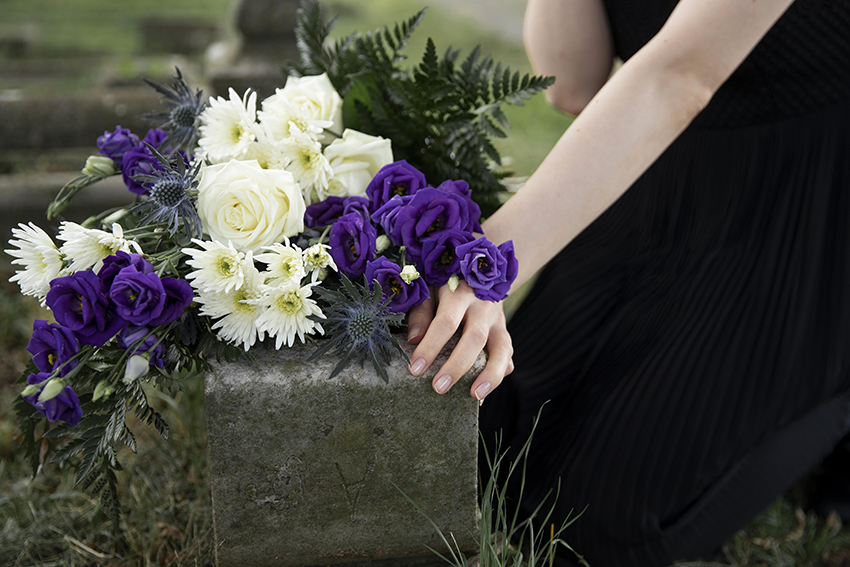
Purple is closely associated with mourning and the spiritual dimension of death in Polish tradition. Flowers in shades of violet, lavender and purple emphasise the solemnity of the funeral ceremony and express deep sorrow after loss. This colour also references liturgical mourning vestments and is associated with prayer for the souls of the departed. Floral arrangements with a predominance of purple are often chosen for funerals of elderly persons and those who during their lifetime demonstrated strong connections with spirituality and religion.
Yellow and Golden – Strong Bonds and Remembrance
Yellow flowers in the funeral context symbolise strong bonds, attachment and melancholy associated with parting. Golden chrysanthemums, being an inseparable element of Polish cemeteries during All Saints' period, carry a message of remembrance and longing for the departed. Yellow roses or gerberas can express friendship and gratitude for years spent together, making them an appropriate choice for more distant acquaintances and friends bidding farewell to a loved one.
Types of Funeral Floral Arrangements
Funeral floristry offers a wide selection of floral arrangement forms that differ in size, shape and purpose. The choice of appropriate form depends on the degree of kinship with the deceased, the character of the ceremony and the place where the arrangement will be displayed. In Polish tradition, clear norms have developed regarding who should present wreaths and who should present bouquets or single flowers.
Funeral Wreaths – Tradition and Symbolism
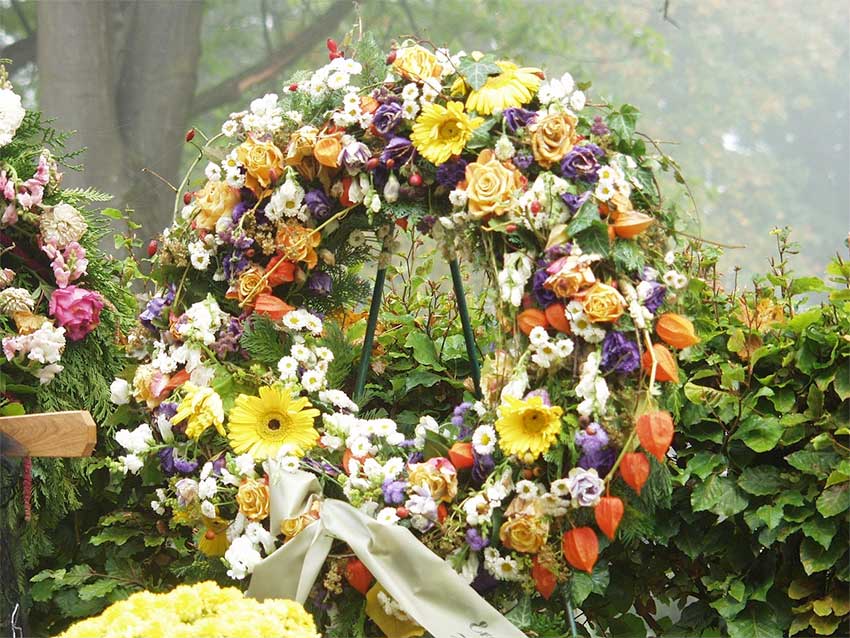
The funeral wreath constitutes the most impressive form of floral arrangement and is traditionally reserved for the closest family of the deceased. The circular shape of the wreath symbolises eternity and the infinity of life, expressing faith in the continuity of existence beyond the boundaries of physical death. Wreaths are created on special bases – most often from spruce, fir or pine branches – to which arrangements of fresh or artificial flowers are attached.
In Polish tradition, several types of funeral wreaths are distinguished. The classic circular wreath is the most popular form, built on a full circle plan with a densely woven layer of flowers. The Roman wreath has the shape of a ring empty in the centre, which gives it lightness and elegance. The Warsaw wreath is characterised by large dimensions and a form resembling the letter T with an oval leg. Heart-shaped wreaths are often chosen by the closest persons to the deceased as a symbol of enduring love.
An inseparable element of the funeral wreath is a sash with a farewell inscription. The sash displays words of remembrance, condolences and information about who is presenting the wreath. Professional funeral homes offer sash calligraphy services, ensuring an aesthetic and dignified appearance of the inscription.
Funeral Bouquets – Smaller Arrangements with Great Symbolism
Funeral bouquets constitute a smaller form of floral arrangement, appropriate for more distant family members, friends, neighbours and colleagues of the deceased. Unlike wreaths, bouquets can only be laid at the coffin or on the grave – they do not have a structure enabling vertical placement. Bouquets often take symbolic shapes – teardrop, heart, cross or rectangle – which additionally strengthen the emotional message.
A funeral bouquet may consist exclusively of flowers or combine flowers with decorative greenery and floral accessories. Similar to wreaths, a sash with a farewell inscription can also be attached to bouquets, although this is not a requirement. An unwritten rule states that the more distant the relationship with the deceased, the more modest the arrangement should be – sometimes a single flower is enough to pay respect and honour the memory of the departing person.
Condolence Bouquets and Single Flowers
Condolence bouquets are the smallest form of funeral arrangement, tied with a ribbon and intended for placing at the coffin or urn. Bouquets are an appropriate choice for acquaintances, distant relatives and persons who wish to express sympathy but were not closely connected with the deceased. A single flower – most often a rose or carnation – constitutes a minimalist yet respectful farewell gesture, particularly popular during large ceremonies with many participants.
Professional Equipment for Wreath Presentation and Transport
Dignified presentation of floral arrangements during funeral ceremonies requires appropriate funeral home equipment. Professional funeral accessories not only facilitate staff work but above all ensure an aesthetic and respectful setting for mourning ceremonies. In the funeraryaccessories.com shop, you will find a wide selection of equipment adapted to the needs of modern funeral homes.
Funeral Wreath Stands
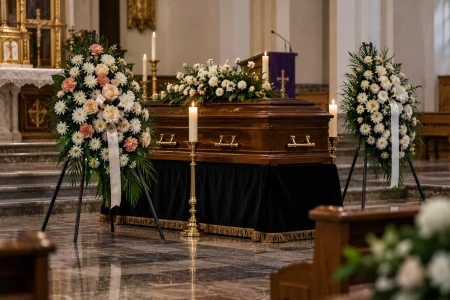
Wreath stands are a basic element of equipment for every funeral chapel and ceremony venue. Made from high-quality powder-coated steel or aluminium, the stands ensure stability and safety for displayed floral arrangements. Available in various sizes and colour variants, they allow elegant placement of wreaths around the coffin or urn, creating a dignified setting for the farewell.
The minimalist design of wreath stands harmonises perfectly with the atmosphere of funeral ceremonies, without distracting from the essence of the ceremony. Solid construction guarantees reliability and longevity of equipment that is intensively used in daily funeral home operations. Wreath stands available in the funeraryaccessories.com shop are characterised by thoughtful ergonomics and ease of use, which streamlines staff work during ceremony preparation.
Hearse Wreath Holder – Essential Transport Accessory
Transporting a wreath together with the coffin requires specialist equipment that will ensure safety of the floral arrangement and protect the vehicle bodywork from damage. The hearse wreath holder available in the funeraryaccessories.com shop is an indispensable accessory for every professional funeral home, enabling dignified and aesthetic wreath transport during the funeral procession.
The holder construction has been designed with universality and practicality of use in mind. The adjustable upper mechanism allows the holder to be adapted to every hearse model available on the market, regardless of vehicle size or body type. Lower adjustment enables transport of wreaths of various sizes, including impressive arrangements of non-standard dimensions. Rubber bumpers effectively protect the hearse bodywork from scratches and mechanical damage, which is important during daily equipment operation.
The wreath holder is made from high-quality aluminium resistant to weather conditions, which guarantees its durability through many years of intensive use. The folding construction allows compact storage of the holder when not in use – a particularly important feature in cases of limited funeral home storage space. Holder installation is intuitive and takes just a few minutes, requiring no specialist tools or additional staff training.
A professional wreath holder is an investment in funeral service quality. The product is available in black and silver, matching the colouring of various hearse models. More information about the product can be found at: https://www.funeraryaccessories.com/product/wreath-hanger-for-hearse
All Saints' Day – Polish Tradition and Cemetery Flowers
The celebration of All Saints' Day observed on 1st November constitutes one of the most important days in the Polish religious and cultural calendar. Poles visit cemeteries in crowds to light candles and decorate the graves of loved ones with flowers, creating an extraordinary, almost mystical landscape of illuminated necropolises. The scale of observance of this holiday in Poland is unique in Europe – cemeteries transform into a sea of light and flowers, which constitutes an expression of deep attachment to tradition and remembrance of ancestors.
The history of All Saints' Day observance in Poland combines Christian traditions with pre-Christian Slavic rituals. Dziady, as the old rites honouring the dead were called, took place on the night from 31st October to 1st November and consisted of summoning ancestral souls and symbolically hosting them. Contemporary customs – lighting candles, placing flowers, communal prayer – constitute a continuation of this centuries-old tradition, enriched with Christian symbolism and liturgy.
Chrysanthemums constitute an inseparable element of Polish All Saints' Day observance. These flowers appear en masse at market stalls and florists as early as mid-October, reaching peak sales in the days preceding the holiday. The tradition of decorating graves with chrysanthemums is so deeply rooted in Polish culture that these flowers are almost exclusively associated with the cemetery context – presenting someone with chrysanthemums as a gift outside the All Souls' period would be a serious faux pas.
Besides chrysanthemums, other floral arrangements also appear in Polish cemeteries – wreaths of roses, lilies and calla lilies, bouquets of carnations and gerberas, as well as increasingly popular decorations made of dried or artificial flowers. Contemporary grave floristry offers a rich palette of possibilities, although the traditional chrysanthemum still remains the symbol of Polish All Saints' Day.
Funeral Flowers in World Traditions
The symbolism of funeral flowers varies significantly depending on cultural sphere, religion and local traditions. Understanding these differences is particularly important in the context of today's globalised world, where we increasingly participate in funeral ceremonies of people with various cultural backgrounds. Knowledge of international floral customs helps avoid unintentional gaffes and express respect in a manner consistent with the expectations of the deceased's family.
France, Italy and Spain – Countries of the Chrysanthemum
In Romance countries, similar to Poland, chrysanthemums are closely associated with the cult of the dead and All Souls' celebrations. In France, chrysanthemums are called La Fleur des Morts – the Flower of the Dead – and are almost exclusively intended for grave decoration. Presenting chrysanthemums as a birthday or name day gift would be a serious faux pas. In Italy and Spain, chrysanthemums also symbolise mourning and remembrance of the departed, appearing en masse in cemeteries during All Saints' Day period.
White flowers – lilies, roses, gerberas – enjoy great popularity during funeral ceremonies in Romance countries. White symbolises purity and peace of soul, expressing faith in eternal life after death. Funeral arrangements in France, Italy and Spain are characterised by elegance and classic aesthetics, avoiding overly bright colours and avant-garde forms.
United Kingdom and Germany – Colourful Farewells
In Germanic and Anglo-Saxon countries, the approach to funeral flowers is somewhat different from continental European tradition. In the United Kingdom and Germany, greater colour variety in funeral arrangements is permitted, treating them as a celebration of the deceased's life rather than merely an expression of mourning. Flowers in vivid colours – yellow, orange and even pink – may appear during farewell ceremonies, particularly when the deceased was a cheerful person who valued joy during their lifetime.
In the United Kingdom, lilies are popular as a symbol of purity, along with roses expressing love and respect. Chrysanthemums, unlike in Poland and Romance countries, do not have an exclusively funeral character here and can be presented on various occasions. In Germany, white lilies and roses are a traditional condolence choice, and a ribbon with an inscription expressing sympathy is often attached to arrangements.
Japan and China – White Chrysanthemums and Lilies
In East Asian cultures, white is the traditional colour of mourning, and white flowers dominate during funeral ceremonies. In Japan, white chrysanthemums, called kiku, serve a dual symbolic function – on one hand they are an emblem of the imperial family and a symbol of longevity, on the other they accompany funeral ceremonies as an expression of respect and mourning. White lilies also enjoy popularity, symbolising peace and purity of the deceased's soul.
In China, tradition dictates avoiding red flowers during funerals, as red is associated with joy, happiness and wedding celebrations. White and yellow chrysanthemums and white lilies dominate, arranged in carefully considered compositions. Observing number symbolism is also important – flowers are presented in even numbers, as odd numbers are reserved for joyful occasions.
Mexico – Marigolds and Día de los Muertos
The Mexican tradition of Día de los Muertos, or Day of the Dead, presents a completely different approach to farewell and commemoration of the departed. Instead of subdued, mourning arrangements, Mexican cemeteries and home altars explode with the vivid colours of marigolds, called cempasúchil. The bright orange and yellow flowers are believed, according to traditional beliefs, to attract and guide the souls of the departed back to their family homes.
The Day of the Dead in Mexico is a joyful celebration of life and remembrance, not a sorrowful farewell. Families gather at graves, organise picnics, play music and reminisce about loved ones in an atmosphere of joy and community. Marigolds strewn on paths leading to homes and decorating ofrendas altars create an extraordinary, colourful spectacle that differs dramatically from European funeral aesthetics.

Practical Tips for Choosing Funeral Flowers
Choosing flowers for a funeral is a decision requiring consideration of many factors. Besides the symbolism and emotional meaning of the arrangement, it is worth paying attention to practical aspects such as flower durability, weather conditions prevailing on the day of the ceremony and preferences of the deceased's family. The following tips will help make the right choice that will be both aesthetic and respectful.
Flower Durability and Seasonality
Funeral arrangements must maintain a fresh appearance through many hours of ceremony, and subsequently present themselves worthily on the grave for several days. When choosing flowers, it is worth considering their natural durability and resistance to weather conditions. Carnations, chrysanthemums and roses are characterised by the longest freshness retention time and tolerate both low temperatures and autumn rains well. Lilies and calla lilies, although exceptionally elegant, are more delicate and may require special care during transport.
Flower seasonality affects not only availability but also quality and freshness. Chrysanthemums are a natural autumn choice when they reach peak season and offer the best quality. In spring and summer, wide availability of roses, lilies and gerberas allows creation of varied arrangements. In winter, it is worth considering the use of more durable species or artificial flower arrangements that maintain aesthetic appearance regardless of temperature.
Fresh Flowers or Artificial – What to Choose?
The question of choice between fresh and artificial flowers sparks discussion among those organising funeral ceremonies. Tradition clearly favours fresh flowers as the proper expression of respect for the deceased – their transience symbolises the fragility of life and passing, giving the farewell a deeper dimension. For the funeral ceremony itself, fresh flowers are an almost obligatory choice, particularly in the case of the closest family.
Artificial flowers, however, find justified application in the context of long-term grave decorations. High-quality artificial flower arrangements are practically indistinguishable from fresh ones, while maintaining an aesthetic appearance for many months. They are particularly recommended for graves visited less frequently, where regular replacement of fresh flowers would be difficult, and during periods of extreme temperatures when fresh plants wilt quickly.
Adapting the Arrangement to the Relationship with the Deceased
The degree of kinship and closeness with the deceased should be reflected in the choice of floral arrangement form. The closest family – spouse, children, parents – traditionally presents impressive funeral wreaths with sashes bearing appropriate inscriptions. More distant relatives, friends and neighbours may choose smaller bouquets or condolence arrangements. Work colleagues or members of the deceased's social circle often decide on a joint arrangement from a group of people, which is a practical and appropriate solution.
It is also worth considering the character and preferences of the deceased. If we know the favourite flowers or colours of our loved one, we can incorporate them into the arrangement as a personal tribute and expression of remembrance of their individuality. Such personalised arrangements are particularly touching and show that the deceased remains in our memory not only as an anonymous person but as a unique individual with their own preferences and character.
Frequently Asked Questions
Which flowers are best suited for funerals during winter?
During the winter period, flowers with high durability and resistance to low temperatures work best. Carnations, chrysanthemums and roses retain freshness even at sub-zero temperatures and are most often chosen by funeral florists for winter ceremonies. Gerberas also tolerate cold well, although they are somewhat more delicate. In particularly severe conditions, it is worth considering arrangements of high-quality artificial flowers, which are virtually indistinguishable from fresh ones while maintaining an aesthetic appearance regardless of weather. Professional funeral homes have transport equipment that protects fresh arrangements during transport, minimising the risk of frost damage.
Can you bring flowers in colours other than white to a funeral?
Yes, the colour palette of funeral flowers is much broader than just white. Although white remains a universal symbol of peace and purity, other colours are equally appropriate and carry specific meanings. Red and crimson flowers express deep love and are appropriate for the closest family of the deceased. Purple shades symbolise mourning and spirituality. Yellow flowers, particularly chrysanthemums, are a traditional choice in Polish culture and express remembrance and longing. Pink flowers symbolise gratitude and sympathy. Only very bright, neon colours and arrangements of a typically festive or joyful character should be avoided, as they could be considered inappropriate in the funeral context.
Are artificial flowers at a funeral acceptable?
For the funeral ceremony itself, tradition dictates presenting fresh flowers as the proper expression of respect – their transience symbolises the fragility of life and adds a deeper dimension to the farewell. However, artificial flowers have justified application in the context of long-term grave decorations. After the ceremony ends and the coffin is placed in the grave, high-quality artificial flower arrangements constitute a practical and aesthetic solution, particularly for graves visited less frequently or during periods of extreme temperatures. Modern artificial flowers are made from materials such as silk or velvet and are virtually indistinguishable from fresh ones, while maintaining aesthetic appearance for many months.
How to professionally transport a wreath to the cemetery?
Transporting a funeral wreath requires appropriate equipment that will ensure the safety of the arrangement and protect the vehicle bodywork. Professional funeral homes are equipped with special wreath holders mounted on hearses, which allow stable and aesthetic transport of even impressive floral arrangements. These holders are characterised by an adjustable structure adapting to various vehicle models, rubber bumpers protecting paintwork from scratches, and the possibility of lower adjustment enabling transport of wreaths of various sizes. The folding holder construction facilitates storage when not in use. Products of this type can be found in the funeraryaccessories.com shop offer, which specialises in funeral home equipment.
Summary
Funeral flowers constitute an inseparable element of farewell ceremonies, expressing emotions that are difficult to put into words. Polish funeral floristry tradition is rich and centuries-old, combining Christian symbols with ancient Slavic rituals. Chrysanthemums, lilies, calla lilies, roses and carnations – each of these flowers carries specific meaning, allowing selection of an arrangement corresponding to the character of the ceremony and the relationship with the deceased.
Professional organisation of funeral ceremonies requires appropriate equipment that will ensure dignified presentation and transport of floral arrangements. Wreath stands, hearse-mounted holders, catafalques and other funeral accessories available in the funeraryaccessories.com shop allow funeral homes to provide services at the highest level, with due respect for the deceased and their families.
Regardless of the chosen arrangement form – an impressive wreath, elegant bouquet or single rose – the gesture of remembrance and respect remains most important. Flowers placed on graves constitute a bridge connecting the living with the departed, expressing continuity of feelings that will survive physical separation. In this context, appropriate flower selection and professional presentation take on special significance, allowing dignified farewell to loved ones and preservation of their memory in the hearts of those who remain.