Table of Contents
- What a necropolis actually was
- The birth of the cemetery as we know it
- Architecture and landscape: stone versus greenery
- The logistics of burial, then and now
- A shift in ritual: from the family grave to the urn
- Memory and technology: the digital necropolis
- What old necropolises teach modern cemeteries
- Frequently asked questions
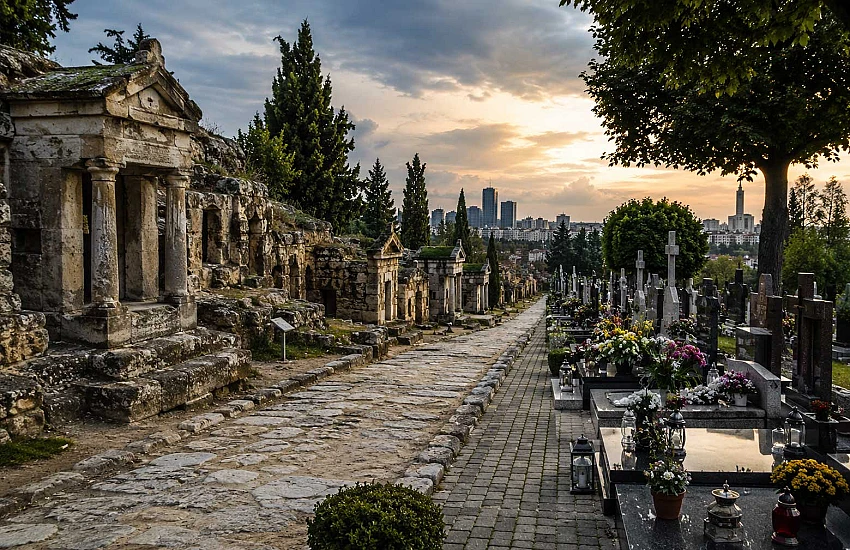
Walking down the path of an old cemetery, it is easy to feel that you have stepped into another time. Leaning headstones, mossy terrazzo, lime-tree roots cracking the slabs apart – it all forms a landscape with more of the city about it than the park. A few kilometres away, on the outskirts of the same town, a municipal cemetery is taking shape according to an entirely different logic: even plots, paved walkways for pedestrians and vehicles, an urn field and a columbarium. These two places are sometimes separated by two thousand years, and sometimes by twenty. Yet they are bound by the same need – a dignified place of remembrance and efficient, safe work for the people who care for it.
Comparing an ancient necropolis with a modern cemetery is not merely an exercise in art history. For a cemetery manager, a funeral home owner or a municipal worker, it is a practical lesson in how burial space has changed, what logistical challenges each model brings, and what equipment makes it possible today to work with respect for the deceased and for grieving families. It is worth walking that road step by step – from a Greek word to the digital headstone.
What a necropolis actually was
The word necropolis comes from Greek and means, literally, a city of the dead. This was no metaphor. In antiquity, burial sites were genuinely organised on the model of cities of the living – with streets, districts, monumental tombs that served as houses, and a clear spatial hierarchy in which a person's standing in life translated into the location and grandeur of the grave.
The first cities of the dead
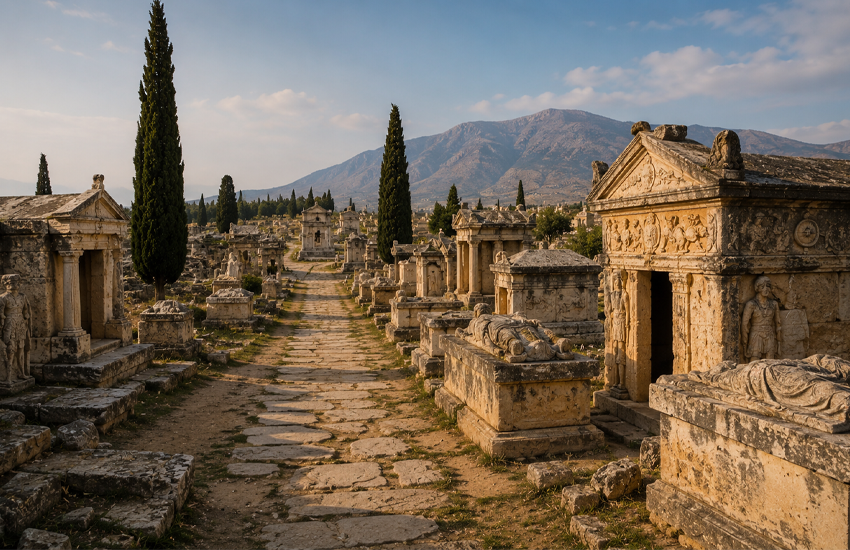
The most famous necropolises of antiquity – the Egyptian pyramid fields at Giza, the Etruscan burial grounds at Cerveteri, or the Roman tombs lining the Via Appia – were usually built beyond the walls of the settlement, yet in its immediate vicinity. This arrangement stemmed both from religious belief and from a practical concern for hygiene. The dead had their world right next to the world of the living, separated but not distant. The grave was an address to which people returned during festivals honouring the ancestors, bringing food, wine and prayers.
It was also characteristic that a necropolis grew organically over centuries. It was not planned in advance as a closed composition. Successive generations added their own tombs, adapting them to the fashion, wealth and beliefs of their era. The result is a dense, multi-layered fabric in which archaeologists today read the entire history of a community – who was wealthy, what was believed, how trade was conducted, what families looked like.
The grave as a reflection of the living world
In a necropolis, almost everything carried meaning. The orientation of the grave relative to the points of the compass, the material from which the monument was raised, the inscription, the sculptural symbolism – every element communicated something about the deceased and about the order of the world as it was understood. The Etruscans furnished their burial chambers with furniture, vessels and wall paintings reproducing the interiors of houses. The Romans placed their tombs along the roads leading out of the city so that a passer-by would read the name of the deceased and remember it for a moment – it was a form of enduring in the memory of the community.
This way of thinking about burial as an extension of social life survived in European culture for centuries, changing only its forms. When we look today at a family tomb from the mid-nineteenth century, we are in fact looking at a late descendant of the Roman mausoleum.
The birth of the cemetery as we know it
The cemetery in today's sense – a defined, orderly, managed area set aside for burying the dead – is a relatively recent invention. For most of the Middle Ages and the early modern period, the dead were buried beside churches, and the most important of them inside the church itself. The churchyard was cramped and dug over many times, and the bones of older burials were moved to ossuaries to make room for new ones.
Hygiene, law and the move beyond the city
The turning point came in the eighteenth and nineteenth centuries. Growing cities, epidemics and advances in sanitary knowledge meant that overcrowded churchyards came to be seen as a threat to public health. Across Europe, regulations were introduced requiring new cemeteries to be established beyond the built-up area. Great compositions arose, such as the Parisian Père-Lachaise, the London cemeteries known as the Magnificent Seven, or the numerous municipal necropolises across Britain and continental Europe.
This was a revolution not only in sanitation but also in culture. The cemetery ceased to be an extension of the church and became an institution in its own right – with a plan, a division into plots, burial registers and an administration. The figure of the cemetery manager emerged, responsible for spatial order, record-keeping and maintenance of the grounds. In time came regulations specifying minimum distances between graves, the depth of burial and the rules for reusing burial places.
The cemetery as a park
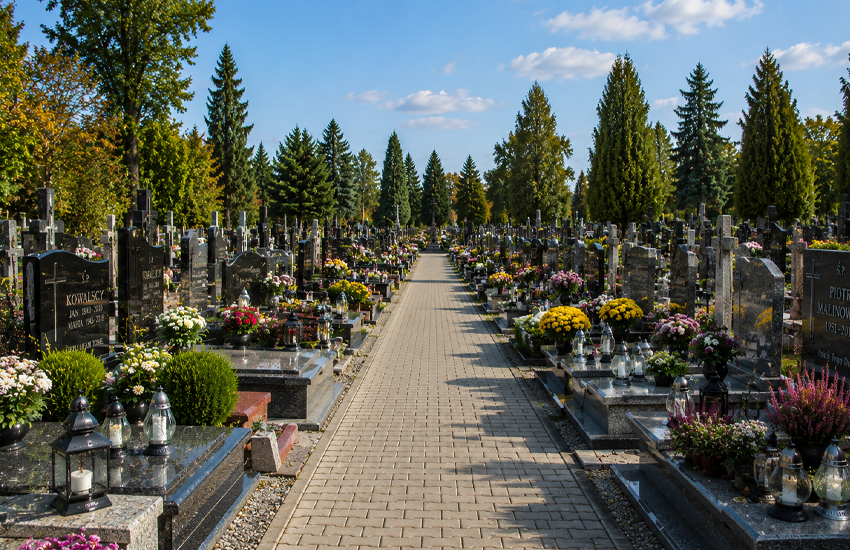
Nineteenth-century cemeteries were often designed as landscape parks. Paths wound picturesquely between trees, benches were set out, avenues were planted, and the very act of walking among the graves was meant to soothe and to prompt reflection. This model – the cemetery as a green enclave within the city – still shapes how we think about a well-kept necropolis. Modern municipal cemeteries continue to draw on this tradition, combining the burial function with that of a green space.
Architecture and landscape: stone versus greenery
The most striking difference between an old necropolis and a modern cemetery concerns the balance between matter and space. Old necropolises are dense and vertical. New cemeteries are expansive, horizontal and restrained.
The monumentality of older grounds
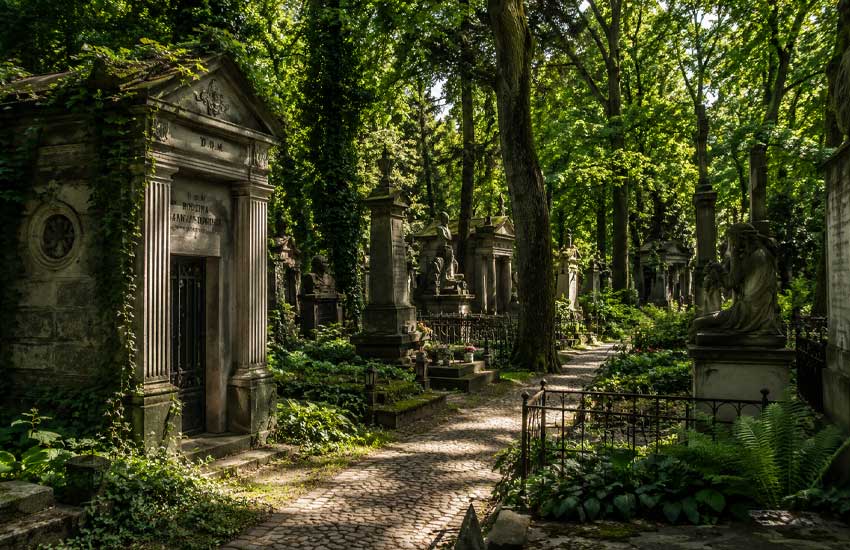
In a historic cemetery, stone dominates. Obelisks, columns, angels, mausoleums, elaborate epitaphs – all of it testified to a family's standing and to the ambition of a commemoration meant to outlast generations. Materials were chosen with eternity in mind: granite, marble, sandstone, cast iron. The grave was a work of the mason's art, and at times of the sculptor's and architect's too.
That grandeur comes at a price, however. Historic monuments decay, lean and tilt, and their conservation is often costly and demands specialist knowledge. The dense layout of old plots also hampers maintenance work and transport – the narrow, often uneven alleys were never designed with modern equipment in mind.
The restraint and greenery of contemporary cemeteries
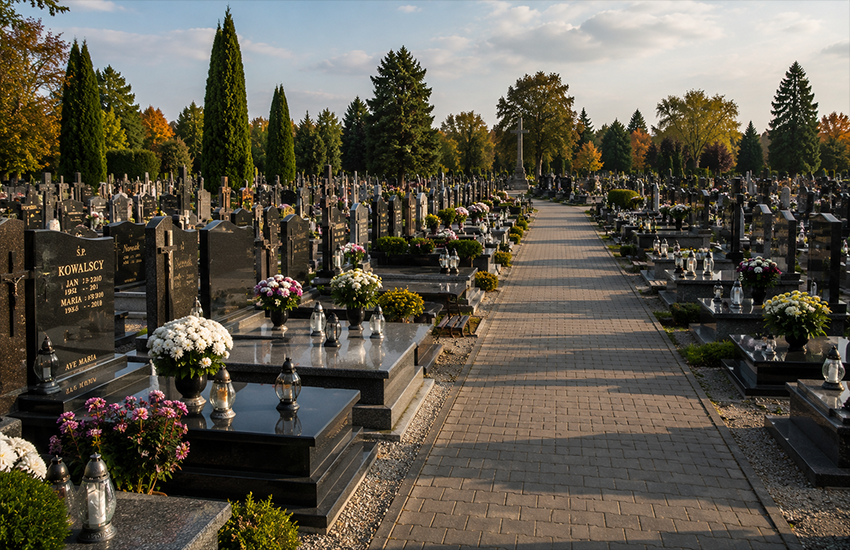
The modern cemetery moves in the opposite direction. Increasingly there are standardised monument designs, limits on height and footprint, and an emphasis on the legibility of the layout and ease of upkeep. Lawned memorial fields, burial meadows, urn gardens and columbaria appear, taking up far less space than traditional earth graves. The aesthetic shifts from the monument towards the landscape – less stone, more greenery and light.
Behind this change lie both economic and spatial considerations and shifts in custom. Families are smaller and more dispersed, less often living near the grave of their relatives, and expectations of a burial place are evolving towards simplicity and low maintenance costs.
The logistics of burial, then and now
What most sharply distinguishes work at a cemetery centuries ago from work today is logistics. The farewell ceremony itself may look outwardly similar, but everything around it – preparing the grave, transport, organising the grounds – has changed beyond recognition.
The gravedigger's work through the centuries
For most of history, graves were dug by hand. It was heavy, time-consuming work, entirely dependent on the weather and the type of ground. The coffin was transported on the shoulders, on a bier or on a simple cart. In the dense fabric of an old necropolis, on uneven and boggy terrain, every stage required many hands and considerable physical effort. The risk of injury was high, and the pace of work limited.
This picture still holds true in many historic cemeteries, where the cramped conditions and heritage protection make it impossible to bring in large machinery. It is precisely there that one sees most clearly how much modern equipment can relieve the human body wherever conditions allow.
Mechanisation and a new generation of equipment
The modern municipal cemetery increasingly relies on mechanisation. Where the width of the alleys and the character of the terrain permit, the digging of graves, the moving of soil and the shifting of heavy elements are taken over by compact machines – small enough to move between plots, yet powerful enough to shorten work that once took a team half a day to a matter of minutes. Mechanisation is not only a saving of time but, above all, a reduction in the strain on the spine and the risk of injury to workers.
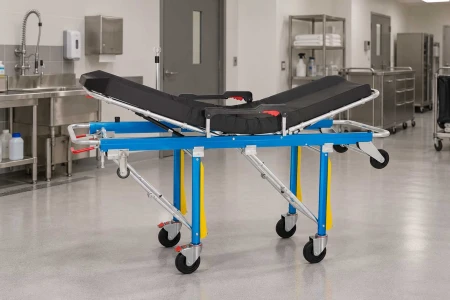
Not every part of a cemetery is suitable for a machine, however. The narrow alleys of historic plots, the boggy verges after rain, the steep paths – these still call for manual solutions, though ones far better than the old biers. This is where equipment such as the off-road coffin cart comes into play, designed precisely with difficult ground in mind. Its reinforced steel construction and load capacity of up to 300 kg make it possible to transport even the heaviest coffin, the large all-terrain wheels cope with uneven and slippery alleys, and the parking brakes give full control during loading. Crucially for businesses with limited space, the cart is foldable and takes up little room once folded, fitting into a typical service vehicle. It is a solution that combines respect for the dignity of the ceremony with the safety of the working team.
Combining both approaches – machines where there is room, and good manual equipment where there is not – best captures the practice of the modern cemetery. The point is not to replace the worker, but to let them work more efficiently, more quietly and with less risk to their health.
A shift in ritual: from the family grave to the urn
The deepest difference between an old necropolis and a contemporary cemetery, however, concerns neither architecture nor equipment, but the very way in which we bury the dead. For millennia in the European cultural sphere, the burial of the body in the earth prevailed. Today urn burials account for an ever-larger share.
The return and rise of cremation
Cremation is not an invention of modernity – the Greeks and Romans knew it, and in many cultures of the world it has remained the principal form of farewell. In Europe, however, it returned on a wider scale only in the second half of the twentieth century, and its share has been growing steadily ever since. The causes are complex: limited space in cemeteries, lower costs, the greater mobility of families, and changing attitudes towards death and forms of commemoration.
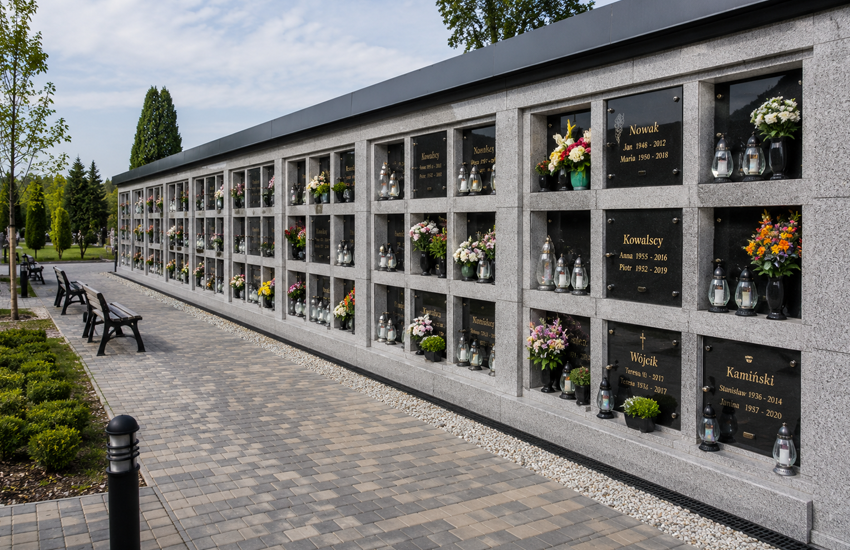
For cemetery managers and funeral homes, this means a need to adapt the infrastructure. An urn field takes up a fraction of the area of a traditional plot, and a columbarium makes it possible to commemorate many of the deceased within a small space. It is an answer to the very same problem faced by the overcrowded necropolises of centuries past – how to hold memory within a finite space.
The urn ceremony and its setting
An urn burial also changes the ceremony itself. It is usually intimate, shorter, and often takes place in a different part of the cemetery from a traditional funeral. Yet it calls for a setting that is not lesser, but different. This is where equipment unknown to the old necropolises comes in, such as a compact, easily assembled funeral tent. The range of funeral tents built around lightweight frames and waterproof, double-impregnated fabric provides stability even in strong wind gusts and protects participants and the urn from rain and sun, while the structure can be set up in minutes anywhere on the grounds. For a funeral home, the option of personalisation – a printed logo or name – also matters, so that even a small ceremony gains a dignified, visually coherent setting.
This seemingly small difference – an intimate tent rather than a monumental mausoleum – illustrates the whole transformation well. The contemporary farewell more often favours intimacy and simplicity over grandeur, yet it still demands care and respect in every detail.
Memory and technology: the digital necropolis
The ancient necropolis carried memory through stone and inscription. The modern cemetery increasingly reaches for digital tools that extend this function far beyond the physical headstone.
QR codes and the augmented grave
In many cemeteries, plaques with QR codes now appear, leading to online biographies, photo galleries or memories left by loved ones. It is a kind of extension of the Roman idea of the grave as an address at which the passer-by pauses for a moment – with the difference that the address today is also digital, and the story of the deceased can be far richer than an inscription carved in stone.
Managing a cemetery in the twenty-first century
Equally important is the digitisation of administration. Electronic grave registers, cemetery maps available online, payment systems for plots and burial search tools have radically changed the manager's work. What once rested in thick ledgers and the gravedigger's memory is today available in seconds. A family searching for a relative's grave no longer has to wander among the plots – a query in the system is enough. In this respect the modern cemetery is more efficiently organised than any historic necropolis, yet paradoxically it serves exactly the same ancient purpose: not to let the deceased disappear from memory.
What old necropolises teach modern cemeteries
Setting the two worlds side by side leads to a conclusion that is not obvious. Progress does not consist in discarding old solutions, but in serving the same needs better. The ancient necropolis teaches the modern cemetery several things that are easily overlooked in the pursuit of efficiency.
First, the burial space is a space of community, not merely an administered area. Old necropolises were places to which people returned, places that shaped the identity of the city. The modern cemetery, in striving for economy and order, should not lose this social dimension. Second, durability matters. The builders of old thought in terms of centuries; today we often think in terms of decades – it is worth ensuring that contemporary infrastructure too is solid and well considered. Third and finally, every detail of the setting of a farewell carries meaning, whether we are speaking of a monumental tomb or a small tent over an urn.
On the other hand, modernity brings what the old necropolises lacked: safety at work, hygiene, accessibility, efficient management and equipment that protects the health of the people caring for the cemetery. The best contemporary cemetery is one that combines the reverence of the old cities of the dead with the practical wisdom of the twenty-first century – where the dignity of the ceremony goes hand in hand with well-chosen equipment and a thoughtfully organised site.
Frequently asked questions
What is the difference between a necropolis and a cemetery
The terms are sometimes used interchangeably, but they carry different shades of meaning. Necropolis is a term of Greek origin meaning a city of the dead, and it usually refers to large, historic or monumental burial grounds, often ancient. Cemetery is the modern, general term for a defined and managed area set aside for burying the dead. In practice, the word necropolis today most often denotes historic or particularly grand cemeteries.
Why were old cemeteries founded within cities and new ones outside them
In earlier eras the dead were buried beside churches, in the heart of settlements, which stemmed from religious belief and the proximity of the place of worship. As cities and sanitary knowledge developed, overcrowded churchyards came to be regarded as a sanitary threat. From the eighteenth and nineteenth centuries onward, therefore, new cemeteries were established beyond the built-up area, in places with more space and a smaller risk to residents' health.
How has mechanisation changed work at the cemetery
Mechanisation has shortened and eased work that for centuries was done entirely by hand. Digging graves, moving soil and shifting heavy elements can today be partly entrusted to compact machines adapted to cemetery conditions. Where a machine cannot fit, modern manual equipment such as high-capacity off-road carts significantly reduces the effort and the risk of injury to workers.
Do modern cemeteries take up less space than old necropolises
Usually yes, especially per burial. Contemporary urn fields and columbaria make it possible to commemorate many of the deceased on an area that a traditional earth grave occupies on its own. This is the result of the growing popularity of cremation and of deliberate spatial planning intended to respond to the limited availability of land near cities.
Why do urn ceremonies require their own equipment
An urn burial is usually intimate and often takes place in a dedicated part of the cemetery. Despite its smaller scale, it calls for a careful setting that ensures the dignity of the occasion and the comfort of participants. Compact funeral tents protect against the weather, bring order to the ceremony space, and allow a funeral home to maintain a coherent, professional image even during a small farewell.
How does digital technology affect contemporary cemeteries
Digitisation operates on two levels. For visitors it means QR codes at graves leading to biographies and memories, and online burial search tools that make it easier to find a loved one's resting place. For managers it means electronic grave registers, online cemetery maps and payment systems that streamline administration and help to maintain order and the availability of information.
What can contemporary cemeteries learn from old necropolises
Above all, that a burial place is a space of community and remembrance, not merely an area to be administered. Old necropolises show the value of durability, of the deliberate composition of space and of attention to every detail of commemoration. The modern cemetery can combine this sensibility with today's standards of safety, hygiene and efficient management, creating a place that is at once dignified and practical.