Table of Contents
- What a Farewell Ritual Actually Is
- The Psychology of Grief - Why the Mind Needs Ceremony
- The Social Dimension of Farewell
- Elements of a Dignified Funeral Ceremony – From Farewell to the Final Gesture
- The Modern Transformation of Farewell Rituals
- The Funeral Home's Role as a Guide Through Grief
- When Farewell Is Absent - The Consequences of a Missing Ritual
- Frequently Asked Questions
The death of someone close stops time. In a single moment, a world that only yesterday seemed orderly and predictable loses its obvious shape, and those who remain are left facing an emptiness that words struggle to capture. It is precisely at this point - when language fails and emotion outstrips our ability to name it - that ritual steps in. A farewell ceremony is not merely a formality or a social convention inherited from our ancestors. It is one of the oldest and most deeply rooted human ways of confronting loss.
For those who work in the funeral profession, understanding why a farewell ritual carries such weight is knowledge that reaches far beyond the logistics of arranging a funeral. It is the foundation that allows them to accompany families through one of the hardest experiences of their lives with empathy, sensitivity, and genuine professionalism. Every element of a ceremony - from the space in which it takes place to the words spoken over the coffin - serves a defined psychological and social function. A well-conducted farewell will not undo the loss, but it can give that loss meaning and open a path toward healing for the bereaved.
What a Farewell Ritual Actually Is
A ritual is a repeated, symbolic sequence of actions whose meaning extends beyond its practical purpose. Preparing the body, keeping vigil beside the deceased, shared prayer or a eulogy, laying flowers, escorting the coffin to its resting place - each of these acts carries a symbolic content that participants understand almost intuitively. Anthropologists have long emphasised that no culture has ever failed to develop its own ways of dealing with death. This is a constant so powerful that it can be counted among the defining traits of humanity itself.
Ritual as a Universal Human Language
Traces of the ceremonial treatment of the dead are found in the earliest layers of human history - in graves tens of thousands of years old, where ornaments, tools, or flowers were laid beside the remains. Even then, humankind did not leave death to itself. It surrounded death with gesture, with rite, with care. Modern funeral ceremonies, though their forms have shifted across eras and religions, fulfil exactly the same role they did centuries ago. They are the way a human community says: this event matters, this person was important, their passing will not go unnoticed.
This continuity is telling. Despite technological progress, secularisation, and profound changes in custom, the need for a ritualised farewell has not weakened. The forms change, but the need itself does not. Faced with death, people still reach for rite - because it is rite that allows us to come to terms with what by its very nature remains beyond reconciliation.
Farewell and Rite - A Distinction That Matters
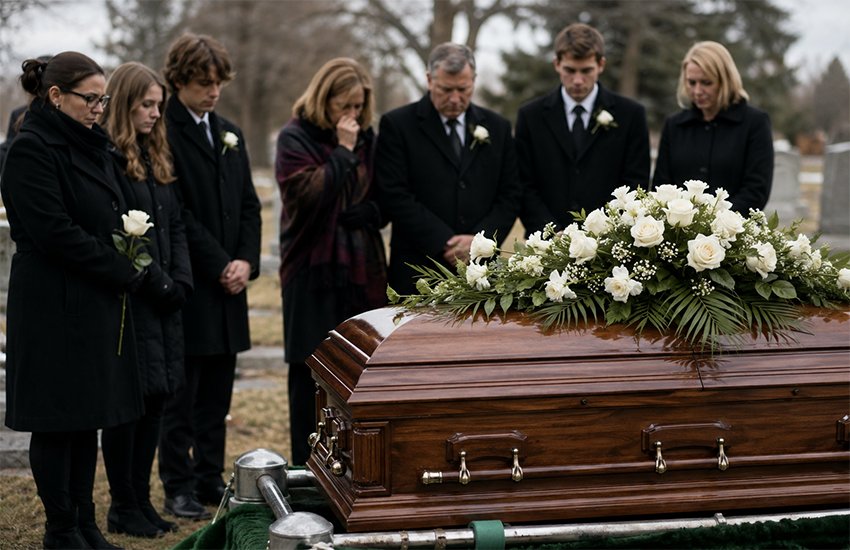
It is worth distinguishing the act of burial itself from the ritual of farewell. Interring the body is an act with a practical, sanitary, and legal dimension. The ritual of farewell is something far greater - it is the space in which loved ones can express emotion, pay tribute to the deceased, and symbolically close a chapter. A funeral stripped of this symbolic layer leaves the bereaved with a sense of something left unfinished. This is why, even in situations where circumstances force simplicity, people instinctively seek at least a minimal form of ceremony. The gesture remains essential, even when it is reduced to its very essence.
The Psychology of Grief - Why the Mind Needs Ceremony
Contemporary grief psychology provides compelling arguments for the view that a funeral ceremony plays a real, measurable role in the process of coping with loss. Grief is not a single event but a complex process that unfolds over time and follows different paths in different people. Within that process, the ritual of farewell serves as one of the most important points of reference.
Grief as a Process, Not a State
For decades, grief was described through stage-based models suggesting that sorrow proceeds in a fixed sequence. Today researchers approach this far more cautiously, stressing that grief is a dynamic and highly individual phenomenon. Some need weeks, others years. Some experience loss loudly, others in silence. What unites all these paths is the necessity of confronting the reality of the loss and gradually working through the emotions it provokes. A funeral ceremony supports both of these processes in a way that is difficult to replace.
Ceremony as a Confirmation of Reality
One of the hardest barriers to cross in grief is disbelief. The mind defends itself against accepting the truth of death, suggesting that the event is unreal, that the loved one will return at any moment. A funeral ceremony - with its tangibility, the presence of the body or urn, the physical act of laying to rest - helps break through this defence mechanism. The farewell becomes the point at which loss ceases to be an abstraction and begins to be an experience lived through together and confirmed by the presence of others. It is a painful but necessary step toward acceptance.
The Role of Ritual in Regulating Emotion
A ceremony gives emotion a safe, socially sanctioned place to be expressed. In everyday life, the open display of despair can feel awkward, and the bereaved often feel pressure to maintain a composed appearance. A funeral lifts that pressure. Tears, emotion, memories spoken aloud - all of this is here not only permitted but even expected. The structural form of the ceremony, with its predictable rhythm and order of events, paradoxically provides a sense of support at the very moment when everything else is slipping out of control. Ritual brings order to chaos.
The Social Dimension of Farewell
Grief is often seen as a deeply personal experience, yet in truth it carries an equally strong communal dimension. The death of a member of a group - a family, a neighbourhood, a local community - tears the fabric of relationships in a way that calls for symbolic repair. Here the funeral ceremony performs a binding function whose significance is often appreciated only in hindsight.
Community in the Face of Loss
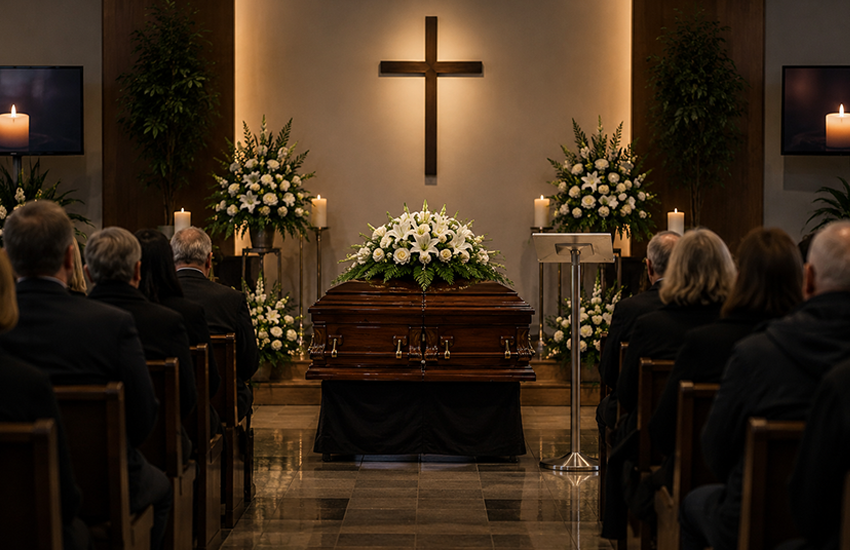
The gathering of loved ones at a funeral is not merely an expression of respect for the deceased. It is also an act of mutual support among the living. The presence of others - their gestures, words of sympathy, their very physical closeness - communicates to the bereaved that they are not alone in their suffering. Sharing the loss distributes its weight and reminds everyone that life continues within a web of relationships that have survived. For many, this very sense of being surrounded by community is the first step toward regaining balance.
Farewell as an Act of Making Meaning
A ceremony is also an opportunity to tell the story of the deceased's life - to recall who they were, what they achieved, how they remained in the memory of those close to them. This act of narration has a profound therapeutic significance. It allows death to be placed within the wider context of an entire life, rather than reduced to the painful moment of departure. A person ceases to be defined by the way they died and is remembered instead for the way they lived. In this way, the farewell gives meaning both to the death and to the life left behind.
Elements of a Dignified Funeral Ceremony – From Farewell to the Final Gesture
Although every farewell is different, a well-organised ceremony rests on a few constant pillars. These are a thoughtfully arranged space, a clearly marked focal point, and the opportunity to speak words of farewell. Each of these elements requires the right supporting equipment, and the quality of that equipment translates directly into how participants experience the occasion. A professional funeral home knows that the details no one names aloud are what determine the atmosphere of solemnity and dignity.
A Space That Soothes
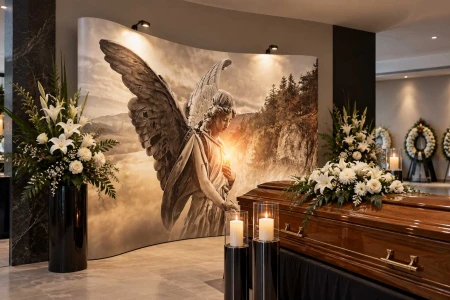
The surroundings in which a farewell takes place affect participants more strongly than is commonly assumed. An orderly, refined, and sheltered space allows people to focus on what matters most and removes distracting stimuli. This is especially true during ceremonies held outdoors - at the graveside, in the cemetery - where the question of adequate shelter can be decisive. Unfavourable weather can disrupt even the most carefully planned occasion, stripping it of its solemnity and comfort.
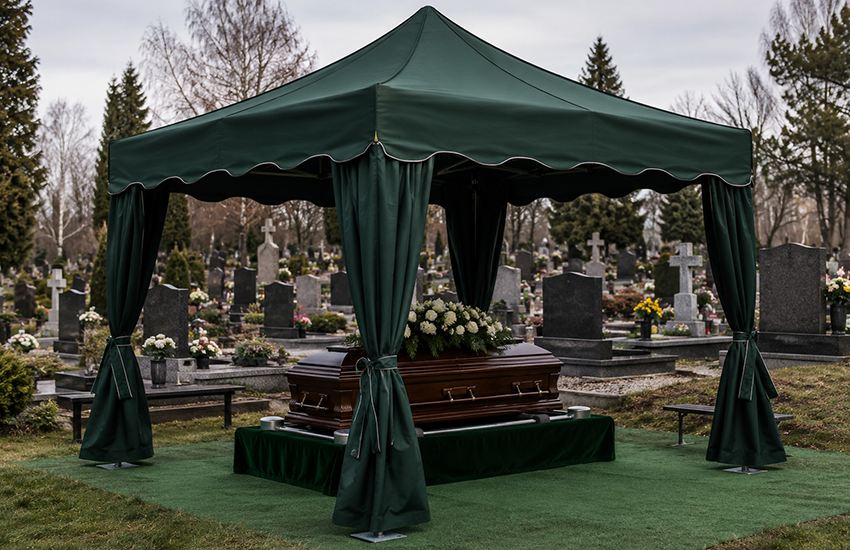
A solution that professional funeral homes increasingly turn to is the funeral tent 3x3m. Its frame, built on a hexagonal aluminium profile, provides stability even in difficult weather, while the waterproof fabric shelters participants from rain, sun, and wind. Equally important is its aesthetic dimension - an elegant, understated design that creates a setting which underscores the gravity of the moment. The option to personalise the print and to add sidewalls makes it possible to safeguard the privacy of the bereaved during the most intimate moments of farewell. This is the kind of equipment whose presence participants often do not consciously notice, yet whose absence would immediately register in their sense of comfort.
The Focal Point of the Ceremony
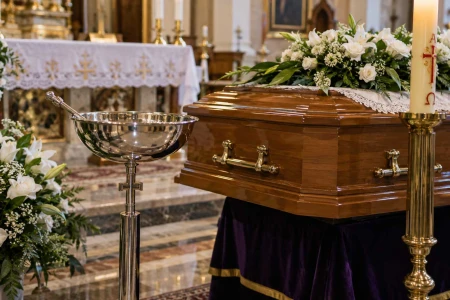
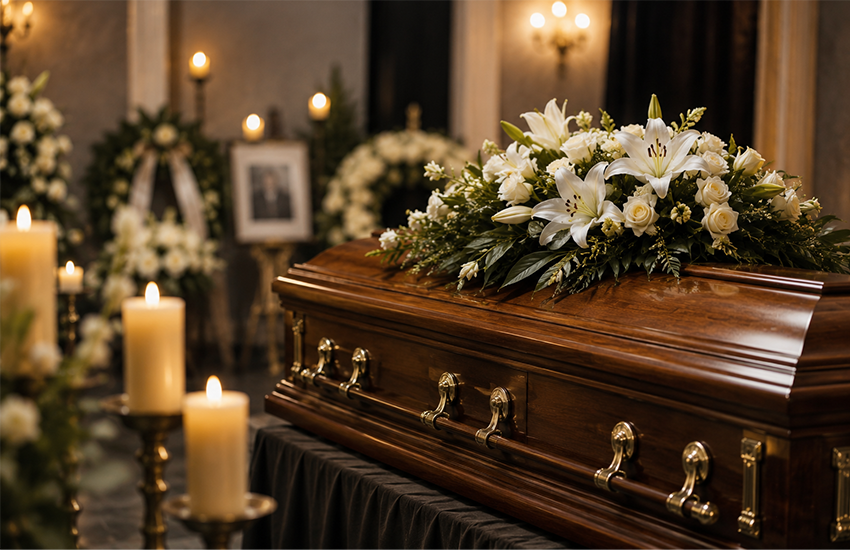
Every farewell ceremony has its focal point - the place toward which eyes are drawn and around which the entire space is arranged. That place is the coffin or urn, and the way they are presented carries enormous symbolic weight. The deceased should be honoured with a presentation that communicates respect and solemnity, while at the same time allowing safe and dignified movement throughout the occasion.
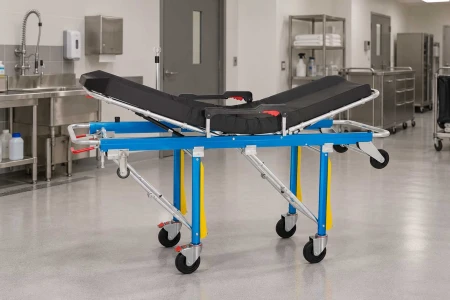
This role is fulfilled by the aluminium casket trolley - a piece of equipment that combines a practical function with a ceremonial one. Its light yet durable aluminium construction supports up to 250 kilograms, while four swivel castors with brakes allow precise, smooth manoeuvring and secure locking in the chosen position. Smoothness of movement matters here beyond mere convenience of handling - any jolt or unexpected movement would disturb the gravity of the moment. The trolley can also be finished with a drape in a chosen colour, which completes the presentation aesthetically and lets the setting be matched to the character of the ceremony. In this way, an object that appears purely technical becomes a vessel for the dignity of the farewell.
The Word That Remains
Of all the elements of a ceremony, it is the word of farewell that lingers most deeply in memory. A eulogy delivered over the coffin, a passage from the deceased's favourite poem, a memory shared by a friend - these moments often prove to be the most important part of the whole occasion and stay in the hearts of the bereaved for years. For them to ring out with the dignity they deserve, the speaker needs the right support, both in the literal and the symbolic sense.
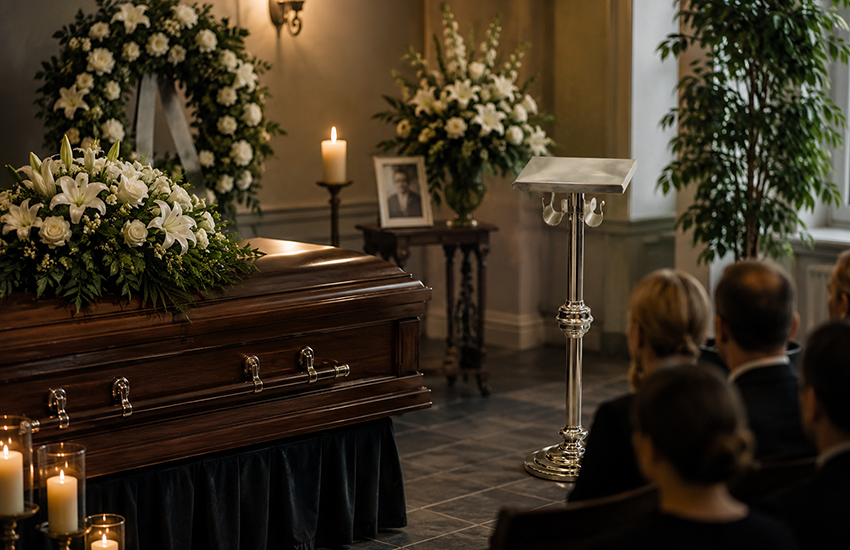
The funeral lectern no 1 was designed with precisely these moments in mind. Its classic, understated design blends seamlessly with the interior of a funeral chapel, while its stable construction and optimal height make delivering a speech comfortable and natural. The broad top will hold notes, texts, or a book of condolences, and the ergonomic angle makes reading easier even in moments of deep emotion. Importantly, the lectern serves equally well during religious and secular ceremonies, which makes it a universal element of any chapel's equipment. Its presence gives the spoken word a setting worthy of its weight.
The Modern Transformation of Farewell Rituals
Although the need for farewell remains unchanged, its forms are undergoing dynamic transformation today. Funeral homes that wish to respond effectively to the expectations of families must understand the direction of these changes and be able to adapt to them flexibly. What was an exception only two decades ago is now becoming the norm.
From Religious Rite to Secular Ceremony
Advancing secularisation means that more and more families are choosing farewells of a secular character, or ones that blend religious elements with personal ones. Funeral celebrants who lead ceremonies without a denominational framework are becoming an increasingly visible part of the profession. This shift does not signal a weakening of the need for ritual - on the contrary, a secular ceremony often demands even more careful planning, because it does not rest on a ready-made script entrenched by tradition. Each of its elements must be consciously chosen and given meaning.
The Personalisation of Farewell
Contemporary families increasingly wish for a ceremony that reflects the uniqueness of the deceased. Favourite music in place of traditional hymns, photographs from different stages of life, personal belongings, symbols of passions and interests - all of this comes together in a farewell tailored to a particular person. For a funeral home, this means a need for greater flexibility and for equipment that allows the setting to be adapted to individual wishes. Personalisation has become one of the strongest trends shaping the profession, and the ability to deliver it is now often the deciding factor when families choose a provider.
Farewell in the Age of Cremation
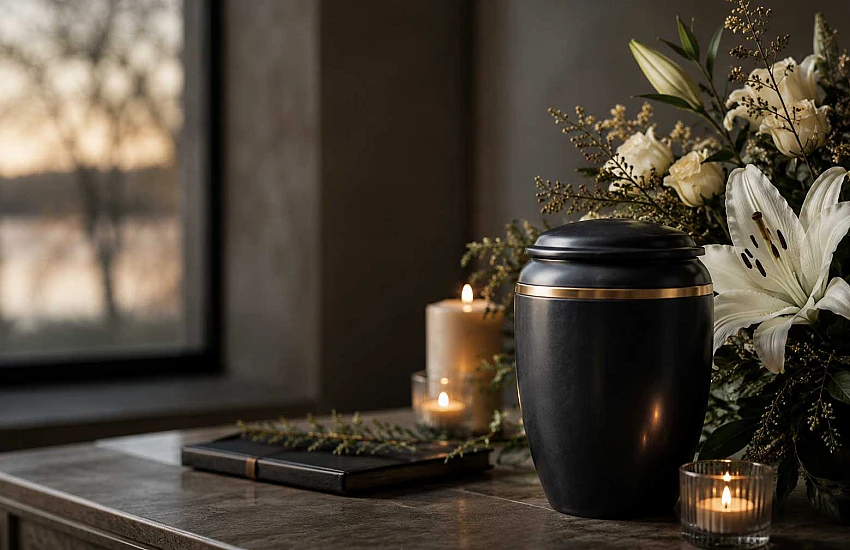
The growing popularity of cremation is changing the logistics and setting of farewells, but it does not eliminate the need for ceremony. Quite the opposite - the urn of ashes becomes the new focal point of the occasion, and the very flexibility that cremation offers opens space for more personalised forms of farewell. A ceremony can take place before cremation or after it, in a chapel, at a cemetery, or in another place meaningful to the family. This is proof that ritual can take on new shapes without losing anything of its essence.
The Funeral Home's Role as a Guide Through Grief
In the face of loss, families rarely have the knowledge and the strength to organise a dignified farewell on their own. The responsibility for guiding them through this process rests with the funeral home - not only in organisational terms, but in human ones. A good funeral director today is in equal measure a logistician, a guide, and a confidant.
Professionalism That Provides a Sense of Security
A grieving family needs the certainty that everything will be handled down to the last detail, so that they themselves can focus on living through the loss rather than on solving organisational problems. The efficiency, discretion, and sensitivity of the service translate directly into the emotional comfort of those close to the deceased. Every element that works flawlessly - from punctuality, through the condition of the equipment, to the manner of communication - builds a sense of security in a situation where the ground is giving way beneath one's feet. That trust is the most valuable capital any funeral home holds.
The Details That Create a Dignified Setting
The dignity of a ceremony arises from the sum of details that participants usually do not consciously analyse, yet which they register on the level of feeling. A neat and safe space, a smoothly moving catafalque, a stable lectern, an elegant setting - all of this adds up to an impression of solemnity and respect. Investing in solid, durable equipment is therefore not merely a practical matter. It is an investment in the quality of a farewell the family will remember for the rest of their lives, and in the reputation of the funeral home, built precisely through these details that escape notice at first glance.
When Farewell Is Absent - The Consequences of a Missing Ritual
The best proof of the importance of a farewell ritual is what happens when it is absent. Situations in which, for various reasons, no ceremony takes place, or in which it is drastically curtailed, leave the bereaved with a sense of incompleteness that can hinder the working-through of loss for long months and sometimes years.
Experiences from the pandemic period, when restrictions made it impossible to hold full ceremonies, exposed this mechanism with painful clarity. Many families, deprived of the chance for a dignified farewell, subsequently struggled with what is known as complicated grief - a state in which the grieving process stalls and finds no natural outlet. The absence of symbolic closure, of community, of a place and time to express emotion - all of this meant that the loss remained an open wound. It is a reminder that the ritual of farewell is not an addition to the grieving process but an integral and often indispensable part of it.
Awareness of this fact places a particular responsibility on the funeral profession. Enabling a family to say a dignified farewell - even in difficult circumstances, even in a modest form - is real support in the process of healing. It is one of the most important reasons why working in the funeral profession, for all its weight, carries deep meaning and value.
Frequently Asked Questions
Why is a funeral ceremony important for the grieving process?
A funeral ceremony helps people confront the reality of loss, gives them a safe space to express emotion, and allows them to symbolically close a chapter. It serves as a point of reference from which many begin the work of processing their grief. Its absence can make a healthy passage through grief more difficult.
Does a farewell ritual matter for secular ceremonies as well?
Yes, and often it matters even more. A secular ceremony does not rest on a ready-made religious script, which means each of its elements must be consciously chosen and given meaning. The need for ritual - for community, for a word of farewell, for a symbolic gesture - remains independent of the denominational dimension.
How do the setting and equipment affect the course of a ceremony?
Space and equipment affect participants more strongly than is usually assumed. An orderly, sheltered, and refined setting allows people to focus on the farewell and builds an atmosphere of solemnity. Elements such as a funeral tent, a catafalque, or a lectern create the dignified frame of the occasion, the absence of which would immediately register in how it is experienced.
Does cremation diminish the significance of a farewell ceremony?
No. Cremation changes the logistics and form of farewell, but it does not eliminate the need for ritual. The urn becomes the new focal point of the occasion, and the flexibility that cremation offers often allows for more personalised forms of farewell, tailored to a family's expectations.
What is complicated grief and how does it relate to the absence of farewell?
Complicated grief is a state in which the grieving process stalls and finds no natural outlet, persisting far longer than usual. The absence of a dignified farewell - of symbolic closure, community, and space to express emotion - is one of the factors that can increase the risk of it developing.
What role does the funeral home play in a family's grieving process?
Today a funeral home is not only the organiser of the occasion but also a guide and confidant for the family. The efficiency, discretion, and sensitivity of the service give the bereaved a sense of security and allow them to focus on living through the loss rather than on organisational matters. It is real support in a difficult time.
How should equipment be chosen to ensure a dignified setting for a ceremony?
It is worth being guided by durability, aesthetics, and functionality, as well as by the versatility of equipment that will perform across different types of ceremony. A solid catafalque, a stable lectern, and a weather-resistant funeral tent form the base on which a dignified setting can be built. Investing in quality translates directly into the comfort of families and the reputation of the funeral home.