Table of Contents
- Ceremony Logistics – The Invisible Pillar of Every Funeral
- Scissor Trolleys – The Heart of Daily Funeral Home Work
- Cemetery Transport – Where Every Surface Matters
- Funeral Lowering Devices – A Revolution in Ceremony Organisation
- The Hydraulic Trolley – Bridging the Preparation Room and the Ceremony
- Stretchers, Transport Chairs, and Accessories – Transport at Every Stage
- The Catafalque Trolley – Equipping the Chapel and Funeral Home
- The Funeral Pall – Completing the Ceremonial Picture
- Why Investing in Professional Equipment Is Investing in the Funeral Home's Reputation
- FAQ – Frequently Asked Questions
Every funeral, regardless of its form or scale, is an organisational challenge that leaves no room for improvisation. Families entrust funeral homes with moments that cannot be undone – and they expect every element to unfold with dignity, calm, and flawless precision. Yet behind every ceremony lies complex logistics: transporting the body, moving the coffin between rooms, reaching the cemetery with a heavy load, and lowering the coffin smoothly into the grave. It is in precisely these moments that the right equipment makes all the difference.
In recent years, the Polish funeral industry has undergone a visible transformation. Funeral homes that were still working with methods carried over from the 1980s have increasingly turned to professional technical solutions – scissor trolleys of various grades, specialist all-terrain carts, hydraulic lifting systems, and electric remote-controlled lowering devices. This shift is driven not only by concern for staff welfare, but also by growing client expectations from families who now pay close attention to how their loved one's final farewell is conducted.
This article explores how modern logistical equipment is changing the daily work of funeral homes – from the preparation room, through the nave of a church, to the cemetery grounds. We present specific products available from funeraryaccessories.com that help professionals work more efficiently, more safely, and with full respect for those in their care.
Ceremony Logistics – The Invisible Pillar of Every Funeral
In the popular imagination, a funeral is a ceremony, a prayer, a eulogy, and a grave. But before the family stands at the coffin, the funeral home staff have carried out dozens of tasks that must be perfectly synchronised. Dressing and preparing the body, transporting it to the chapel or church, positioning the coffin on the catafalque, managing the ceremony, transporting the cortège to the cemetery, and finally the committal – every single one of these stages carries the risk of failure when the right equipment is missing.
Funeral home staff frequently work in conditions far from ideal. Narrow staircases in old tenement buildings, muddy cemetery pathways, steep slopes, uneven surfaces – these are everyday realities they must contend with regardless of the weather. On top of this comes the health dimension: manually carrying coffins and bodies is one of the leading causes of back injuries in this industry. Well-chosen equipment is therefore not a luxury – it is an investment in staff safety and service quality.
It is worth viewing funeral logistics as a sequence of precisely planned operations, where every transition between stages is a potential bottleneck. Collection of the body from the place of death, transport to the funeral home, preparation and dressing, placing in the coffin, transport to the chapel or church, conducting the ceremony, the cortège to the cemetery, the committal – that is at least seven distinct stages, each requiring different equipment and different competencies. In a modern funeral home every stage is thought through, and equipment is chosen not at random, but systematically.
Professional ceremony logistics rests on several equipment categories that complement one another. Scissor trolleys handle internal and ceremonial transport, terrain carts excel in cemetery conditions, and lowering devices solve the challenge of placing the coffin or urn into the grave. Every one of these elements can today be matched to the specific needs of a funeral home – both functionally and aesthetically.
Scissor Trolleys – The Heart of Daily Funeral Home Work
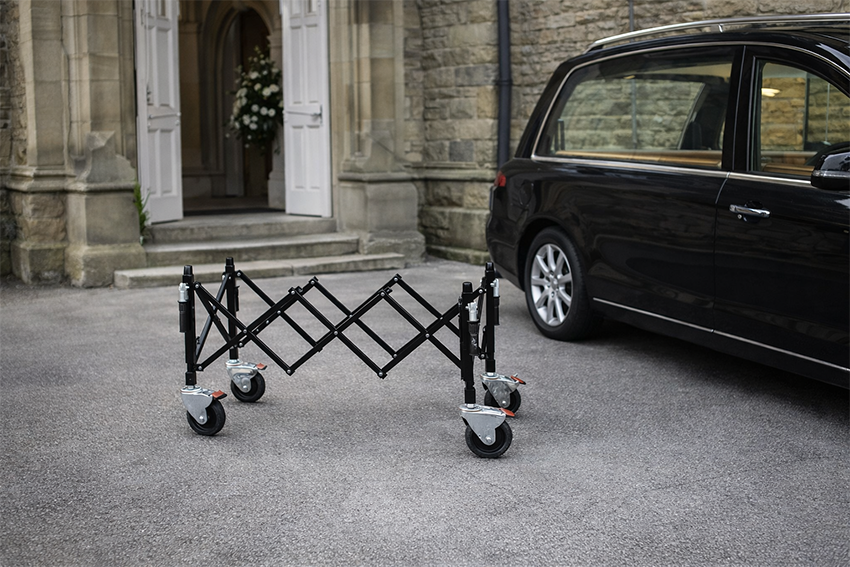
The scissor trolley is the absolute foundation of every professional funeral home's equipment. Its scissor mechanism allows the platform on which the coffin rests to be raised or lowered, meaning the same machine works equally well when loading into a vehicle and when displaying the coffin during a ceremony. A well-designed scissor trolley moves smoothly, produces no unwanted noise, and looks impeccable even during the most solemn ceremonies.
The scissor trolley has been part of the funeral industry for several decades, but the range available today has never been broader. Manufacturers – including Prima-Tech S.C. – have responded to the diverse needs of the market with an entire spectrum of solutions that differ not only in price and materials, but also in their suitability for specific working scenarios. A trolley for a small hospital chapel, one for a historic church with narrow naves, one for a modern funeral home with a wide foyer – each environment has its own requirements, and the market is now meeting them with increasing precision.
STANDARD and PREMIUM Scissor Trolleys – Two Worlds, One Purpose
The funeraryaccessories.com range of funeral trolleys covers a broad spectrum of scissor trolleys that fall into two main streams. Models from the STANDARD series, such as the STANDARD Gold Scissor Trolley with aluminium handles, are solid, reliable workhorse tools ideal for funeral homes handling multiple funerals per day. The lightweight aluminium handles reduce the total weight of the equipment, which matters greatly under intensive use.
The PREMIUM series is for funeral homes where the aesthetics of a ceremony are just as important as functionality. The PREMIUM Gold Scissor Trolley with steel handles, along with the silver and bronze versions, feature heavy-duty steel handles that give the whole unit a distinguished, representative character. A trolley of this kind does not leave the stage after transport is complete – it accompanies the coffin throughout the ceremony and must look befitting the gravity of the moment.
A distinct option is the COMPACT Brown Scissor Trolley with small wheels, which solves the problem of limited space. The smaller wheel diameter makes it easier to manoeuvre in tight corridors, sacristies, and narrow passageways – a solution designed with older churches and chapels in mind, where guiding a standard trolley can be genuinely difficult.
The Folding Version – For Funeral Homes Working in the Field
Funeral homes covering a wide geographical area, reaching small towns and rural cemeteries, need compact equipment – something that fits in a service vehicle without sacrificing capability. The Black Folding Scissor Trolley addresses this need precisely.
The folding mechanism reduces the trolley's dimensions to a minimum, so it fits easily in the cargo area of even a smaller vehicle. Once unfolded on site, it is immediately fully operational – nothing needs to be tightened, adjusted, or assembled. This is equipment that respects the employee's time and does not force them to lose precious minutes on preparation when every second counts.
When More Is Needed – The Elevated Version
For funeral homes serving cemeteries with high grave surrounds, or working with oversized coffins, the PREMIUM Elevated Silver Scissor Trolley with steel handles proves essential. The extended height range of the scissor mechanism gives staff better ergonomics and greater comfort during ceremonies – the coffin is displayed at the optimal height without staff having to stoop unnaturally.
Cemetery Transport – Where Every Surface Matters
A cemetery is an environment that can defeat even the best-equipped funeral home. Gravel pathways, tree roots breaking through the surface, slippery slabs after rain, the undulating terrain of old necropolises – all of this means that a standard scissor trolley is often not the optimal solution here. The industry has responded with a whole family of terrain carts, designed specifically for outdoor conditions.
The difference between a ceremonial trolley and a terrain cart is fundamental and should not be underestimated. The ceremonial trolley is designed for flat, hard surfaces – marble chapel floors, polished church floors, smooth pavements. Its wheels are small and precise, and the entire structure is oriented towards smooth movement and aesthetics. On cemetery gravel or soft autumn earth, such a trolley loses its effectiveness – it catches in ruts, jams on stones, and requires excessive force to guide. Terrain carts operate on a different design philosophy: large-profile wheels, a robust steel frame, and a solid load capacity are the three pillars on which their usefulness rests.
The Terrain Cart – A Classic in a New Form
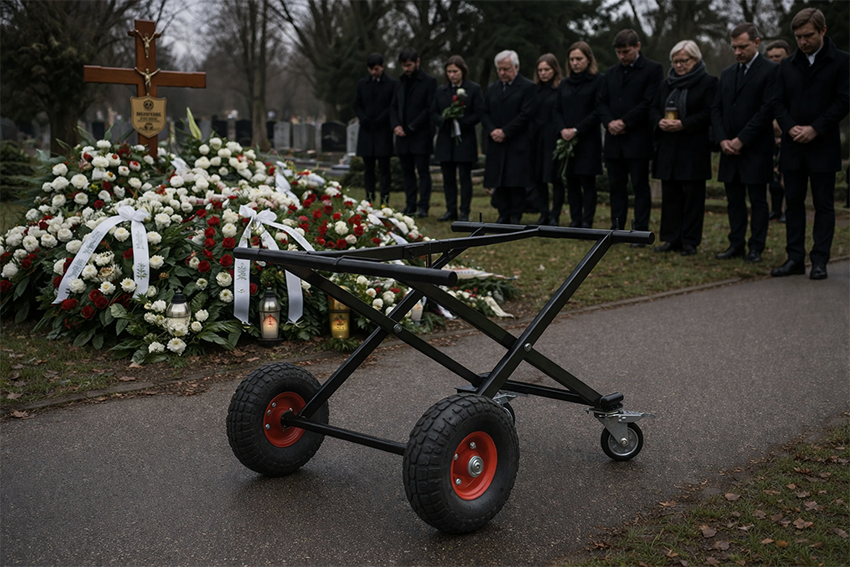
The basic Terrain Cart is simple in construction yet extraordinarily robust, designed for transporting coffins directly across cemetery grounds. Its large-profile wheels roll over uneven surfaces without jolting, minimising the risk of staff losing their balance and – most importantly – ensuring calm, dignified transport of the coffin. The steel frame carries loads that would be unacceptable for lighter ceremonial trolleys.
The PREMIUM Cemetery Terrain Cart – A New Standard in Mobility
A new addition to the funeraryaccessories.com range is the PREMIUM Cemetery Terrain Cart. This device sets a new standard in cemetery mobility. Its robust steel construction with large all-terrain wheels fitted with retaining rings provides a load capacity of up to 300 kg – meaning it can handle any coffin, regardless of its dimensions or weight.
Just as important as the technical specifications is the compactness of this model. The cart folds down to a form that allows it to be carried in any service vehicle. For funeral homes operating across a wide territory, running a fleet of vans, this is a decisive argument. Rather than transporting two separate trolleys – one ceremonial and one terrain – a single, versatile solution becomes possible.
The Terrain Cart with Chain – Safety First
On steep pathways and inclined passages, even the best cart can create a risk of the coffin sliding. The Terrain Cart for Coffin Transport with Chain eliminates this risk. The additional chain securing system prevents the coffin from shifting during movement on uneven ground – a detail that may seem small, but in the context of ceremony dignity and staff safety takes on enormous significance.
The combination of all-terrain wheels, a solid frame, and the chain securing system makes this model one of the most complete solutions for working in demanding cemetery environments. Funeral homes serving historic necropolises with difficult surfaces will find in it an answer to many everyday challenges.
Funeral Lowering Devices – A Revolution in Ceremony Organisation
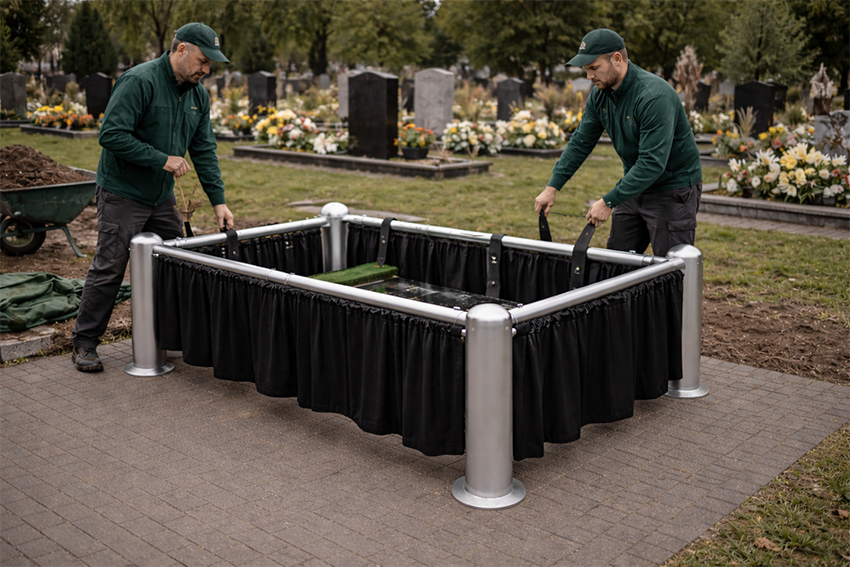
Of all the innovations that have reached Polish funeral homes over the past decade, lowering devices are the one that most profoundly changes the character of the ceremony itself. Traditional coffin lowering required several people, ropes, and considerable physical effort. The entire process carried the risk of uneven descent, involuntary jerking, and loss of control over the pace. A modern funeral lowering device eliminates these problems radically.
Many experienced funeral professionals recall the moment of coffin lowering as the most logistically demanding element of the entire ceremony. A moment's inattention or one person's uncoordinated movement is enough to disturb the atmosphere of the occasion. A mechanical or electric lowering device transfers this responsibility from human hands to a precise mechanism – something families frequently recognise as visible evidence of the funeral home's care and professionalism.
The full range of products in this category is available in the funeral lowering devices section at funeraryaccessories.com. The products come directly from the manufacturer – Prima-Tech S.C. of Kolonia Poczesna – which means individual configuration and full technical support are available.
Electric Remote-Controlled Lowering Device – Precision Without Effort
The flagship product in this category is the Electric Remote-Controlled Funeral Lowering Device. The unit is fitted with a battery-powered electric drive, eliminating the need to connect to the mains – it operates at any cemetery, regardless of power supply availability. The wireless remote allows the operator to control the mechanism from a distance, giving them full oversight of the lowering process throughout.
One of this model's key advantages is that a single person can operate it. In the traditional method, coffin lowering involved at least two – and often four to six – people. The electric lowering device reduces that need to a minimum, which matters not only operationally but aesthetically: fewer staff around the grave gives the ceremony a calmer, more dignified appearance.
The aesthetic dimension of the electric lowering device is hard to overstate. Smooth, controlled lowering without jolts, without rope tension, and without the need to coordinate a group of people is a moment the family carries with them. Where the traditional manual method made the moment of lowering one of tension rather than peaceful farewell, the electric device restores its proper character – of silence, dignity, and control.
The device's frame is constructed from stainless steel, resistant to moisture and variable weather conditions. Adjustable length and width allow it to be matched to different grave and coffin dimensions, making it a genuinely universal piece of equipment.
Lowering Device with Curtain – Aesthetics and Function Combined
For funeral homes that place particular emphasis on the visual presentation of a ceremony, the Funeral Lowering Device with Curtain has been developed. This model combines all the advantages of a mechanical lowering device with an elegant decorative element – the curtains conceal the mechanism and create a unified, solemn scene during the final farewell.
The curtain ensures that the attention of ceremony participants is focused on the coffin and the act of committal itself, rather than on the device making it possible. This is a subtle but significant difference from the families' perspective – the mechanics recede into the background, and dignity and calm come to the fore. The curtained lowering device is the solution for funeral homes that treat ceremony presentation as an integral part of their service.
Gravity Urn Lowering Device – A Solution for Cremation Ceremonies
The growing popularity of cremation in Poland has created demand for equipment tailored to the specific requirements of urn ceremonies. The Gravity Urn Lowering Device is modest in scale but fulfils the same role as a coffin lowering device – providing a controlled, calm, and dignified placement of ashes into the grave.
The gravity mechanism is elegant in its simplicity: it requires no electrical power, is reliable in all weather conditions, and produces no sounds that might disturb the quiet of the ceremony. The urn lowering device is part of the growing trend towards professionalising cremation ceremonies and meets the expectations of families choosing this form of burial and looking for a worthy, carefully considered presentation.
The Hydraulic Trolley – Bridging the Preparation Room and the Ceremony
Between the embalming table and the hearse stands a device without which work in the preparation room would be near impossible. The Hydraulic Trolley with Foot Pump is a specialist tool used primarily for body transfer – between the table and the coffin, between the coffin and the vehicle, between different levels of working spaces.
The foot pump allows smooth platform height adjustment using the leg, without the need to use the hands. The operator can precisely match the trolley level to that of the table or vehicle floor, and slide the coffin or body onto the correct surface without physical effort. This is a seemingly technical detail that in practice greatly reduces the risk of injury and significantly speeds up the work.
The hydraulic trolley is especially valued in the preparation room, where staff carry out many repetitive tasks requiring precise positioning of the body or coffin at the right height. Without hydraulic support, every change of position demands physical strength and full coordination from several people – which over long shifts leads to overloading and injury. The hydraulic trolley converts that physical effort into a few calm movements of the foot.
It is worth emphasising that the hydraulic trolley with foot pump belongs to that class of equipment which, once introduced into the workflow, becomes almost immediately indispensable. It is hard to imagine a funeral home reverting to previous methods after using this device. It is one of those products that changes working standards not gradually, but immediately and definitively.
Stretchers, Transport Chairs, and Accessories – Transport at Every Stage
Funeral home logistics begin not with the ceremonial trolley, but at the moment of body collection. Field work – in private homes, hospitals, care facilities – requires equipment that is mobile, robust, and easy to handle by a small team. Indispensable here are transport stretchers, available at funeraryaccessories.com in several variants.
In funeral home work, stretchers must be not only mechanically robust, but easy to keep clean and compliant with sanitary and epidemiological requirements. Models with a waterproof coating meet both of these criteria and perform well in all weather conditions.
For funeral homes that regularly collect bodies from multi-storey buildings without lifts, a key accessory is the Stair Wheels for Stretchers. This simple device allows stretchers to be transported safely down staircases without being carried by hand – which is both safer for staff and more dignified from the perspective of transport aesthetics. A large proportion of Poland's residential stock consists of buildings without lifts, with narrow stairwells and steep flights of stairs. For staff collecting a body from a fourth-floor flat in such a building, the right equipment can determine their safety and health. Stair wheels for stretchers should be standard equipment in every service vehicle.
A separate category is formed by transport chairs, sometimes fitted with stair-climbing mechanisms. Their presence in a funeral home's equipment inventory demonstrates readiness for every scenario.
The Catafalque Trolley – Equipping the Chapel and Funeral Home
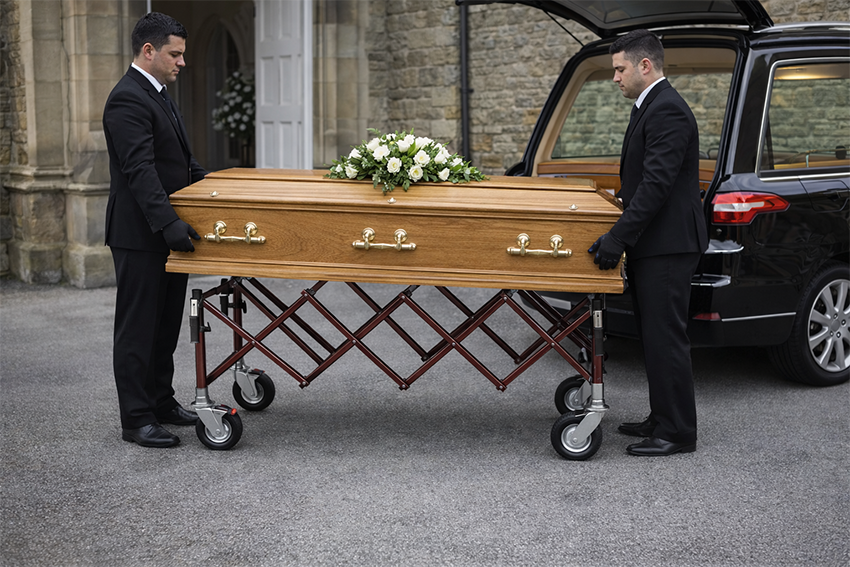
A distinct category in ceremony logistics is equipment designed specifically for use inside chapels and funeral homes. The Catafalque Trolley combines the function of a transport trolley with that of a ceremonial stand. Thanks to its stable, flat platform and representative appearance, it can serve as a catafalque during the lying-in-state and simultaneously be used to move the coffin within the premises.
In funeral homes with their own chapel or ceremony hall, the catafalque trolley simplifies space management – there is no need for a separate catafalque and a separate trolley, because one device fulfils both functions. This is especially valued in smaller premises, where every square metre counts and where rearranging the room between one ceremony and the next must be carried out quickly and without unnecessary physical effort from staff.
The catafalque trolley works exceptionally well with a funeral pall – together they create a complete, aesthetically unified ceremonial position that can be set up or dismantled in a matter of minutes. This is the type of equipment that determines whether a chapel looks like a carefully finished space of farewell or a makeshift room.
The Funeral Pall – Completing the Ceremonial Picture
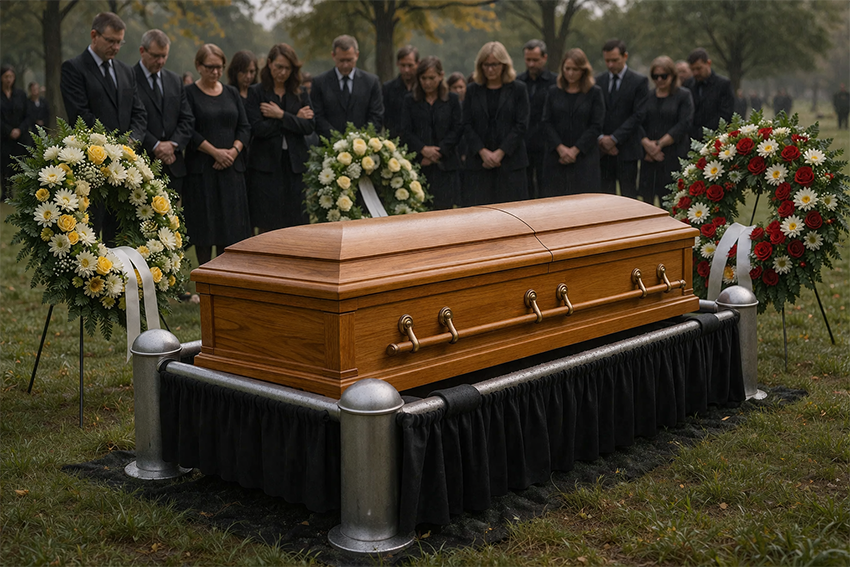
Every scissor trolley, regardless of its class and finish, requires an appropriate covering during the ceremony. The Funeral Pall for Scissor Trolley is a black fabric of the right shape and dimensions that covers the scissor mechanism and gives the whole unit a solemn, unified appearance. It is an apparently minor element that nonetheless visually unifies the entire presentation and means the trolley is no longer perceived as a device – it becomes an integral part of the ceremonial scene.
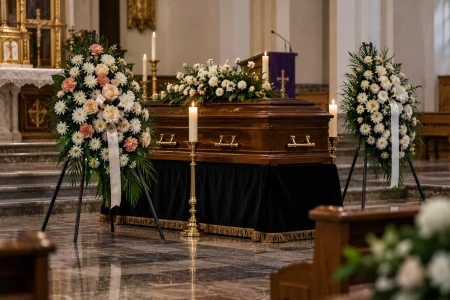
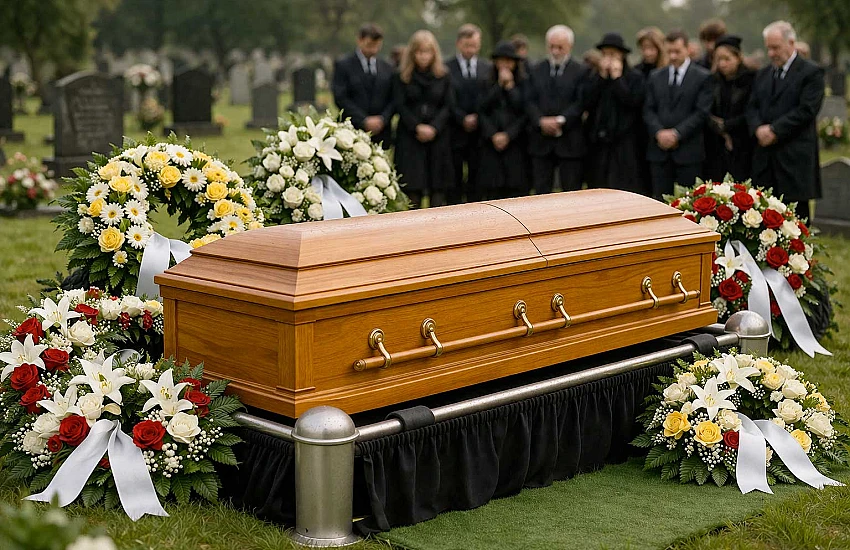
The funeral pall acts as a kind of bridge between technology and tradition. The scissor mechanism, however high in quality and beautifully finished, is a mechanical device – and a funeral ceremony requires that none of the equipment imposes itself on the participants' awareness beyond what is appropriate. The black pall conceals what is technical and foregrounds what matters – the coffin and the elements of the ceremony surrounding it. A coffin displayed on a dark, elegant pall, surrounded by wreaths and flowers, looks entirely different from one resting on an exposed steel mechanism.
Why Investing in Professional Equipment Is Investing in the Funeral Home's Reputation
The funeral services market in Poland is changing in ways that were difficult to foresee even a few years ago. Clients are more aware, more demanding, and – crucially – better informed. Opinions about funeral homes circulate on social media and local online forums. One failed funeral, one awkward moment at the graveside, one instant when something went wrong – any of these can damage a reputation built over years.
Professional equipment is a shield against such situations. An electric lowering device that lowers a coffin smoothly and silently leaves no room for mishap. A terrain cart with a chain securing system eliminates the risk of a coffin slipping on a sloped pathway. Stair wheels for stretchers allow staff to maintain professional composure even in the most challenging residential conditions.
There is also a purely human dimension to this investment that is rarely spoken of directly. Funeral home employees carry out one of the most emotionally demanding professions. When to that difficulty is added the burden of working with inadequate equipment – excessive physical effort, fear of an accident, embarrassment when equipment fails in full view of the family – burnout follows far more quickly. Good equipment protects the employee's body and supports their sense of professional dignity.
It is also worth considering the legal dimension. Workplace ergonomics and safe lifting are areas regulated by health and safety legislation. Funeral homes lacking adequate equipment for safe transport and lifting may face scrutiny from the National Labour Inspectorate. Investment in trolleys, lowering devices, and stretchers is therefore not only a business decision, but an expression of responsibility towards one's own employees.
The funeraryaccessories.com range is aimed at funeral homes of all scales – from small, family-run businesses handling a few funerals a week, to large enterprises with their own chapels and vehicle fleets. The manufacturer – Prima-Tech S.C. – offers the option of leasing and full technical support, meaning equipment modernisation need not be a single, large outlay. Whether the next step is a new terrain cart bought ahead of a difficult winter season, an electric lowering device ordered for a high-profile ceremony, or a set of replacement waterproof stretchers – every such decision builds the funeral home, step by step, piece of equipment by piece of equipment. The knowledge that behind every ceremony stands a well-prepared, professionally equipped funeral home gives staff the confidence to act, and families the peace of mind they deserve.
FAQ – Frequently Asked Questions
What is the difference between a STANDARD and a PREMIUM scissor trolley?
The primary difference lies in the materials used for the handles and finish. The STANDARD series uses aluminium handles, which are lighter and entirely sufficient for intensive daily work. The PREMIUM series features heavy-duty steel handles that give the trolley a more representative appearance and greater mechanical durability. PREMIUM trolleys are available in gold, silver, and bronze, and their aesthetics allow them to remain alongside the coffin throughout the ceremony without any need to conceal the mechanism. An additional product within this range is the elevated version, enabling a higher platform setting – useful when working with oversized coffins or at cemeteries with deep grave surrounds. The choice between STANDARD and PREMIUM should be guided by the nature of the ceremonies served and the expectations of the funeral home's clients.
Can the electric funeral lowering device be operated by a single person?
Yes, the electric remote-controlled funeral lowering device was designed with single-operator use in mind. The wireless remote allows the operator to control the lowering from a safe distance, without needing to hold any levers or ropes. The battery-powered electric drive ensures smooth, controlled operation without jerking, meaning one person can competently conduct the entire procedure. In the traditional manual method, between two and six staff members were typically engaged in lowering the coffin, which carried the risk of uneven descent. The electric lowering device eliminates this problem entirely – something particularly valued by smaller funeral homes with limited staff.
How should I choose a terrain cart for the conditions at a particular cemetery?
Choosing the right terrain cart depends on several factors: the type of pathway surface (gravel, concrete, paving, earth), the topography (flat, hilly, with steep slopes), the typical dimensions and weight of the coffins handled, and how the equipment will be transported to the ceremony site. On flat, paved cemeteries the standard terrain cart performs well. On challenging, varied ground it is worth considering the PREMIUM Cemetery Terrain Cart with a 300 kg capacity and large all-terrain wheels with retaining rings. Where the cemetery has sloped pathways, the terrain cart with chain adds an important safety element. For funeral homes covering large territories who need to transport equipment over long distances, compactness is the priority – here the folding version is the best choice.
Can funeral trolleys be adapted to different coffin sizes?
Standard scissor trolleys are designed with the typical coffin dimensions used in the Polish market in mind. COMPACT models with small wheels work well with standard coffins and can be used in narrower spaces. The PREMIUM elevated scissor trolley offers a wider height adjustment range, making it easier to work with non-standard coffin proportions. For lowering devices the question of fit is even more critical – the electric remote-controlled lowering device has adjustable length and width, allowing it to be matched to different grave and coffin dimensions. It is always worth consulting the manufacturer or supplier at the point of purchase, describing the typical coffin dimensions your funeral home handles – this enables selection of the optimal solution without the need for later modifications.
How long does it take to fulfil an order for a funeral lowering device or other made-to-order products?
Some products in the funeraryaccessories.com range are available immediately and dispatched as soon as payment is confirmed. Made-to-order products such as the electric remote-controlled lowering device and the lowering device with curtain require a production lead time of 6 to 8 weeks. This reflects the fact that they are manufactured directly by Prima-Tech S.C. with the option of individual configuration. It is worth factoring this lead time into investment purchasing plans – particularly if the device needs to be ready before a specific season. When purchasing on lease the lead time is the same and should be included in financial planning. For any questions about the availability of a specific product, the Prima-Tech S.C. sales team can be reached by telephone or email.