Table of Contents
- The Selection Room as the Face of Your Funeral Home
- Casket Racks – The Cornerstone of a Professional Display Room
- Powder-Coated Steel – Why Material Choice Matters
- Mobility and Layout Flexibility
- Designing the Selection Room – Principles That Work in Practice
- Safety and Structural Integrity as Non-Negotiable Requirements
- The Casket Lid Stand – Bringing Order to the Back of House
- Planning Your Display Room – A Practical Framework
- Casket Racks and Back-of-House Storage Organisation
- Customisation and Personalisation Options
- Integrating Casket Racks into the Wider Equipment Picture
- Frequently Asked Questions
The way a funeral home presents its casket selection tells families far more than any brochure or price list ever could. When a grieving family walks into the selection room for the first time, their initial impression determines trust – or undermines it. Caskets stacked haphazardly on the floor, propped against the wall without any organizational logic, or crammed into a corner with no thought for presentation are signals that register instantly, even in a state of emotional distress. For this reason, professional casket storage and display is an investment – not in equipment per se, but in reputation, client confidence, and the day-to-day comfort of the entire funeral team.
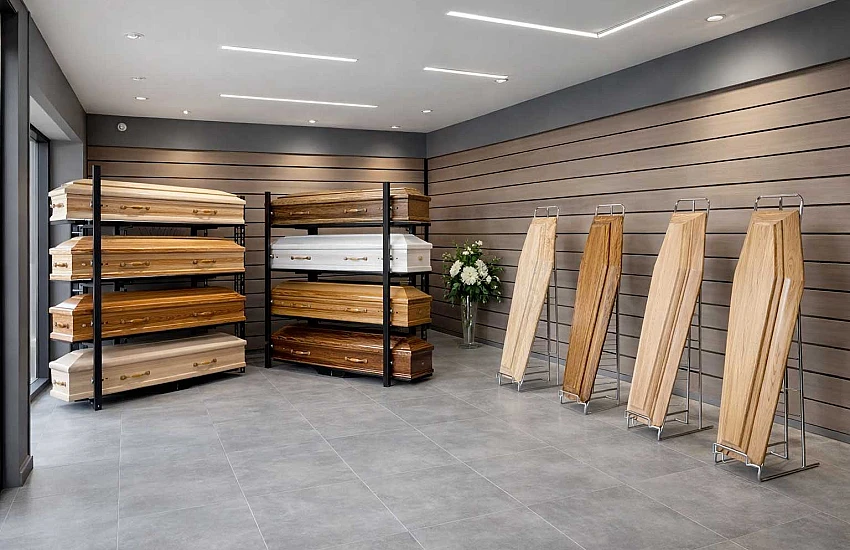
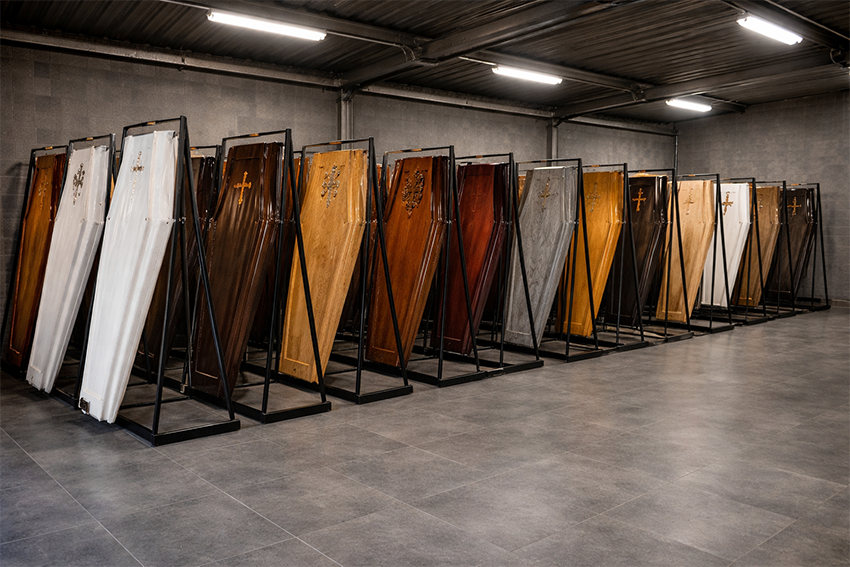
Forward-thinking funeral homes increasingly treat the selection room as a purpose-designed retail environment in the truest sense of the word: a space where every product is properly showcased, accessible both visually and physically, and arranged with deliberate care. Casket racks become both an organizational tool and a branding statement in this context. Well-chosen, solidly built, and thoughtfully positioned racks allow a funeral home to display a dozen or more caskets without any sense of clutter or disorder. Beyond the showroom, there is also the question of the preparation room and back-of-house storage – where casket lids, ceremonial accessories, and equipment must be stored in ways that protect them from damage and allow staff to locate them quickly when needed.
The Selection Room as the Face of Your Funeral Home
Many funeral directors invest heavily in technical equipment – casket trolleys, catafalques, mortuary refrigerators – and rightly so, because those items form the operational backbone of the business. The selection room, however, is sometimes treated as secondary, arranged almost as an afterthought, without deeper consideration of ergonomics or aesthetics. This is a mistake with real commercial consequences.
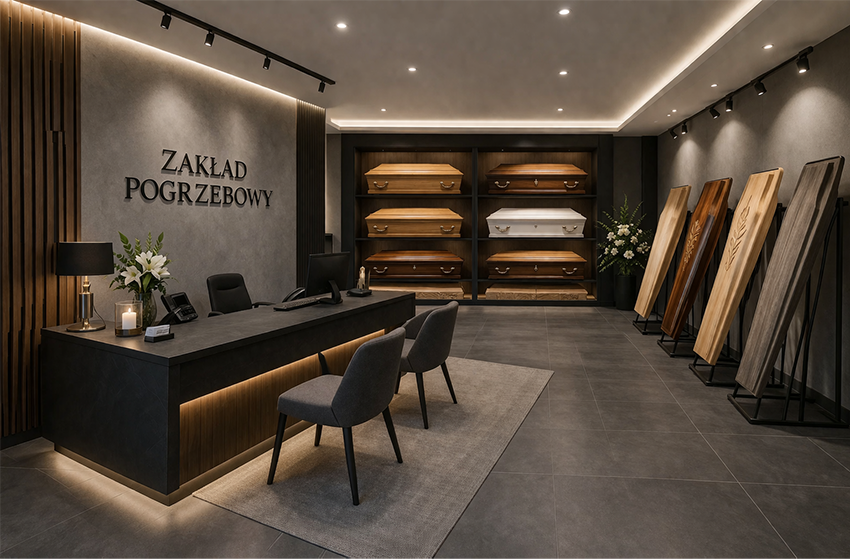
A family arriving at a funeral home is typically under significant emotional stress. Decisions are made quickly and intuitively, and attention gravitates toward details: whether the space is clean, whether it feels orderly, whether the staff seem composed and professional. A selection room where caskets are displayed on solid, elegant racks – visible, accessible, neatly presented – builds an immediate sense of order and competence. Such a funeral home communicates that every detail has been attended to. The opposite impression – caskets leaning against walls, stacked without structure, the room feeling improvised – undercuts even the finest inventory.
The first step toward changing that impression is equipping the room with appropriate casket display racks. This is not about extravagant furniture; it is about purposeful, durable structures that, once installed, will serve without repair or modification for many years.
Casket Racks – The Cornerstone of a Professional Display Room
The funeral equipment market offers several fundamentally different types of casket racks, varying in shelf configuration, depth, capacity, and mobility. The right choice depends on the size of the room, the number of caskets to be displayed, the interior style of the home, and preferences regarding display layout. The full range available at funeraryaccessories.com covers Polish-manufactured racks designed with the practical realities of funeral home operation firmly in mind.
Single-Sided Casket Rack with Even Shelves – Reliable and Classic
The natural starting point for building a selection room display is the Casket Rack No. 1, single-sided. This is a one-sided structure, meaning caskets are displayed and accessed from a single face – ideal for positioning against walls or in a row configuration along the perimeter of the room.
The rack measures 164 cm wide, 78 cm deep, and 170 cm tall, accommodating three caskets on three vertically stacked shelves. All three shelves are of equal length, giving the display a symmetrical, harmonious appearance. From the family's perspective this means a clear, legible layout: each casket is equally visible and easy to approach. From a staff perspective, equal shelves simplify the daily routine of loading, removing a casket for closer inspection, and restocking after a selection.
The entire structure is made from powder-coated steel, standard in black, though the manufacturer can paint it in any colour to match the funeral home's interior. Thick-walled steel profiles ensure stability even under full load, and the adjustable levelling foot allows the rack to be set perfectly upright even on uneven flooring – a detail that matters greatly in many older buildings. An optional caster wheel upgrade is available, making it straightforward to reorganise the room layout without physically moving caskets off the rack first.
Double-Sided Casket Rack with Even Shelves – Maximum Floor Efficiency
In funeral homes with a larger selection room where display units can be positioned centrally rather than against walls, the Casket Rack No. 1, double-sided is the natural choice. Unlike the single-sided version, this rack allows access from both faces, effectively doubling the display surface without a proportional increase in the floor area occupied.
The double-sided rack measures 164 cm wide, 156 cm deep, and 170 cm tall. Capacity is six caskets – three per side. This is an excellent solution for funeral homes that want to present a broad selection without the room feeling overcrowded. Families can walk completely around the unit, which creates a sense of openness and ease during the selection process.
Construction, finish, and customisation options are identical to the single-sided model: powder-coated steel, standard black, adjustable levelling foot, and optional caster wheels. The double-sided configuration does require central positioning – enough clearance on all sides for comfortable access. This should be factored into the room layout plan from the outset, so the rack can be used to its full potential without obstructing traffic flow.
Tiered Casket Rack – Display with Perspective
For those seeking something visually more distinctive than a classic even-shelf arrangement, the Casket Rack No. 2, single-sided with tiered shelves offers a compelling alternative. The defining feature of this model is graduated shelf lengths: the top shelf is shortest, the middle shelf somewhat longer, and the bottom shelf the longest. The profile this creates has an almost stepped or tiered appearance, and it serves a practical purpose as well as an aesthetic one – each of the three caskets is fully visible independently, without being obscured by the casket above it.
From a merchandising standpoint this is particularly valuable when a funeral home wants to draw clear distinctions between models – differences in wood species, hardware finish, interior fabric, or casket profile. When each casket occupies a shelf of its own length, a family's gaze moves naturally from one model to the next rather than perceiving the whole rack as an undifferentiated block.
Dimensions are identical to the single-sided even-shelf version: 164 x 78 x 170 cm, three-casket capacity. Material, finish, and personalisation options remain the same – powder-coated steel, standard black with custom colours available, adjustable levelling foot, and optional casters for an additional fee.
Tiered Double-Sided Casket Rack – For Large Showrooms
Combining the double-sided format with the tiered shelf configuration produces one of the most comprehensive display solutions in the range – the Casket Rack No. 2, double-sided. Designed for large showrooms or funeral homes wanting to present an extensive selection, it offers six-casket display capacity while preserving the open sightlines that tiered shelving delivers.
This variant combines the best properties of both previous formats: dual-face access characteristic of the double-sided models, and the dynamic visual layering of the tiered configuration. At 164 cm wide, 156 cm deep, and 170 cm tall, this unit functions best as a central island display, positioned at least 70 to 80 cm from any wall to allow comfortable circulation and full visual access from every angle.
Mobile Casket Rack with Caster Wheels – Flexibility for Daily Operations
A separate category in the range is the mobile casket rack – a model designed from the outset with mobility as a primary requirement. Four swivel casters with individual locking brakes allow the entire structure, caskets and all, to be rolled freely to any position in the room, enabling a fundamentally different approach to space management.
Funeral homes that use a single room for both storage and client display will particularly appreciate the ability to reconfigure instantly. Before a family consultation the rack can be repositioned to showcase a specific price tier or casket type. After a service it can be rolled back to a storage position, freeing up space. The locking casters ensure that once the rack is placed, it stays there securely until a staff member deliberately chooses to move it again.
This model also offers the greatest configuration flexibility in the range. The manufacturer allows the buyer to choose the shelf angle – either a classic right-angle layout or angled shelves that tilt caskets toward the viewer for easier inspection – and shelf length: even or tiered. Standard dimensions are 164 x 78 x 174 cm with three-casket capacity. Custom dimensions and any RAL palette colour are available to order.
Powder-Coated Steel – Why Material Choice Matters
Every rack in this range shares one defining characteristic: powder-coated steel construction. This is not an arbitrary or purely aesthetic decision. Steel, at the right profile dimensions and wall thickness, delivers load-bearing capacity that wood, aluminium, or other common alternatives simply cannot match. A casket – even one made from solid hardwood – is a substantial, heavy object. The rack must withstand years of daily loading and unloading, frequently at full capacity on all three shelves simultaneously, without deflection or structural fatigue.
Powder coating addresses the specific environmental challenges found in funeral home settings: fluctuating temperatures, elevated humidity near mortuary refrigerators, and regular contact with cleaning agents. The powder is applied electrostatically and cured under heat, producing a finish considerably harder and more resilient than conventional wet paint. It does not chip or flake at minor scratches, it does not rust when the underlying steel is not exposed, and maintenance consists of nothing more than wiping with a damp cloth. The standard black finish is visually neutral, appropriate to the professional register of funeral home environments, and it contrasts cleanly with the lighter finishes typically found on casket exteriors.
The manufacturer – Prima-Tech S.C. based in Kolonia Poczesna, Poland – produces all racks domestically, which has practical significance for custom orders and lead times. Production time for made-to-order models runs from one to two weeks depending on current order volumes. Shipping is arranged individually, with costs confirmed at the time of order.
Mobility and Layout Flexibility
The question of rack mobility is more operationally significant in the funeral industry than it might initially appear. Funeral homes run to a rhythm that is both regular and unpredictable. Families arrive at varying times, services require different room configurations, and seasonal demand fluctuations can be intense. In these conditions, the ability to reorganise the selection room quickly – without extra labour or the risk of damaging caskets – has measurable operational value.
The optional caster wheel upgrade available on the single-sided and double-sided models (Racks No. 1 and No. 2) allows the rack to be retrofitted with mobility after initial purchase, or ordered in the wheeled version from the start. The purpose-built mobile rack takes this a step further with locking swivel casters as a standard feature – the same principle found in professional logistics trolleys, applied to the specific context of casket display.
The adjustable levelling feet, standard on every model, solve a problem that arises consistently in practice: uneven floors in older buildings. A few turns of the adjustment screw eliminate any rocking and establish full stability, regardless of minor surface irregularities. This detail may seem minor in a specification sheet but proves its worth immediately on installation.
Designing the Selection Room – Principles That Work in Practice
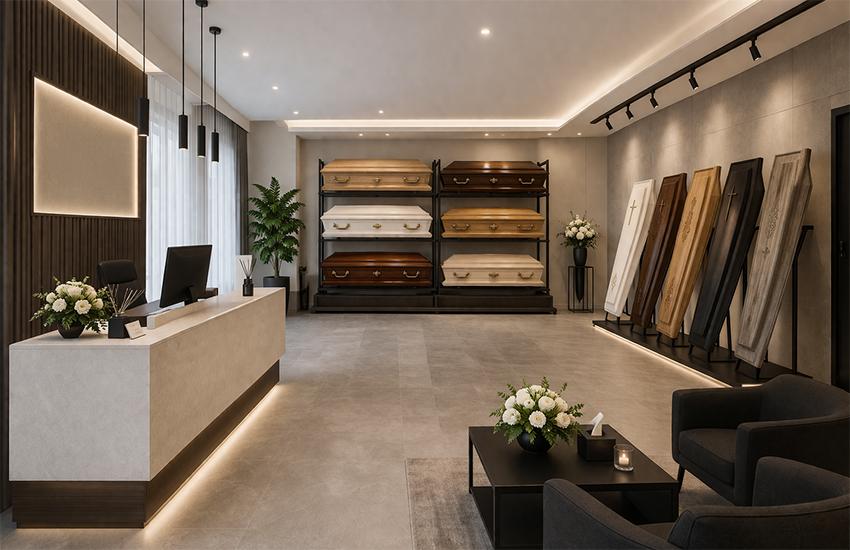
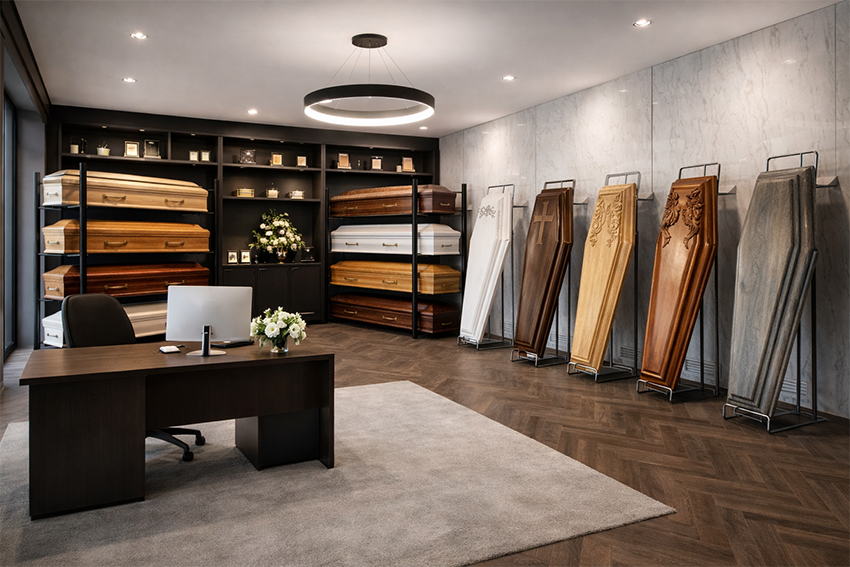
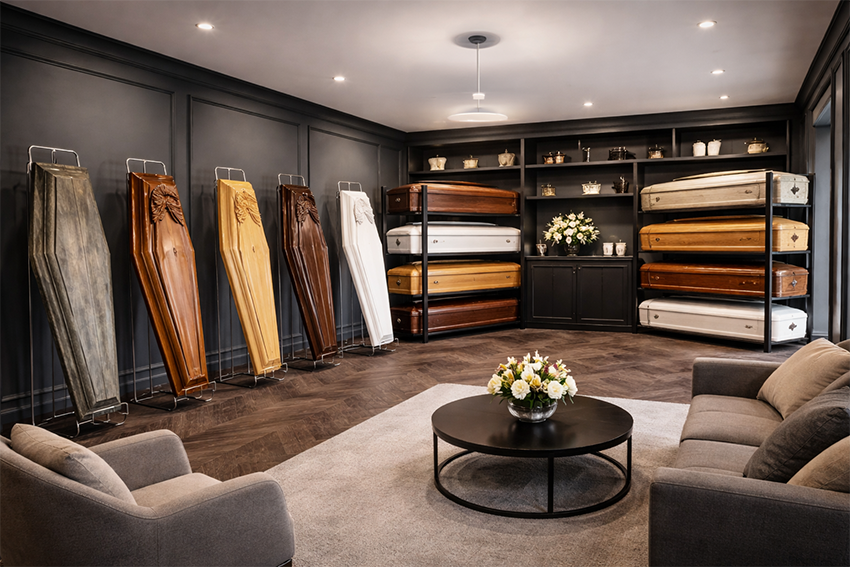
Approaching the selection room as a coherent, designed space rather than a collection of independent objects produces a markedly better result. Casket racks are the dominant element, but what surrounds them creates the context. Several principles apply consistently across well-designed funeral home showrooms.
Rack colour should be considered alongside the room's broader palette. The standard black is neutral and versatile, but homes with interiors in walnut tones, charcoal, or deep green can order racks in matching shades from the full RAL colour system. The manufacturer accommodates any RAL colour, giving effectively unlimited options for visual coordination.
Lighting has an outsized effect on how caskets read in a room. Racks positioned beneath warm, diffused light sources bring out the grain and hardware of wooden caskets far more effectively than cold fluorescent strip lighting. Many funeral homes use directional LED spotlights mounted above or near the racks – the improvement in presentation quality is immediate and significant.
Aisle widths must account for two simultaneous requirements: a family member moving through the room comfortably, and a staff member manoeuvring a casket. In practice a minimum of 90 to 100 cm between rack faces is workable for browsing, but where caskets need to be carried or lifted clear of the rack, 120 to 130 cm is more appropriate. The floor area immediately in front of each rack should be kept clear of decorative props and secondary equipment. In selection room design, restraint almost always produces better results than abundance.
Temperature and humidity in the selection room deserve attention as well. Caskets made from solid wood or natural veneer are sensitive to extreme swings in relative humidity: air that is too dry risks cracking or splitting veneers, while excessive moisture encourages surface staining. A controlled indoor environment at 40 to 60 percent relative humidity is generally appropriate. Steel racks, it is worth noting, have a clear advantage over wooden display furniture here – they do not respond to humidity changes, do not warp or swell, and do not transfer moisture to stored caskets.
Safety and Structural Integrity as Non-Negotiable Requirements
In the context of funeral home equipment, no criterion outweighs structural stability and reliability. A casket is, by its very nature, an object of reverence – the prospect of one falling from a display rack would be distressing on every level, not only practically but symbolically. Rack selection must therefore be based on genuine load capacity, not simply manufacturer declarations.
The casket racks available through funeraryaccessories.com are fabricated from thick-walled steel profiles – not the lightweight sections that can deflect under full load. The broad base of each rack, combined with the adjustable levelling foot, eliminates the risk of rocking even on a slightly uneven surface. On models fitted with caster wheels, the individual locking mechanism on each wheel ensures that once the rack is positioned, it remains stationary until a staff member consciously releases the locks.
One technical detail that distinguishes a well-engineered rack from a cheaper alternative is the quality of weld joints and connection points. Racks manufactured by Prima-Tech are built with care at every joint and fitting. Customer reviews available on the product pages consistently highlight the solidity of the steel profiles and the stability of the finished structure under daily, intensive use. Even the most robustly built rack should be periodically inspected: checking that levelling feet are still correctly set and that any mounting hardware remains tight takes only minutes and ensures continued reliable performance.
The Casket Lid Stand – Bringing Order to the Back of House
A full discussion of casket storage and display would be incomplete without addressing an element that clients never see but that is critical to smooth back-of-house operation. The casket lid – removed repeatedly during preparation procedures, embalming, refrigeration storage, and transfer – is a cumbersome object to manage if no dedicated storage position exists for it. Leaning it against a wall, laying it on the floor, or leaving it balanced on a work surface introduces unnecessary risk of damage and creates disorder in what should be an organised workspace.
The answer to this problem is a purpose-built casket lid stand, available from funeraryaccessories.com. This is a vertical chromium-finished metal structure measuring 67 x 40 x 230 cm, designed to hold a casket lid upright in a stable, controlled position.
Vertical storage is elegant in its simplicity: the lid occupies just 67 cm of width and 40 cm of depth, meaning the stand can be positioned in practically any corner of a preparation room, alongside a refrigerator unit, or in a back-of-house corridor. The alternative – placing the lid horizontally on the floor or propping it against a wall – risks surface damage, marks from the floor surface, and the physical hazard of a large flat panel becoming a trip obstacle.
The chrome finish is not merely decorative. Chromium-finished metal is resistant to moisture, corrosion, and the disinfecting agents routinely used in preparation room environments. The smooth, non-porous surface does not trap contamination and wipes clean easily – an important consideration in spaces where hygiene standards are elevated. The stand's narrow footprint means it integrates into even smaller preparation rooms without disrupting workflow or creating obstruction.
The stand's dimensions – 67 cm wide by 230 cm tall – accommodate casket lids across a wide range of standard sizes and profiles. Whether used for adult caskets, oversize models, or alternative dimensions, the geometry of the stand provides a secure and stable vertical resting position with no additional fixings or adjustments required.
Planning Your Display Room – A Practical Framework
The decision to invest in casket racks is best preceded by a brief, systematic analysis of your own requirements and space. Several questions frame the decision clearly.
First, how many caskets do you want to display simultaneously? A standard showroom with one or two single-sided racks accommodates between three and six models. Double-sided racks, or combinations of multiple units, can bring that figure to twelve or more while maintaining a sense of spaciousness. The answer will determine whether single-sided racks positioned along walls are sufficient, or whether double-sided central units are warranted.
Second, what is the shape and layout of the available space? Narrow, elongated rooms favour single-sided racks along the long walls. Square or broadly proportioned rooms allow double-sided central islands, row arrangements with clear aisles between them, or even separate thematic zones for different casket categories.
Third, does the room serve exclusively as a showroom, or does it also function as working storage? If caskets are regularly moved, removed for preparation, and returned to display within a single day, mobile racks with locking casters are the logical choice. If the display is relatively static, with caskets changed infrequently, fixed racks with levelling feet are entirely sufficient and structurally simpler.
Fourth, how important is visual coherence to your brand? If you are refitting or renovating the room, this is the right moment to order all racks in a consistent custom colour rather than accumulating different units over time. Ordering the complete set from one manufacturer in one colour, with the option to add further identical units as the business grows, produces a result that is significantly more polished than mixing equipment from different sources and different eras.
Casket Racks and Back-of-House Storage Organisation
Not every funeral home has the luxury of entirely separate storage and display rooms. Many establishments – particularly those in smaller communities or operating from older buildings – combine both functions in one or two rooms. In these situations, casket racks need to serve a dual role: organised storage and client-facing display, sometimes within the same day.
Mobile racks with locking casters address this challenge directly. During preparation and operational work, the racks can be arranged to maximise staff access. Before a family consultation, they can be reconfigured into a display layout that presents the inventory to best advantage. The time required to reposition a wheeled rack is measured in seconds, not minutes.
For funeral homes that do maintain separate operational and display areas, different rack types in each zone make sense. In storage, capacity and access are the priorities: a double-sided even-shelf rack positioned centrally can hold six caskets in a relatively compact footprint. In the showroom, visual impact matters: tiered racks or sets of single-sided units along the walls, with clear aisles and clean sightlines, communicate professionalism and care. The casket lid stand should always be in the back-of-house space – in the preparation room or adjacent to the refrigerator – where it will be used daily and where its presence is a practical necessity, not an optional accessory.
Thinking of casket racks as part of an integrated spatial system, rather than as isolated purchases, consistently leads to better long-term decisions. A funeral home that accumulates equipment piece by piece over the years typically reaches a point where the whole inventory needs replacing at once. Purchasing a complete, coordinated set from one manufacturer, in a single consistent finish, with the ability to order identical additional units if the business expands, is an investment that pays dividends for many years without requiring revision.
Customisation and Personalisation Options
One of the tangible advantages of working with a manufacturer rather than a middleman distributor is the ability to specify almost any parameter of the rack. Standard dimensions – 164 cm wide, 78 cm deep (or 156 cm for double-sided models), and 170 cm tall – suit the vast majority of funeral home selection rooms. But the market is varied. Some facilities have low ceilings, unusually proportioned rooms, or specific requirements around displaying smaller caskets in a dedicated section.
In these cases the manufacturer can modify dimensions in both planes. A taller room can accommodate a four-shelf rack rather than three – increasing capacity without using more floor area. A smaller showroom may require narrower leg spacing or shorter shelves. These are all realisable through a custom order, with lead times of one to two weeks depending on current production scheduling.
Colour personalisation is a separate conversation. The standard black is chosen by the substantial majority of clients because it integrates into the aesthetic of professional funeral environments and contrasts cleanly against caskets. But black is not the only option. Anthracite, deep charcoal, graphite grey, and warmer tones are all achievable through the RAL colour system. Funeral homes that invest in visual brand coherence – consistent colours across signage, interior fittings, and operational equipment – can align the rack finish to their broader palette.
It is also worth noting that working directly with a Polish manufacturer through the funeraryaccessories.com platform eliminates intermediaries and reduces response times. Any questions about specification, lead time, custom configurations, or after-sales matters are handled directly, without the delays and information losses that can accumulate in multi-tier distribution chains.
Integrating Casket Racks into the Wider Equipment Picture
Casket display racks are a central element of the selection room, but they do not exist in isolation. A well-equipped funeral home is a system of complementary components, each fulfilling its specific function within the operational and ceremonial whole. Wreath stands, photo stands, funeral podiums, chapel sets, barrier posts – every element plays its role in both the ceremony and the daily logistics of the business.
Professional casket storage through dedicated racks, combined with orderly lid management through a purpose-built stand, forms the foundation. But raising the overall quality of the space requires holistic attention: considered lighting, appropriate clearances between display units, colour and finish consistency throughout, and care for every detail that a family will encounter during their visit. This approach yields dividends not only in how families experience the funeral home, but in how efficiently and comfortably staff are able to work within it. A well-organised space is one in which work proceeds more smoothly, with less physical effort and fewer opportunities for error. Investing in that kind of environment is an investment in the quality of the service itself.
Frequently Asked Questions
How many caskets can a single rack hold?
Standard single-sided racks – both the even-shelf and tiered variants of Rack No. 1 and Rack No. 2 – hold three caskets on three vertically stacked levels. Double-sided racks, whether with even or tiered shelves, hold six caskets in total, three per side. The mobile rack with caster wheels accommodates three caskets in its standard configuration, but the manufacturer can produce versions with additional shelf levels or modified dimensions to order.
Can racks be ordered in non-standard sizes or custom colours?
Yes. All casket rack models available through funeraryaccessories.com can be ordered in non-standard dimensions and in any colour from the RAL palette. This requires placing a custom order, with a lead time the manufacturer estimates at one to two weeks from the date the order is confirmed. Personalisation options cover width, height, and depth of the structure, as well as shelf angle and shelf length configuration.
How should steel casket racks be cleaned and maintained?
The powder-coat finish applied to all racks in this range is resistant to moisture, standard cleaning agents, and surface abrasion. Under normal operating conditions, regular wiping with a damp cloth and mild detergent is all that is required. Strong acids, alkalis, and abrasive cleaning products should be avoided, as these can damage the coating. After each clean, drying the surface prevents mineral deposits from hard water from building up. The adjustable levelling feet and caster wheel mountings require no lubrication or specialist maintenance under normal conditions.
What is the difference between even shelves and a tiered configuration?
In racks with even shelves, all three levels are of identical length, producing a symmetrical, conventional display. Each casket is supported along its full length. In the tiered configuration, shelf lengths are graduated: the top shelf is shortest, the middle shelf somewhat longer, and the bottom shelf the longest. This layout provides better independent visibility for each casket, since the unit above does not visually overlap the one below. The choice between the two configurations comes down to aesthetic preference and how the funeral home wishes to present its range – whether it prefers a classical symmetry or a more differentiated, hierarchical display.
What is a casket lid stand used for, and where should it be positioned?
A casket lid stand is a dedicated fixture for storing a casket lid vertically and safely while the casket body is in use during preparation procedures, embalming, body refrigeration, or transfer. Vertical storage conserves floor space, protects the lid from surface damage, and keeps it within easy reach when needed. The stand is best positioned in preparation rooms, back-of-house corridors, or directly adjacent to mortuary refrigerator units. At 67 cm wide and 40 cm deep, it fits comfortably in a narrow corner or against a wall without creating an obstruction.