Table of Contents
- From Simplicity to Splendour – A Brief History of Funeral Aesthetics
- Contemporary Funeral Aesthetics – Where Tradition Meets Innovation
- The Catafalque – The Heart of the Funeral Ceremony Through the Ages
- The Funeral Trolley – Aesthetics in Motion
- The Funeral Tent – Aesthetics Under Open Skies
- The American-Style Grave and Cover – A New Standard of Burial Aesthetics
- The Modern Approach to Body Transport and Preparation
- Aesthetics and the Funeral Home's Image
- The Future of Funeral Aesthetics – Where Are We Heading?
- Frequently Asked Questions
A funeral is one of the most significant events in the life of any family. Regardless of the era, culture, or faith, people have always sought ways to ensure that the final farewell to a loved one is given a proper setting – one that expresses respect for the deceased while giving mourners a sense of dignity in the moment. Over the centuries, virtually everything has changed: from the shape of coffins, to the manner of transporting the body, to the small decorative elements that we now take for granted. Yet one thing has remained constant – the need for order, harmony, and aesthetics, even in the face of death.
In this article, we will explore the fascinating evolution of funeral ceremony aesthetics, from ancient rituals to the modern standards of professional visual presentation. We will trace how individual epochs shaped our conception of a dignified farewell, which items of funeral equipment became symbols of entire cultural periods, and why contemporary funeral homes treat the visual coherence of a ceremony as one of the cornerstones of their professional offering.
From Simplicity to Splendour – A Brief History of Funeral Aesthetics
To understand why modern funeral ceremony organisers attach such enormous importance to every detail, it is worth going back in time and tracing how people's approach to the visual setting of burial has changed. The history of funeral aesthetics is, in essence, the history of the human need to bring meaning and beauty even to the most difficult moments of existence.
Antiquity – The Birth of Ceremonial Rites
In ancient Egypt, funeral aesthetics reached a level that continues to impress archaeologists and historians to this day. Richly decorated sarcophagi, wall paintings in tombs, amulets and jewellery accompanying the deceased on their journey to the afterlife – all of this was part of a precisely planned ritual in which every object carried its own symbolic meaning. The Egyptians believed that the quality of the funeral setting directly influenced the fate of the soul in the afterlife, which is why even less affluent families made every effort to ensure the burial was as beautiful as possible. The process of mummification, wrapping the body in linen bandages, and placing amulets in strictly defined positions – this was a ritual in which aesthetics and spirituality were inextricably intertwined.
In ancient Greece and Rome, aristocratic funerals included processions with torches, funeral orations delivered in public forums, and laurel wreaths adorning the bier of the deceased. The Greeks attached particular importance to the prothesis, the public display of the body before burial – the deceased lay on richly decorated biers, surrounded by flowers and fragrances, while the family kept vigil for a set period, receiving condolences. The Romans developed this tradition further, adding theatrical elements – professional actors wearing ancestral masks accompanied the cortège, and music and funeral chants echoed along the entire route of the procession. Even then, it was clear that the visual setting of a funeral served a dual purpose: it expressed grief over loss while simultaneously communicating the family's social status.
The Middle Ages – Christian Symbolism Shapes the Aesthetics of Mourning
In medieval Europe, funeral aesthetics became firmly subordinated to Christian symbolism, and the Church became the principal regulator of what a dignified farewell ceremony should look like. Black fabrics – precursors to modern pall cloths – began to be used for decorating coffins and catafalques as early as the 12th and 13th centuries. Churches were draped in dark fabrics during Lent and periods of mourning, and the colour black became unequivocally associated with departure, grief, and humility before the mystery of death. It is from this period that the tradition of using funeral pall cloths originates – cloths that remain one of the most important elements of the visual setting of ceremonies to this day.
The medieval catafalque – a raised platform on which the coffin was placed during the funeral mass – became the focal point of the entire funeral staging. It was surrounded by candles, crosses, and fabrics, creating a composition intended to remind the faithful of the transience of earthly life and the hope of eternal life. Interestingly, the size and richness of the catafalque reflected the social position of the deceased – monarchs and nobles rested on monumental structures adorned with coats of arms and gilded elements, while common folk were honoured on modest wooden platforms. This tradition of hierarchical funeral presentation persisted for centuries and has survived in various forms to the present day, though nowadays the differences stem more from individual preferences than from social status.
It is worth noting that it was precisely in the Middle Ages that the concept of the "final journey" as a processional event took shape, in which the order of participants, the manner of carrying the coffin, and the arrangement of decorative elements were all subject to strictly defined rules. The funeral cortège had its own dramaturgy – from the departure from the house of mourning, through the streets of the town, to the church and the cemetery. Each stage of this journey required an appropriate setting and spatial organisation.
The Victorian Era – The Golden Age of Funeral Aesthetics
If there is a period in history that can be called the apex of ceremonial funeral aesthetics, it is certainly the Victorian era. In 19th-century England, and following its example across the whole of Europe, the funeral became an event of unprecedented formality and opulence. Mourning had its strictly defined stages, each of which required appropriate attire, decorations, and accessories. Hearses drawn by horses in black trappings, coachmen in top hats, professional mourners hired for the cortège – all of this created a spectacle that was intended to express grief while simultaneously underscoring the social status of the deceased's family.
Queen Victoria, following the death of her husband Prince Albert in 1861, introduced mourning on an unprecedented scale, imposing rigorous rules concerning dress, behaviour, and mourning decorations upon the entire court and, consequently, upon society as a whole. The colour black dominated not only funeral ceremonies but the daily lives of those in mourning – women wore black dresses for a prescribed period, men wore black armbands, and homes were draped in dark fabrics and crape. This level of ritualisation had an unprecedented impact on the development of the funeral industry as a distinct service sector, one that had to meet increasingly refined client expectations.
It was during the Victorian era that the model of the funeral ceremony took shape whose echoes we can still discern today. Flowers on the grave, wreaths made from living plants, dedicated ribbons with inscriptions, a photograph of the deceased placed on a special stand – all of these elements have their roots in 19th-century tradition. The professional funeral homes that emerged during this period began treating aesthetics as an integral part of their offering, the consequence of which is the modern availability of wreath stands and photograph stands designed with both elegance and functionality in mind.
The 20th Century – Democratisation and Simplification
The 20th century brought two significant changes in the approach to funeral aesthetics. First, two World Wars forced societies into mass burials in which individual ceremony gave way to simplicity and pragmatism. Millions of soldiers buried on battlefields were not afforded elaborate ceremonies – their graves were marked with simple crosses or stars. This traumatic lesson influenced post-war funeral aesthetics, which became more subdued and less ostentatious than in Victorian times. At the same time, the experience of mass death paradoxically strengthened the need for individual farewell – after the war, increasing importance was placed on ensuring that every burial, even a modest one, had a personal and dignified character.
Second, the development of industry and technology enabled the democratisation of funeral services. What had previously been reserved for the aristocracy and wealthy burghers became accessible to wider social circles. Professional funeral trolleys, standardised catafalques, and high-quality upholstery materials could all be mass-produced, reducing costs while simultaneously raising the overall standard of ceremonies. Today, funeral homes can choose from a diverse range of solutions, such as folding scissor trolleys with height adjustment or catafalques with elegant designs that combine tradition with modernity.
The second half of the 20th century was dominated by the standardisation of funeral services. In Poland, particularly during the communist era, funeral ceremonies were often simplified and uniform – a limited range of coffins, no possibility of personalisation, and minimal visual presentation. It was only the political transformation after 1989 that opened the market to private funeral homes, which began competing with one another on the quality of services and the aesthetics of their visual offering. This moment can be regarded as the beginning of modern Polish funeral culture, in which professionalism and aesthetics became values no less important than the efficient logistics of burial.
Contemporary Funeral Aesthetics – Where Tradition Meets Innovation
Today's funeral services market is a place where centuries-old tradition coexists with modern design and advanced technology. Families expect a ceremony that is simultaneously dignified, aesthetically pleasing, and tailored to individual needs – and funeral homes must meet these requirements with the appropriate equipment at their disposal.
The Role of Detail in Building Ceremony Atmosphere
Every experienced funeral ceremony organiser knows that the perception of the entire event is often determined by the details. A neatly arranged pall cloth on the scissor trolley, symmetrically positioned wreaths on solid stands, a properly lit chapel, a photograph of the deceased placed on an elegant stand at the focal point of the room – these seemingly minor elements combine to create a cohesive whole that gives mourners the feeling that everything has been prepared with the utmost care.
The funeral pall cloth, as one of the oldest elements of ceremonial presentation, retains its symbolic significance to this day, expressing mourning and respect for the deceased. Its history reaches back to the Middle Ages, when black fabrics decorated churches during periods of mourning, and over the centuries the pall became an inseparable element of the cortège and coffin display. The funeralne.com shop offers both classic pall cloth models for scissor trolleys and premium versions made from thicker, better-draping materials. The premium pall cloth for scissor trolleys provides an exceptionally elegant presentation, while specialist pall cloths for catafalque trolleys fit perfectly on the catafalques used in farewell halls and churches. Pall cloths for American-style grave covers are also available, allowing visual consistency to be maintained regardless of the type of burial.
Contemporary funeral aesthetics increasingly draws inspiration from hospitality and event design. Just as luxury hotels attend to every centimetre of space, professional funeral homes invest in equipment that not only serves a practical function but also builds an atmosphere of dignity and respect. Funeral tents with decorative valances and silver satin edging, lecterns for delivering eulogies, elegant wreath stands – all of this creates a stage design whose purpose is to surround mourners with care at the most difficult moment of their lives.
Visual Coherence as a Standard of Professionalism
One of the most important trends in the contemporary funeral industry is the pursuit of visual coherence. This means that all items of equipment used during a ceremony should form a harmonious whole – from the colour scheme of the fabrics, through the style of the metal elements, to the shape and finish of the stands and catafalques. Funeral homes that achieve this level of coherence build their brand and earn the trust of clients, because every detail testifies to professionalism and attention to detail.
In this context, it is worth noting the equipment sets that allow a uniform style to be maintained throughout the entire ceremony. The Standard scissor trolley with Standard pall cloth set or the scissor trolley with premium pall cloth set are solutions that immediately ensure visual coherence and eliminate the risk of mismatched individual elements. For funeral homes that conduct ceremonies both inside chapels and outdoors, the availability of well-matched sets represents an enormous time saving and a guarantee of elegance.
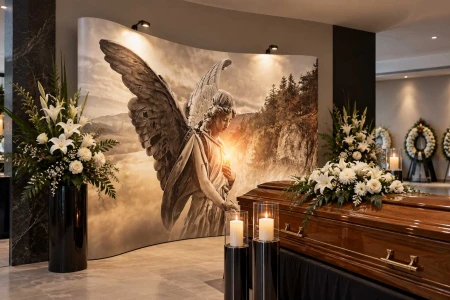
Visual coherence also extends to the arrangement of chapels and farewell rooms. Chapel sets, containing colour- and style-coordinated equipment elements – from the catafalque, through the pall cloth, to flower stands, grave crosses and photograph stands – make it possible to create an interior that communicates professionalism and respect for the deceased from the very threshold. This is particularly important in the context of the first impression a family receives upon entering the chapel – a coherent, aesthetically pleasing arrangement immediately builds trust and gives the sense that the ceremony is in good hands.
The Catafalque – The Heart of the Funeral Ceremony Through the Ages
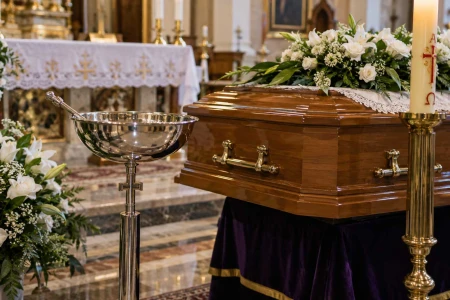
No analysis of funeral aesthetics would be complete without a closer look at the catafalque, which for centuries has been the central element of the entire burial staging. It is around the catafalque that the ceremony space is organised, it is upon the catafalque that the coffin or urn rests, and it is the catafalque's appearance that to a large extent determines the aesthetic perception of the entire event.
From Medieval Platform to Contemporary Design
As already mentioned, the medieval catafalque was a raised platform serving both practical and symbolic functions – it raised the coffin above floor level so that the faithful could see it during the funeral mass, while simultaneously expressing respect for the deceased through the symbolic elevation towards heaven. Over the centuries, catafalques evolved from simple wooden structures to richly decorated ceremonial furnishings, often covered with gilding, carvings, and fabrics.
Modern catafalques combine the traditional function with contemporary design and practicality. The funeralne.com range includes a diverse selection of models – from classic Type C and G catafalques designed for chapels to more versatile structures that perform equally well indoors and at the graveside. Each model is distinguished by a solid construction and aesthetics appropriate for a funeral ceremony. The materials used in their manufacture are selected with durability and resistance to outdoor conditions in mind, meaning that a single catafalque can serve for many years of intensive use.
The Catafalque and Chapel Space Organisation
The way in which a catafalque is positioned in a chapel determines the entire interior arrangement. It is around the catafalque that wreaths, candles, photographs, and other decorative elements are placed. Professional ceremony organisers know that the catafalque should stand centrally, on the axis of symmetry of the room, to create a focal point that naturally draws the gaze of entering mourners. The height of the catafalque matters – too low and the coffin is lost in the space; too high and it may create an impression of distance. Models with adjustable height, available on the market, allow the display to be precisely adapted to the conditions of a specific interior.
Wreath stands are typically placed on either side of the catafalque, allowing for an elegant presentation of floral compositions. Well-chosen stands – stable, aesthetically pleasing, and colour-matched to the rest of the equipment – frame the central composition, lending the entire arrangement symmetry and harmony. Behind or beside the catafalque, a photograph stand for the deceased and a cross are placed, completing the composition and creating a cohesive stage design in which every element has its justified place.
The Funeral Trolley – Aesthetics in Motion
While the catafalque is the static centre of the ceremony, the funeral trolley is responsible for its dynamic element – transporting the coffin from the vehicle to the chapel, from the chapel to the grave, and sometimes along the entire route of the funeral cortège. And although it might seem that a trolley is a purely utilitarian element, in reality its appearance has enormous significance for the aesthetic perception of the ceremony.
The Evolution of the Funeral Trolley
Before modern scissor trolleys appeared, coffins were transported on biers carried by several men, on simple wooden carts pulled by hand, or on special horse-drawn hearses. Each of these methods of transport had its own aesthetic and its own ritual – carrying the coffin on shoulders symbolised closeness and respect, while horse-drawn hearses were associated with pomp and dignity. The modern scissor trolley combines practicality with aesthetics – the height-adjustment mechanism allows the coffin to be smoothly raised and lowered, while a pall cloth covering lends the whole arrangement an elegant, ceremonial character.
Funeral trolleys available in the funeralne.com range represent this evolution – from the compact black folding scissor trolley, ideal for smaller chapels and cemeteries, to the advanced hydraulic trolley with foot pump, which provides maximum operating comfort and precise height adjustment. For outdoor ceremonies, particularly in difficult terrain conditions, the cemetery terrain trolley with large wheels and a reinforced construction rated for up to 300 kg is designed.
The Pall Cloth as the Element Unifying Trolley Aesthetics
A funeral trolley on its own, even one of the highest quality, is a metal construction with a purely technical appearance. It is the pall cloth that gives it a ceremonial character and integrates it into the funeral aesthetic. A well-chosen pall cloth conceals the trolley mechanism, creating an elegant base for the coffin, while its gathered finish and velvet or velour texture add warmth and nobility to the solemn event.
In the funeralne.com range, pall cloths are available in several variants: from the classic pall cloth for scissor trolleys to the premium pall cloth and the fringed pall cloth, which adds an additional decorative accent. Sets combining a trolley with a matching pall cloth – such as the scissor trolley set with fringed pall cloth – eliminate the problem of mismatching and guarantee a consistent appearance from the first to the last ceremony.
The Funeral Tent – Aesthetics Under Open Skies
A cemetery ceremony takes place in the open air, which means the organiser has no control over weather conditions but has full control over the appearance of the space around the grave. And here, the funeral tent plays a key role – having evolved over the centuries from a simple sheet offering protection from rain to an elegant element of funeral staging.
Funeral tents available in the funeralne.com range are distinguished by double-impregnated polyester fabric, a lightweight frame ensuring stability even in strong winds, and above all decorative valances and curtains that can be edged with silver satin trim. It is precisely these decorative details that distinguish a professional funeral tent from an ordinary event or commercial tent. Available in various sizes – from the compact 3x3 metre model to the spacious 3x4.5 metre premium pro variant – they allow adaptation to the scale of the ceremony. The option of placing the funeral home's logo on the valances in the form of silver prints is an additional element that builds brand recognition.
A funeral tent serves a dual function: it protects ceremony participants from rain, snow, or blazing sun, while simultaneously creating a defined, intimate space around the grave that lends the ceremony a contemplative, focused character. Without a tent, an open-air ceremony dissipates into the surrounding space – with a tent, it gains its centre, its frame, and its aesthetics.
The American-Style Grave and Cover – A New Standard of Burial Aesthetics
One of the clear trends in recent years in Polish funeral culture is the growing popularity of American-style graves, that is, burials using a steel cover that shields the grave opening during the ceremony. This solution, adopted from North American tradition, changes the aesthetics of burial in a fundamental way – instead of an open excavation, which for many ceremony participants can be a distressing sight, the family and guests see an elegant, enclosed structure on which the coffin rests covered by a pall cloth.
American-style grave covers available in the funeralne.com range have been designed with maximum aesthetics in mind while maintaining full functionality. This is an important item of equipment that adds elegance and respect to the funeral ceremony. Combined with a dedicated pall cloth for the cover, with dimensions perfectly matched to the structure, a coherent, professional arrangement of the burial site is created in which nothing is left to chance.
The popularity of American-style graves is an expression of a broader tendency – the drive to ensure that the funeral ceremony is an event that is as dignified and aesthetically refined as possible, even in those moments that have traditionally been associated with the starkness and technicality of burial. Funeral homes that include American-style grave covers along with the appropriate pall cloths in their offering are responding to the growing expectations of clients who increasingly seek an alternative to the traditional open burial.
The Modern Approach to Body Transport and Preparation
The aesthetics of a funeral ceremony do not begin at the moment mourners gather in the chapel. They begin much earlier – at the moment the body of the deceased comes into the care of the funeral home. The way professionals handle the body at every stage – from collection at the place of death, through storage, preparation, and transport, to display in the chapel – should be imbued with respect and a commitment to dignity, even when the family cannot see it.
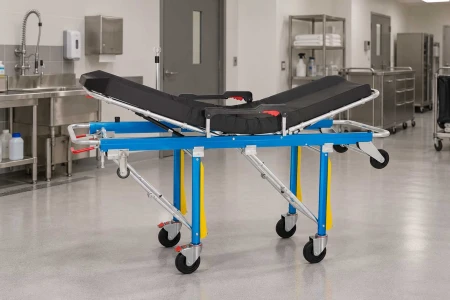
Transport capsules made from high-quality materials ensure safe and dignified body transport in all weather conditions. Black waterproof stretchers with body bags guarantee discretion and protection during transport, while professional embalming tables with adjustable height and corrosion-resistant steel construction enable the proper preparation of the body for the final farewell. Each of these elements, though unseen by the family, contributes to the final result – a dignified, aesthetically pleasing ceremony in which the deceased is presented as they should be.
It is worth mentioning in this context the role of body refrigeration units, which in the funeralne.com range are available in versions with lacquered galvanised sheet metal and wood-effect finishes. Glazed side panels on refrigerated catafalques lend them a representative appearance, which is particularly important in farewell rooms where the family spends time in prayer beside the deceased. The design of these units is not accidental – every detail has been designed so that the technical equipment does not disturb the gravity and aesthetics of the moment.
Aesthetics and the Funeral Home's Image
In an era of growing competition in the funeral services market, every detail matters for building a company's image. Families going through a difficult time are particularly sensitive to the quality of service and visual presentation – and their experience directly translates into the reviews and recommendations that are of fundamental importance in this industry.
Professionalism Visible at First Glance
Let us imagine two situations. In the first, mourners arrive at the ceremony and encounter a chaotic scene: a mismatched pall cloth on the trolley, crookedly placed wreath stands, a tent without decoration. In the second, guests enter a chapel in which everything is in its place: symmetrically arranged wreaths on elegant stands, the coffin on a solid catafalque draped with a matching pall cloth, a photograph of the deceased on an aesthetic stand beside a carefully chosen cross. The difference in perception is enormous, and its source is not a large budget but the thoughtful use of appropriate equipment.
Each of these elements – funeral tent, catafalque, pall cloth, wreath stands, photograph stands, and funeral trolleys – is available in one place at funeralne.com, enabling a funeral home to fully equip itself with a stylistically coherent set.
Investing in Equipment as Brand Building
Purchasing professional ceremonial equipment is an investment that pays for itself many times over. High-quality equipment serves for years, and its presence at every ceremony builds in clients' eyes the image of a company that spares no expense on the quality of its services. In an industry where word-of-mouth recommendations carry enormous weight, such details can determine whether a family recommends a particular funeral home to their acquaintances.
The manufacturer of equipment available at funeralne.com – Prima-Tech S.C. – possesses many years of experience in the funeral industry, ensuring that every product is designed with the specific needs of professionals in mind. Competitive prices, fast delivery throughout the country, and professional advice on selecting the appropriate equipment make assembling a complete set of ceremonial equipment simpler than it might seem.
The Future of Funeral Aesthetics – Where Are We Heading?
The funeral industry, like any other, is subject to trends and evolves under the influence of changing social expectations. Several clear directions are emerging on the horizon, each of which has an impact on what funeral ceremonies will look like in the years to come.
Personalisation and Individualism
An increasing number of families expect a ceremony that reflects the personality and life of the deceased, rather than merely repeating a well-worn template. This translates into growing demand for equipment that can be personalised – tents with custom prints, pall cloths in unusual colours, decorative elements referencing the interests or profession of the deceased. Funeral homes that can meet these expectations gain a competitive advantage. Funeralne.com responds to this trend by offering, among other things, the possibility of custom-made pall cloths in a chosen colour and personalised funeral tents with the funeral home's logo and graphics.
Ecology and Sustainable Development
Growing environmental awareness is also influencing the funeral industry. Coffins made from biodegradable materials, wreaths from living plants instead of artificial flowers, ceremonies in natural settings – these are tendencies gaining in popularity, particularly among younger generations. In this context, reusable equipment – solid catafalques, steel stands, durable tents, and trolleys – aligns with the philosophy of sustainable development. A single well-made piece of equipment serves hundreds of ceremonies, reducing the need for disposable solutions and limiting the industry's environmental footprint.
Technology in the Service of Ceremony
Although a funeral ceremony is by nature a traditional and conservative event, technology is slowly entering this sphere as well. Remote funeral broadcasts for those unable to attend in person, digital condolence books, LED lighting in funeral tents, hydraulic height adjustment for trolleys and catafalques – these are solutions already being used with increasing frequency. In the future, we can expect further integration of technology with traditional ceremony, but always with respect for its fundamental, deeply human character.
It is worth emphasising, however, that technology in the funeral industry should never dominate over tradition – its role is one of service. A hydraulic funeral trolley does not replace the symbolism of the cortège, and an online broadcast does not replace physical presence at the graveside. The best solutions are those that combine modernity with tradition in a way invisible to ceremony participants – so that technology facilitates the work of staff and enhances the comfort of mourners without disturbing the sacred character of the moment. This is precisely why it is so important that funeral equipment is designed by specialists who understand the specifics of the industry, rather than adapted from other sectors without respect for the context in which it will be used.
Frequently Asked Questions
Which items of equipment have the greatest impact on the aesthetics of a funeral ceremony?
The greatest impact on the visual perception of a ceremony is made by the elements forming the central composition in the chapel or at the graveside: the catafalque on which the coffin rests, the pall cloth covering the funeral trolley, the wreath stands arranged on either side, and the photograph stand for the deceased. It is precisely these elements, appropriately matched in colour and style, that create a coherent stage design communicating the professionalism of the funeral home and respect for the deceased. It is worth investing in sets, such as a trolley with pall cloth, which guarantee that the individual elements are properly matched.
Why is visual coherence so important during a funeral ceremony?
Visual coherence works on the subconscious of ceremony participants – when all items of equipment form a harmonious whole, mourners subconsciously feel that the ceremony has been organised with the utmost care. Colour-mismatched pall cloths, differing stand styles, or a lack of symmetry in the chapel arrangement can disturb this perception and divert attention from the essence of the ceremony. Professional funeral homes ensure coherence by selecting equipment from a single manufacturer and using ready-made chapel sets.
How has the approach to funeral aesthetics changed in Poland since 1989?
The political transformation opened the market to private funeral homes, triggering quality-based competition in the industry. Before 1989, funeral ceremonies were often standardised and modest – a limited range of coffins, no personalisation, minimal visual setting. The free market brought diversity, the professionalisation of services, and growing client expectations regarding the aesthetics of the ceremony. Today, Polish funeral homes offer a standard comparable to Western European levels, with professional equipment available in shops such as funeralne.com.
Is a funeral tent essential during a cemetery ceremony?
A funeral tent is not legally required, but its presence during an open-air ceremony is strongly recommended – both for practical and aesthetic reasons. It protects participants from rain, snow, or blazing sun, while simultaneously creating an intimate, defined space around the grave that lends the ceremony a contemplative character. Funeral tents with decorative valances and edging elevate the aesthetics of the ceremony and build the professional image of the funeral home.
Where can one purchase complete funeral ceremony equipment in one place?
Comprehensive equipment for funeral homes – including funeral trolleys, catafalques, pall cloths, tents, wreath and photograph stands, stretchers, transport capsules, embalming tables, refrigeration units, lecterns, grave crosses, and many other accessories – is available at the online shop funeralne.com. The shop offers competitive prices, fast delivery throughout the country, and professional advisory services. The manufacturer – Prima-Tech S.C., with many years of experience in the funeral industry – guarantees the highest quality and support at every stage of the order.